
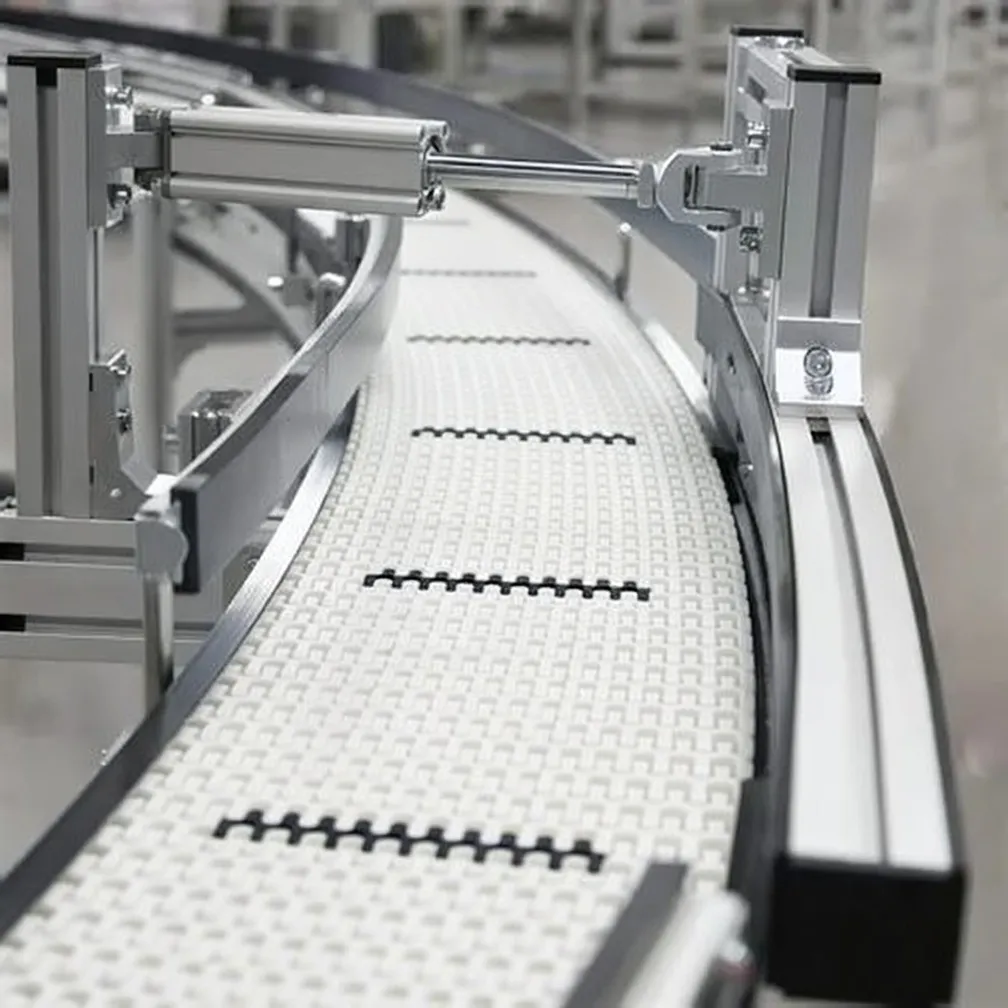
 Food production and poultry processing in the United Kingdom operates under some of the most stringent hygiene, traceability, and engineering standards in the world. From the cold-chain lines of Yorkshire’s largest chicken processing plants to the ready-meal manufacturing halls across the West Midlands, conveyor infrastructure is the backbone of output efficiency — and the choice of belting material defines both uptime and compliance. The plastic modular belt has progressively replaced traditional fabric and metal mesh solutions across these environments, not merely because of cost arithmetic, but because of a genuinely superior combination of hygienic geometry, structural modularity, and chemical resistance that no previous belt category could match simultaneously.
How a Plastic Modular Belt Actually Works
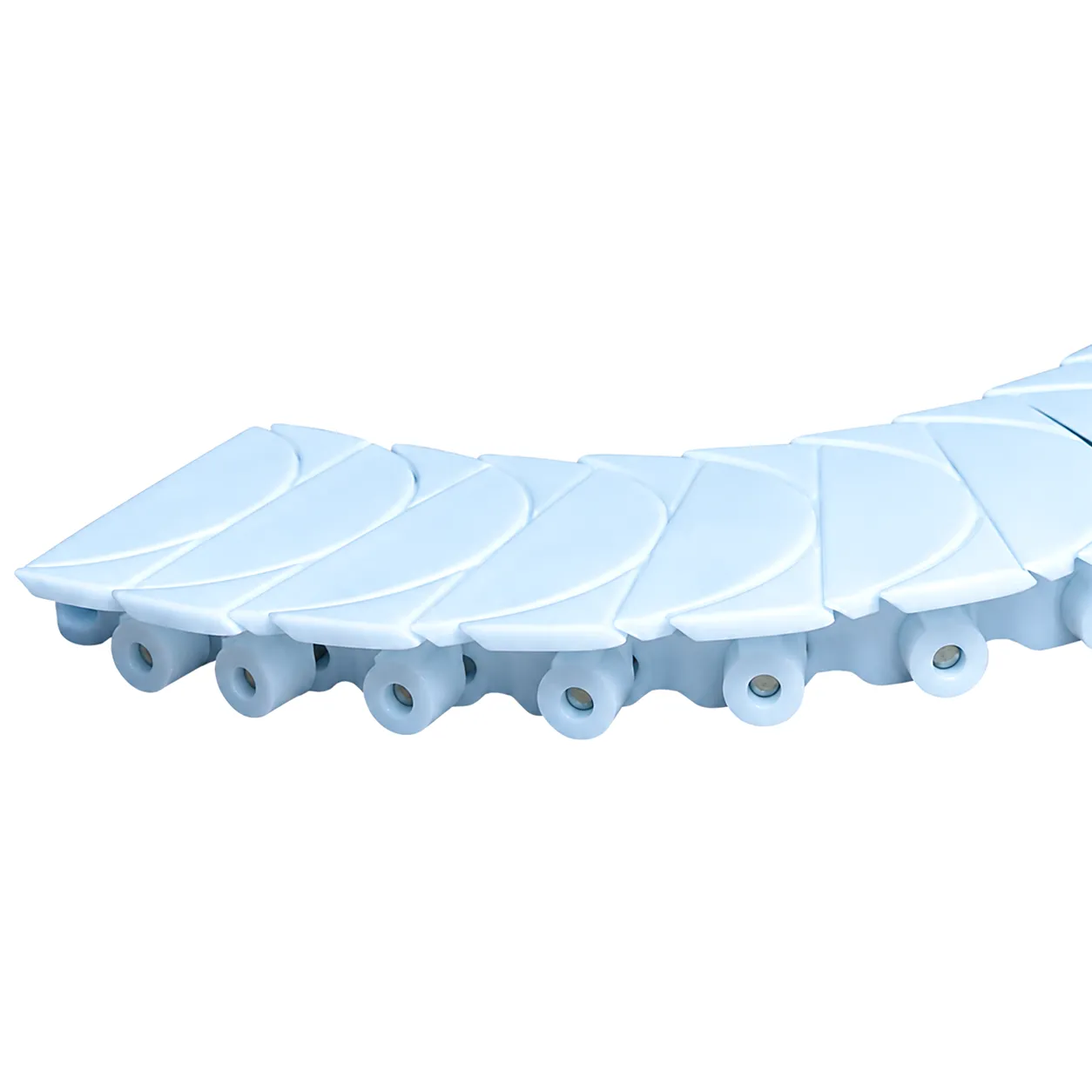
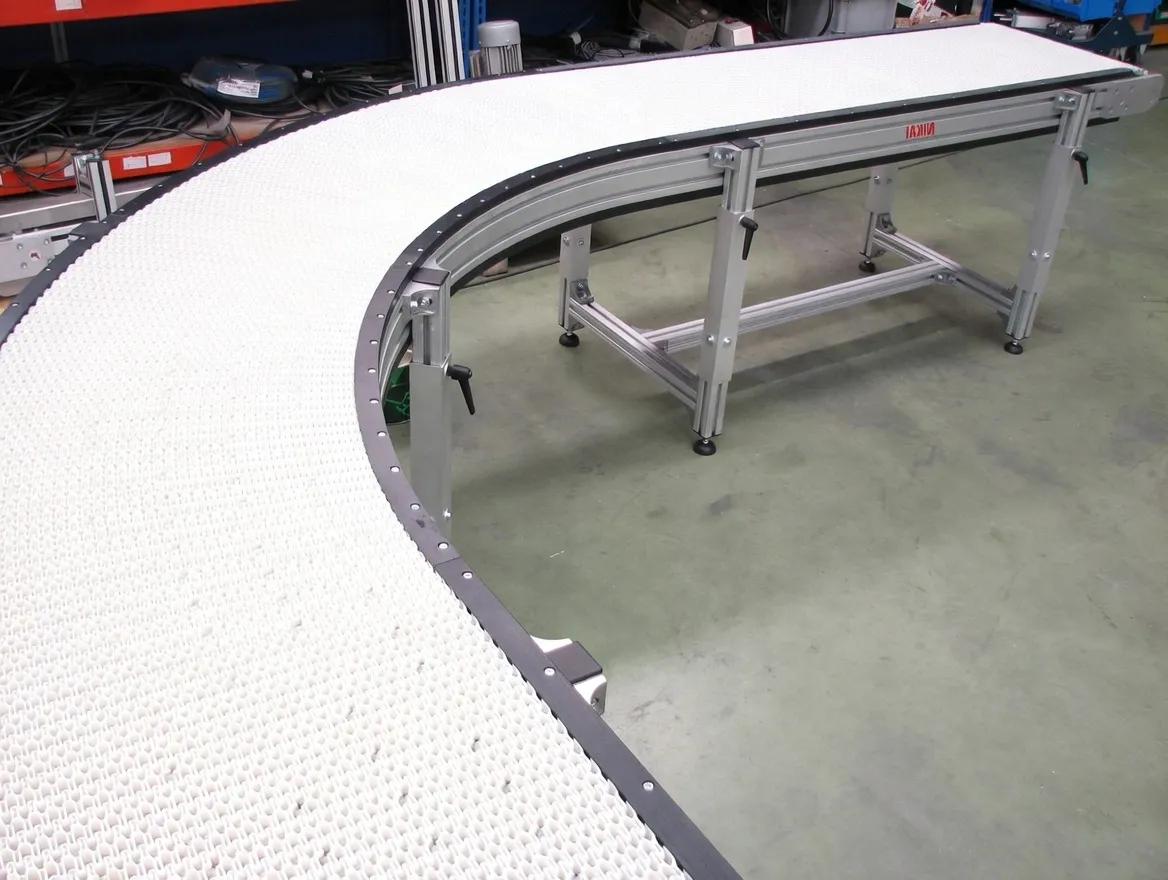
The fundamental mechanical principle of a plastic modular belt is interlocking rod-and-module construction. Individual modules — typically 100 mm to 200 mm in width — are moulded from engineering thermoplastics with precisely dimensioned hinge tabs on their leading and trailing edges. Stainless steel or plastic hinge rods thread laterally through the aligned tabs, locking modules into rows. Each row then connects to the next via the same rod-through-tab geometry, forming a continuous articulating surface. When the belt wraps around sprocket wheels at drive and return ends, each row pivots independently at the hinge axis, allowing smooth directional transition without flex-induced stress on any single module. This means the belt can handle both straight-run and radius-turning conveyor paths within the same structural framework, a capability critical for the multi-directional product flows found in large UK poultry processing facilities.
The drive mechanism engages positively with sprocket teeth that mesh directly into the belt’s underside geometry — unlike friction-driven rubber belts where slip and tension imbalance are persistent concerns. Positive engagement eliminates belt drift under asymmetric loads, which is particularly relevant when processing unevenly distributed poultry carcasses or packaged food trays moving at speed. The return path runs the belt inverted around the return sprocket, and because the open lattice or perforated surface design allows gravity drainage, water and organic debris do not pool beneath the belt during washdown cycles. This drainage characteristic is not incidental — it directly affects microbial control scores in UK Food Standards Agency audits, making the conveyor’s geometry as much a hygiene tool as a transport mechanism.
Core Materials in Plastic Modular Belt Manufacturing
POLYPROPYLENE (PP)
Polypropylene is the workhouse material for general-purpose food conveying. Its density sits around 0.90 g/cm³, it is FDA and EU food-contact compliant, and it withstands continuous operating temperatures from –20°C up to approximately 90°C — ideal for chilled poultry lines where product enters near 0°C and the environment cycles between cold store and ambient. PP’s inherent chemical resistance to weak acids, alkalis, and standard caustic cleaners used in UK processing plants (sodium hypochlorite, peracetic acid solutions) means belt surface integrity is maintained through hundreds of daily washdown cycles. Its relatively low cost makes it the default choice for high-volume, moderate-load conveyor runs.
ACETAL / POM (POLYOXYMETHYLENE)
Acetal delivers a step-change in mechanical performance: tensile strength of 60–70 MPa, a coefficient of friction as low as 0.15 against stainless steel wear strips, and dimensional stability across temperature fluctuations that would cause PP modules to creep or distort. For UK poultry lines where belts carry heavy hanging carcasses or dense trays of packaged portions at moderate speed, POM’s rigidity prevents module sagging — a failure mode that disrupts product tracking and causes mis-registration at cutting or weighing stations. POM is equally suited to the dry lubrication environments that many UK processors now favour for water conservation and pathogen control, as it does not require continuous water lubrication to maintain low running friction.
POLYETHYLENE (PE / HDPE)
High-density polyethylene occupies the niche between PP’s flexibility and POM’s rigidity. Its outstanding impact toughness at cryogenic temperatures — relevant in quick-freeze tunnels and blast chiller conveyors operating below –30°C — makes it indispensable in the frozen food segment, particularly at large-scale operations near Grimsby where seafood processing ties directly into cold-chain export logistics. HDPE is also notably resistant to UV degradation, a useful trait for outdoor yard conveyors at UK abattoirs where parts of the belt run through natural light. The material’s self-lubricating surface characteristics reduce the need for external lubrication, supporting the low-chemical-intervention approach increasingly demanded by UK retail buyers’ codes of practice.
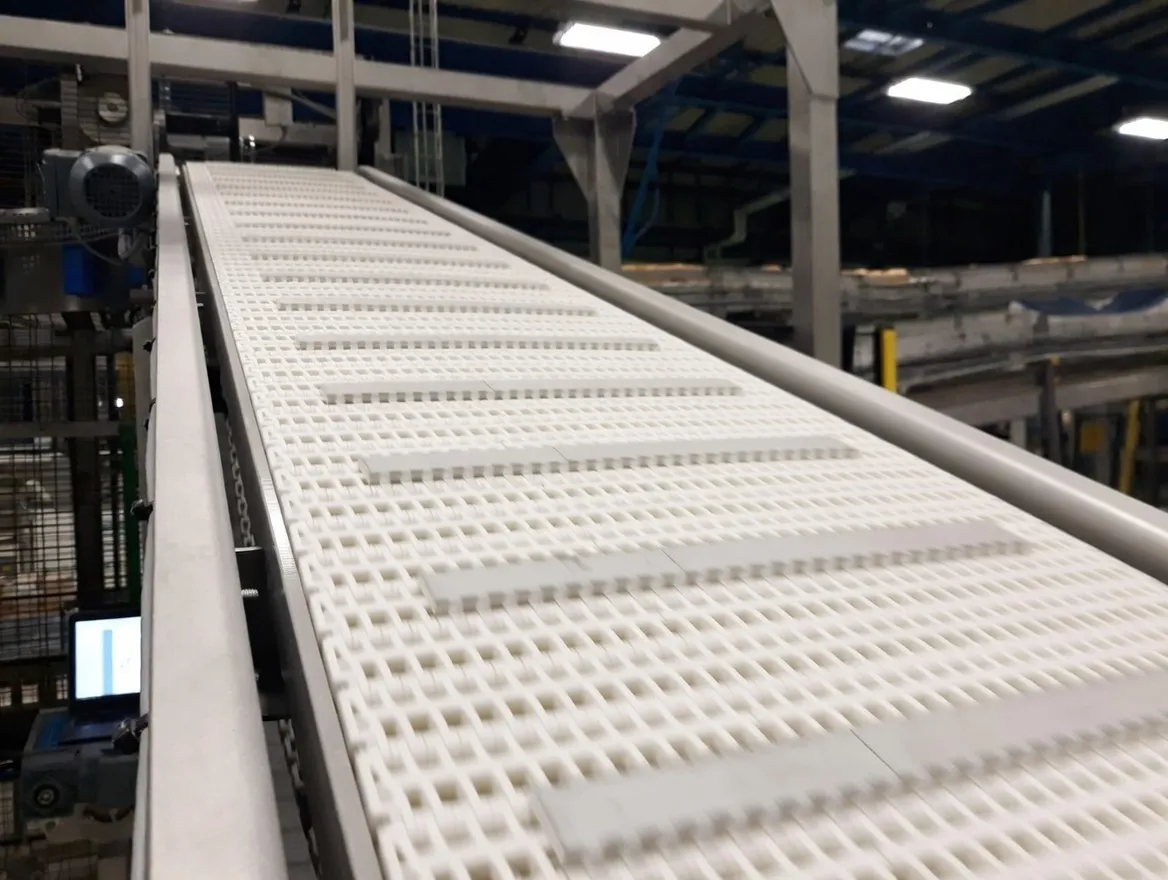
Why UK Food Engineers Specify Plastic Modular Belts
HYGIENIC DESIGN
The modular structure allows the belt to be fully disassembled without tools during scheduled line stops. Every hinge point, rod channel, and module surface can be accessed for mechanical scrubbing and chemical sanitisation. There are no internal cavities where biofilm can establish undetected — a compliance requirement under Regulation (EC) No 852/2004 as retained in UK law post-Brexit. This design openness is what makes the plastic modular conveyor belt the dominant technology across UK chicken, pork, and seafood processing sites operating under BRC Global Standard for Food Safety.
FIELD REPAIRABILITY
When a conventional flat belt tears or a metal mesh link fractures, the entire belt must be shut down and replaced — an unplanned event that can cost UK food manufacturers £5,000–£25,000 per hour in lost throughput depending on line speed and product type. With a modular plastic belt, a damaged section is replaced at module level in minutes using spare rows carried in the plant’s MRO store. This replaceability transforms an emergency shutdown into a scheduled micro-intervention, and it is a core reason procurement teams at major UK processors increasingly specify modular over continuous-loop alternatives.
LOAD DISTRIBUTION
The modular belt’s structural stiffness in the transverse direction distributes point loads across multiple modules simultaneously. This matters enormously on poultry evisceration lines where carcasses of varying weights hit the belt from overhead shackle lines. Localised deformation — the failure mode common with fabric belts — does not occur because each acetal or PP module acts as a rigid plank within the wider flexible structure. The practical result is a flat, stable carrying surface that maintains product orientation for automated portion weighing and inline vision inspection systems increasingly deployed across UK poultry sites from Norfolk to Humberside.
TEMPERATURE RANGE
A single plastic modular belt solution can span applications from –40°C blast freezer environments to 120°C pasteuriser tunnels, depending on the polymer chosen. This thermal breadth eliminates the need to specify different belt types for different sections of the same processing line, simplifying inventory, reducing spare-part complexity, and improving engineering team familiarity. The ability to handle thermal cycling — moving between cold and hot zones — without delamination or adhesive failure is a fundamental advantage over laminated belting that is still common in older UK plants undergoing modernisation.
Featured Products from Ever Power
HIGH LOAD CONVEYING
Heavy Duty Grid Straight Run Conveyor Belt
Designed for demanding straight-run conveyor applications where maximum load capacity, open-grid drainage, and chemical washdown resistance are simultaneous requirements. An excellent match for bulk protein handling in UK abattoir and portioning environments where product weight per metre of belt is high and line speeds are aggressive.
PRODUCT CONTAINMENT
Flat Top Straight Run Belt with Side Guards
The integrated side guard design prevents product migration off the belt edge during acceleration, deceleration, and lateral vibration — a recurring issue on packaging lines where sealed pouches or tray-packed portions are prone to edge drift. This belt type is widely deployed across food manufacturing sites in the West Midlands and around Birmingham’s established ready-meal production corridor.
Product Technical & Performance Parameters
| Παράμετρος | PP (Πολυπροπυλένιο) | POM / Acetal | HDPE |
|---|---|---|---|
| Θερμοκρασία λειτουργίας | –20°C to +90°C | –40°C to +110°C | –40°C to +80°C |
| Αντοχή σε εφελκυσμό | 30–35 MPa | 60–70 MPa | 22–32 MPa |
| Belt Pitch (standard) | 25,4 χιλ. / 38,1 χιλ. / 50,8 χιλ. | 25,4 χιλ. / 38,1 χιλ. | 25,4 χιλ. / 50,8 χιλ. |
| Μέγιστο πλάτος ζώνης | Up to 3,600 mm | Up to 3,000 mm | Up to 3,600 mm |
| Max Allowable Tension | Up to 8 kN/m width | Up to 18 kN/m width | Up to 6 kN/m width |
| Συντελεστής τριβής (ξηρός) | 0,25–0,35 | 0.12–0.18 | 0.20–0.30 |
| Open Area (grid / perforated) | 28–52% | 18–45% | 20–48% |
| Food Contact Compliance | FDA / EU 10/2011 / UK SI 2012/2619 | FDA / EU 10/2011 / UK SI 2012/2619 | FDA / EU 10/2011 / UK SI 2012/2619 |
| Available Colours | White, Blue, Green (Detectable) | Natural (White), Black | White, Blue |
| Υλικό ράβδου μεντεσέ | SS304 / SS316 / PP | SS316 / POM | SS304 / HDPE |
| Τυπική ταχύτητα ιμάντα | 0.05–2.5 m/s | 0.05–3.0 m/s | 0.05–2.0 m/s |
Industrial Application Scenarios
SCENARIO 1
Poultry Evisceration and Portioning Lines
In UK poultry processing facilities — concentrated heavily in Norfolk, Lincolnshire, and the East Midlands — evisceration lines must handle carcasses arriving at high throughput rates while maintaining strict zone separation between dirty and clean processing areas. A plastic modular belt designed with an open lattice surface allows blood and organic fluids to drain away from the product-contact surface continuously, preventing pooling that would otherwise elevate bacterial counts and trigger FSA intervention. The modular belt’s colour-coded design (blue or green detectable modules) also satisfies the foreign body detection protocols mandated by retailer codes like Tesco’s Nature’s Choice and M&S’s Integrity programme. Key technical requirement: belt must withstand caustic wash solutions at 65°C for 30-minute daily cycle cleaning without dimensional change.
SCENARIO 2
Ready-Meal Packaging and Tray Sealing Conveyors
Birmingham and its surrounding food manufacturing zone in the West Midlands represents one of the largest concentrations of ready-meal production in Western Europe. Packaging lines in these facilities require belt surfaces that are dimensionally precise, vibration-free, and capable of maintaining tray alignment under the intermittent motion profiles of tray sealing and labelling machines. The flat-top plastic modular belt provides a rigid, smooth carrying surface that does not develop the surface corrugations or thickness variation seen in worn fabric belts, which cause tray misalignment that triggers expensive line stoppages. Because tray sealing machines operate with precise vertical tooling, even 1–2 mm of belt surface variation creates seal failures — a defect rate issue that modular belt’s tight dimensional tolerances eliminate.
SCENARIO 3
Fish Processing and Seafood Filleting Lines
Grimsby’s fish processing sector — one of the UK’s most geographically concentrated manufacturing clusters — presents a particularly aggressive chemical environment for conveyor belting. Brine exposure, fish oil saturation, and the intensive use of iodophor-based sanitisers create conditions where most generic plastic components degrade rapidly. PP and HDPE modular belts with stainless steel hinge rods provide the combination of salt-water corrosion resistance, food-safe surface chemistry, and tolerance for iodine-based cleaning agents that this application demands. The ability to run the belt through CIP (Clean-in-Place) spray systems without disassembly, combined with the option for full strip-down between shifts, gives Grimsby processors the dual flexibility they need to manage both speed-intensive production and stringent end-of-day hygiene protocols.
SCENARIO 4
Bakery and Biscuit Cooling Conveyors
Across Sheffield’s and Leeds’s bakery manufacturing sector, product emerging from tunnel ovens at temperatures between 150°C and 220°C must transition onto cooling conveyors immediately. High-temperature-rated POM modular belts handle the initial oven-exit thermal shock, while PP belting takes over for the extended ambient cooling run. The modular system’s ability to use different materials in different sections of a single line — joined at splice points — gives bakery engineers the material optimisation that a single-material continuous belt cannot offer. Additionally, the belt’s open area allows conditioned cooling air to circulate around products from both above and below the carrying surface, accelerating throughput and reducing energy consumption in cooler rooms.
SCENARIO 5
Dairy Processing and Cheese Handling
UK dairy processing — with major manufacturing operations anchored in Cheshire, Somerset, and Derbyshire — places particular demands on conveyor belts that contact soft, moisture-heavy products like fresh curds, portioned cheese blocks, and butter pats. Flat-top PP modular belts with smooth surfaces and minimal open area ensure product integrity is maintained without product wedging into belt cavities. The ability to quickly switch between belt widths and configurations when the same line alternates between product formats — a common operational scenario at contract dairy processors — is made viable by the modular belt’s system-level adaptability. Hinge rods can be swapped and modules replaced without specialist tooling, meaning a three-person maintenance team can reconfigure a 10-metre belt run in under 45 minutes.
SCENARIO 6
Logistics and Distribution Centre Sortation
Beyond food processing, plastic modular belts serve critical roles in UK food retail and grocery logistics infrastructure. Ambient ambient distribution centres operated by major retailers around Coventry, Daventry, and the M1 logistics corridor use radius-turning modular belts to route packaged food products through multi-level sortation systems. The lateral stiffness of POM and PP modular belts prevents product skew during direction changes, an essential characteristic for automated barcode scanning and weight checking systems that require products to arrive in a known orientation. These sortation environments also benefit from the belt’s resistance to edge damage caused by repeated contact with sorting diverters — a wear mode that causes early failure in rubber and fabric alternatives.
Ever Power: Κατασκευή προσαρμοσμένων πλαστικών αρθρωτών ιμάντων
Ever Power has operated as a precision manufacturer of plastic conveyor system components for over two decades, supplying B2B customers across the food, agricultural, automotive, and industrial packaging sectors worldwide. The company’s manufacturing infrastructure is built around high-precision injection moulding, with tooling capability in-house that allows module geometry to be adjusted for customer-specific sprocket spacing, carry surface texture, or side guard integration without the minimum-order constraints that generic catalogue suppliers impose. For UK food processing customers, this matters: every production facility has a slightly different conveyor footprint, drive configuration, or product flow requirement, and off-the-shelf belting often requires mechanical compromises that cost throughput.
Ever Power’s customisation capabilities extend from individual module geometry through to full belt assembly in specified widths and lengths, colour-matched detectable variants, and co-engineered configurations for multi-directional conveyor paths. The supply chain reliability that UK buyers require — consistent lead times measured in weeks rather than months, responsive technical support, and documentation packages that satisfy BRC and SQF audit requirements — is embedded in the company’s operational model. Every order is accompanied by material certification traceability, food-contact compliance documentation to UK statutory instrument requirements, and dimensional inspection data for the delivered belt sections.
For processing engineers working to tight project timelines — a site upgrade window, a new line commissioning schedule, or an emergency replacement driven by an unplanned failure — Ever Power’s application engineering team provides selection support, CAD clearance review, and prototype review before full-volume commitment. This pre-order technical engagement has historically reduced installation delays and compatibility issues across customer projects in the UK food and agricultural machinery sectors, where equipment integration complexity is consistently underestimated during the procurement stage.
EVER POWER CAPABILITIES
Customer Success Story: Lincolnshire Poultry Processor
A mid-sized poultry portioning and marination facility operating on the outskirts of Grimsby — serving several major UK grocery retailers — was experiencing unacceptable downtime on its primary evisceration and portioning conveyor line. The facility ran three shifts, six days per week, processing approximately 180,000 birds per day. The incumbent fabric belt had a mean replacement cycle of just 11 weeks, requiring complete line shutdowns of 6–8 hours each time. Additionally, the belt’s woven structure retained moisture and fat residues in its fibres despite aggressive daily chemical cleaning, causing recurring failed swab results at internal audit and prompting a formal corrective action request from one of its retail account buyers.
The facility’s engineering manager contacted Ever Power following a referral from a peer at a Norfolk chicken processing site. Ever Power’s technical team conducted a site survey covering belt path geometry, drive shaft spacing, sprocket condition, load profile, and the cleaning chemical specification being used. Based on these parameters, Ever Power specified a custom-width blue-detectable PP modular belt at 38.1 mm pitch, with SS316 hinge rods and a semi-open lattice surface area of 36%, matched precisely to the facility’s existing sprocket PCD dimensions to avoid drive modifications.
After installation and a four-week production monitoring period, the results were measurable and significant. The replacement cycle extended from 11 weeks to a projected 24 months based on wear rate measurement. The average daily cleaning time dropped from 2.1 hours to 48 minutes because the belt’s modular open surface cleaned faster and required no soaking period. Swab results at hinge points — previously a persistent problem area — met retailer target thresholds at every audit during the monitoring period. The plant estimated annual maintenance savings exceeding £68,000 when combining reduced belt material cost, shorter cleaning downtime, and the elimination of emergency replacement labour previously charged at weekend overtime rates.
What UK Customers Say About Ever Power
“We specified Ever Power’s detectable PP modular belt across four evisceration lines and the hygiene performance data speaks for itself — swab failures at hinge points dropped from a monthly occurrence to zero across a nine-month period. The custom width matched our existing drive configuration perfectly, which saved us a significant sprocket replacement cost. Delivery was well within the quoted lead time, and the material certificates were ready before the belt arrived on site.”
— Site Engineering Manager, Poultry Processing Facility, Lincolnshire
“Our Birmingham ready-meal packaging line had a persistent tray skew problem that was costing us seal failures at around 2% of production volume per shift. Ever Power recommended a flat-top modular belt with integrated side guards, dimensioned specifically for our tray width range. Within two weeks of installation the seal failure rate dropped below 0.1%. The belt’s dimensional consistency has been exceptional — we’ve run it for 14 months without a single module replacement. The Ever Power technical team were responsive and understood our process constraints from the first conversation.”
— Conveyor Systems Lead, Ready-Meal Manufacturer, West Midlands
“We operate a seafood filleting line in Grimsby and the brine and iodophor cleaning cycle is brutal on standard plastic components. Ever Power supplied HDPE modules with SS316 rods as recommended for our conditions. Eighteen months in, there is no visible corrosion at any hinge point, no surface crazing on the modules, and no measurable width growth from moisture absorption. Compared to the metal mesh we were previously running, the cleaning time is 40% shorter and there are no broken wire contamination events. A genuinely superior product, and the custom order process was straightforward.”
— Production Manager, Seafood Processing Company, Grimsby
Συχνές ερωτήσεις
What is the typical cost of a custom-width plastic modular belt for a UK poultry processing line, and how do I get a quote?
Pricing for a custom plastic modular belt depends on the material (PP, POM, or HDPE), belt width, pitch size, hinge rod specification, and required length. For a standard PP modular belt at 38.1 mm pitch with SS304 rods in a width of 600–1,200 mm, indicative pricing typically falls in the range of £35–£85 per metre of belt length depending on configuration. POM belts command a 35–60% premium over equivalent PP configurations due to material cost. To receive an accurate, project-specific quote — including material compliance documentation — contact Ever Power directly at [email protected] with your belt width, conveyor length, pitch preference, and operating environment details.
Which type of plastic modular belt is best suited for high-throughput poultry evisceration lines in UK processing facilities operating under BRC audit requirements?
For BRC-audited poultry evisceration environments, a blue or green metal-detectable PP modular belt with an open lattice surface (30–45% open area) and SS316 hinge rods is the standard specification. The open area allows continuous drainage of blood and organic fluids, directly supporting microbial control metrics. The detectable pigment satisfies foreign body detection requirements. SS316 rods resist the chlorine-based and peracetic acid cleaning agents standard in UK poultry plants. Ensure the belt supplier provides UK SI 2012/2619 food contact compliance certification with every delivery batch.
How long does a plastic modular conveyor belt last in a fish processing environment in Grimsby, and what factors affect its service life?
In a well-maintained Grimsby-style seafood processing environment — with brine exposure, iodophor cleaning, and three-shift operation — an HDPE modular belt with SS316 rods typically achieves 18–30 months of service life before individual module replacement becomes necessary. The primary wear mechanisms are abrasion from product contact and chemical stress on the hinge geometry. Service life is shortened by: running the belt under tension higher than its rated load; using cleaning chemicals outside the recommended pH range; or operating at speeds that generate excessive heat at sprocket engagement points. With correct specification and scheduled inspection, modular belts consistently outperform fabric and metal mesh alternatives in the same environment.
Where can I find a UK-based supplier of plastic modular belts with the technical capability to specify and customise belts for food manufacturing applications?
Ever Power operates as a specialist manufacturer and technical supplier serving the UK food processing market. Unlike distribution-only suppliers, Ever Power’s manufacturing capability allows for custom belt widths, material selection, detectable variants, and integrated accessories — all backed by food contact compliance documentation. UK food engineers can access technical consultation, application review, and project-specific quotation via [email protected]. Ever Power has supplied plastic modular belt solutions to food manufacturing operations across Birmingham, Grimsby, Sheffield, Norfolk, and the broader Midlands and Northern England processing regions.
How much does it cost to replace a section of a failed plastic modular belt on a ready-meal packaging line in the West Midlands compared to replacing an entire flat belt?
This is one of the most commercially important distinctions between modular and continuous belting. When a flat or fabric belt fails, the entire belt must be replaced — typically involving a 4–8 hour line shutdown, specialist installation labour, and a full belt cost. For a 10-metre, 800 mm-wide packaging line belt, total replacement cost including labour can reach £2,500–£6,000. With a plastic modular belt, a localised failure requires only the replacement of the damaged modules — often one to five rows — at a material cost of £15–£120 and a downtime of 20–45 minutes using in-house maintenance staff. Over a five-year operating period, this repair model typically delivers 40–65% lower total belt ownership cost compared to continuous belt alternatives.
When should I consider upgrading from a fabric conveyor belt to a plastic modular belt on an existing food production line, and what performance improvements should I expect?
The case for upgrade is strongest when any of the following conditions apply: fabric belt replacement cycles are shorter than 6 months; swab results at belt or conveyor joint points are failing microbiological thresholds; unplanned downtime attributable to belt failure exceeds two occurrences per quarter; or a retail buyer code requires detectable foreign body controls that the existing belt cannot satisfy. Expected improvements on upgrading include: cleaning time reduction of 25–50% in most food environments; extended belt service life of 3–8 times versus woven fabric; elimination of fibre-contamination risk; and alignment with BRC Global Standard, SALSA, and UK FSA Inspection requirements. The engineering investment is typically recovered within 18–24 months in medium to high-throughput UK food production environments.
Ready to Specify the Right Plastic Modular Belt for Your UK Plant?
Ever Power’s application engineering team will review your conveyor layout, product type, and compliance requirements — and provide a fully specified solution with lead time, material certs, and pricing.
επεξεργασία από gzl