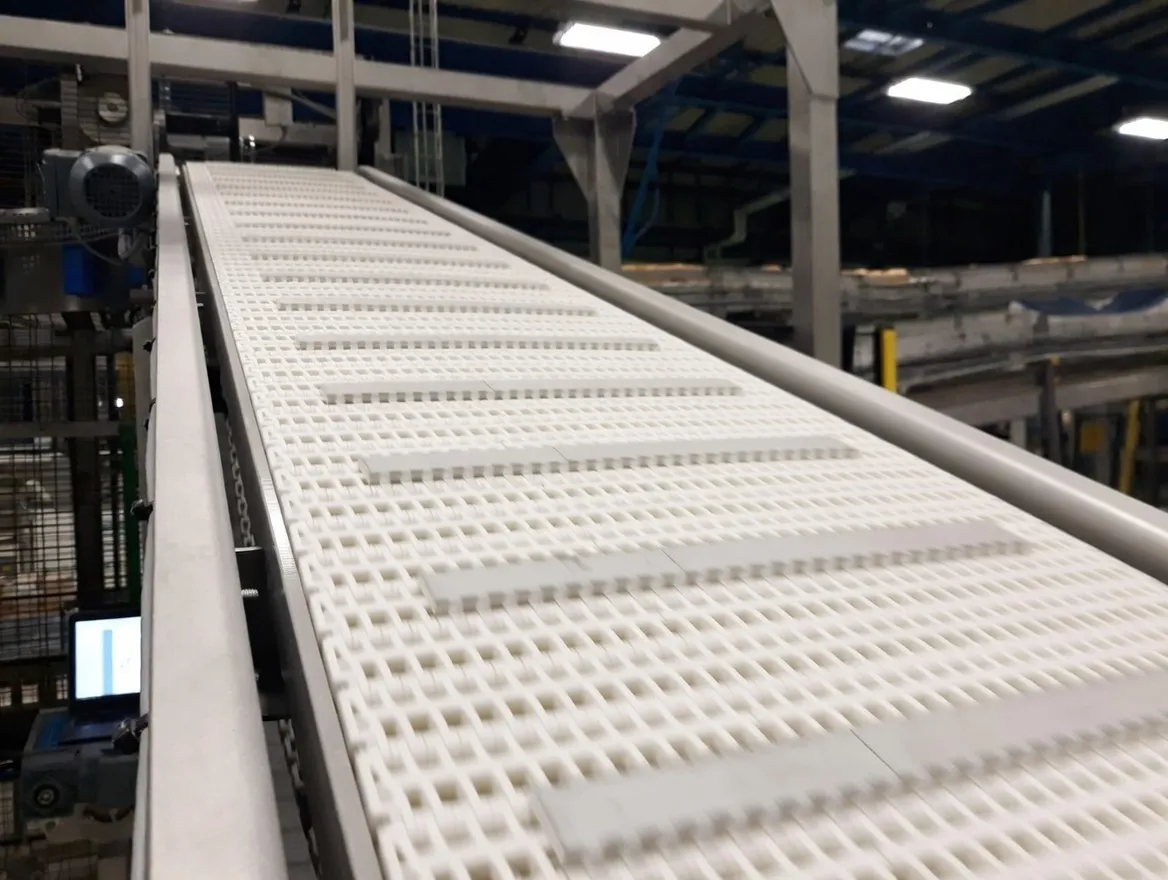
 Inside a UK brewery or soft drink bottling plant, the conveyor system is not a passive element — it is the circulatory system of the entire production floor. Every bottle, can, keg, or carton that moves from filling station to labelling, from pasteurisation tunnel to palletiser, does so on the surface of a conveyor belt. When that belt falters — whether through corrosion, product buildup, excessive noise, or mechanical failure — the consequences ripple across the entire line: production stops, waste accumulates, hygiene audit scores drop, and engineering teams face reactive maintenance rather than planned upkeep. This is precisely the environment where the plastic modular belt has displaced older alternatives and established itself as the industry-preferred solution across plants in Burton-on-Trent, Tadcaster, Edinburgh, and beyond.
Working Principle: How the Modular Architecture Functions Under Production Loads
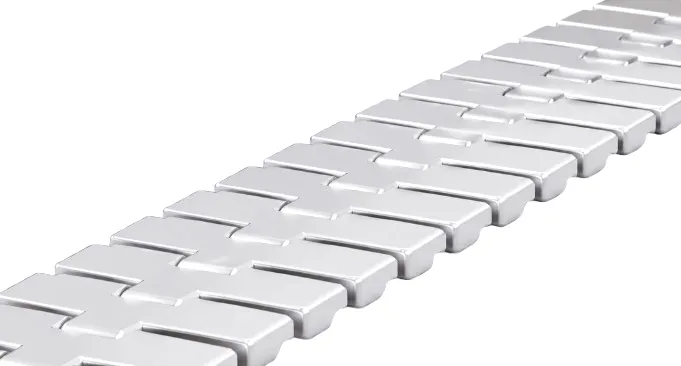
 The plastic modular belt operates on a fundamentally different mechanical principle from conventional flat or troughed belts. Each module is an injection-moulded thermoplastic unit — typically rectangular, though T-shaped, L-shaped, and specialty profiles exist — with interlocking rod apertures along its leading and trailing edges. A series of cross-rods, usually fabricated from stainless steel or engineering-grade polypropylene, threads through aligned apertures across the belt’s full width, creating articulated hinges between each row of modules. The result is a belt that flexes transversely around drive and idler sprockets while maintaining a rigid, flat, or textured carrying surface in the conveying zone.
Drive is imparted through plastic or stainless sprockets that engage moulded teeth on the underside of the module rows — a positive drive system that eliminates the slip and slippage variability endemic in friction-driven flat belts. Tension, which causes premature wear and structural fatigue in traditional belting, is dramatically reduced in the modular system because the sprocket teeth positively index each module row. This is particularly valuable in high-humidity environments like pasteurisation tunnels, where condensation can cause rubber belts to stretch unpredictably.
The belt returns on its underside, either as a flat return or guided by support rails, and the open-grid variants allow wash-down water, CIP chemicals, and thermal transfer fluids to pass freely through the belt surface — a critical hygiene advantage in food-grade beverage operations subject to BRC Global Standard and SALSA certification requirements widely observed across Yorkshire, the Midlands, and Scotland’s distillery belt.
Material Science: What the Belt Is Made Of and Why It Matters
Polypropylene is the workhorse material across most standard beverage conveyor installations. Its resistance to acids, alkalis, and the detergent solutions used in daily CIP (Clean-In-Place) cycles — concentrations of caustic soda, peracetic acid, and chlorinated compounds that are standard practice in UK bottling halls — makes it the default specification for ambient-temperature conveying of bottles, cans, and cartons. PP belts retain dimensional stability from -10°C up to approximately 80°C, covering the typical range encountered between cold store discharge conveyors and pre-pasteurisation accumulation tables. The material’s intrinsic low coefficient of friction against glass and PET reduces surface marking on premium spirits packaging, a specification point increasingly demanded by distilleries in Edinburgh and Glasgow.
HDPE modules are specified where weight reduction and impact resistance take precedence. In can-handling lines, where aluminium cans travel at speeds exceeding 1,200 units per minute, the softer surface of HDPE modules reduces the metallic ringing and surface denting that harder plastics can cause. HDPE also offers excellent moisture absorption characteristics — effectively zero — which prevents the swelling and warping that causes alignment drift in poorly specified belting. Plants in Sheffield’s food and beverage processing zone have adopted HDPE-based plastic modular belt configurations specifically for high-speed carbonated soft drink canning lines, where belt noise reduction is as much a production-floor welfare consideration as it is a quality factor.
POM, also sold under trade names such as Delrin, is selected for demanding applications where precision, stiffness, and dimensional consistency under cyclic loading are paramount. Its extremely low coefficient of sliding friction — typically 0.2 to 0.25 against polished stainless — makes POM modules ideal for accumulation conveyors, where stationary containers must slide freely on a moving belt surface without toppling. This property is indispensable on back-pressure accumulation tables ahead of labelling machines, a standard configuration in high-volume bottled water plants across the Southeast. POM also resists creep more effectively than PP at elevated temperatures, extending service life in thermal tunnels operating up to 70°C.
POM-LF grades incorporate internal lubricant additives that further reduce surface friction without external lubrication. In traditional wet-lubricated conveyor systems — where soap or chain lube is continuously sprayed across the belt to assist container sliding — the environmental and maintenance overhead is substantial: water consumption, chemical cost, floor contamination, and slip hazards. POM-LF plastic modular belt installations allow plants to operate entirely dry or with greatly reduced lubrication, a transition that several mid-sized cider and craft beer producers in the West Midlands and Southwest have made as part of sustainability and operational efficiency programmes. The reduction in lube chemical spend alone typically achieves payback within 18 months on medium-scale lines.
Product Advantages That Distinguish Modular Belting in Beverage Environments
The open-grid plastic modular belt design allows cleaning chemicals and high-pressure water jets to penetrate every surface of the conveying zone, eliminating the biofilm harbourage points that are routinely flagged in BRC Global Standard audits when traditional solid belts are used. In wet zones — post-pasteurisation, rinser discharge, and bottle washing — this structural openness means cleaning validation is straightforward and repeatable, reducing the duration and chemical load of mandatory hygiene cycles. For any UK plant operating under SALSA, Red Tractor, or retailer-specific supply codes, this compliance advantage is not peripheral — it directly influences audit outcomes.
The sprocket-engagement drive system means the plastic modular belt never requires re-tensioning during its service life. In contrast, traditional flat belts elongate under load and must be periodically tensioned — a maintenance intervention that removes the conveyor from service and introduces the risk of misalignment on re-commissioning. For a three-shift production site with minimal planned downtime windows, eliminating tension-related maintenance entirely represents a significant gain. Positive drive also ensures consistent belt speed regardless of load, which is critical on line-speed-controlled conveyor sections feeding filling machines calibrated to within ±0.1% speed accuracy.
When a section of a traditional flat belt is damaged — cut by a broken bottle fragment, abraded by a misaligned guide, or deformed by a localised heat source — the entire belt must be replaced. With a plastic modular belt, an engineer can remove and replace individual module rows in under ten minutes with no specialised tools, returning the conveyor to service within a single break period. This modular repairability has been cited by plant engineers at several Nottinghamshire and Leicestershire canning facilities as the single most impactful maintenance advantage, reducing belt-related downtime events by over 70% compared to their previous flat-belt configurations.
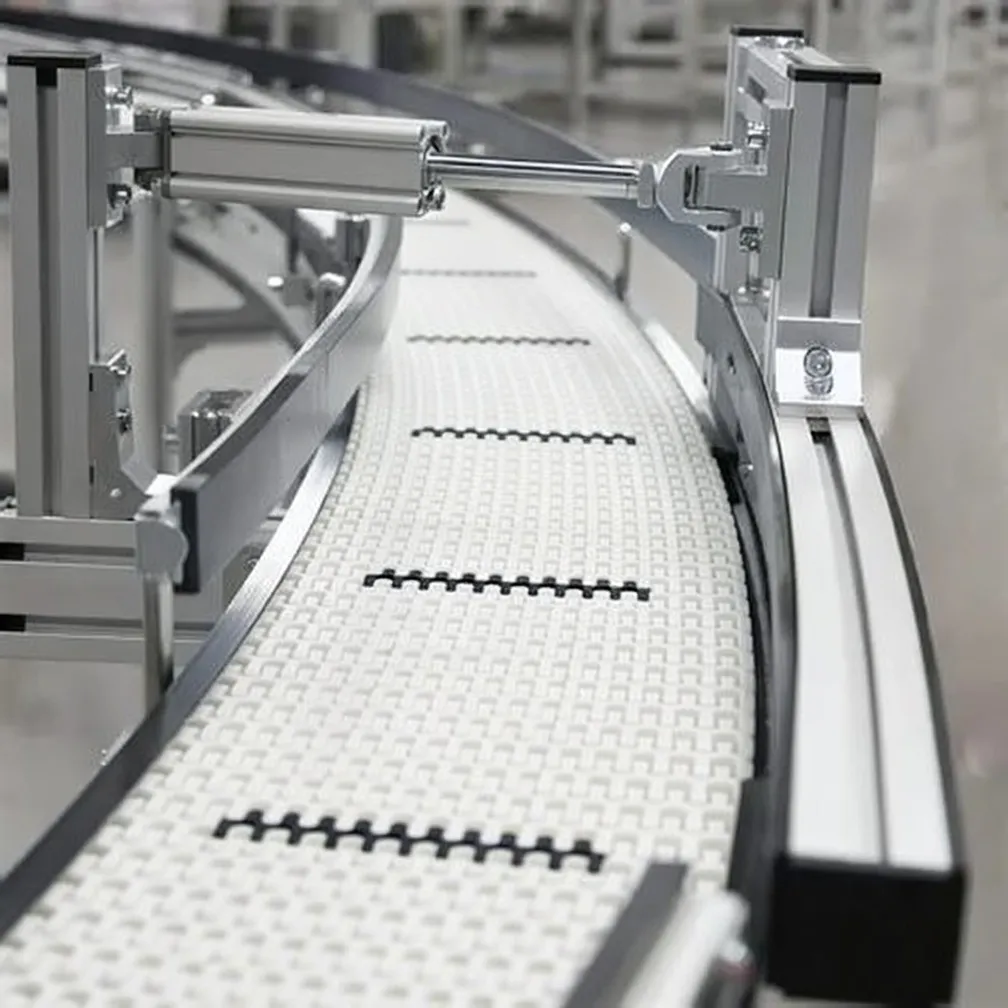
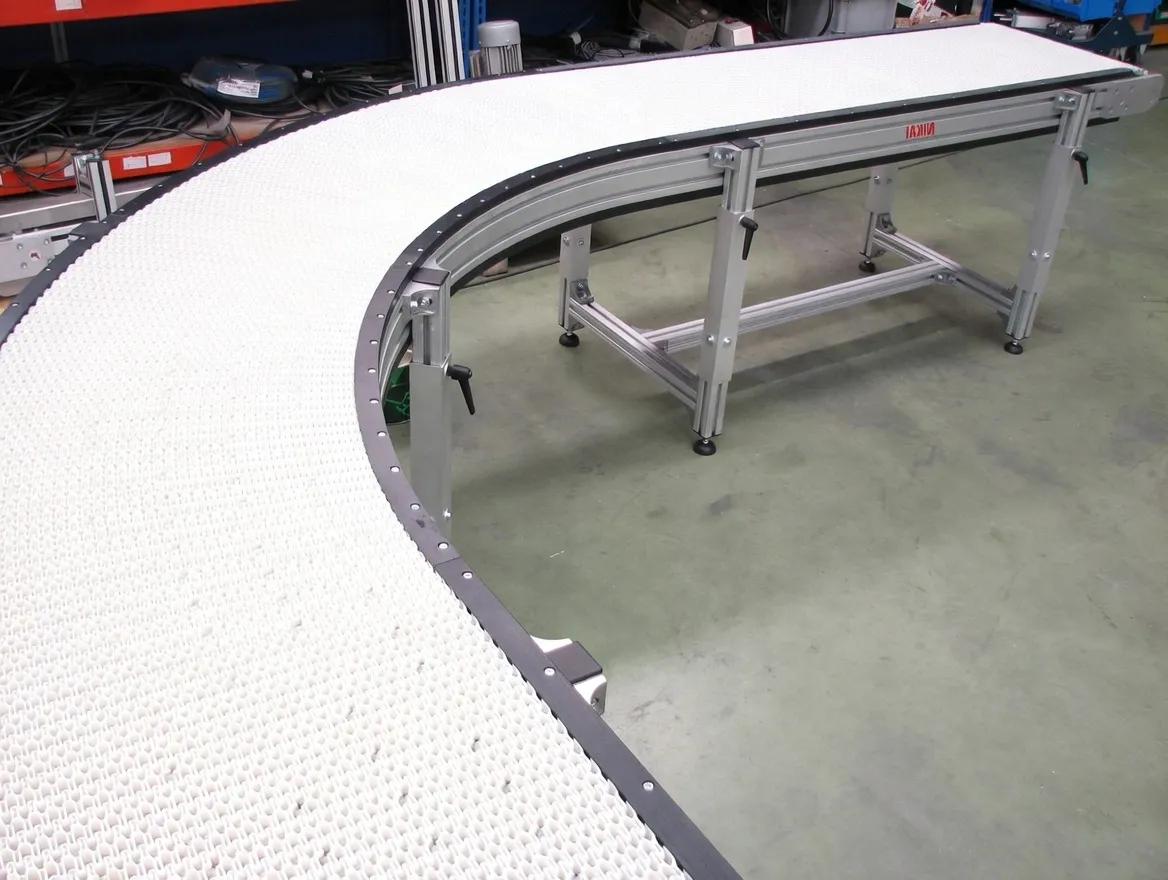
Modern beverage plant footprints — particularly in retrofitted Victorian-era brewery buildings common in Birmingham, Leeds, and Manchester — rarely offer the straight-run luxury that engineers prefer. Side-flexing plastic modular belt modules are engineered with tapered profiles that allow the belt to navigate horizontal curves with radii as tight as 500 mm, turning a layout constraint into a design opportunity. The side-flexing belt maintains full container support through the curve, eliminating the product tip-over and jams that would otherwise require guide rail complexity and reduced line speeds on curved sections.
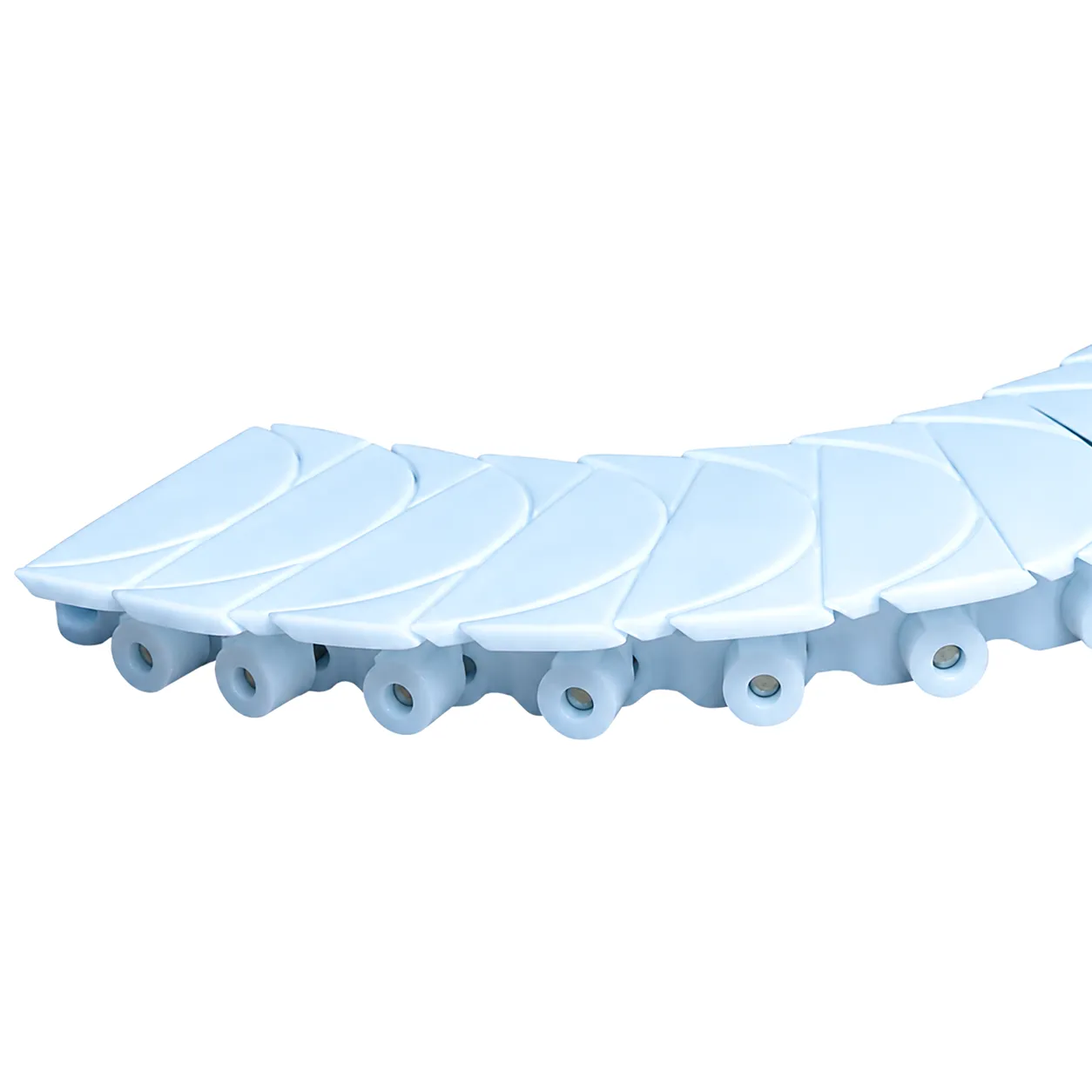 Featured Product
Heavy Duty Grid Straight Run Conveyor Belt
Engineered for heavy glass and PET bottle handling on straight runs. Open grid construction allows full CIP wash-through, reducing hygiene cycle duration in high-throughput UK brewery bottling halls and soft drink filling lines.
Product Technical & Performance Parameters
| Παράμετρος | PP Grade | HDPE Grade | POM / Acetal Grade |
|---|---|---|---|
| Module Pitch (mm) | 25.4 / 38.1 / 50.8 | 25.4 / 38.1 | 25.4 / 38.1 / 50.8 |
| Belt Width Range (mm) | 100 – 2,400 | 100 – 1,800 | 100 – 2,200 |
| Working Temperature Range | -10°C to +80°C | -40°C to +60°C | -40°C έως +100°C |
| Max. Allowable Tension (kN/m) | 8 – 14 | 6 – 10 | 10 – 18 |
| Belt Speed (max. m/min) | Up to 60 | Up to 80 | Up to 120 |
| Friction Coefficient (dry / wet) | 0.25 / 0.15 | 0.20 / 0.12 | 0.20 / 0.10 |
| Side Flex Min. Curve Radius (mm) | 500 – 1,000 | 600 – 1,200 | 500 – 900 |
| Open Area (grid modules, %) | Up to 52% | Up to 48% | Up to 55% |
| FDA / EU 10/2011 Compliance | Ναί | Ναί | Ναί |
| Υλικό ράβδου μεντεσέ | SS 304 / SS 316 / PP | SS 304 / SS 316 | SS 316 / Acetal |
Application Scenarios: Where Plastic Modular Belts Operate in UK Beverage Plants
The pasteurisation tunnel is one of the most thermally aggressive zones in any bottling operation. Bottles or cans enter at ambient temperature, are subjected to hot water spray zones reaching 70–72°C for a defined pasteurisation unit (PU) exposure, then progressively cooled to prevent thermal shock to glass or label adhesives. The plastic modular belt operating through this zone must cycle between wet-cold and wet-hot conditions repeatedly without dimensional change, delamination, or hinge seizure. At Burton-on-Trent — home to some of England’s highest-volume beer brands — engineering teams specify POM or POM-LF plastic modular belt modules for this application, relying on their thermal stability and low hygroscopic uptake to maintain consistent hinge engagement with sprockets even after thousands of hours of wet-thermal cycling. The open-grid format also allows pasteurisation water to fall freely from the belt surface on exit, preventing pools from carrying forward into labelling zones.
Aluminium can conveying at speeds above 1,000 cans per minute places extraordinary demands on the belt surface. Any irregularity — a raised module edge, a warped section, a contaminated hinge — creates the conditions for can tip-over, which at these speeds triggers cascade jams that can cost tens of thousands of pounds in downtime and product wastage per incident. The flat-top plastic modular belt, specified with HDPE modules and SS 316 hinge rods in the can-contact zones, delivers the continuous, seamless surface geometry that eliminates these tip-over triggers. Sheffield and Rotherham’s established food and drink manufacturing cluster has adopted flat-top modular belt configurations across several carbonated soft drink canning lines in the past decade, driven by the industry-wide shift from single-shift operations to 24/7 continuous production schedules.
Accumulation conveyors act as buffer reservoirs between line sections that operate at different speeds — a filling machine running at 4,000 bottles per hour feeding a labeller rated at 3,600 bottles per hour, for example, creates a demand for upstream buffer capacity. The plastic modular belt’s combination of low sliding friction (critical for bottles to slide freely over the stationary belt surface in back-pressure accumulation) and positive drive makes it the default specification for this application. In Edinburgh and Speyside distillery bottling halls, where premium glass bottles command surface protection standards that would be unacceptable with higher-friction alternatives, POM-LF flat-top modular belts enable accumulation at back-pressure loads without surface marking. Dead plate transitions between conveyors are also improved with modular belt geometry: the consistent module pitch eliminates the step discontinuity that traps bottle bases on traditional belt ends.
The secondary packaging stage — where filled and labelled bottles or cans are grouped into multi-packs, shrink-wrapped, or cartoned — presents a different set of demands. Cartons and trays are heavier, wider, and less stable than individual containers, and the belt must deliver positive, slip-free transport without lateral drift. Flat-top plastic modular belt with integrated side guards — raised module extensions that prevent product migration off the belt edge — handles this application with precision. The side-guard-equipped plastic modular belt has replaced chain-and-slat systems at several Midlands-based drinks distribution centres in the past five years, delivering lower noise output (a meaningful benefit in warehouse environments subject to UK Control of Noise at Work Regulations 2005), easier cleaning, and reduced lubrication requirements.
Featured Product
Flat Top Straight Run Belt with Side Guards
Side guard modules prevent product migration on carton and multi-pack lines. Ideal for secondary packaging conveyors in UK distribution and contract packing facilities handling mixed beverage formats.
Manufacturing Partner
Ever Power: Precision Manufacturing and Custom Engineering for UK Beverage Conveyor Demands
 Ever Power is a dedicated industrial conveyor belt and power transmission manufacturer with deep engineering capabilities in plastic modular belt design, tooling, and high-volume production. The company’s manufacturing facilities operate to ISO 9001:2015 quality management standards, with dedicated injection moulding lines for PP, HDPE, and POM module grades, precision hinge rod fabrication in SS 304 and SS 316, and an in-house testing laboratory that validates belt samples against tension, temperature cycling, and chemical resistance specifications before despatch.
What distinguishes Ever Power in the UK beverage sector is not simply product range breadth — it is the depth of customisation capability available to customers. Belt width, module profile, pitch, surface texture (flush grid, raised rib, perforated flat-top, flush-grid with side guards), hinge rod material, and colour coding for lane identification can all be specified to a customer’s exact production drawings. For breweries and soft drink manufacturers operating proprietary conveyor frames — a common situation in UK plants that have evolved organically over decades — this ability to produce a replacement plastic modular belt to a non-standard width or pitch, rather than forcing a change to the conveyor frame, represents a significant capital cost saving.
Ever Power’s supply chain is structured to serve UK customers with lead times that are competitive with European belt manufacturers, maintaining buffer stock of high-rotation module grades for rapid despatch. Technical sales engineers are available to support specification, sample provision, and on-site trial coordination with UK production teams, making the transition from legacy belting to modular systems straightforward for plant engineering departments without dedicated procurement resource.
Custom mould tooling available for proprietary module profiles, integrated cleats, and speciality surface textures tailored to specific container base geometries.
FDA and EU 10/2011 food-contact declarations, material safety data, and third-party test reports provided as standard with each order.
Buffer stock of standard PP and HDPE module grades maintained for rapid order fulfilment, with tracked freight to UK addresses within 5–12 working days.
Ιστορία Επιτυχίας Πελάτη
Leeds Craft Brewery Eliminates Belt-Related Downtime on High-Speed Canning Line
A mid-sized craft brewery based in Leeds, West Yorkshire — operating a recently expanded canning line producing up to 18,000 cans per hour across three shifts — was experiencing chronic downtime on its primary can conveyor. The existing rubber flat-belt system required retensioning every six to eight weeks, and the belt’s smooth surface provided insufficient grip differentiation between the can base and the belt in the wet zone following the rinser, causing periodic can clusters and topple incidents that triggered emergency stops. Each incident required a minimum of 25 minutes to clear and reset, and the frequency — approximately four incidents per week — was consuming over 1,600 hours of production capacity annually.
After a specification review with Ever Power’s technical team, the brewery transitioned the primary canning conveyor to a flat-top plastic modular belt in HDPE, 25.4 mm pitch, 600 mm wide, with SS 316 hinge rods throughout for full corrosion compatibility with the CIP chemicals in use. A side-flexing plastic modular belt section was also introduced on the 90-degree curve between the rinser discharge and the filler infeed, replacing a roller-curve transfer that had been a persistent jam point. The changeover was completed during a scheduled two-day maintenance window, with Ever Power providing pre-cut belt sections and on-site technical guidance on sprocket alignment.
In the twelve months following commissioning, the brewery recorded zero belt-tension maintenance interventions and zero belt-change events. Can topple incidents on the primary line dropped from four per week to under two per month — a reduction of over 85%. Annual production capacity recovered from the belt-related losses, contributing approximately 60,000 additional filled cans to the brewery’s output — at typical craft pricing, a meaningful revenue impact that outweighed the capital cost of the belt upgrade within the first quarter of operation.
“The reduction in can toppling since switching to the Ever Power modular belt has been genuinely transformative for us. We had engineers tied up clearing jam events almost daily — now it is a rarity. The product held up through a full year of three-shift operation without a single hinge failure or module replacement. The corrosion resistance on the stainless rods in our CIP-intensive environment is exactly what the specification promised.”
“Ever Power’s technical team walked us through the module selection in detail and were honest about the trade-offs between PP and HDPE grades for our specific operating temperatures. That level of specification support from a manufacturer is rare, and it gave us confidence placing the order. The custom belt width was produced accurately to our drawing tolerance — no modifications needed to the existing frame.”
“We switched to Ever Power’s POM-LF flat-top modular belt on our accumulation tables as part of a broader move to reduce water and lube consumption. The dry-run performance exceeded our expectations — bottle slide behaviour is consistent even at elevated back-pressure loads. Our sustainability reporting now reflects the removal of approximately 4,000 litres of lube chemical per year from the line, which is a visible environmental improvement our retail customers notice.”
Voice Search Optimised
Συχνές ερωτήσεις
For brewery pasteurisation tunnel applications in the UK, POM or POM-LF grade plastic modular belt modules are the preferred specification. These materials maintain dimensional stability through repeated wet-hot and wet-cold thermal cycles between approximately -10°C and +100°C, resist hinge seizure caused by mineral deposits from hard UK water, and their low hygroscopic uptake prevents the swelling that causes alignment issues in high-humidity spray zones. An open-grid surface profile allows wash water to drain freely from the belt on exit, preventing carryover into downstream labelling zones.
The cost of a custom plastic modular belt depends on width, pitch, module material grade (PP, HDPE, or POM), hinge rod specification, surface profile, and total belt length. For UK facilities in Sheffield, Birmingham, or any other location, the most accurate way to obtain a price is to contact Ever Power directly at [email protected] with your conveyor’s width, required belt length, operating temperature range, and the product being conveyed. Ever Power’s technical team can typically provide a preliminary quote within 48 hours of receiving these details, along with a material recommendation and compliance documentation where required.
For glass bottle accumulation at a Scottish distillery, a flat-top plastic modular belt in POM-LF grade is the standard recommendation. The smooth flat-top surface allows bottles to slide freely in back-pressure accumulation zones without surface marking on premium glass, while the POM-LF material’s internal lubricant eliminates the need for external lubrication spray — a meaningful advantage from both a sustainability and floor-safety perspective. This configuration handles back-pressure loads from 2,000 to over 6,000 bottles without toppling or excessive bottle-to-bottle friction.
Ever Power supplies plastic modular belt directly to UK beverage and food manufacturers, including facilities in Leeds, Manchester, Sheffield, Birmingham, Edinburgh, and across England, Wales, and Scotland. Standard PP and HDPE module grades are held in buffer stock for rapid despatch, with tracked freight reaching most UK addresses within 5 to 12 working days. For urgent replacement orders, expedited arrangements can be coordinated through the sales team. Contact details are available at plastic-modular-belt.com, and enquiries sent to [email protected] typically receive a same-day or next-business-day response.
Service life in a 24/7 soft drink canning environment depends on the material grade, can speed, CIP chemical concentrations, and conveyor alignment quality. Under well-maintained conditions with correct sprocket engagement and appropriate chemical exposure, HDPE and PP plastic modular belt modules typically achieve service lives of three to six years before meaningful module wear requires section replacement. Because individual module rows can be replaced independently without removing the full belt, the effective operational life of the belt assembly — through progressive targeted maintenance — often exceeds ten years. POM and POM-LF grades in lower-friction accumulation applications can achieve even longer intervals.
The transition from rubber flat belt to plastic modular belt is financially justified when a plant is experiencing recurring issues with belt tension maintenance, belt replacement due to localised damage, hygiene compliance challenges related to belt surface cleaning, or can and bottle topple events caused by belt surface inconsistency. In most UK brewery scenarios where these problems are present, the payback period on the belt upgrade investment — accounting for reduced maintenance labour, reduced belt replacement frequency, and reduced downtime event costs — falls between 12 and 30 months. Ever Power can provide a cost-benefit framework alongside quotation, allowing plant managers to present a business case to senior management with production data support.
Ready to Upgrade Your Beverage Line?
Contact Ever Power for a Technical Specification and Quote
Share your conveyor dimensions, operating environment, and container type with our engineers. We’ll recommend the right plastic modular belt grade, provide compliance documentation, and deliver a competitive price for UK delivery.
επεξεργασία από gzl