Plastic Modular Belt for Baking & Confectionery Conveyor Lines: High-Temperature & Easy-Clean Solutions for UK Bakeries
Engineered for food-grade precision, high thermal resistance, and relentless hygienic performance across commercial bakery and confectionery production floors throughout the United Kingdom.
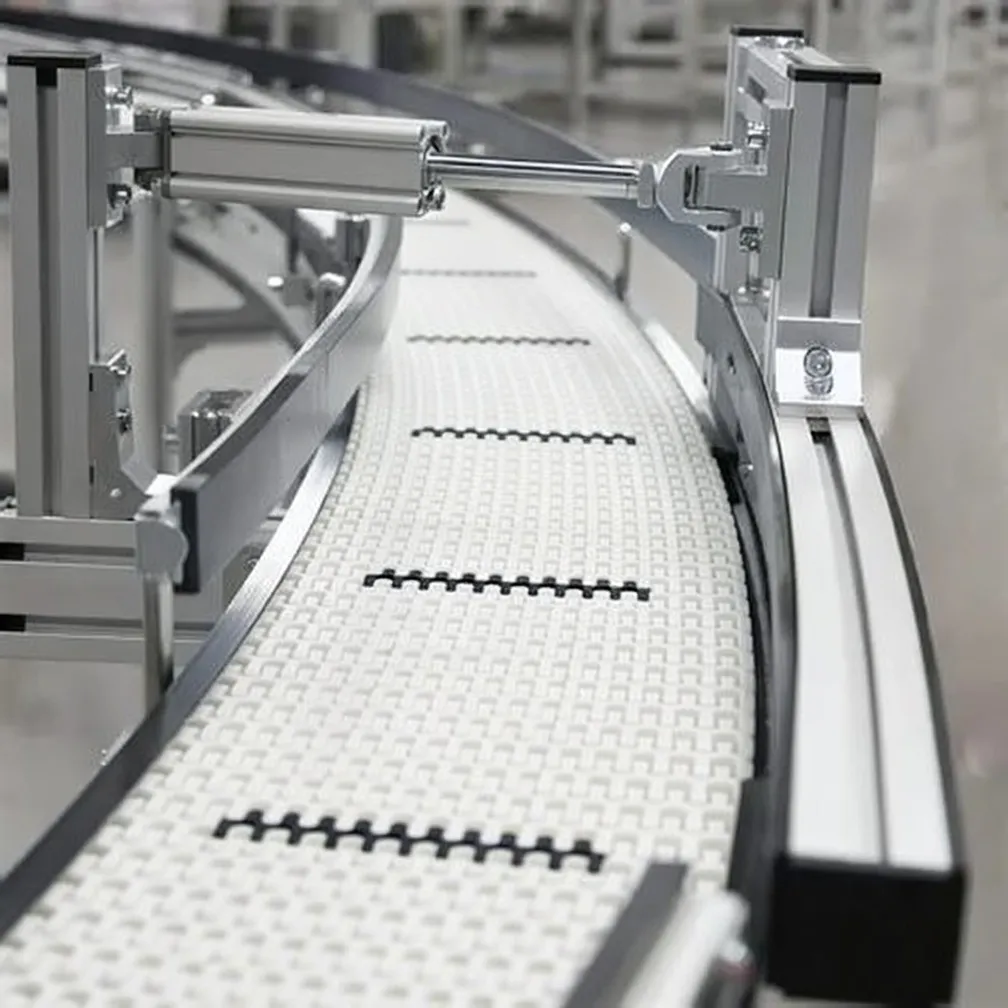 The modern bakery production floor in the United Kingdom is an environment of extremes. Biscuits, bread loaves, pastries, chocolate-coated confectionery, and artisan cakes move through tunnel ovens, cooling spirals, chocolate enrobers, and blast-freeze sections in a relentless, high-speed sequence that never stops. In this world, the conveyor belt is not a passive carrier — it is the backbone of every quality and safety decision made on the line. A belt that degrades under heat, harbours allergen residue in its joints, or resists cleaning agents forces operational shutdowns, risks food safety non-conformances under BRC Global Standard and HACCP audit, and ultimately costs British bakeries money that cannot be recovered. The plastic modular belt was developed to answer precisely these challenges: a fully interlocking, modular conveyor system constructed from engineering-grade polymers chosen for thermal stability, chemical resistance, and the ability to withstand repeated high-pressure wash-down cycles without warping, swelling, or losing dimensional accuracy.
How Plastic Modular Belts Work in Bakery Conveyor Environments
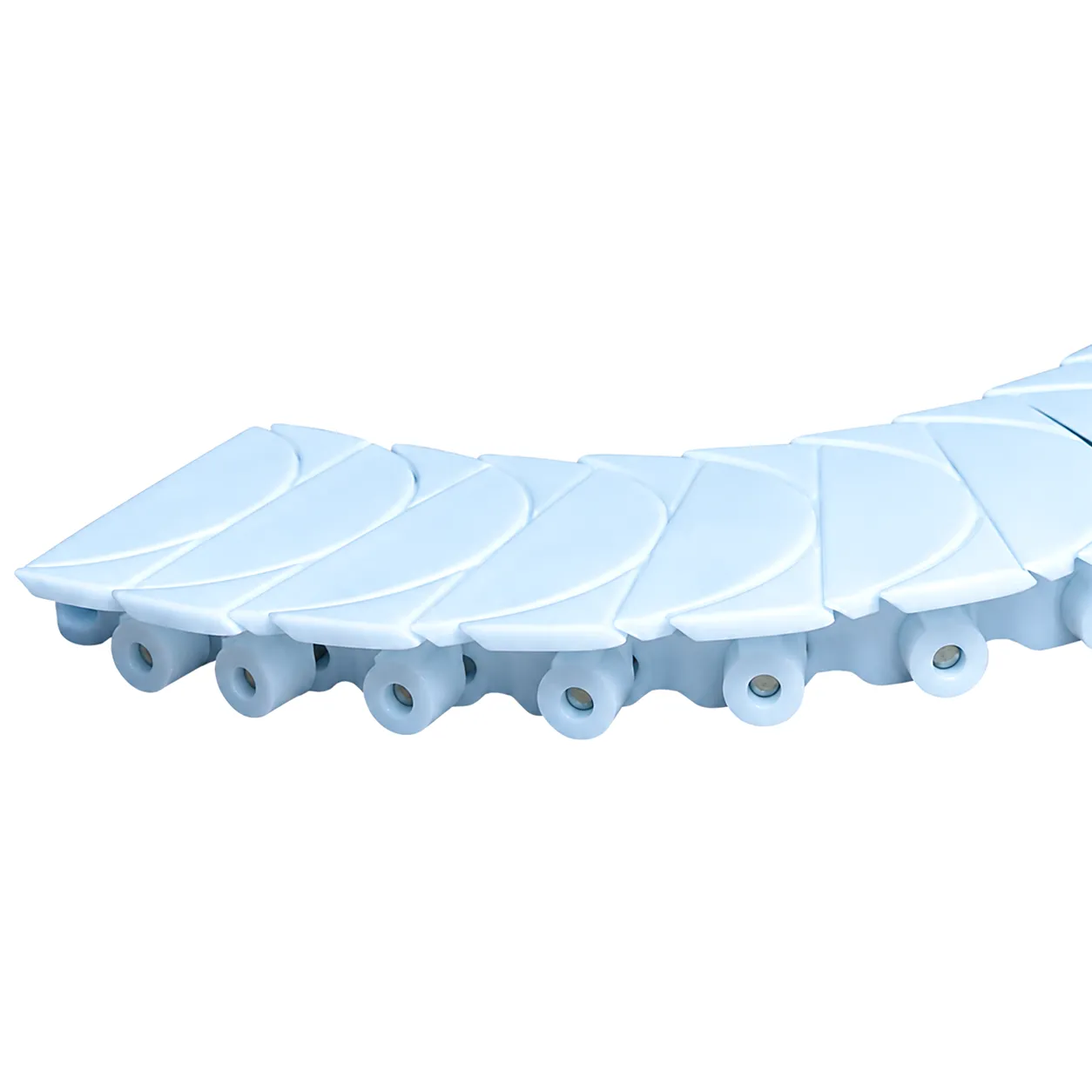
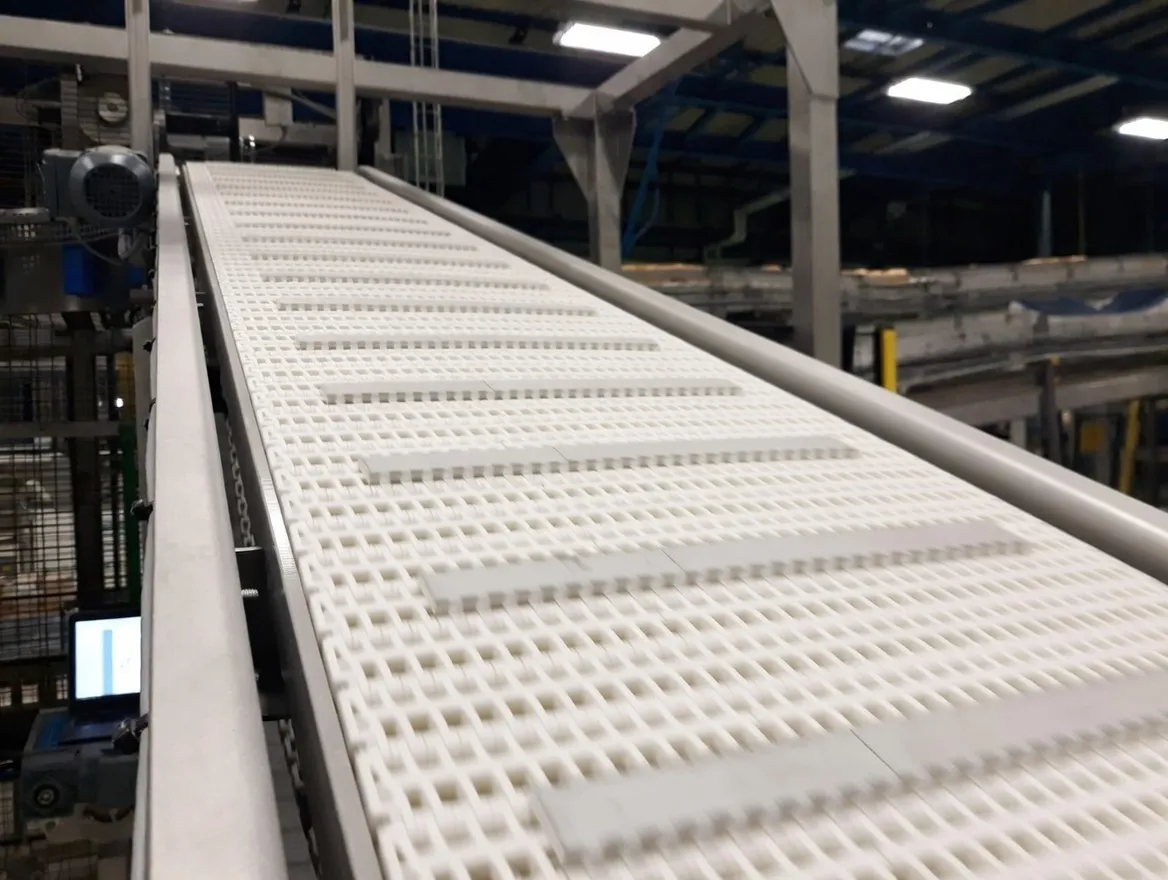 The plastic modular belt operates on a simple yet robust interlocking principle. Individual link modules — typically manufactured from food-grade polypropylene (PP), acetal (POM), or polyethylene (PE) — are joined laterally using stainless steel or plastic hinge rods that pass through alternating knuckle profiles on adjacent modules. This hinge-and-rod assembly allows the belt to articulate smoothly around sprockets at both drive and return ends of the conveyor, producing a flat, stable top surface between those transition points. The modular architecture means that belt width and length are not fixed at manufacture; instead, engineers at Ever Power configure the belt precisely to match the customer’s conveyor frame geometry, choosing from a catalogue of module pitches and open-area percentages suited to the specific baking or confectionery task at hand.
In tunnel oven applications, the belt must carry unbaked dough pieces, par-baked loaves, or biscuit blanks through temperature zones that can reach 260°C or above. The modular link design allows heated air or direct flame impingement to pass through open-grid modules, promoting even bake from below while the product rides the belt surface. In cooling and conditioning sections that follow the oven exit, the same open-grid geometry accelerates airflow across the product base, reducing cooling time and shortening the overall line footprint. For chocolate enrobing and coating applications, closed-top flat modules present a continuous surface that prevents chocolate from flowing into the belt structure, keeping waste to a minimum and simplifying the wash-down cycle at the end of production.
Core Materials: Engineering Polymers Chosen for Food-Grade Performance
Πολυπροπυλένιο (PP)
The most widely used material in bakery plastic modular belt applications. PP offers continuous service temperatures up to 120°C with short-term excursions permitted to 140°C, making it suitable for cooling conveyors, depanning lines, and ambient-temperature packaging infeed sections. Its food-grade certification under EC No 10/2011 (the European standard for plastic materials in contact with food, still widely adopted as the benchmark across UK food processing facilities) makes it the default choice for production environments with strict BRC and HACCP requirements. PP modules exhibit excellent resistance to fats, vegetable oils, and the dilute alkali and chlorine-based cleaning agents used in bakery CIP (clean-in-place) programmes. The material’s low moisture absorption — typically below 0.02% — means that repeated immersion during sanitation does not alter the module dimensions or the hinge rod fit, preserving belt tracking accuracy over extended service life.
Acetal / POM (Polyoxymethylene)
Where the plastic modular belt must operate at higher belt speeds, carry heavier product loads, or articulate around very tight-radius drive sprockets, acetal (POM) is the preferred engineering choice. POM combines a compressive strength roughly 50% greater than standard PP with a coefficient of friction low enough to reduce power consumption on long conveyor runs — a direct operating cost benefit for large-format industrial bakeries. In biscuit and cracker manufacturing lines where belt speeds can exceed 60 metres per minute and product cross-sections are thin and fragile, the dimensional stability of POM prevents the hinge-rod channels from deforming under cyclic loading, maintaining consistent belt pitch and preventing the product bounce that causes breakage rates to climb. POM modules are also used in wrapping and flow-wrapping infeed conveyors where precise product spacing is critical to packaging machine performance.
High-Temperature Nylon (PA) & PEEK Composites
For direct oven conveyor applications where continuous belt temperature reaches 180–260°C, standard PP and POM are insufficient. Ever Power’s plastic modular belt range for tunnel-oven use specifies high-temperature polyamide (PA) variants or glass-reinforced PEEK composite modules that retain structural integrity throughout the thermal cycle. These materials resist the oxidative degradation and chain-link loosening that destroy conventional belts in oven environments. Their low thermal conductivity relative to woven wire mesh also means that product contact surfaces do not deliver sharp heat spikes to delicate baked goods, reducing bottom-crust burning on products like shortbread, naan bread, or filled pastry lines common across bakeries in the North of England and Scotland. Stainless steel 316L hinge rods are standard across all high-temperature configurations to prevent galvanic corrosion in steam-laden oven atmospheres.
Core Technical Advantages of Plastic Modular Belts in Bakery & Confectionery Lines
Superior Hygienic Design
The closed, smooth top surfaces of flat-top modular modules eliminate the recessed wires and knot points where dough, cream, and allergen particles accumulate in woven mesh belts. Where open-grid modules are specified for airflow, the regular, geometric opening pattern allows high-pressure jet wash-down water to penetrate every surface completely, and the lack of internal cavities means microbial harborage sites are engineered out from the start. This design philosophy directly supports allergen management programmes — critical in any UK bakery producing both gluten-containing and “free from” product lines on shared production equipment.
On-the-Line Repairability
When a baking line in Coventry runs three shifts, taking the belt off the conveyor for repair is a decision measured in thousands of pounds of lost throughput. The modular construction of a plastic modular belt means that a maintenance technician can remove a damaged module section using hand tools — typically a hinge rod extraction tool and a few minutes of effort — and click a replacement module into position without disturbing adjacent sections. The belt does not need to be cut, spliced, or vulcanised. This field-repairability makes it possible for bakeries to carry a small stock of replacement modules rather than a complete spare belt, reducing capital tied up in maintenance inventory.
Broad Thermal Range
Material selection within the plastic modular belt family allows a single conveyor system design to be adapted across widely different temperature zones. A standard PP belt handles the -30°C blast-freeze zone at the end of a ready-meal or quiche production line; a PA or PEEK-reinforced belt handles the 240°C tunnel oven at the line’s entry. This thermal versatility means that bakery engineers can standardise on one belt platform and supplier — Ever Power — rather than managing separate belt types, sprocket systems, and spare parts inventories for different process zones.
Dimensional Consistency & Tracking
Belt tracking — the tendency of a running belt to drift laterally off its sprockets — is a persistent problem with rubber and fabric conveyor belts, requiring constant manual tensioner adjustment. The plastic modular belt’s interlocking geometry engages positively with the drive sprocket tooth profile, producing a self-centring action that keeps the belt running true even on conveyors with slight frame misalignment or when belt tension varies across the width due to uneven loading. For confectionery lines handling fragile products like wafer sheets or chocolate bars, this positive drive eliminates the edge damage caused by belt drift.
Product Technical & Performance Specification Table
Industrial Application Scenarios in UK Bakery & Confectionery Manufacturing
Scenario 1: Tunnel Oven Conveyor for Biscuit & Cracker Manufacturing (Birmingham, West Midlands)
 Large-scale biscuit and cracker manufacturing facilities in the Birmingham area — home to some of the UK’s largest food manufacturing campuses — operate continuous tunnel ovens 60–120 metres long running at temperatures between 180°C and 260°C. A plastic modular belt fitted with high-temperature PA modules and a 38.1 mm pitch open-grid surface carries dough pieces at controlled speed through the oven’s drying, baking, and setting zones. The open-grid geometry allows hot air circulation both above and below the product, reducing bake time by up to 15% compared to solid-surface alternatives and improving colour consistency across the belt width — a quality attribute that directly affects shelf-appeal and retail buyer acceptance. The belt’s positive-drive engagement with anti-static sprockets eliminates static electricity build-up that otherwise triggers flour dust ignition hazards, a significant compliance benefit under the Dangerous Substances and Explosive Atmospheres Regulations (DSEAR) enforced across UK food manufacturing sites.
Scenario 2: Chocolate Enrobing & Cooling Conveyor (York, Yorkshire)
York has a historic and ongoing association with confectionery manufacturing, and chocolate enrobing lines at facilities in the area present one of the most demanding plastic modular belt challenges in the food sector. After a chocolate waterfall deposits a controlled coating over biscuit centres, wafers, or caramel-topped bars, the enrobed product must travel across a flat-top modular belt through a cooling tunnel without product sticking, belt contamination, or surface marking. The smooth acetal top surface of Ever Power’s flat-top modules releases chocolate cleanly, and the belt’s dimensional stability prevents the surface undulations that create thin-spot or thick-spot coating defects. At line changeover, the entire belt can be removed from the conveyor frame in under 20 minutes, taken to the bakery’s dedicated CIP wash bay, and returned — a critical advantage in facilities running multiple chocolate variants across the same day’s production schedule.
Scenario 3: Spiral Cooling & Blast-Freeze Conveyors (Sheffield & South Yorkshire Food Parks)
Spiral conveyor systems used for cooling bread loaves, pastries, and quiches after baking compress a long conveyor path into a small floor footprint. The plastic modular belt in a spiral configuration must navigate tight inside-turn radii while maintaining a flat product surface and consistent belt speed around the curve. Side-flexing modular belt designs — where individual modules are linked with additional side-flex allowance — achieve inside-radius turns as tight as 400 mm while keeping the belt tension distributed evenly across the belt width. In blast-freeze applications common in the ready-meal and pastry sectors around Sheffield’s food processing parks, PP belts specified to -40°C minimum operating temperature prevent the brittleness and link fracture that plague standard polymer belts in sub-zero environments, ensuring uninterrupted operation during overnight freeze cycles.
Scenario 4: Packaging Infeed & Product Orientation Lines (Manchester & Greater North West)
Between the oven and the packaging machine lies a conveyor section that handles product sorting, lane division, and orientation before the product enters the flow-wrapping, pillow-pack, or tray-sealing equipment. In high-throughput bakeries across Manchester and the broader North West, these infeed sections run at speeds up to 80 metres per minute and must present products to the packaging machine with consistent gap spacing. POM flat-top plastic modular belts with low friction top surfaces allow controlled product sliding and accumulation without marking delicate cake surfaces, shortbread tops, or chocolate coatings. Side guards — moulded polymer deflector plates that attach directly to the belt edge modules — contain products during high-speed lane merging without requiring a separate guide rail framework.
Featured Product
Flat Top Straight Run Belt with Side Guards
Ever Power: Custom Plastic Modular Belt Manufacturing & Supply Chain Excellence
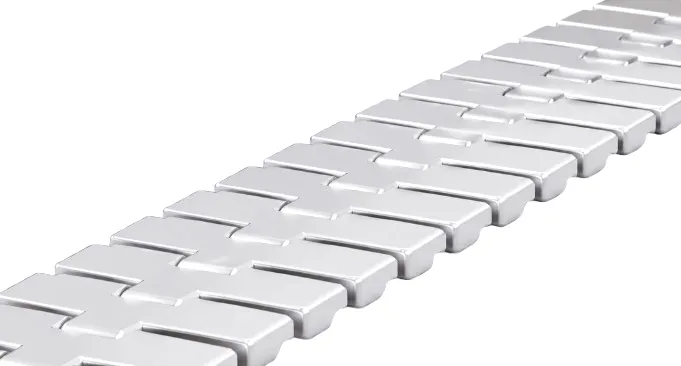
Ever Power operates a fully integrated manufacturing facility producing plastic modular belt assemblies across the full material spectrum — PP, POM, PA, and PEEK — with capacity to deliver finished belt assemblies in customised widths from 200 mm to 3,000 mm within standard lead times of 15–25 working days from order confirmation. For UK bakery and confectionery customers requiring belt replacements on short notice — common when an ageing belt fails during peak seasonal production before Christmas or Easter — Ever Power maintains a pre-cut module stock programme that compresses delivery to 5–7 working days via established logistics partnerships with DHL and DPD UK services, ensuring production continuity even in critical periods.
The customisation capabilities at Ever Power extend well beyond standard catalogue selection. The engineering team works directly with bakery plant engineers and conveyor OEMs to configure module pitch, open area, surface texture, colour, and edge profile for each specific process zone. For applications requiring metal-detectable belts — mandatory in many UK BRC-accredited bakeries where finished product passes through inline metal detection — blue metal-detectable PP modules are available with confirmed traceability documentation. Laser engraving of production batch codes on belt modules supports full traceability during internal QA audits. Anti-microbial additive packages, hot-press bonded cleated surfaces, and FDA-compliant lubricant-impregnated modules for dry-running applications are all achievable within the Ever Power production platform.
Ever Power’s quality management system operates under ISO 9001:2015 certification, and all food-contact module materials carry third-party food safety certification under EC Regulation 10/2011 and FDA 21 CFR guidelines. Each order is accompanied by a complete material declaration, certificate of conformity, and — on request — full material traceability documentation back to the raw polymer batch, satisfying the most rigorous supplier qualification requirements from UK grocery retailers and contract food manufacturers alike.
Customer Success Story: Artisan Bakery Scale-Up in Leeds, West Yorkshire
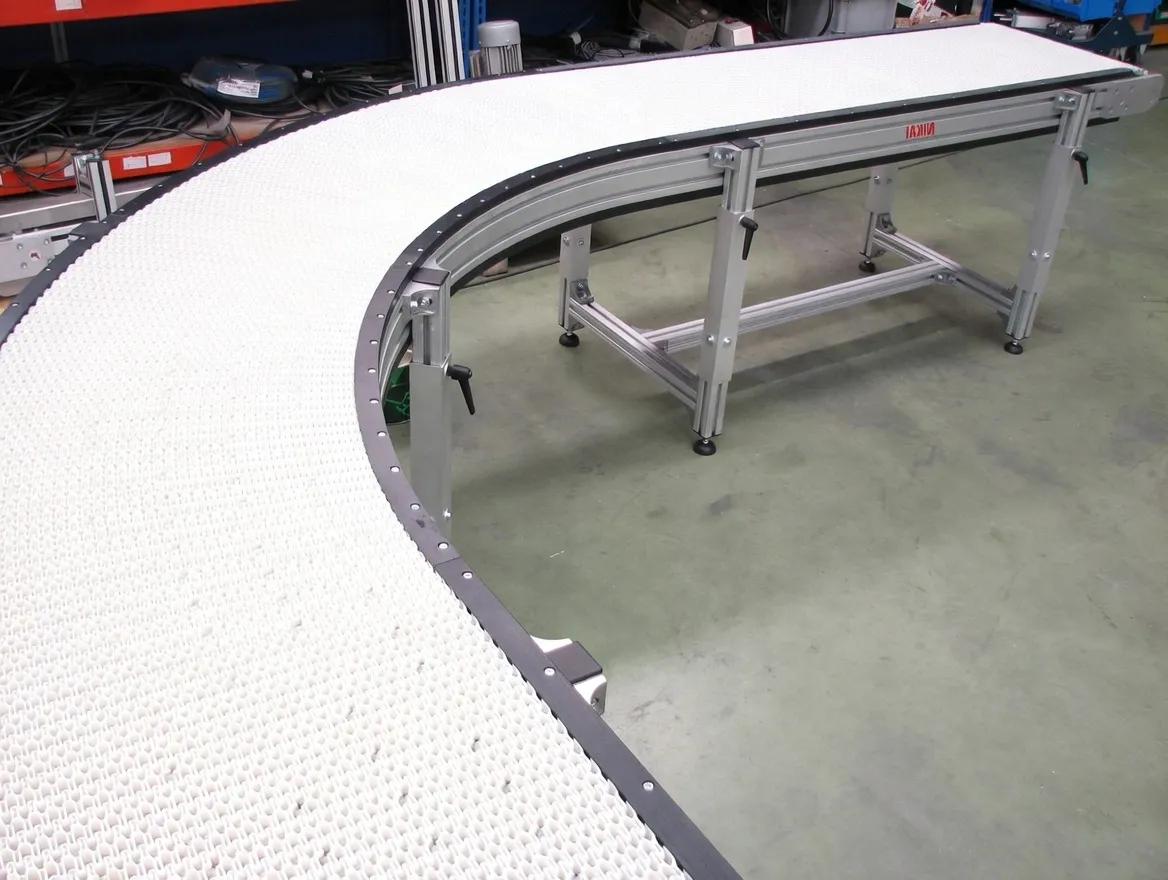
A specialist savoury pastry producer based in Leeds, supplying filled pastry products — including Cornish-style pasties, sausage rolls, and shortcrust quiches — to a major UK grocery retailer, approached Ever Power after experiencing repeated belt failures on their tunnel oven conveyor during a production ramp-up to meet new retail contract volumes. The existing woven wire mesh belt, originally installed when the bakery operated at lower throughput, was failing within 8–12 weeks at the elevated line speed and oven temperature required by the new production schedule, resulting in production stoppages that threatened the bakery’s ability to fulfil its delivery commitments.
Ever Power’s applications team visited the Leeds site, reviewed the existing conveyor frame dimensions and drive sprocket configuration, and specified a custom-width plastic modular belt in high-temperature PA material with a 38.1 mm pitch open-grid surface and SS316L hinge rods. The belt was sized to 1,200 mm working width to match the existing frame, with the module count optimised to eliminate any lateral play that could cause edge damage to the pastry products during oven transit. The new belt was delivered to the Leeds site within 18 working days and was installed by the bakery’s maintenance team over a scheduled Sunday shutdown with telephone technical support from the Ever Power engineering team throughout the changeover.
Within six weeks of commissioning, the bakery reported zero unplanned belt-related stoppages across the oven line, a reduction in bottom-crust burning due to improved airflow distribution through the open-grid surface, and a first CIP cycle completed in 40% less time than with the previous mesh belt. The Leeds site subsequently ordered a second plastic modular belt for its adjacent cooling spiral, citing the consistency of product quality and the responsiveness of Ever Power’s UK-facing sales and technical support team as the primary reasons for staying with the supplier across both applications.
Customer Reviews
“The high-temperature PA modules Ever Power specified for our tunnel oven have now run continuously for seven months without any link failure or dimensional shift. We’ve had two CIP cycles per week throughout, and the belt looks as clean and true as the day it was installed. The product quality difference — particularly the consistency of the bottom crust across our sausage roll range — was visible from the first production run.”
— Operations Director, Savoury Pastry Manufacturer, Leeds, West Yorkshire
“We switched to Ever Power’s modular belt for our chocolate enrobing line after two years of frustration with a competitor’s product that kept tracking off on the inside turns. The dimensional accuracy of the Ever Power modules and the positive-drive sprocket engagement means we have not had a single tracking incident in over 200 production shifts. The customisation service — particularly the metal-detectable blue module option — made our BRC audit sign-off straightforward.”
— Production Manager, Premium Confectionery Manufacturer, York, Yorkshire
“Ever Power’s technical team understood our blast-freeze application immediately and specified the correct low-temperature PP grade without us having to push for it. The belt arrived with full material certification documentation that our quality team accepted without any queries. Lead time was 16 working days to our facility in Coventry, which is genuinely impressive for a custom-width belt. We will not be looking at any other supplier for our upcoming production line expansion.”
— Maintenance & Engineering Manager, Ready Meal Bakery, Coventry, West Midlands
Συχνές ερωτήσεις
What is the best type of plastic modular belt to use on a high-temperature tunnel oven conveyor in a UK bakery?
For continuous oven temperatures above 150°C, a high-temperature polyamide (PA) or PEEK-reinforced plastic modular belt with SS316L hinge rods is the recommended solution. PP-grade modules are not rated for continuous temperatures above 120°C and will deform in tunnel oven environments. Ever Power’s engineering team can advise on the correct material grade based on your specific oven temperature profile and belt speed.
How much does a custom plastic modular belt for a bakery conveyor line typically cost, and where can I get a quote for supply in the UK?
Pricing for a custom plastic modular belt depends on belt width, material grade, module pitch, and total belt length. Standard PP open-grid belts for cooling or ambient applications are the most competitively priced; high-temperature PA or PEEK belts command a premium reflecting the material cost. Ever Power provides detailed, itemised quotations within 24–48 hours. Contact the sales team directly at [email protected] with your conveyor dimensions and process temperature requirements.
Which UK confectionery and baking industry regulations require metal-detectable conveyor belts, and does Ever Power supply metal-detectable plastic modular belts to manufacturers in Birmingham and Sheffield?
BRC Global Standard for Food Safety (Issue 9) requires that all product-contact conveyor equipment used in facilities supplying major UK grocery retailers is capable of being detected by the production line’s inline metal detection system. Blue-coloured metal-detectable PP modules satisfy this requirement. Ever Power supplies metal-detectable plastic modular belts to bakery and confectionery manufacturers across Birmingham, Sheffield, and the wider UK, with full material certification and third-party detection sensitivity data provided with each order.
How long does it take to clean and sanitise a plastic modular belt on a confectionery production line compared to a woven wire mesh belt?
In practical bakery and confectionery environments, a flat-top plastic modular belt can typically be CIP-cleaned in 30–50% less time than an equivalent woven wire mesh belt, because the smooth module surfaces release food deposits immediately under high-pressure wash-down water with no need to scrub individual wire intersections. Removal of the modular belt from the conveyor frame for an off-line wash bay clean — often required at allergen changeover — takes under 20 minutes for a trained operator.
Who is the best supplier of food-grade plastic modular belts for bakery conveyor lines in the UK, and what lead times should I expect for delivery to Manchester or Leeds?
Ever Power is a specialist manufacturer and supplier of food-grade plastic modular belt systems for bakery, confectionery, and broader food processing applications, serving UK customers including manufacturers in Manchester, Leeds, York, Birmingham, Sheffield, and Coventry. Standard custom belt orders typically deliver within 15–25 working days; urgent replacement orders using pre-stocked module dimensions are fulfilled within 5–7 working days via DPD or DHL UK services.
What open area percentage should I specify when choosing a plastic modular belt for cooling baked goods after they leave a tunnel oven?
For forced-air or ambient cooling conveyors following a tunnel oven, an open-area percentage between 28% and 50% is generally recommended. Higher open area accelerates cooling by maximising airflow across the product base, but very high open-area modules (above 50%) may allow small product pieces — small biscuit fragments or cake crumbs — to fall through the belt surface, increasing waste and cleaning frequency. Ever Power’s applications team can recommend the correct open area for your specific product size and cooling system airflow rate.
Ready to Upgrade Your Bakery Conveyor?
Contact Ever Power for a Custom Plastic Modular Belt Quote
Get a Quote: [email protected]
επεξεργασία από gzl