
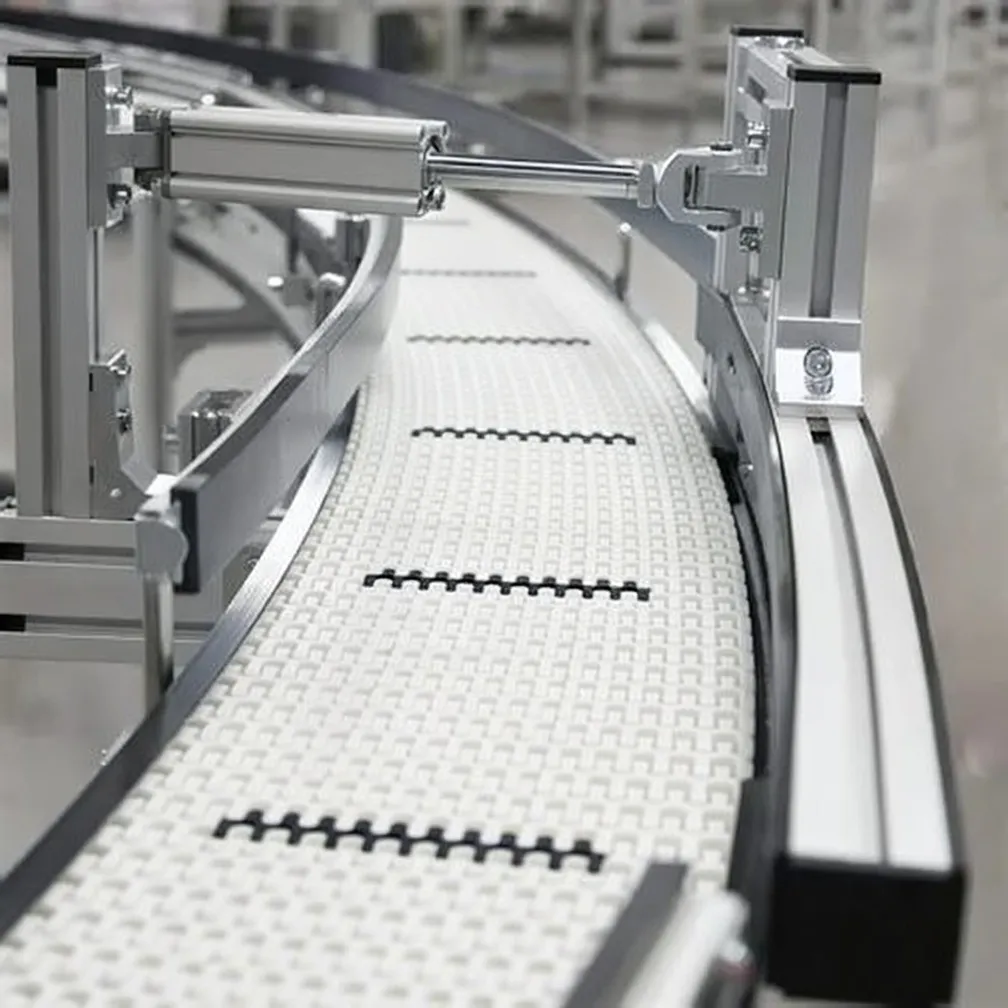
 In modern British manufacturing — from the precision engineering corridors of Coventry to the food production clusters of Leeds — the pitch of a plastic modular belt governs virtually every performance parameter that matters: the minimum sprocket diameter, the maximum articulation angle, the achievable open area, the cleanability rating, and the load-bearing capacity per unit length. Engineers who treat pitch as a trivial detail typically discover the consequences only after a commissioning failure, a hygiene audit, or premature belt wear. The pitch, expressed in millimetres, is the centre-to-centre distance between the hinge points of adjacent belt modules, and it determines the entire geometry of the belt-sprocket engagement.
What Exactly Is Belt Pitch and Why Does It Drive Everything Else?
Belt pitch is the fundamental dimensional constant from which all other belt parameters are derived. When a plastic modular belt engages with a sprocket, the sprocket teeth must mesh precisely with the belt’s hinge rods at every pitch interval. A shorter pitch means more teeth per sprocket revolution, which distributes the tension load across a greater number of engagement points — beneficial for strength and smooth motion at lower speeds. A longer pitch means fewer, more widely spaced engagement events, which suits high-load, lower-speed applications where each individual module must bear significant weight.
The pitch also sets the minimum wrap radius, which is the tightest curve the belt can negotiate at a nose-bar transfer or a change-of-direction roller. A 12.7 mm pitch belt can wrap around an extraordinarily small nose bar — some designs achieve wrap radii under 10 mm — making it ideal for tight transfers where product must pass from one conveyor section to another with minimal gap. A 38.1 mm pitch belt requires a significantly larger wrap radius, typically 50 mm or more, which limits its use in compact conveyor layouts but allows it to handle very heavy modules with greater structural integrity.
Fine pitch · small nose bar · high precision · food-grade
Mid pitch · universal · widest variety of styles available
Coarse pitch · heavy load · robust structure · lower cost per metre
12.7 mm Pitch Plastic Modular Belt: Precision, Fine Transfer, and Food-Grade Performance
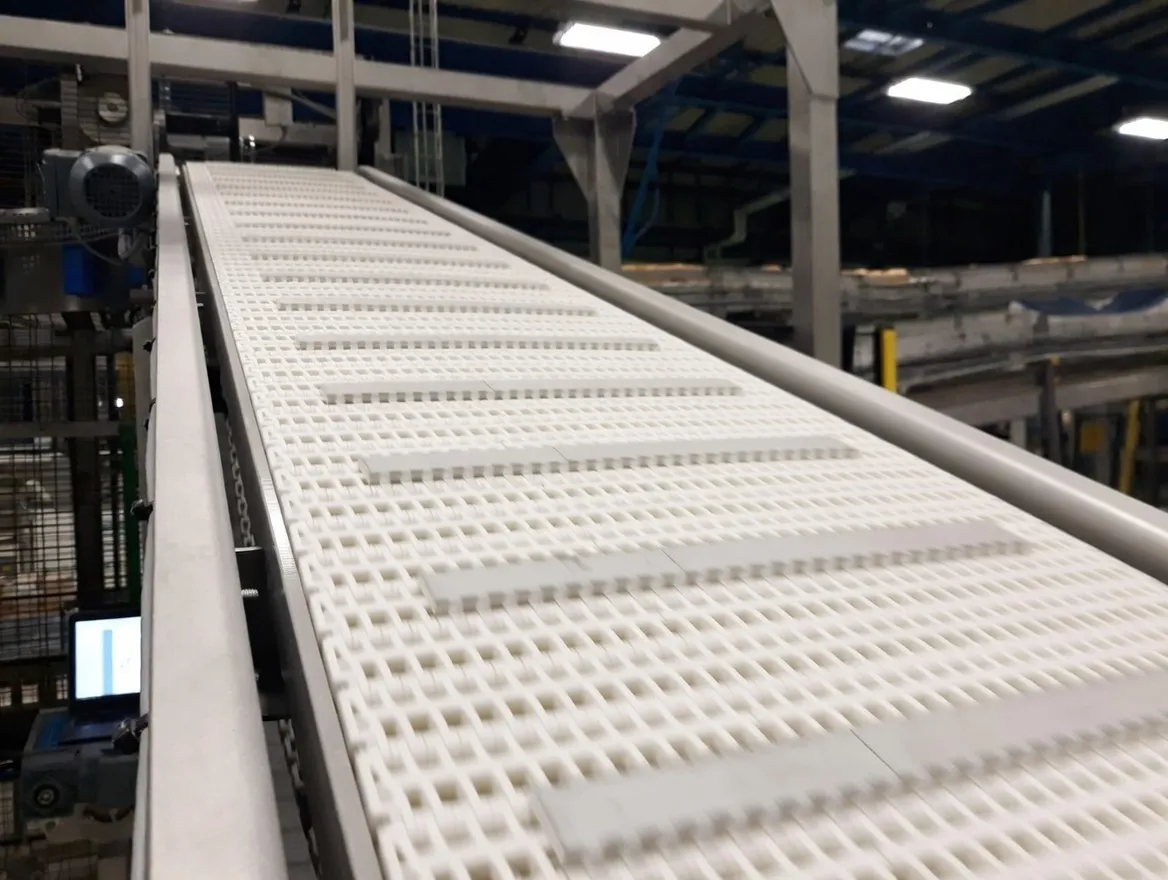
The 12.7 mm pitch plastic modular belt is the precision instrument of the conveyor world. Its defining characteristic is the ability to traverse extraordinarily tight nose-bar radii — in some configurations as small as 8–12 mm — which makes it the engineering standard wherever product transfer gaps must be minimised. Think of a biscuit travelling from a baking oven conveyor to a cooling conveyor in a Yorkshire food factory: a large gap between the two belt surfaces risks the product tipping, jamming, or breaking. The 12.7 mm pitch belt, with its fine module geometry, produces a surface that is almost continuous at the transfer point, drastically reducing the risk of product mishandling.
Beyond tight transfers, the fine pitch geometry distributes load more evenly across the belt width, which translates to smoother running at elevated speeds. Food processing lines in Manchester and Northampton running at 60–90 metres per minute experience significantly less vibration with a 12.7 mm pitch belt than they would with coarser alternatives. This vibration reduction matters not just for product integrity — fragile biscuits, small confections, pharmaceutical tablets — but also for bearing and gearbox longevity, as harmonic loading in conveyor drives is a primary cause of premature drivetrain failure.
The trade-off is that the finer module structure demands tighter manufacturing tolerances, which is reflected in a higher per-metre cost. The smaller hinge-rod diameter also places an upper ceiling on the tensile load the belt can sustain before fatigue failure of the rod becomes a concern. Engineers working with 12.7 mm pitch belts must verify that the calculated belt tension — accounting for the loaded weight, incline angle, and friction coefficient of the carrying surface — remains comfortably within the manufacturer’s rated tensile strength, typically expressed in kilonewtons per metre of belt width.
Fine-pitch belts enable gentle product handling at high throughput, critical for fragile biscuits, cakes, and chocolates in UK food factories.
Minimal gap at transfer points prevents tablet jamming and breakage; smooth surface reduces contamination risk in GMP environments.
Polypropylene 12.7 mm pitch belts resist wash-down chemicals and drain liquids efficiently in Grimsby’s fish processing facilities.
25.4 mm Pitch Plastic Modular Belt: The Universal Workhorse of British Industrial Conveying
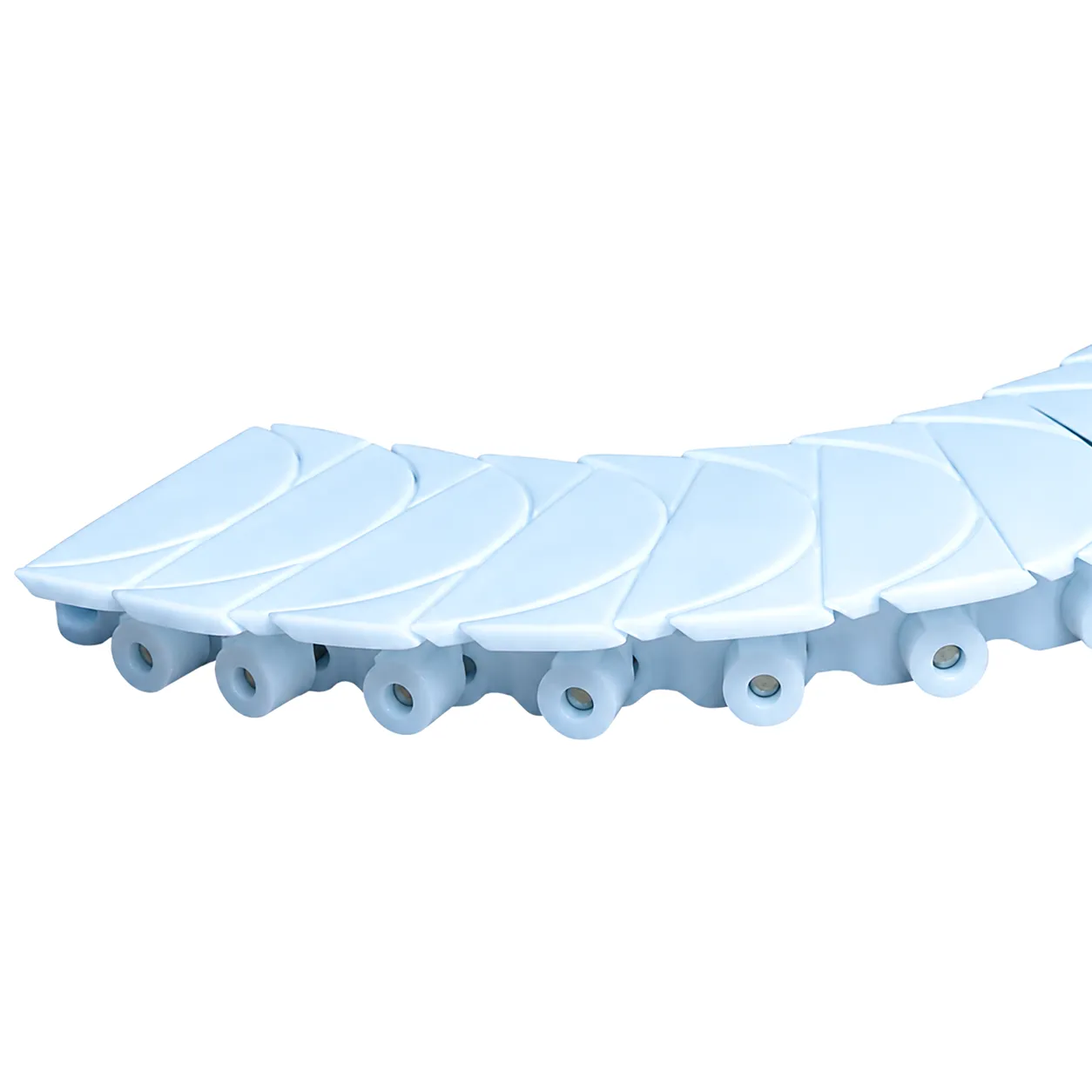
If 12.7 mm is the scalpel and 38.1 mm is the sledgehammer, then 25.4 mm is the all-round workshop tool that handles the vast majority of industrial conveying tasks with competence and economy. This pitch has become the de facto standard for general-purpose plastic modular belt installations across the UK manufacturing sector precisely because it strikes an effective balance between all the competing engineering parameters: it is not so fine that manufacturing becomes expensive, nor so coarse that it struggles with medium-weight loads or moderate-speed operations.
The 25.4 mm pitch is where belt manufacturers invest the most development resource, which means buyers benefit from the widest possible range of surface styles — flat top, flush grid, raised rib, open grid, roller top, and dozens of speciality configurations — all available in this pitch. Specifying a 25.4 mm belt means you are drawing from the deepest catalogue pool, which simplifies spare parts management, shortens delivery lead times, and provides optionality when your production process evolves and requires a surface configuration change without a full sprocket and framework replacement.
For distribution centres along the M1 corridor and in the logistics hubs around Daventry and Milton Keynes, the 25.4 mm pitch plastic modular belt handles mixed carton sizes, tote boxes, and bagged goods across sortation and accumulation conveyors without requiring frequent maintenance interventions. The pitch provides a good wrap angle on sprockets of moderate diameter, keeping drive unit sizing within the standard gearmotor catalogue, which reduces both capital cost and long-term spare-parts expenditure. In environments where cleanliness is a regulatory requirement but not the absolute priority that it is in food-contact applications, the 25.4 mm pitch open-grid variant provides excellent drainage and air circulation while maintaining enough structural rigidity to carry loads up to 25–35 kg per square metre without perceptible deflection.
✔ Moderate tensile strength & drive cost
✔ Compatible with standard sprocket ranges
✔ Best balance of drainage and surface area
✔ Fastest lead times from UK distributors
38.1 mm Pitch Plastic Modular Belt: Heavy-Duty Conveying for Demanding UK Industrial Environments
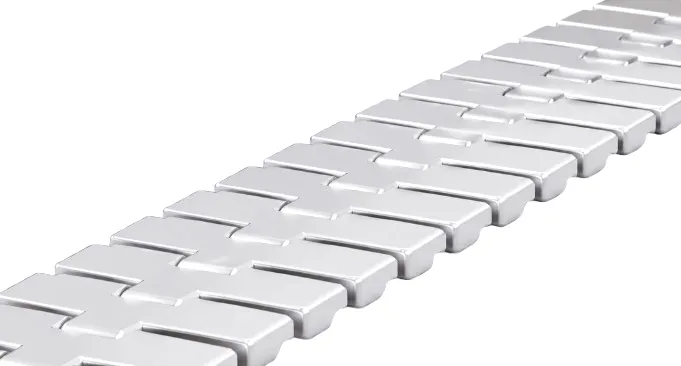 The 38.1 mm pitch plastic modular belt occupies the category where structural mass and tensile strength take priority over finesse. Developed to compete with steel slat conveyors and drag chain systems in the automotive, heavy engineering, and waste management sectors, this pitch produces modules that are physically larger and more robust than their finer-pitch counterparts. The wider module body allows the use of thicker hinge rods — typically 8–12 mm in diameter compared to 3–5 mm in 12.7 mm pitch designs — which translates directly into higher rated tensile loads and longer fatigue life under cyclic loading conditions.
In Birmingham’s automotive component manufacturing plants and Sheffield’s steel service centres, the 38.1 mm pitch belt handles workloads that would fatigue lighter belt constructions within weeks. Cast engine blocks, fabricated steel brackets, heavy glass panels, and automotive body-in-white components can be conveyed on suitably specified 38.1 mm pitch belts with load ratings in excess of 80 kg per square metre, provided the belt material, module wall thickness, and hinge rod specification are correctly matched to the load profile. The coarser pitch also allows the use of more robust module geometries, including deeply ribbed or cleated surfaces that prevent heavy items from sliding on inclined conveyors without requiring any additional attachment hardware.
Another advantage specific to the 38.1 mm pitch that is rarely highlighted in standard product literature is its acoustic signature. Finer-pitch belts running at high speed over worn sprockets develop a characteristic chatter frequency that can contribute significantly to workshop noise levels — an increasingly regulated concern under UK Control of Noise at Work Regulations. The larger-pitch belt, running at lower cadence with more widely spaced sprocket engagements, produces lower-frequency sound events that are generally less irritating and easier to attenuate with standard acoustic screening.
Plastic Modular Belt Technical & Performance Parameters by Pitch
| Παράμετρος | 12.7 mm Pitch | 25.4 mm Pitch | 38.1 mm Pitch |
|---|---|---|---|
| Βήμα ενότητας | 12.7 mm (0.5 in) | 25.4 mm (1.0 in) | 38.1 mm (1.5 in) |
| Minimum Nose-Bar Radius | 8 – 12 mm | 20 – 30 mm | 45 – 60 mm |
| Typical Hinge Rod Diameter | 3.0 – 4.0 mm | 4.5 – 6.0 mm | 8.0 – 12.0 mm |
| Rated Tensile Strength | Up to 5 kN/m width | Up to 12 kN/m width | Up to 28 kN/m width |
| Typical Max Load (flat surface) | 15 – 25 kg/m² | 25 – 50 kg/m² | 50 – 100 kg/m² |
| Typical Max Belt Speed | Up to 90 m/min | Up to 60 m/min | Up to 30 m/min |
| Primary Material Options | PP, PE, POM, PA | PP, PE, POM, PA, PVDF | PP, PE, POM, PA, UHMWPE |
| Operating Temperature Range | -40°C to +120°C | -40°C to +130°C | -40°C to +130°C |
| FDA / Food-Contact Compliance | Yes (PP/PE grades) | Yes (PP/PE grades) | Yes (selected grades) |
| Open Area Availability | 15% – 50% | 20% – 65% | 25% – 70% |
| Cost Index (relative) | Ψηλά | Μέσον | Lower |
Core Materials Used in Plastic Modular Belt Manufacturing
The standard material for food-contact and wash-down environments. Excellent chemical resistance, FDA-compliant grades readily available, low moisture absorption. Operating temperature up to 110°C continuous. Widely used in UK food manufacturing and beverage lines.
Superior stiffness and dimensional stability compared to PP, with a lower coefficient of friction that reduces drive power requirements on long conveyors. Ideal for dry environments where sliding contact occurs — automotive parts conveying in Coventry assembly plants is a classic application.
Higher temperature resistance than PP — up to 130°C continuous — and excellent fatigue resistance under high-cycle loading. The material of choice for 38.1 mm pitch heavy-duty belts carrying engine components through heat-treatment or powder-coating ovens in Birmingham’s automotive supply chain.
Ultra-high molecular weight polyethylene offers outstanding impact resistance and an exceptionally low surface friction coefficient. Used in 38.1 mm pitch configurations for coarse, abrasive bulk materials — mineral processing near Sheffield’s industrial zone benefits from UHMWPE’s wear resistance, which can be ten times greater than standard PP.
Application Scenarios: Matching Pitch to Industry in the UK Manufacturing Landscape
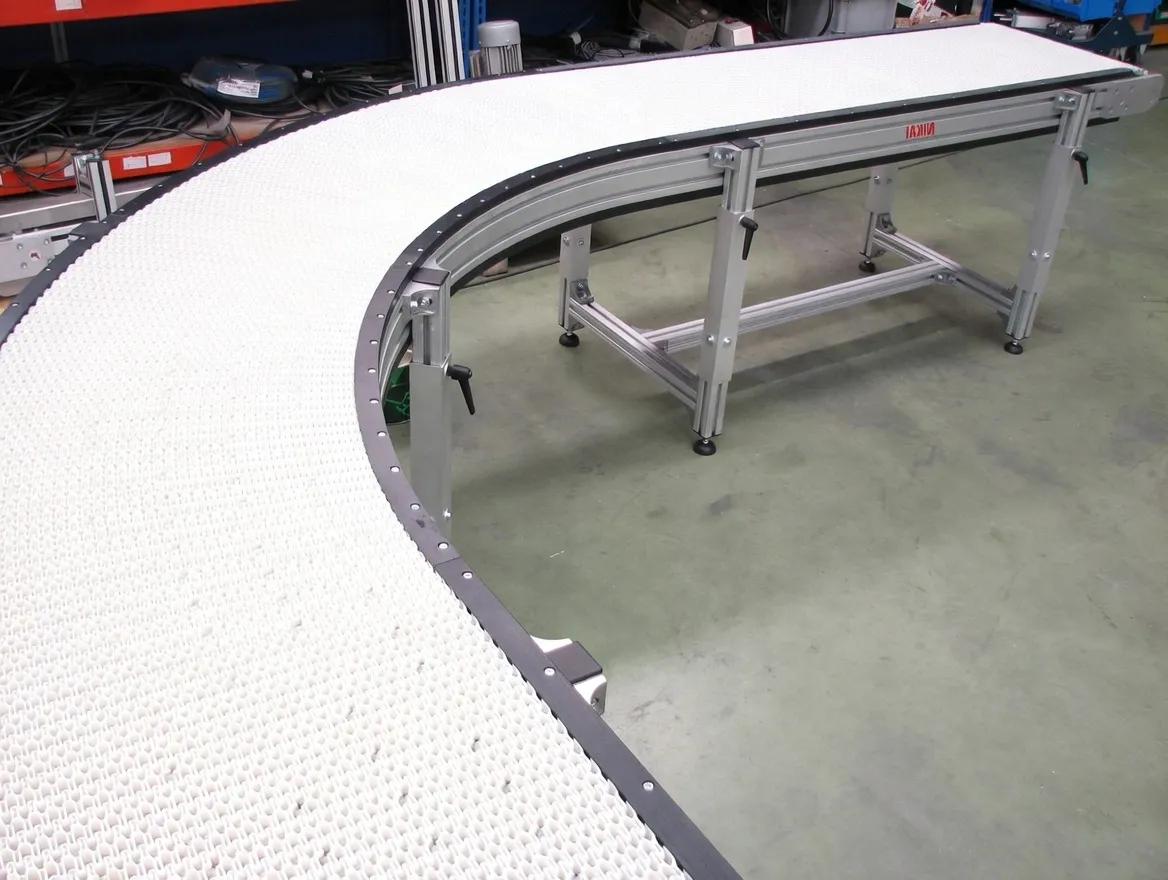
The West Midlands automotive cluster remains one of the most active plastic modular belt end-markets in Britain. Engine assembly lines favour 25.4 mm pitch belts for component feeding, while body-in-white transfer systems increasingly adopt 38.1 mm pitch heavy-duty configurations. The combination of oil resistance (POM or PA material) and high tensile load ratings makes plastic modular belt systems a compelling alternative to traditional steel conveyors in these environments.
This sector is the largest single market for 12.7 mm pitch belts in the UK. The combination of tight nose-bar transfer capability, FDA-compliant PP construction, and resistance to caustic cleaning chemicals makes fine-pitch modular belts the standard for fish processing in Grimsby, ready-meal production in Lincolnshire, and confectionery manufacturing across Yorkshire. Regulatory requirements under UK Food Safety legislation drive the need for hygienic designs with minimal crevices.
Distribution centres along the M1 and M6 corridors, serving major e-commerce retailers out of Daventry, Lutterworth, and Milton Keynes, represent a growing segment for 25.4 mm pitch plastic modular belts used in sortation, accumulation, and zone-routing conveyors. The ability to handle mixed load sizes, from small parcel bags to medium-weight tote boxes, without belt reconfiguration is a key operational advantage in high-throughput facilities running 24/7.
Material recovery facilities (MRFs) across the UK deploy 38.1 mm pitch plastic modular belts on primary sorting and picking lines where abrasive, sharp, and irregularly shaped waste items would destroy lighter belt constructions in days. The open-grid surface variant allows fines and liquids to pass through freely, reducing carry-over contamination. UHMWPE construction further extends service life where glass fragments and hard plastics are present.
Ever Power: Precision Manufacturing and Custom Plastic Modular Belt Solutions
Customer Success Story: Sheffield Pressed Steel Components
A mid-sized pressed steel components manufacturer operating in Sheffield’s Lower Don Valley had been running a 25-year-old steel slat conveyor system to move stamped blanks and formed brackets between their press shop and the shot-blasting line. The legacy conveyor suffered from persistent chain elongation, frequent jam events when punched slugs fell between slat panels, and escalating maintenance costs — the maintenance team was spending an estimated 14 hours per month on conveyor-related interventions, at direct cost to production throughput.
Ever Power’s engineering team conducted an on-site load survey and proposed a direct replacement using a 38.1 mm pitch PA6 open-grid plastic modular belt running on new mild steel framework built to the existing conveyor’s footprint. The open-grid surface allowed the fine punched slugs to fall through into collection chutes below rather than building up on the belt surface and triggering jam sensors. PA6 material was selected for its oil resistance — the pressed components arrive on the belt coated in stamping lubricant — and its rated tensile strength of 22 kN per metre of belt width, comfortably exceeding the calculated running tension of 9 kN/m under full load.
After installation, the Sheffield facility recorded a reduction in planned conveyor maintenance hours from 14 to under 2 hours per month, a complete elimination of slug-jam stoppages, and a 12% improvement in stamping line uptime over the following six-month period. The modular construction of the plastic belt meant that a single damaged module — previously a full belt replacement event with the steel slat system — could be replaced in under 20 minutes without any specialist tooling, a significant operational benefit in a shift-production environment.
✅ Jam stoppages: eliminated
✅ Line uptime: +12% in 6 months
✅ Module swap time: under 20 min
✅ ROI payback: under 18 months
Material: PA6
Surface: Open Grid
Width: 800 mm
Belt length: 22 m
Max belt tension: 22 kN/m
“We specified a 38.1 mm pitch PA6 open-grid belt from Ever Power for our shot-blast feed line, and the improvement over the steel slat system has been dramatic. The dimensional consistency of Ever Power’s modules is noticeably better than what we received from two previous suppliers — you can feel the quality in how smoothly the belt tracks without requiring constant tension adjustment.”
“We upgraded our fresh fish processing line in Grimsby to a 12.7 mm pitch PP belt from Ever Power, and the difference in hygiene performance has been remarkable. The fine-pitch nose bars have essentially eliminated the product breakage we were getting at transfer points, and the belt survives our daily caustic wash-down cycle without any cracking or distortion after eighteen months of continuous use.”
“Ever Power delivered a custom 25.4 mm pitch belt in a non-standard 1,100 mm width for our sortation conveyor in our Daventry distribution centre in a lead time that no other supplier could match. The technical support during the installation commissioning phase was genuinely excellent — the Ever Power application engineer was available remotely to troubleshoot our tracking issue within the hour, and we have been running without incident for over a year.”
How to Choose the Right Pitch: A Practical Decision Framework
Translating the technical parameters into a pitch selection that works for your specific installation requires working through four sequential decision filters. Each filter eliminates one or more pitch options, and the process reliably converges on the correct choice for the overwhelming majority of conveying applications.
If your product is small (under 50 mm in the direction of travel), fragile, or risks tipping at transfers — choose 12.7 mm. If the transfer gap is not a critical constraint, proceed to filter two.
If peak load exceeds 50 kg/m², go straight to 38.1 mm. If load is between 25–50 kg/m², 25.4 mm should be evaluated carefully. Below 25 kg/m², all three pitches are viable.
Above 60 m/min, only 12.7 mm pitch is reliably validated. Between 30–60 m/min, both 12.7 mm and 25.4 mm work. Below 30 m/min, all three pitches are appropriate.
If you are in a food-contact, pharmaceutical, or regulated wash-down environment, 12.7 mm PP provides the least-crevice geometry. For non-food-contact environments, optimise on cost and choose 25.4 mm or 38.1 mm based on filters two and three.
Συχνές ερωτήσεις
Get a Custom Plastic Modular Belt Quote from Ever Power
Share your conveyor layout, load data, and environmental requirements with our engineering team. We will recommend the correct pitch, material, and surface configuration — and provide a detailed commercial quotation within 24 hours.