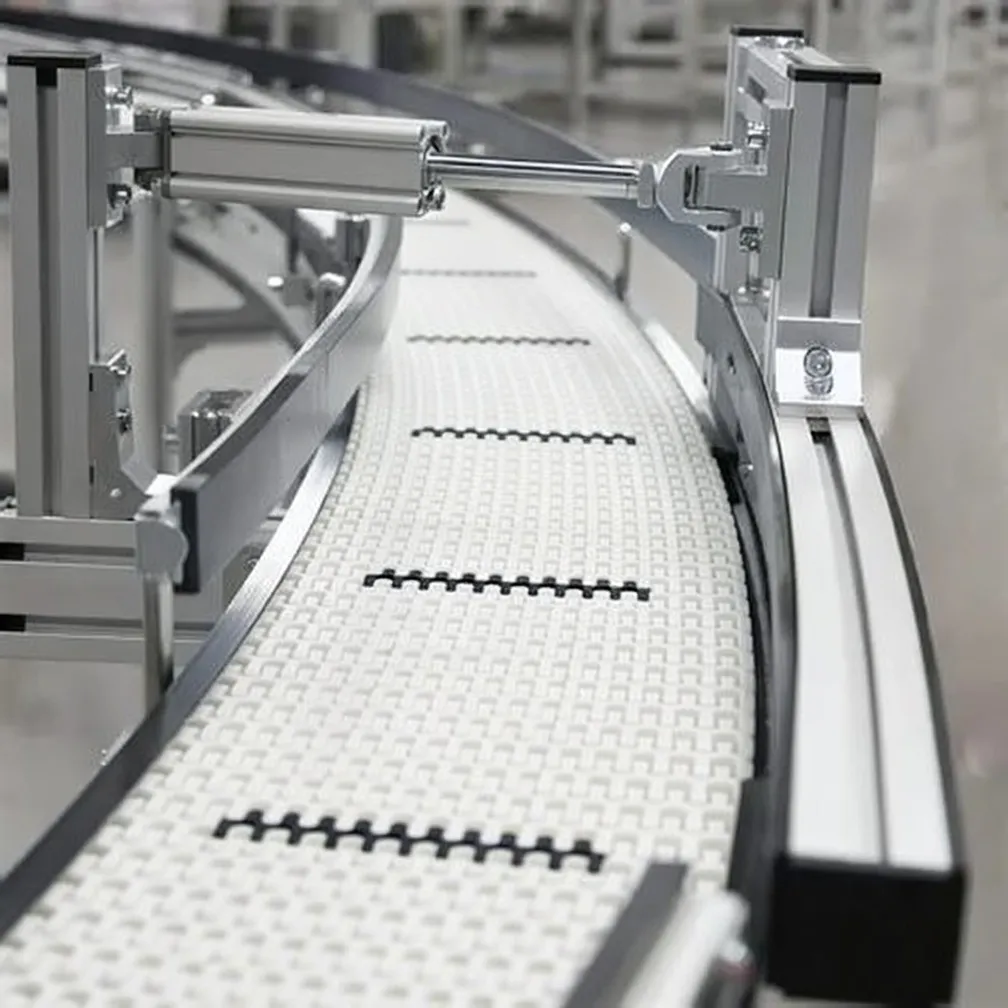
 Walk through any food processing plant in Grimsby, a packaging hall in Coventry, or a logistics hub near Birmingham and you will see one thing that almost every conveyor line has in common — modular plastic belting running quietly under load, shift after shift. The question that procurement managers, maintenance engineers, and operations directors keep asking is straightforward: how long should a plastic modular belt actually last? The honest answer is that lifespan varies enormously. A well-specified belt running in a controlled environment can deliver eight to twelve years of service. A mismatched specification in a demanding application may fail within eighteen months. Understanding what drives that gap is the difference between a capital asset and a recurring cost. This guide breaks down the real factors behind plastic modular belt longevity — covering material science, load dynamics, cleaning cycles, and the supplier criteria that separate a reliable UK-market partner from a catalogue-only vendor.
What Actually Determines How Long a Plastic Modular Belt Lasts
Lifespan is not a single number printed on a product sheet. It is the outcome of four interacting systems: the belt’s base material and module geometry, the mechanical loads imposed by the application, the chemical and thermal environment through which it runs, and the maintenance regime applied by the site team. Getting all four right is what separates a twelve-year service life from a two-year replacement cycle. UK manufacturing environments add their own layer of complexity — the Food Standards Agency hygiene requirements that apply to Grimsby’s fish processing sector differ entirely from the temperature and abrasion conditions inside a foundry caster line in Sheffield. A specification that works perfectly on one site can fail on another within months if these environmental variables are not properly mapped at the selection stage.
Polypropylene (PP), acetal (POM), polyethylene (PE), and nylon (PA) each have distinct wear rates, chemical compatibility windows, and temperature ceilings. The wrong polymer selected for an acidic cleaning environment or an elevated-temperature conveyor can reduce belt life by 60% or more.
Rated tensile strength means little without understanding real-world peak loads, product distribution patterns, and how the belt behaves under incline or accumulation backpressure. Continuous overloading — even at 10–15% above nominal — creates micro-fractures in hinge pins that compound over millions of cycles.
High-pressure hot water wash-down cycles — standard in UK food production sites — impose thermal cycling stress on module hinge geometry. Chlorinated or caustic sanitising agents attack certain polymers at the molecular level. A belt specified for ambient dry-goods handling will degrade rapidly in a wet, chemically active environment unless material and hinge design are matched correctly.
Poorly aligned sprockets, worn guide rails, or incorrect return-path tracking create uneven lateral loads that concentrate wear on one edge of the belt. This is the most commonly overlooked cause of premature plastic modular belt failure on UK production lines — and it is entirely preventable through correct installation and quarterly tension checks.
Material Science: Why Polymer Choice Is the Starting Point of Lifespan Planning
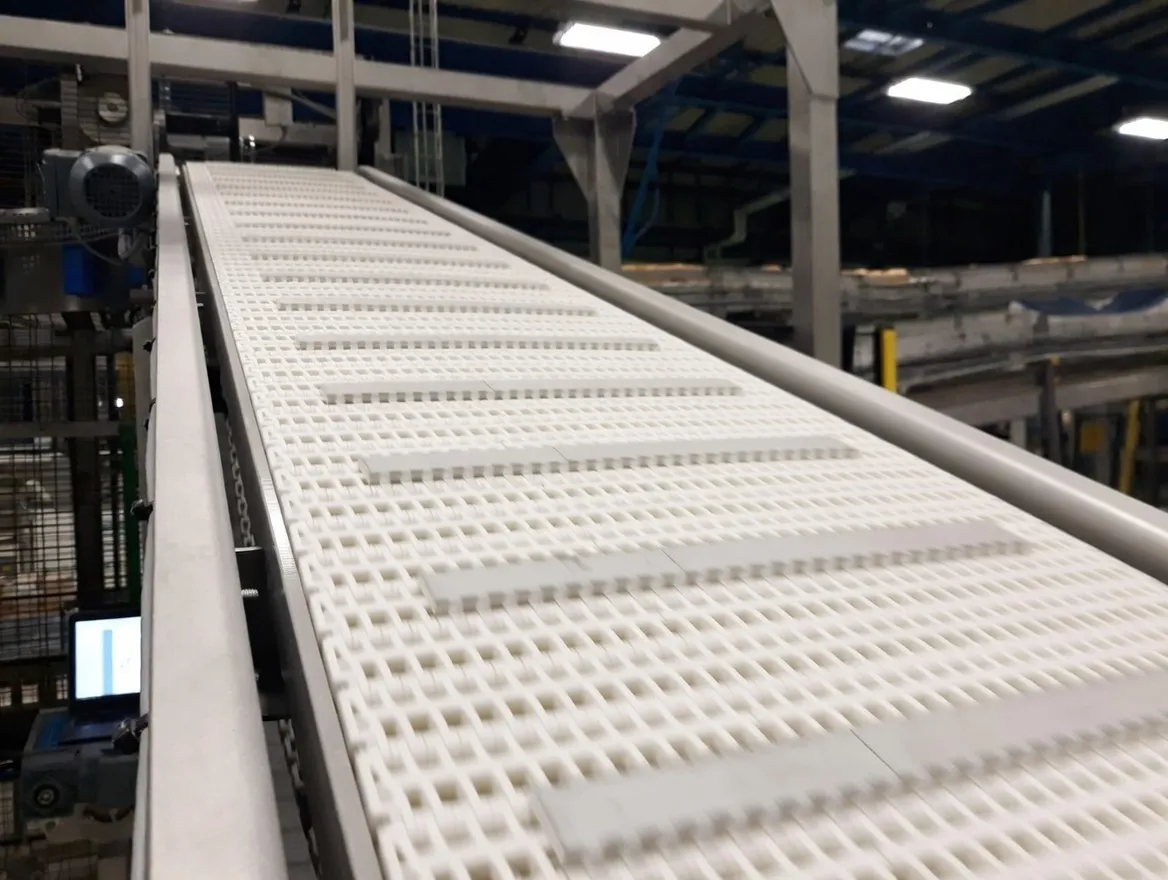
Polypropylene remains the volume workhorse of the plastic modular belt industry. It is cost-effective, reasonably resistant to dilute acids and alkalis, and suitable for ambient-temperature applications from light packaging through to medium-weight product handling. Its Achilles heel is brittleness at low temperatures — below 0°C, PP modules can become notch-sensitive, and impact failures on cold-store conveyor lines in sites near Manchester and Leeds have been traced back to precisely this issue. For refrigerated or frozen environments, high-density polyethylene (HDPE) or acetal grades should replace standard PP.
Acetal copolymer (POM-C) sits at the performance upper end of the standard range. Its tight dimensional stability, low moisture absorption, and excellent wear resistance make it the preferred material for high-cycle applications where hinge pin wear is the primary failure mode. POM-C plastic modular belts commonly outlast PP equivalents by a factor of 1.5 to 2.2 in equivalent load conditions — a meaningful difference when the replacement cost includes downtime as well as materials.
Nylon-based modules bring superior abrasion resistance for applications where product being conveyed has sharp edges or high-friction contact surfaces. Ever Power produces nylon-reinforced modules for quarry aggregate screening lines, recycled materials processing, and automotive parts handling — all sectors where surface abrasion would consume a standard PP belt in a fraction of the expected life.
POM-C — Precision, wear-critical duty
HDPE — Cold store & wash-down duty
PA (Nylon) — Abrasive product handling
PVDF — Chemical-aggressive environments
Plastic Modular Belt Technical and Performance Parameters
The table below consolidates key technical parameters across the main material families and module pitches available from Ever Power. These figures are provided as engineering reference values. Actual performance in any specific application should be confirmed with our technical team, particularly for applications involving elevated temperatures, chemical exposure, or sustained high-belt-tension running conditions common in Sheffield and Teesside heavy industry environments.
| Παράμετρος | PP Grade | POM-C Grade | HDPE Grade | Nylon (PA) Grade |
|---|---|---|---|---|
| Module Pitch (mm) | 25.4 / 38.1 / 50.8 | 25.4 / 38.1 | 25.4 / 38.1 / 50.8 | 25.4 / 38.1 |
| Working Temp. Range (°C) | -10 to +90 | -40 to +100 | -50 to +80 | -30 to +120 |
| Max. Working Tension (kN/m) | Up to 6.5 | Up to 9.5 | Up to 7.0 | Up to 11.0 |
| Max. Belt Speed (m/min) | 60 | 80 | 60 | 75 |
| Hinge Pin Material | PP / Stainless | POM / SS316 | HDPE / SS304 | PA / SS316 |
| Chemical Resistance (acid/alkali) | Good / Fair | Very Good / Very Good | Excellent / Good | Fair / Good |
| FDA / EU Food-Contact Compliant | Διαθέσιμος | Standard | Standard | Διαθέσιμος |
| Estimated Service Life (years, optimal conditions) | 5–8 | 8–12 | 6–9 | 7–11 |
| Typical UK Application Sectors | Packaging, FMCG | Pharmaceuticals, Food | Cold chain, Dairy | Automotive, Abrasives |
Industrial Application Scenarios Where Plastic Modular Belt Lifespan Varies Most
Real-world lifespan differences across UK industry are dramatic, and understanding why helps procurement teams set realistic expectations and maintenance budgets before installation rather than after the first failure event.
Design Features That Extend Plastic Modular Belt Service Life
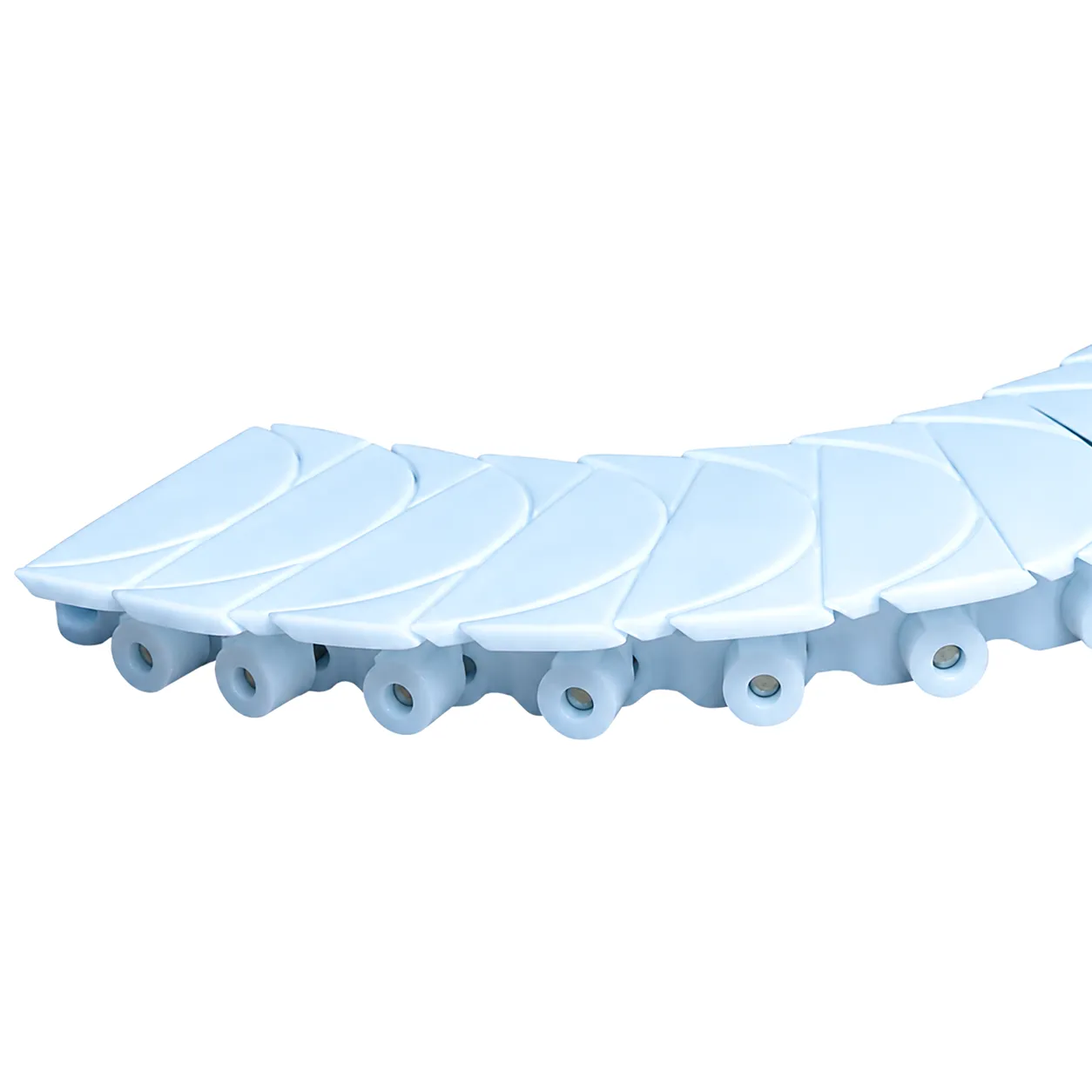 Beyond material selection, the geometric design of the modular belt itself has a substantial effect on how long it survives in service. Hinge pin cross-section diameter directly affects the maximum pin load per unit width — a pin that is 3mm too small for the application will see accelerated wear at the hinge eye contact surfaces, shortening belt life by years rather than months. Ever Power engineers calculate pin load geometry against application-specific tensile demand as a standard part of the specification process, not an afterthought.
Surface texture choices — open grid, flat top, friction top, and perforated configurations — affect both wear rate and cleanability. Open-grid surfaces self-drain liquids and debris, reducing the abrasive contamination that grinds module surfaces over time. Friction-top surfaces increase grip for incline applications but introduce additional drag on the return path that can elevate hinge wear if drive tensions are not carefully set. Getting these design parameters right at the outset is what separates a plastic modular belt that lasts a decade from one that needs constant attention.
UK Supplier Checklist: 8 Questions to Ask Before You Order
Selecting a plastic modular belt supplier based on price alone is one of the most expensive decisions a UK operations manager can make. The purchase price of the belt is typically between 15% and 30% of the total cost of ownership over the belt’s service life — the rest is installation labour, maintenance time, product loss during unplanned downtime, and the cost of emergency replacements on short notice. The checklist below helps identify suppliers who deliver on total value rather than unit cost. It is structured for procurement professionals who are evaluating both UK-stocking distributors and direct international manufacturers with UK service capability.
Material traceability records confirming polymer grade, food-contact compliance certification (EU No 10/2011 or equivalent), and batch identification are non-negotiable for UK food-sector buyers and NHS-adjacent pharmaceutical applications.
A modular belt’s maintainability advantage over a solid rubber belt depends on fast module replacement. If your supplier has a 6–8 week lead time from China with no UK buffer stock, that advantage is eliminated on the day you need it most.
Many conveyor upgrades in existing UK factories require non-standard belt widths. A supplier with genuine custom moulding capability — not just catalogue selection — can prevent a costly conveyor frame rebuild.
ISO 9001 certification is the baseline. For UK pharmaceutical or food-sector buyers, additional confirmation of IFS or BRCGS-aware supply chain practices from the manufacturer is increasingly expected as part of vendor qualification.
A supplier who simply takes an order without reviewing your load data, conveyor geometry, cleaning chemistry, and operating environment is not protecting your interests. The right supplier asks these questions before issuing a quotation, not after the first belt fails.
For UK operations, a 4–6 week standard lead time is acceptable for planned projects. Emergency replacement capability — either from local stock or expedited air freight — and realistic MOQs for spare module quantities are critical service level metrics that separate capable suppliers from catalogue vendors.
Tensile strength, wear coefficient, and temperature resistance data claimed in product brochures should be available in third-party test report format on request. Suppliers who cannot provide these documents are typically reselling product they did not manufacture and cannot validate.
UK food hygiene regulation, PSSR, and ATEX requirements create sector-specific demands. A supplier with a track record of supplying plastic modular belt systems to comparable UK operations — and who can provide reference projects — is substantially lower-risk than one offering only export catalogue sales.
Ever Power: Precision Manufacturing and Custom Plastic Modular Belt Solutions
Ever Power operates a dedicated plastic modular belt manufacturing facility where production capacity, tooling depth, and quality management systems are structured around the demands of international industrial buyers — particularly those in the UK market who require documented material compliance, consistent dimensional accuracy, and the ability to receive custom configurations at commercially viable minimum order quantities.
Our customisation capability extends well beyond colour selection. Ever Power engineers work with clients to modify module pitch, hinge pin diameter, surface texture pattern, side-wall configuration, and belt width to match specific conveyor frame dimensions. For UK clients operating ageing conveyor infrastructure where standard catalogue widths do not correspond to existing frame geometry, this custom tooling capability eliminates what would otherwise be a complete conveyor rebuild project. The average custom width lead time from confirmed order to production-ready belt is 28–35 days, with express scheduling available for urgent replacement requirements.
Every batch of plastic modular belt leaving the Ever Power facility is accompanied by a full production record including polymer batch identification, moulding parameter logs, dimensional inspection results, and where applicable, food-contact compliance declaration. These records are retained for a minimum of five years to support client audit requirements. UK buyers working within BRCGS, BRC/IoP, or pharmaceutical GMP frameworks can request copies of current quality management documentation as part of the pre-order qualification process.
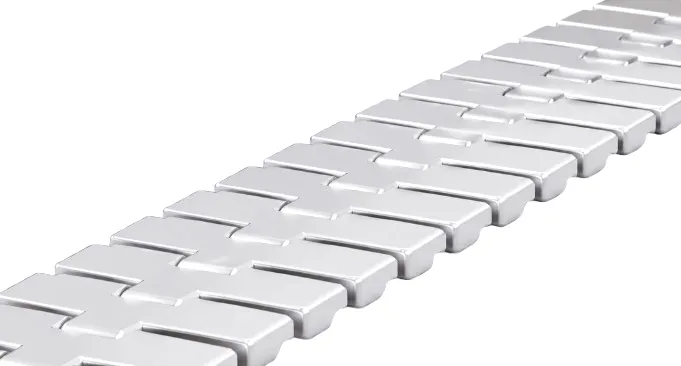
Customer Success Story: Sheffield Dairy Products Manufacturer
Ferndale Dairy Ltd, a mid-size chilled dairy product manufacturer operating from a modern processing facility on the outskirts of Sheffield, had been running the same rubber flat-belt conveyor system for eleven years when a combination of increasing BRCGS audit pressure and two significant unplanned downtime events in a single quarter forced a capital review of their entire conveyor infrastructure.
The core problem was their packaging and collation conveyor lines, which ran at 2–4°C in a refrigerated zone and were subjected to twice-daily wash-down using a chlorinated alkaline solution approved to British Retail Consortium hygiene standards. The rubber belts were absorbing the cleaning chemistry and degrading from the inside — a failure mode that was invisible until cracking appeared on the surface, at which point belt integrity was already compromised. The maintenance team was replacing belts at an average interval of fourteen months and carrying significant spare belt stock at substantial cost.
Ferndale’s engineering director contacted Ever Power following a recommendation from their conveyor OEM service partner. After a detailed application review covering operating temperature range, cleaning chemistry compatibility, belt width requirements, and available drive motor specifications, Ever Power specified an HDPE modular belt in a 12.7mm pitch flat-top configuration across four primary packaging lines, with a POM-C open-grid variant on two wet-drain product transfer conveyors. All six configurations were supplied in custom widths matching Ferndale’s existing conveyor frames — eliminating any frame modification costs.
The results after 30 months of operation have exceeded the projections made during the pre-sales review. Zero unplanned belt failures have occurred across all six lines. The chemical resistance of HDPE to Ferndale’s specific cleaning agents has proven complete — no surface degradation or hinge swelling has been observed during scheduled maintenance inspections. The modular design has allowed two spot-repairs — replacing small sections of modules damaged by a mechanical incident — without any production line shutdown. Ferndale’s maintenance cost for these six conveyor lines has reduced by an estimated 58% compared to the final three years of the rubber belt era.
What UK Customers Say About Ever Power Plastic Modular Belt
“The HDPE belt Ever Power supplied for our refrigerated pack-out line has now run for two and a half years without a single unplanned stop. The custom width meant no frame work at all — we bolted it in over a weekend. The reduction in maintenance call-outs has been genuinely significant.”
“We were sceptical about moving away from a European belt supplier we’d used for years. Ever Power’s pre-sales technical team actually challenged our original material specification and recommended POM-C over PP for our application — that kind of honesty is rare. The belt has performed exactly as they said it would, and the price-to-quality ratio is excellent.”
“Getting a price and a quote from Ever Power was straightforward, and the documentation package they provided — material certs, compliance declarations, batch records — was exactly what our quality team needed for supplier approval. The belt itself has been running on our IPA wash-down line for eighteen months now and looks like new.”
Practical Maintenance Habits That Protect Belt Lifespan
The material and design specification sets the upper limit of what a plastic modular belt can achieve — maintenance practice determines whether that limit is ever approached. Conveyor teams in UK manufacturing sites who carry out consistent, scheduled inspection routines get significantly more life from their belting than those operating reactive-only maintenance models, regardless of belt quality. The difference in practice is often as little as forty minutes per conveyor per month — a trivial investment against the cost of an unplanned stop.
Quarterly tension checks are the single most impactful routine maintenance task for plastic modular belt life extension. Drive tension creep — the gradual increase in belt tension caused by frame settling, motor mount shift, and tail roller bearing wear — is invisible until hinge pin loads have already exceeded design limits by a significant margin. A simple torque check at the drive shaft, referenced against the belt manufacturer’s specified tension range, takes under twenty minutes and can be done during a scheduled shift changeover. Ever Power includes application-specific tension reference data with every belt order.
Cleaning chemistry compatibility should be reviewed annually, not just at installation. Detergent and sanitiser formulations used by UK food manufacturers change through contract renegotiations, regulatory updates, and supply chain substitutions. A cleaning agent that was compatible with the installed belt at commissioning may not remain so if the formulation changes — particularly for chlorine-based sanitisers where concentration and contact time both affect polymer degradation. Maintaining a current chemical compatibility record aligned with the actual cleaning regime in use is a straightforward measure that prevents unnecessary belt degradation.
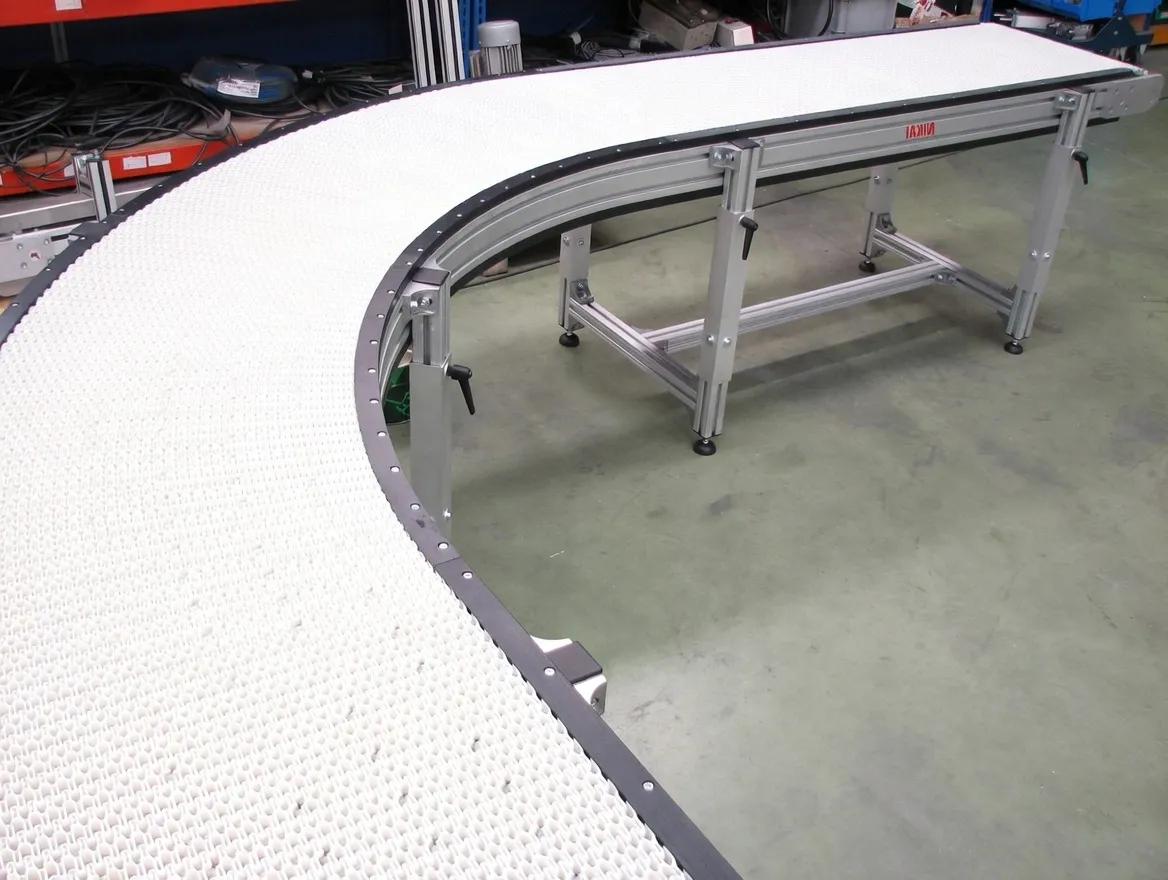
Monthly — Belt tracking & tension check
Quarterly — Drive sprocket wear assessment
Bi-annual — Chemical compatibility review
Annual — Full conveyor geometry survey
Frequently Asked Questions About Plastic Modular Belt Lifespan and UK Supply
These are the questions our UK sales and technical teams receive most regularly from food processing engineers, procurement managers, and maintenance professionals across Birmingham, Sheffield, Grimsby, Coventry, and beyond.