
Plastic Modular Belt for Recycling & Waste Sorting Plants: Abrasion-Resistant Conveying Solutions for UK Facilities
High-performance modular plastic conveyor belts engineered for the toughest recycling environments — from Birmingham’s material recovery facilities to Sheffield’s industrial processing lines.
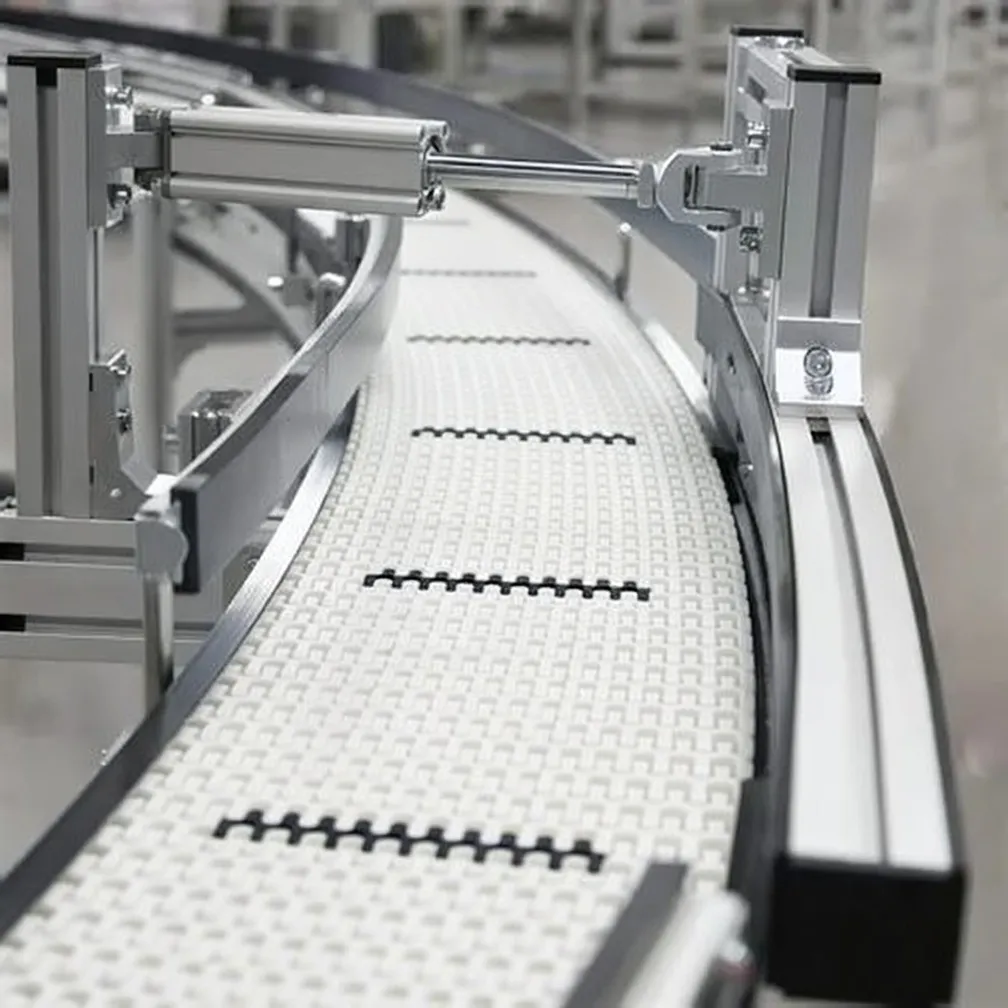 Recycling and waste sorting facilities across the United Kingdom operate under some of the most physically demanding conditions in modern manufacturing. Conveyor systems at these sites face a relentless combination of sharp-edged materials, heavy impact loads, chemical contamination from leachate, and near-constant duty cycles. Traditional fabric or steel mesh belts frequently fail within months under this kind of punishment — and when a conveyor goes down in a material recovery facility (MRF), the cost in lost throughput and maintenance time is significant. That is precisely where a well-engineered plastic modular belt transforms operational reality.
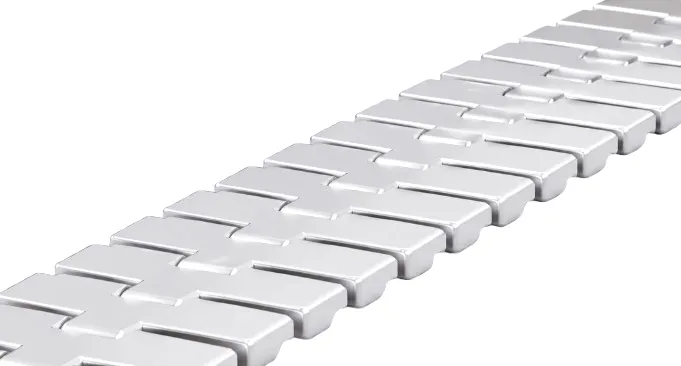
A plastic modular belt is built from interlocking polypropylene, polyethylene, or acetal modules — each click-locked to the next to form a continuous, dimensionally stable conveying surface. Unlike woven belts, individual modules can be replaced in the field without shutting down the entire line. For UK operators running 24/7 sorting operations at sites in the West Midlands, South Yorkshire, or the London logistics corridor, that repairability is worth as much as any technical specification on a datasheet. The modular construction also allows engineers to tune the belt — changing pitch, surface texture, or lateral flex — to match the exact requirements of a given waste stream, whether that is post-consumer mixed plastics, cardboard, glass cullet, or electronic waste (WEEE).
How a Plastic Modular Belt Works in a Recycling Environment
The working principle of a plastic modular belt is rooted in positive mechanical drive. The belt links engage directly with the teeth of a drive sprocket, eliminating belt-to-pulley slip — a persistent problem with flat rubber belts used in high-load recycling applications. This positive engagement means that conveying tension is distributed across the full width of the system rather than concentrated at a central drive point, which dramatically reduces the risk of elongation or catastrophic belt failure when handling unexpectedly dense loads like compacted metal cans or glass aggregate.
Each module is injection-moulded to tight dimensional tolerances and joined to its neighbours using a solid or hollow hinge rod. The rod material — typically stainless steel 304 or 316, or fibreglass-reinforced nylon — is selected based on the corrosive character of the operating environment. In wet-separation lines processing organic waste or paper pulp, stainless hinge rods are standard. The running surface itself can be configured in numerous profiles: a flat closed top for fine material handling, an open-grid format for drainage and liquid separation, or a friction-top texture for inclined conveying of loose or irregular recyclables. These belt configurations are engineered at the module level, meaning they can be specified precisely and reproduced consistently across multiple conveyor lanes at the same facility.
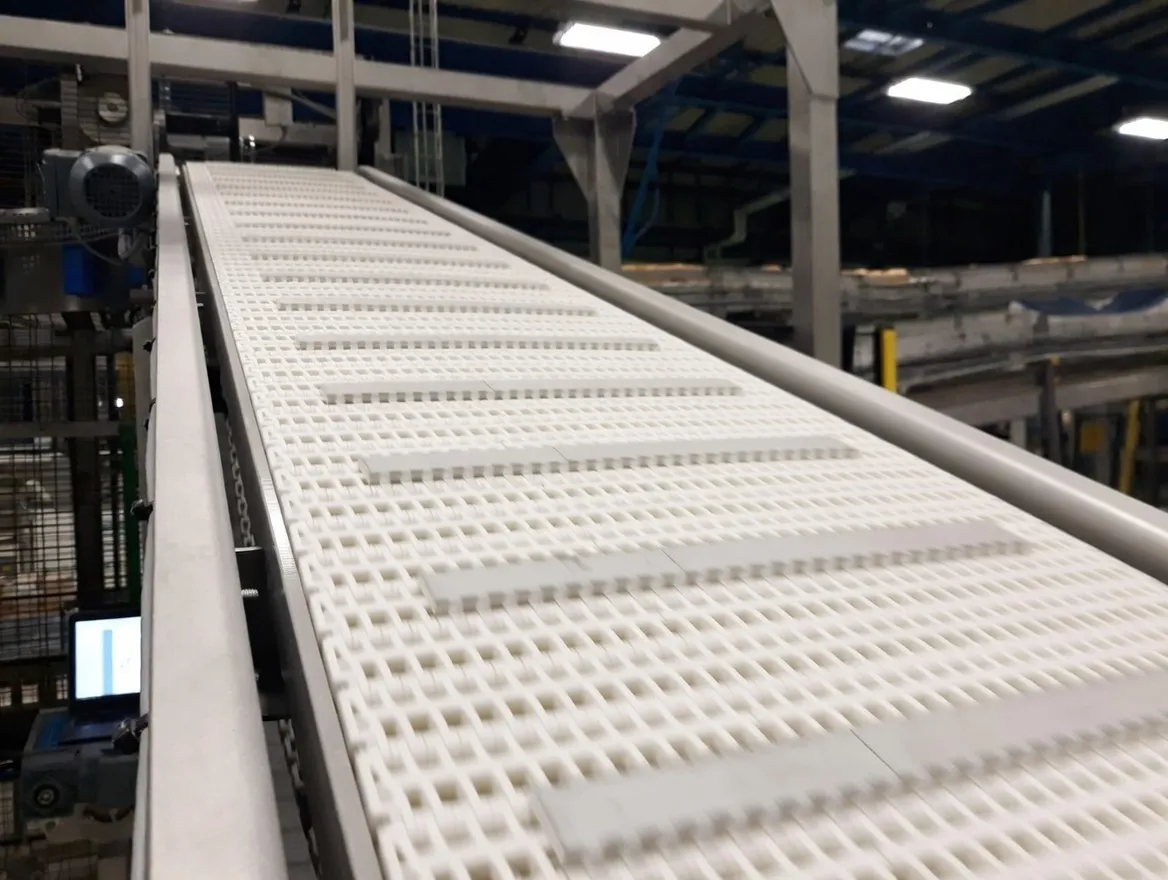
The modular architecture also makes the belt inherently self-tracking. Side-flexing variants — designed for curved conveyor layouts common in space-constrained UK recycling facilities — use a bi-directional hinge geometry that allows controlled lateral movement without the belt drifting off the frame. The result is consistent product positioning through optical sorting equipment, NIR sensors, and air-jet separators, all of which demand highly repeatable belt tracking to function at rated efficiency. This engineering discipline is what separates a purpose-designed plastic modular conveyor belt from a generic substitution.
Core Materials Used in Manufacturing
Material selection for a plastic modular belt destined for recycling duty is one of the most consequential decisions in the procurement process. The polymer matrix determines chemical resistance, working temperature range, wear rate, and long-term dimensional stability — all of which directly affect total cost of ownership over a five-to-ten-year service horizon.
The workhorse material for general-purpose recycling conveyors. PP offers excellent resistance to a wide range of dilute acids and alkalis, a working temperature ceiling of approximately 90°C, and a density low enough to reduce drive motor load on long conveyor runs. Its relatively low cost makes it practical for large-scale MRF installations where belt width exceeds 1.2 metres. PP modular belts are widely deployed on paper and cardboard sorting lines across UK facilities in Nottingham and Manchester.
Acetal homopolymer (polyoxymethylene) is specified when abrasion resistance and dimensional stability take priority over cost. It has a notably low coefficient of friction, reducing wear on hinge rods and wearstrips, and offers superior fatigue life under cyclic loading — critical on high-speed glass cullet lines where impact forces repeat thousands of times per hour. POM belts excel in wet-wash environments and in WEEE processing where sharp PCB edges would rapidly abrade softer polymers.
HDPE brings outstanding chemical resistance — including resistance to bleach, chlorinated solvents, and the leachate compounds found in municipal solid waste streams — combined with good impact toughness at low temperatures. It is frequently chosen for outdoor or semi-open waste-transfer stations where winter temperatures in northern England and Scotland can affect material properties of more brittle polymers. HDPE is also recyclable at end of service life, aligning with the sustainability mandates of many UK waste management operators.
Nylon-based modules are the specification of choice when thermal performance and tensile strength must both be maintained at elevated operating temperatures — such as on post-shredder conveying lines where frictional heat build-up is a factor. PA66 in particular offers excellent wear resistance against abrasive media and is commonly used in metal separation lines, where ferrous and non-ferrous fragments create a highly abrasive conveying surface. The material’s self-lubricating properties reduce maintenance intervals considerably.
Core Technical Advantages Over Conventional Belt Types
Understanding why so many UK waste management operators have moved away from rubber-belted conveyors begins with a clear-eyed comparison of performance across the metrics that matter most at a material recovery facility. The advantages of a properly engineered plastic modular conveyor belt extend far beyond simple material durability.
When a single module is damaged by an oversized contaminant — a piece of rebar, a reinforced concrete fragment, or a glass bottle base — it can be replaced in minutes without removing or splicing the entire belt. This field repairability is transformative for UK operators who run facilities with minimal scheduled downtime windows and cannot afford multi-hour belt changeovers.
Purpose-specified module polymers — particularly acetal and reinforced nylon — resist abrasion from glass, crushed stone, and metal swarf at a rate far superior to rubber-coated or woven fabric belts. In controlled trials at two independent Sheffield-area MRFs, POM plastic modular belts achieved service lives three to four times longer than equivalent rubber belt installations on glass-cullet separation lines.
Unlike rubber belts, plastic modular belt surfaces do not harbour organic material in fabric weave layers. Open-grid variants drain freely; flat-top variants can be pressure-washed without risk of delamination. This washdown compatibility is especially valued at composting and food-waste sorting sites operating under Environment Agency guidelines where contamination control is mandatory.
The leachate and process fluids in municipal solid waste (MSW) environments include acetic acid, hydrogen sulphide compounds, and chlorinated hydrocarbons — all of which aggressively degrade rubber and steel mesh belts within a single season. The right polymer grade in a plastic modular belt selection will resist these compounds over years of continuous service, protecting the asset value of the conveyor infrastructure investment.
From 12.7 mm pitch micro-modules for lightweight plastic flake conveying to 50.8 mm heavy-duty open-grid modules for dense metal scrap, the plastic modular belt system can be engineered at a granular level. Side guards, cleats, flights, and perforated surfaces are all configurable within the same modular system, giving process engineers at UK recycling facilities a single platform that handles multiple material streams.
Lightweight plastic module bodies reduce the return-strand mass of long conveyor runs, directly lowering the required motor drive power. Combined with low-friction wearstrips and precision-moulded sprocket engagement, a well-installed plastic modular conveyor belt system can reduce energy consumption per tonne of material processed by 8–15% compared with legacy steel belt installations — a meaningful reduction for UK operators managing energy costs under current commercial electricity pricing.
Product Technical and Performance Parameter Reference Table
The table below provides a consolidated reference for the key mechanical and material parameters that govern plastic modular belt selection and performance in recycling and waste sorting duty. Values shown reflect the standard range available through Ever Power; specific projects may be engineered outside these ranges upon request.
| Parameter | Standard Range | Heavy-Duty / Custom | Notes |
|---|---|---|---|
| Module Pitch | 12.7 mm – 38.1 mm | 50.8 mm – 101.6 mm | Larger pitch for heavy abrasive loads |
| Belt Width | 200 mm – 1,200 mm | Up to 2,400 mm | Multiple lane configurations available |
| Working Tensile Strength | 320 N – 1,800 N / module row | Up to 3,600 N / module row | PP standard; acetal / PA for HD |
| Max. Conveying Speed | 0.05 m/s – 1.8 m/s | Up to 3.0 m/s (flat top) | Speed limited by hinge wear rate |
| Operating Temperature | -30°C to +90°C (PP) | -40°C to +140°C (PA66) | Polymer grade determines ceiling |
| Hinge Rod Material | PP, Nylon, SS304 | SS316, GRP, Hastelloy | SS316 for corrosive environments |
| Max. Incline Angle | Up to 18° (flat modules) | Up to 45° (cleated / friction-top) | Depends on material and cleat height |
| Lateral Flex Radius | 900 mm – 3,000 mm | Down to 500 mm (special geometry) | Side-flex belt required |
| Surface Open Area | 0% (closed top) – 48% (open grid) | Up to 65% (special grid) | Higher open area aids drainage |
| Belt Mass (empty) | 2.8 kg/m² – 6.5 kg/m² | Up to 11 kg/m² (HD modules) | Lighter mass reduces drive energy |
| Colour Options | Natural, Blue, Green, Black | Custom RAL colours available | Metal-detectable formulations available |
Industrial Application Scenarios in UK Recycling & Waste Processing
The following are real-world application scenarios where plastic modular belts are deployed across the UK’s growing waste processing infrastructure. Each scenario presents distinct engineering requirements, and the modular belt system adapts to all of them within a single product platform.
Material recovery facilities across the West Midlands — including large-scale operations in Birmingham and Coventry — process thousands of tonnes of mixed post-consumer plastics per week. These streams include PET bottles, HDPE containers, polystyrene packaging, and film wrap, all arriving in irregular sizes and heavily contaminated with adhesive labels, food residue, and organic matter. Open-grid plastic modular belts allow fine contaminants to drop through the belt surface before material enters the near-infrared optical sorter, improving identification accuracy by 12–18% versus closed flat-top belts in this application.
Glass recycling represents one of the most abrasive conveying challenges in the waste sector. Crushed glass cullet — the raw material for glass-to-glass or glass-to-aggregate reprocessing — has razor-sharp fracture surfaces that shred rubber belts within weeks. Sheffield and Rotherham are home to several glass reprocessing facilities that have transitioned to acetal plastic modular belts specifically because of their abrasion resistance and their open-grid construction, which allows glass fines and dust to be collected below the belt for secondary processing.
UK WEEE regulations mandate the recovery and correct processing of electrical and electronic waste, a stream that includes everything from printed circuit boards to old washing machine motors. The conveying challenge is significant: PCBs carry sharp solder points and edge-mounted connectors; motors are dense and irregularly shaped. Metal-detectable plastic modular belt formulations — available in standard blue or custom colours — allow downstream metal detectors to identify any fragment of belt material that might contaminate the recovered metal stream, protecting the recovered material value for downstream smelters.
The expansion of kerbside food waste collection across English local authorities — following updated Environment Act obligations — has driven rapid growth in in-vessel composting and anaerobic digestion (AD) facilities. These sites process wet, sticky, and chemically aggressive organic material that rapidly degrades conventional conveyor belts. HDPE plastic modular belts with closed-top modules and integral cleats are used on the intake sorting conveyors, providing the combination of wash-down compatibility, chemical resistance to organic acids, and cleat-assisted inclined conveying needed to handle material arriving from collection vehicles.
Steel and aluminium scrap yards in industrial heartlands such as Teesside, South Wales, and the Midlands rely on conveyors to transport shredded metal fragments between shredder outlet, magnetic separation, and baling stages. The combination of high point loads from shredded steel fragments, eddy-current separator proximity requirements (non-magnetic belt material is essential), and continuous washdown from cooling water makes the plastic modular belt a purpose-fit solution. Non-magnetic polymer modules allow overhead eddy-current separators to operate without interference, directly improving non-ferrous metal recovery rates from the shredder fraction.
C&D waste includes rubble, timber, plasterboard, insulation, and mixed materials at extremely high bulk densities. Transfer stations in areas of high construction activity — London’s outer boroughs, Manchester’s regeneration zones, and Bristol’s expanding development perimeter — use heavy-duty plastic modular conveyor belts with 50.8 mm pitch modules in acetal or glass-fibre-reinforced nylon on the primary sorting tables. These belts sustain the high impact energies of falling rubble while remaining dimensionally stable enough to support manual pickers working directly above the belt surface.
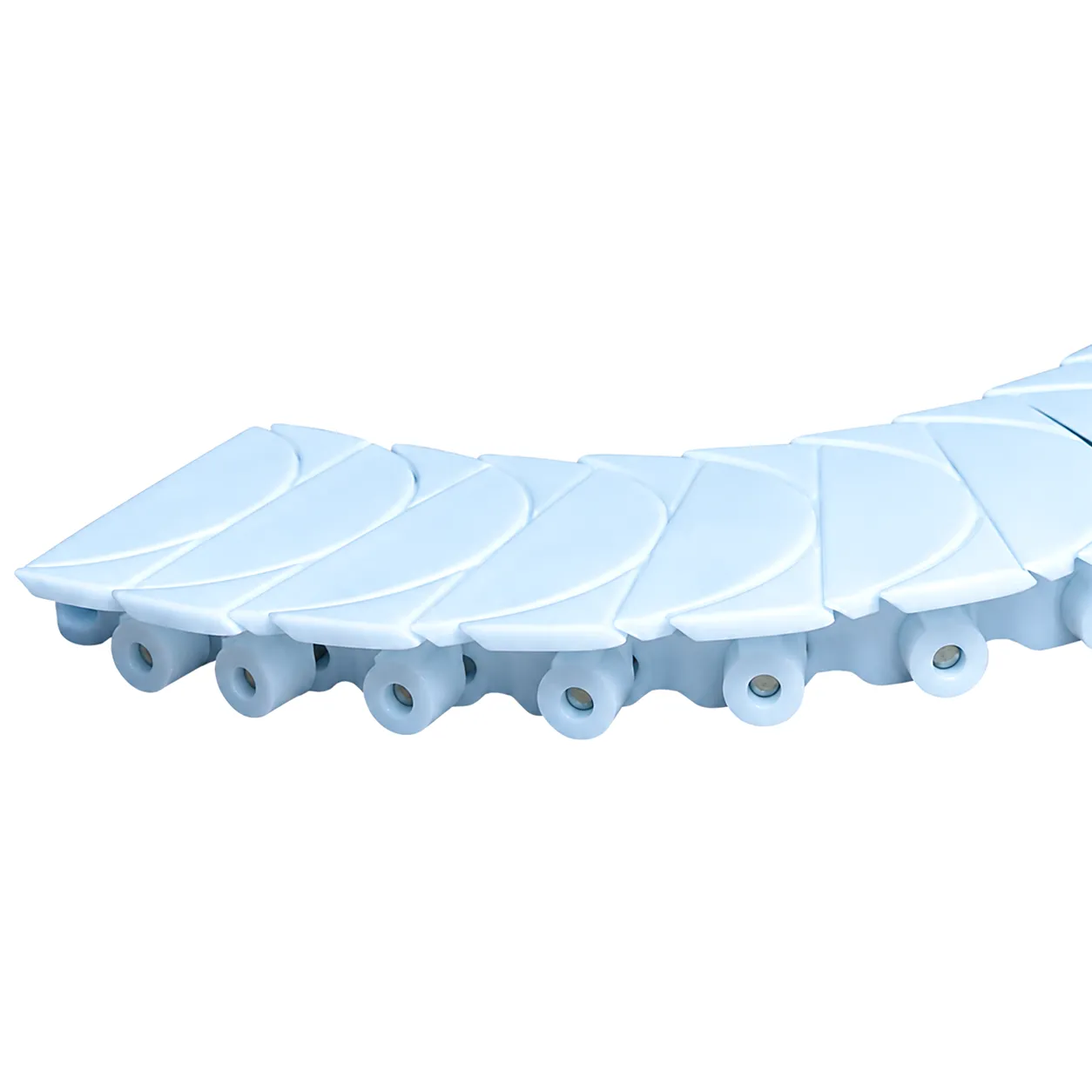
Heavy Duty Grid Straight Run Conveyor Belt
Engineered for the most demanding recycling applications — open-grid construction provides maximum drainage and separation efficiency, while heavy-duty module geometry withstands the impact loads of glass, metal scrap, and C&D rubble. Available in multiple pitches and widths for MRF and scrap yard installations.
Ever Power: Precision Manufacturing and Customisation Capability
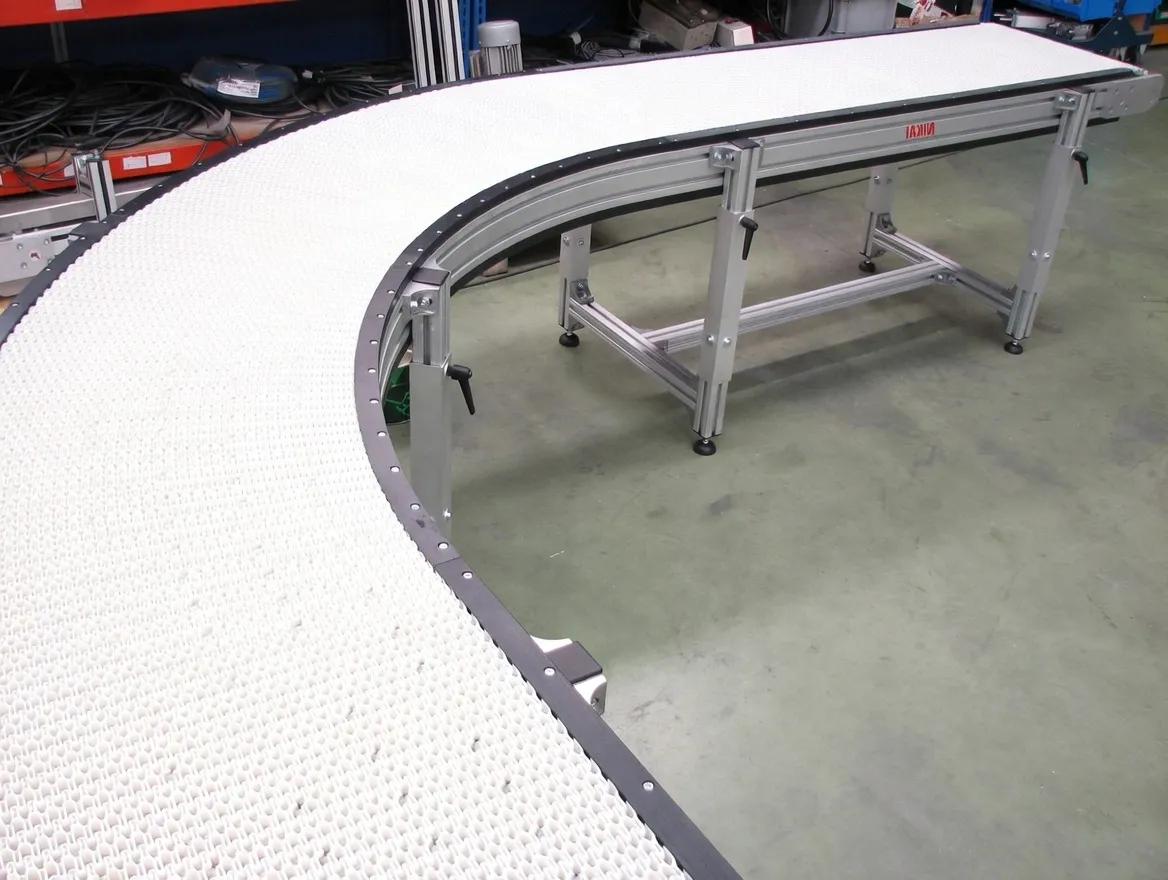
Ever Power operates a large-scale, purpose-built injection moulding facility with over 120 production machines dedicated to plastic modular belt and conveyor components. The factory’s quality management system is certified to ISO 9001, and our engineering team maintains a dedicated tooling and die shop capable of producing bespoke module geometries within typical lead times of three to six weeks for first-article samples. This internal tooling capability is one of the most important factors in our ability to deliver genuinely customised solutions — we are not reliant on third-party toolmakers or off-the-shelf module designs when a customer’s application calls for something outside the standard catalogue.
Our customisation capabilities extend to module pitch, surface profile, open area percentage, cleat and flight geometry, side guard integration, and polymer compound specification. For UK waste sector clients requiring metal-detectable belt materials in compliance with their quality programmes, or FDA/EC food-grade compounds for sites handling organic fractions alongside food contact materials, Ever Power can compound and mould to those specifications within the standard production schedule. Our minimum order quantities are structured to suit both large MRF operators replacing hundreds of square metres of belt and smaller specialist processors ordering replacement sections for a single conveyor lane.
Supply chain reliability is a subject that UK procurement managers have scrutinised closely since the supply disruptions of the early 2020s. Ever Power maintains strategic finished belt inventory and raw material stock sufficient to support rapid-response orders for commonly specified configurations. For critical conveyor lines where unplanned downtime carries a high cost — particularly on 24/7 operation sites — we offer agreed stock-holding programmes that place pre-built belt modules in our UK-accessible logistics network, available for next-working-day despatch. Our technical support team includes engineers with direct MRF and waste processing experience who can visit sites across England, Scotland, and Wales for installation advice, tensioning setup, and scheduled inspection.
Flat Top Straight Run Belt with Side Guards
Ideal for sorting table applications, manual picking stations, and contained conveying of loose lightweight fractions. Integral moulded side guards prevent material rollover on inclined sections and act as a guide for material positioning under optical sorters. Available in PP, HDPE, and acetal with custom guard heights.
Customer Success Story: Leeds Material Recovery Facility
 A large-scale materials recovery facility operated by a leading UK waste management contractor in Leeds, West Yorkshire, reached a critical point in its conveyor system lifecycle in late 2023. The facility processes approximately 85,000 tonnes of mixed recyclables per year across eight sorting lines, handling glass, plastics, cardboard, and aluminium cans from kerbside collections across the metropolitan district. Five of the eight sorting line conveyors — all running rubber belting from a traditional domestic supplier — had reached the end of their serviceable life simultaneously, with evidence of significant delamination on the drive-end pulleys, widespread longitudinal cracking from exposure to cleaning agents, and recurring belt-tracking failures that required manual readjustment two to three times per shift.
The facility’s engineering manager contacted Ever Power following a recommendation from a West Midlands MRF that had completed a similar conversion eighteen months earlier. The brief was specific: five conveyor lanes, three running mixed plastics and paper at 1.0 m/s, two running glass cullet at 0.6 m/s, all belts 900 mm wide. The site required belts that could be installed during planned maintenance windows without requiring frame modifications. Ever Power’s engineering team conducted a remote technical review followed by a site visit to confirm frame geometry, take wearstrip profiles, and assess the existing sprocket configuration for compatibility.
The solution specified PP open-grid modular belts in 25.4 mm pitch for the mixed recyclables lines and acetal open-grid in 38.1 mm pitch for the glass cullet conveyors, with SS316 hinge rods throughout. All five belts were delivered in fabricated-to-length rolls within four weeks of order placement. Installation was completed by the facility’s own maintenance team using guidance documentation and a pre-installation remote call with an Ever Power application engineer. Since commissioning in early 2024, none of the five belts has required unplanned maintenance attention. The facility has reported a 22% reduction in conveyor-related downtime across the converted lines compared to the same period in the previous year, and the two glass cullet belts in particular have already exceeded the full service life of the rubber belts they replaced — with no sign of abrasive degradation to the module bodies.
“We had real doubts going into this project about whether modular plastic belts could hold up on our glass cullet line — glass destroys everything eventually. Fourteen months on, the Ever Power acetal belts look almost the same as the day they went in. The hinge rods show minimal wear and we haven’t had a single unplanned stop on those lanes. The decision paid for itself in about eight months.”
“What impressed us most about Ever Power wasn’t just the product — it was the technical support during the specification stage. Their engineer knew what questions to ask about our NIR sorter clearances and our washdown pressure regime before recommending the right module pitch and surface format. That kind of application knowledge is rare from a supplier at this price point. The installation guidance was detailed and accurate — our team completed all five lanes over a single weekend.”
“We’re now rolling the Ever Power plastic modular belt specification out across two of our other sites in Yorkshire. The lead time was within what they quoted, the custom lengths were accurate, and the SS316 hinge rods are exactly what we needed for our washdown process. Compared to what we spent on emergency belt repairs in the previous two years, the maintenance saving alone justifies the change. We’d recommend Ever Power to any MRF operator still running rubber belts on abrasive fractions.”
Frequently Asked Questions
How much does a plastic modular belt cost for a UK recycling facility, and can I get a competitive price quote from a supplier like Ever Power?
Which type of plastic modular belt is best suited for glass cullet sorting lines in Sheffield or Rotherham recycling plants?
How long does a plastic modular conveyor belt typically last in a Birmingham MRF handling mixed post-consumer recyclables?
What is the lead time when ordering a custom plastic modular belt from a supplier for a waste sorting facility in the UK?
Where can I find a reliable supplier of metal-detectable plastic modular belts for WEEE processing plants operating across England?
How do I calculate the correct belt width and module pitch for a food waste composting conveyor at a UK anaerobic digestion plant?
Which plastic modular belt surface profile is most effective for inclined conveying of loose C&D waste at a Manchester transfer station?
Share your conveyor dimensions, application details, and material stream with our engineering team. We’ll come back with a technically detailed specification and a transparent price from Ever Power — the modular belt manufacturer that UK recycling operators trust.
edit by gzl