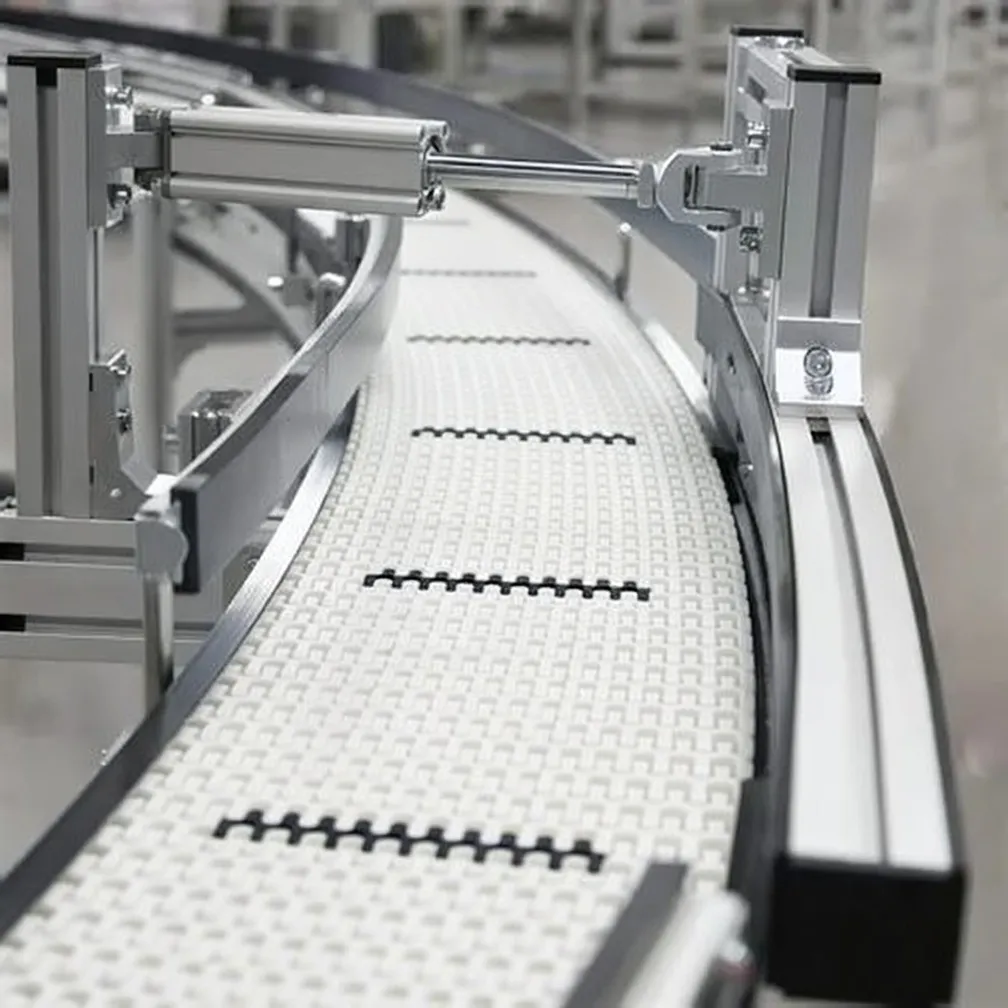
 Across food processing plants in the West Midlands, automotive assembly lines in Birmingham, and pharmaceutical packaging facilities in the East Midlands, conveyor chain selection has never been a minor decision. The wrong chain in a curved transfer section can mean persistent product jams, unplanned downtime, and accelerated wear that drains maintenance budgets faster than most plant engineers anticipate. Two technologies dominate the plastic modular belt market for side-flexing applications: standard thermoplastic modular chains and magnetic-variant modular side-flexing chains. Each technology carries a distinct mechanical logic, a different cost profile, and a narrow range of applications where it genuinely outperforms the other. Understanding those boundaries — precisely — is how production engineers avoid costly retrofits.
Working Principles: Two Fundamentally Different Approaches to Curved Conveying
Standard Plastic Modular Side-Flexing Chain
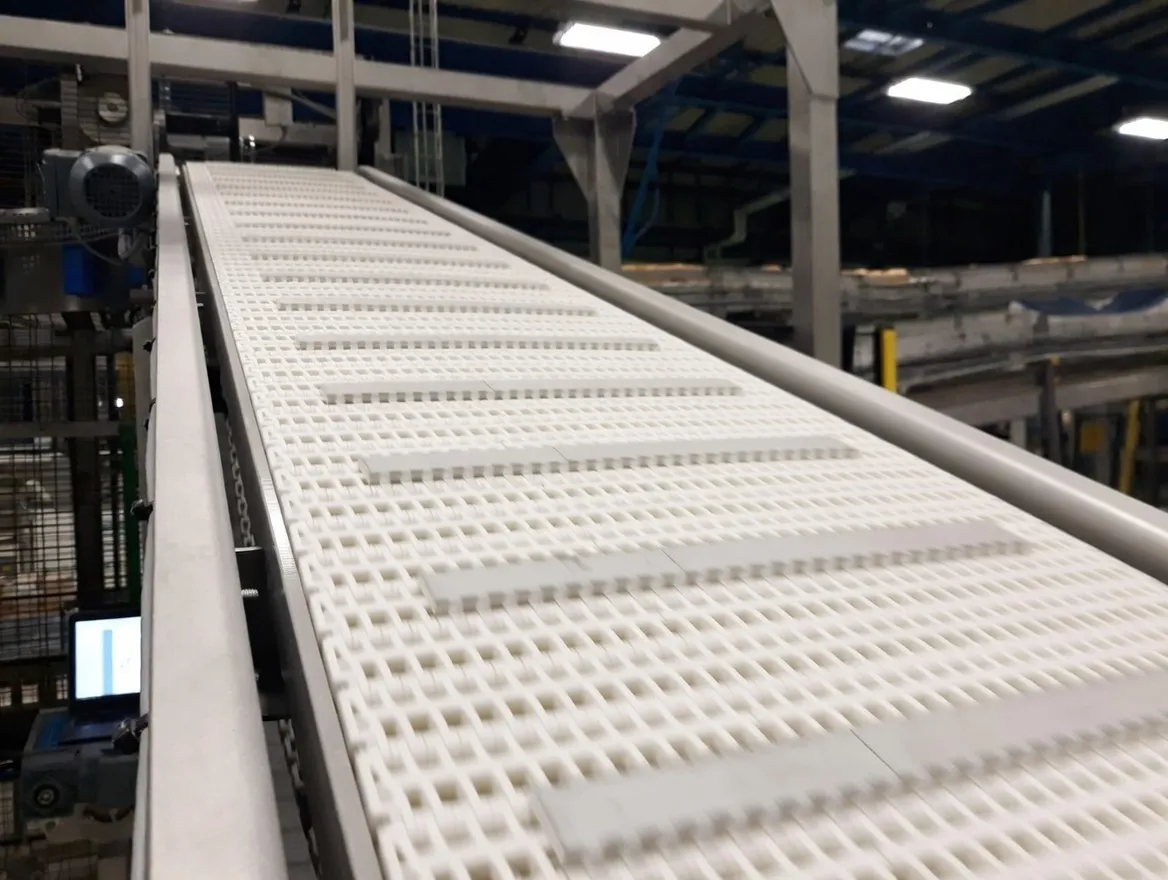
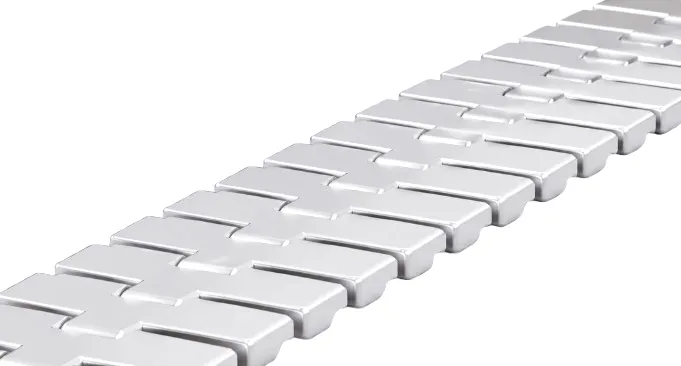
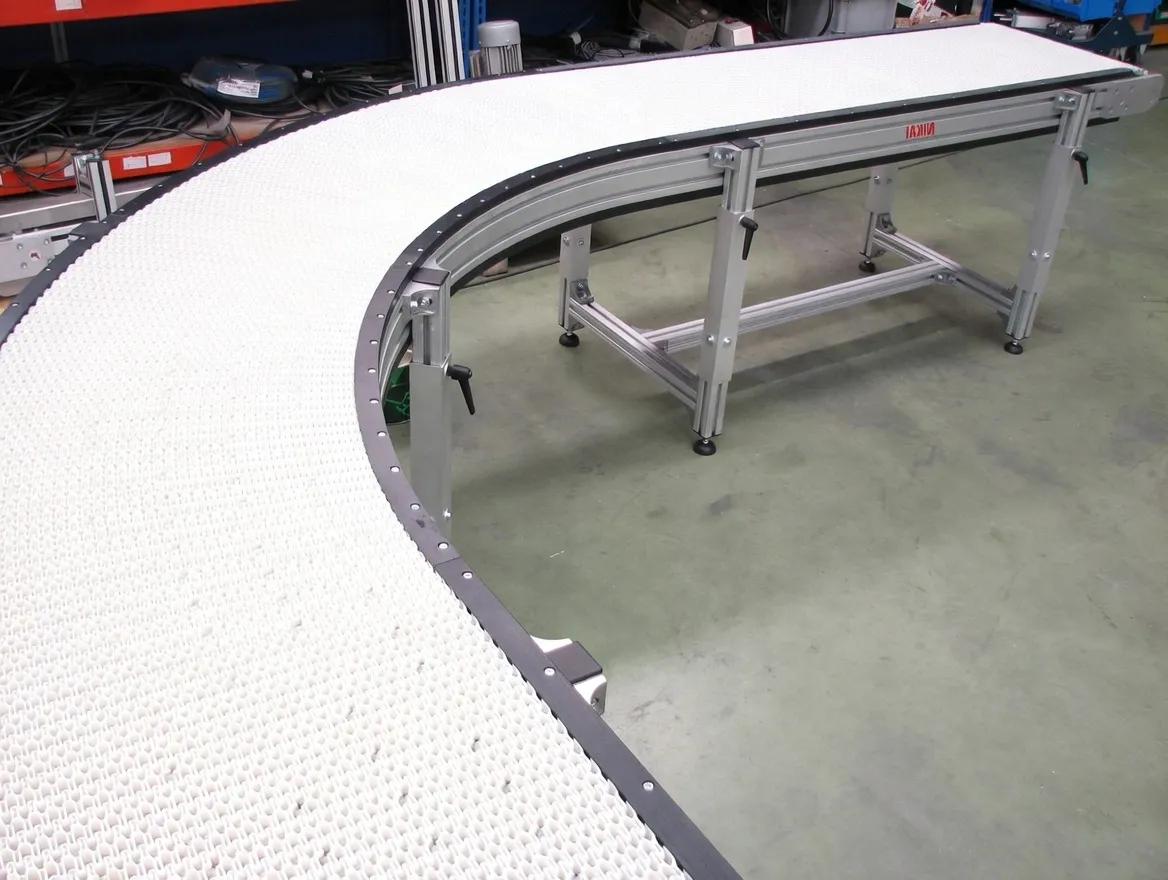
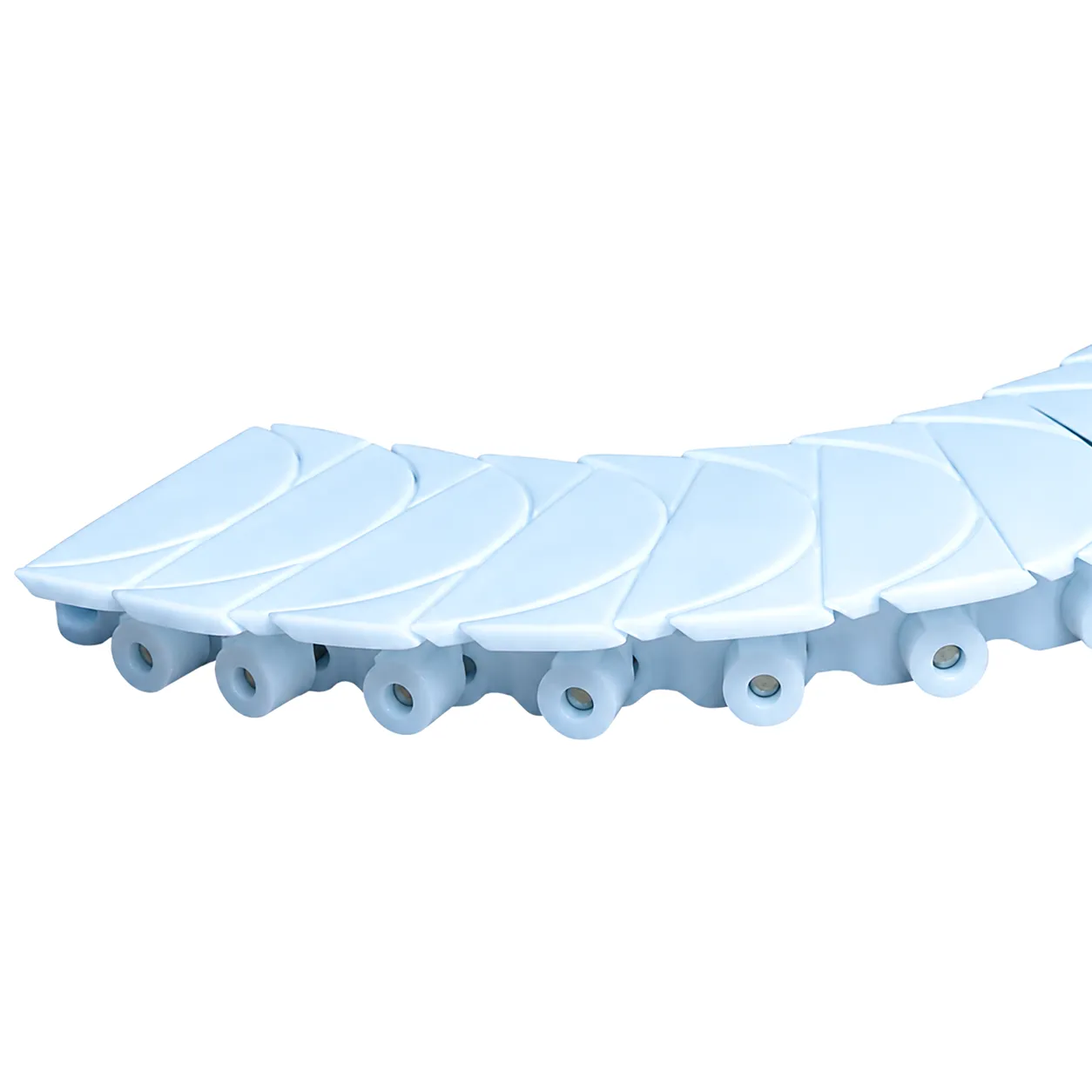
Standard plastic modular side-flexing chains navigate curves through a purely mechanical geometry. Each module is moulded with tapered lateral flanges — wider at one edge, narrower at the other — so when the chain enters a curve, the modules fan outward on the outer radius while compressing on the inner. The pivot pins connecting individual modules allow a controlled angular deviation, typically between 10° and 30° per metre of chain length depending on the pitch and module width. No external energy source or special sprocket engagement is required: the chain follows the curve as a direct consequence of its moulded geometry.
Drive force is transmitted through friction between the chain underside and the wear strips, combined with direct sprocket tooth engagement at the drive and return stations. This arrangement is straightforward to install and maintain. A trained conveyor technician in Birmingham or Leeds can reconfigure a standard modular side-flexing line in a few hours using basic tools — no specialist equipment needed. The technology is mature, well-understood, and available in a broad range of materials suitable for food-grade, corrosive, and high-temperature environments.
Magnetic Plastic Modular Side-Flexing Chain
Magnetic modular side-flexing chains embed rare-earth or ferrite magnets directly within the thermoplastic module body, or attach them to a stainless steel insert that is moulded into the module. These magnets generate a persistent, low-profile magnetic field directly at the belt surface. When the chain runs over a steel wear plate or a magnetic bedplate, the belt holds itself against the surface with a defined, measurable clamping force — typically expressed in Newtons per module. This clamping action is what allows magnetic chains to transport ferrous workpieces, hold parts through inverted sections, and keep products stable during aggressive acceleration and deceleration cycles.
The side-flexing geometry in a magnetic chain uses the same tapered-module principle as the standard variant, but the engineering challenge is considerably greater: the magnets must retain their field strength across the entire operational temperature range, and the moulding process must prevent stress fractures around the insert pocket that could cause magnet ejection over time. Premium magnetic modular chains — such as those manufactured by Ever Power — undergo independent pull-force testing at the module level before any chain is assembled, ensuring consistent clamping performance across the belt width and along its full running length.
Core Materials: What Each Chain Is Actually Made Of
Polypropylene (PP)
The default material for general-purpose modular side-flexing chains in ambient or moderately warm environments. PP offers excellent chemical resistance to mild acids, alkalis, and cleaning detergents — a critical requirement for food production lines in Yorkshire and the East of England where multi-shift hygiene washdowns are standard. Its density of approximately 0.91 g/cm³ keeps the chain lightweight, reducing motor load on long curved conveyor sections. Operating range typically sits between -10°C and +100°C.
Acetal (POM)
Polyoxymethylene is specified when low friction and dimensional stability are priorities. POM modules exhibit a coefficient of friction against stainless steel of approximately 0.15–0.20, significantly lower than PP’s 0.25–0.35, which translates directly into reduced drive power requirements and less wear strip replacement in high-duty cycling applications. Automotive component transfer lines in the West Midlands frequently specify POM side-flexing chains precisely because the materials handle dimensional tolerances far better than commodity thermoplastics across temperature fluctuations from cold-store to production hall environments.
HDPE & Nylon PA
High-density polyethylene is the go-to choice for chains that must handle wet, fatty, or detergent-intensive environments without absorbing moisture into the module body. Nylon (PA6 or PA66), by contrast, is selected when elevated operating temperatures up to 120°C and higher tensile strength are required. In Sheffield’s steel processing satellite industries, where coolant spray and metal swarf are environmental realities, HDPE side-flexing chains outperform standard PP over medium to long service intervals because they resist crazing and maintain module geometry under sustained mechanical load.
Magnet Inserts: Rare Earth vs Ferrite
In magnetic modular chains, the magnet material determines the clamping performance envelope. Neodymium (NdFeB) rare-earth magnets deliver clamping forces of 8–20 N per module in a compact geometry, making them suitable for high-speed inverted transport or thin ferrous sheet handling. Ferrite magnets offer a lower pull force (3–8 N per module) but exhibit far superior thermal stability above 80°C and cost significantly less. Ever Power’s engineering team works with clients to select the magnet grade precisely matched to their product weight, line speed, curve radius, and ambient temperature — avoiding both under-specification and unnecessary cost.
Product Technical and Performance Specifications
Key engineering parameters for standard and magnetic plastic modular side-flexing chains
Core Technical Advantages: Standard vs Magnetic
Standard Chain: Where It Excels
The breadth of material choices in standard plastic modular side-flexing chains is unmatched. A food factory in Lincoln can run an FDA-compliant PP chain on the primary sort curve and switch to POM on the high-speed downstream merge without changing any frame or sprocket hardware. This material interchangeability eliminates the costly redesign cycles that magnetic chain upgrades typically require. In addition, standard chains carry a significantly higher tensile load ceiling for a given belt width, which is why they remain the dominant choice for heavy-carton accumulation curves in distribution centres across the Midlands and the North of England.
Long-term total cost of ownership strongly favours the standard side-flexing chain in applications where the magnetic functionality is not needed. Spare module availability, simplified maintenance scheduling, and lower energy draw on the drive motor all contribute to a favourable operating cost profile over five-year assessment periods. Ever Power’s standard side-flexing range, including the popular Heavy Duty Grid Straight Run Conveyor Belt, demonstrates how flexibility in belt selection can serve broad industrial need across the UK.
Magnetic Chain: Capabilities That Standard Cannot Match
The defining capability of magnetic side-flexing chain is product stabilisation without external fixturing. Consider a steel can line in a Sheffield food manufacturer that needs to navigate a 90-degree overhead curve before entering a labelling station: a standard chain requires guide rails, pusher devices, or vacuum assistance to prevent toppling. A magnetic chain holds the cans against the belt surface purely through field attraction, eliminating all that auxiliary hardware. This simplification is not just an engineering elegance — it translates directly into fewer breakdown points, shorter changeover time, and reduced capital expenditure on guide systems.
Magnetic chains also make it possible to transport ferrous workpieces through inverted conveyor sections — something physically impossible with standard side-flexing chain. In automated engine component assembly in Birmingham, crankshaft blanks can be conveyed upside-down through a rinse tunnel on a magnetic chain, then righted at a downstream station without any manual intervention. The productivity gains in high-volume production environments can justify the higher unit cost of magnetic chain in fewer than twelve months of operation. Ever Power engineers these transitions as turnkey configurations, modelling the exact pull force per module needed to handle the product weight safely at the specified curve radius and belt speed.
Industrial Application Scenarios: Where Each Chain Belongs
Food and Beverage Processing — Standard Side-Flexing Chain
Across UK poultry processing facilities in Norfolk and Lincolnshire, standard plastic modular side-flexing chains handle the primary conveying duties: routing product from processing through chilling tunnels, across 45-degree curve merges before weighing stations, and into packaging lines. The FDA-compliant PP module material, combined with the open-grid or flush-grid surface option, allows effective high-pressure washdown between shifts without moisture entrapment in hollow module bodies. The side-flexing geometry reduces the number of required transfer points compared to straight-run chain systems, cutting product damage incidents at transfers by up to 30% in measured site trials. Standard chains are also available with integrated side guards — as seen in the Flat Top Straight Run Belt with Side Guards — to prevent product migration over the belt edge during curved sections at moderate line speeds.
Automotive Component Handling — Magnetic Side-Flexing Chain
Manufacturing plants in Coventry and Sunderland handling stamped steel brackets, door hinges, and pressed body components represent a primary use case for magnetic side-flexing chain. These parts are ferrous, relatively light (typically 0.2–2.5 kg each), and need to navigate tight curve sections between forming press and quality inspection without repositioning. Magnetic chains eliminate the lateral guide rails that previously required manual cleaning and periodic adjustment, and the clamping force holds components flat against the belt surface even when the line accelerates sharply from a stop. Ever Power’s engineering team configures these lines with NdFeB module inserts at a pull force calculated to hold the heaviest part in the product family at the tightest curve radius on the line, ensuring that lighter parts are never dislodged while heavier ones are never strained against the magnet retention capacity.
Pharmaceutical Packaging Lines — Standard POM Side-Flexing Chain
Pharmaceutical packaging facilities in Macclesfield and Harlow run some of the most demanding conveyor hygiene regimes in British industry. Standard POM side-flexing chains are specified for these environments because POM is non-porous, easy to visually inspect for contamination, and dimensionally stable across the temperature swings between isolator cleaning and ambient production conditions. The low friction coefficient of POM against stainless steel wear strips reduces particle generation compared to PP — a meaningful consideration in cleanroom-adjacent conveyor sections where airborne particulate must be minimised. Validation documentation for the chain material batch, including extraction test results, is routinely supplied by Ever Power to satisfy the regulatory burden on UK pharmaceutical manufacturers operating under MHRA site inspection criteria.
E-commerce Distribution Centres — Standard Side-Flexing, High-Speed Configuration
Mega-distribution facilities in Daventry, Doncaster, and Peterborough demand conveyor chains that can sustain continuous operation at 50–60 m/min across complex multi-level sort systems with tight curve sections between chutes. Standard side-flexing chains in 25.4 mm pitch POM excel here: they run fast, they run cool, they tolerate the inevitable polybag, tote, and carton mix without surface damage or contamination issues. The key engineering consideration at these speeds is chain tension management: poorly sized side-flexing chains will migrate laterally on the wear strip under high centrifugal load. Ever Power designs the full conveyor run with tension calculations for each curve section, pre-specifying the correct drive and take-up arrangement to keep lateral migration within the 3 mm tolerance that prevents module edge wear on the drive sprocket flanges.
Ever Power: Manufacturing Depth and Customisation Capability
Precision manufacturing for demanding UK industrial applications
Precision Moulding Facility
Ever Power operates CNC-managed injection moulding lines with cavity tolerances held to ±0.05 mm on module pivot bore diameter, ensuring consistent pin engagement across the full belt width. Every module batch undergoes dimensional sampling to ISO 9001:2015 quality protocols, with records retained for traceability over a minimum ten-year period — a requirement that UK automotive and pharmaceutical clients frequently mandate in their supplier qualification processes.
Custom Geometry on Demand
Non-standard pitch configurations, custom module widths, combined straight-run and side-flexing modules within a single belt run, and proprietary surface textures (such as friction-enhancing inserts or anti-static coatings) are all available as engineered-to-order products from Ever Power. UK OEM conveyor builders regularly use Ever Power’s custom tooling service to produce branded modules that interlock with their existing frame hardware, reducing the supply chain to a single point of contact for the full belt assembly.
Supply Chain Reliability for UK Buyers
Ever Power holds bonded inventory of high-runner module configurations in a European transit warehouse, enabling ex-works dispatch within 48 hours for standard items. For UK importers working with freight forwarders through Felixstowe, Southampton, or Tilbury, Ever Power’s logistics team prepares full documentation sets (commercial invoice, packing list, material certificates, CE declarations where applicable) as standard — reducing customs clearance time and ensuring goods arrive on schedule even when urgent plant maintenance situations drive unplanned demand.
Customer Success: Midlands Automotive Stamping Plant, Coventry
 A Tier-2 automotive stamping facility near Coventry supplying pressed steel brackets and reinforcement panels to a major OEM bodyshop contacted Ever Power after persistent problems with their existing conveyor system on the post-press transfer line. The original installation used a straight-run modular belt combined with fixed guide rails to route steel brackets through a 90-degree overhead curve and then inverted down into a rinse tunnel. Two problems had become chronic: the guide rails caused surface scuffing on cosmetically sensitive brackets that the OEM’s inspection regime was increasingly flagging, and the overhead transfer section required a manual assist device that added one headcount to each shift purely to prevent product jams.
Ever Power’s application engineering team visited the site, measured the bracket dimensions and weights (ranging from 0.35 kg to 1.8 kg depending on part variant), surveyed the existing frame geometry, and designed a drop-in replacement belt running Ever Power’s 38.1 mm pitch magnetic side-flexing chain with NdFeB inserts calibrated to deliver 12 N of clamping force per module — sufficient to hold the heaviest bracket through the inverted tunnel section at the 35 m/min production line speed without exceeding the motor specification already in place. The guide rail system was completely removed, and the manual assist device position was reallocated to a quality inspection role.
Following the retrofit, bracket surface scuff rejection rates fell by 87% in the first measurement period. Line availability on the affected section improved from 91.3% to 97.6% over the subsequent quarter, as the primary cause of unplanned downtime — product jams at the guide rail transitions — was eliminated. The complete project, from initial contact to belt commissioning, was delivered in eleven weeks, meeting the plant’s requirement to complete the work within their scheduled maintenance window.
“The pull-force data Ever Power provided before we signed off on the specification was exactly what our engineering team needed to get internal approval. The chain performs precisely as modelled — zero migration through the overhead section at the speeds we run. We’ve had zero unplanned stops on that section in four months of production.”
— Maintenance Engineering Manager, Tier-2 Automotive, Coventry
“We’ve been sourcing standard side-flexing chain from Ever Power for our food processing lines in Yorkshire for three years. The POM modules have outlasted the previous supplier’s equivalent by about 40% in hours run, and the documentation pack for our BRC audit is always complete and on time. Very reliable supply chain partner.”
— Operations Director, Food Packaging Manufacturer, Yorkshire
“We needed a custom width magnetic chain with a non-standard pitch that no UK distributor could supply from stock. Ever Power came back with a confirmed lead time and a sample within six weeks. The customisation capability is genuinely better than anything else we’ve found at this price point. The custom belt has been running in our Sheffield plant for eight months without issue.”
— Conveyor Systems Engineer, Metal Components Manufacturer, Sheffield
Frequently Asked Questions
Answers to the questions UK procurement engineers and plant managers most commonly ask
Ready to Specify the Right Side-Flexing Chain for Your Line?
Ever Power’s engineering team is ready to review your application, recommend the correct chain type, and provide a competitive UK-delivered price. Contact us today.
✉ Email Ever Power: [email protected]
edit by gzl