
 Getting the belt width and load capacity wrong at the specification stage is one of the most expensive mistakes a plant engineer can make. A belt that is too narrow creates product spillage and safety hazards; one that is over-specified drives up capital expenditure and running costs needlessly. In UK manufacturing environments — where floor space is often constrained, throughput targets are non-negotiable, and downtime is measured in tens of thousands of pounds per hour — the engineering precision applied at the selection stage pays dividends throughout the conveyor’s entire operational life. Plastic modular belt conveyors have become the preferred solution across food processing in Yorkshire, pharmaceutical packaging in the East Midlands, and automotive assembly in Birmingham’s supply chain network, precisely because they offer a combination of dimensional flexibility, load-bearing consistency, and hygienic maintainability that no woven fabric belt can match.
The calculation process is not guesswork. It involves a structured evaluation of product geometry, mass distribution, conveyor geometry, belt material properties, and the service environment — all of which feed into a dimensional specification that must then be cross-referenced against the structural limits of the modular belt system. This guide walks through every layer of that process, providing practical formulae and real-world context drawn from Ever Power’s engineering experience supplying plastic modular belts to UK-based manufacturers and integrators.
Why Belt Width Is the Foundation of Every Load Calculation
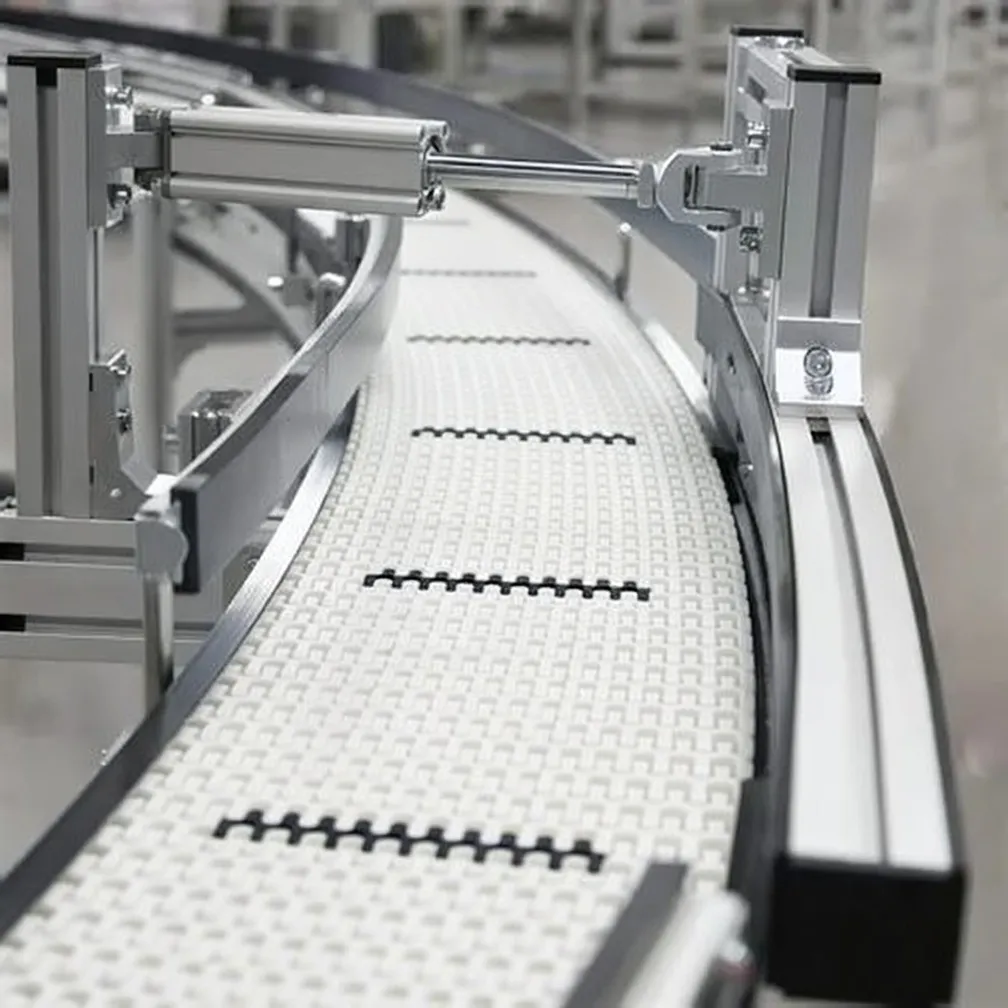 Belt width is not simply the measurement across a conveyor frame — it is the primary constraint from which all other performance variables flow. The effective carrying width of a plastic modular belt is typically 10 to 25 mm less than the nominal frame width on each side, because the module interlocks, guide rails, and side-wear protection consume physical space. This effective width determines how product can be arranged across the belt surface, which in turn determines the maximum load that the belt needs to support at any given moment.
For a standard straight-run plastic modular belt installation in a Birmingham automotive component facility, the calculation begins with the largest product footprint — typically the widest component — and adds a clearance allowance of 50 to 75 mm on each side to prevent product fouling on the guide structure. This minimum clearance is essential in environments where vibration or acceleration forces might cause lateral product shift. Adding the two clearances to the maximum product width, then rounding up to the nearest standard modular width increment (commonly 100 mm or 152 mm for metric and imperial-compatible systems), gives the minimum acceptable belt width for single-lane transport. Multi-lane configurations multiply this base figure by the number of lanes and add inter-lane separators, which typically consume between 30 and 50 mm each.
+ Lane Separators x Separator Width (mm)
Round up to nearest standard increment
Example: Products 380 mm wide, 60 mm clearance each side, single lane. Minimum belt width = 380 + 120 = 500 mm. Standard increment → 508 mm (20-inch) or 600 mm wide belt. Always select upward.
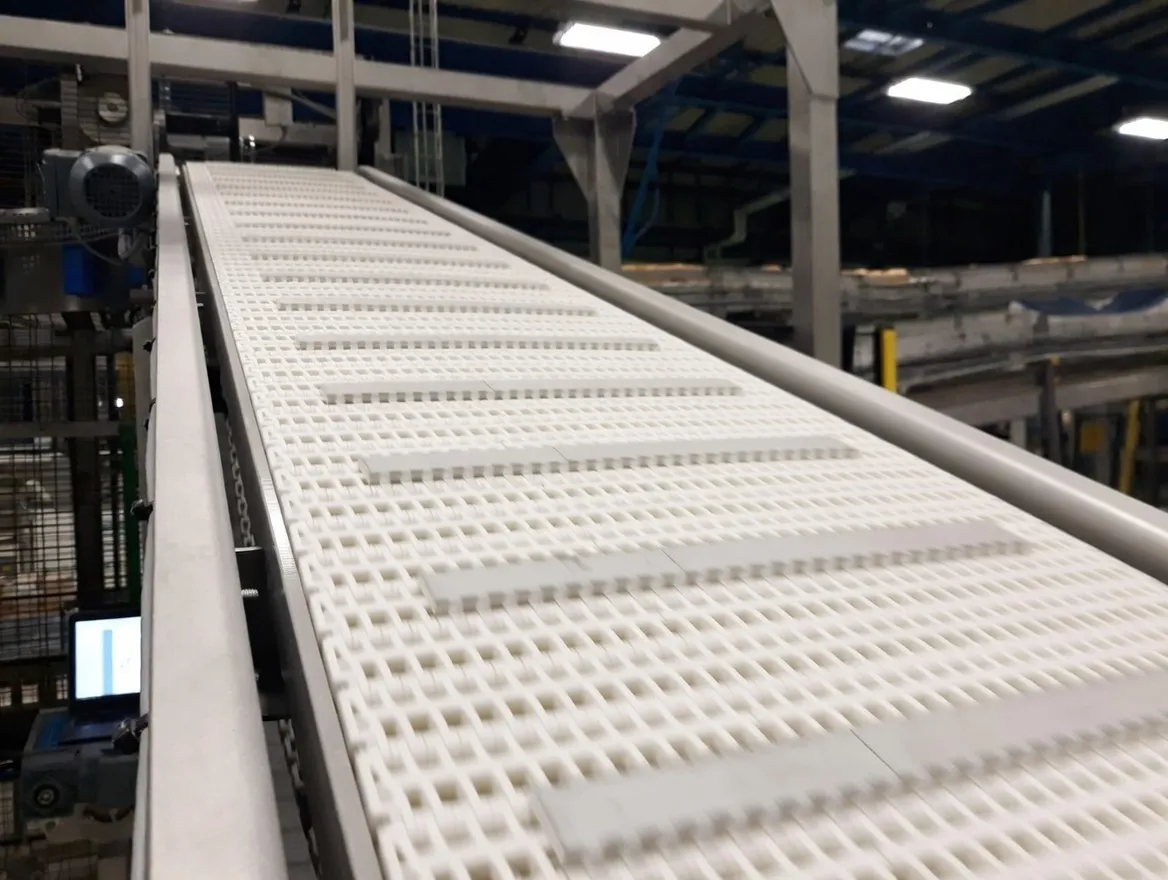
Heavy Duty Grid Straight Run Conveyor Belt
Engineered for high-load straight-run applications, this plastic modular belt features an open-grid design that reduces belt weight while maintaining exceptional structural rigidity. Available in multiple widths and compatible with standard UK conveyor frames — ideal for Sheffield steel processing, Birmingham automotive, and food processing lines across the North West.
Understanding Load Capacity: The Three Forces That Govern Your Plastic Modular Belt
Load capacity in a plastic modular belt system is governed by three distinct force categories, and an accurate specification must account for all of them. The first is static load — the weight of product resting on the belt at any point in the conveyor’s cycle. The second is dynamic load, which includes impact forces at loading stations and acceleration/deceleration stresses at start-up and stopping. The third is cumulative tension load — the longitudinal pull that accumulates along the belt’s return path and drive system, which increases with conveyor length and gradient. Ignoring any one of these three force categories leads to premature module cracking, hinge pin wear, or drive sprocket damage, all of which generate unplanned downtime costs that dwarf the original savings from under-specifying the system.
Static load per unit width is expressed in kg per metre of belt width (kg/m) and is the most straightforward to calculate: divide the maximum product weight at the densest point of loading by the belt width in metres. For a food processing line in Leeds handling canned goods at 2.4 kg per can with 12 cans per row across a 900 mm belt, the static load per metre width equals (2.4 x 12) / 0.9, giving 32 kg/m. This figure must sit well within the rated working load of the selected plastic modular belt module — typically with a safety factor of at least 2.5 applied in food and pharmaceutical environments governed by UK HSE guidance.
Weight of product on belt at maximum density. Calculated as total product weight divided by the effective carrying area (belt width x pitch length). Must include packaging, pallets, or trays.
Impact and inertial forces. Apply a dynamic factor of 1.25 for gentle loading, 1.75 for drop-zone impact loading. Relevant at infeed from overhead chutes common in Sheffield packaging lines.
Longitudinal belt tension from drive pull, friction, incline angle, and return-side weight. Critical for conveyors over 10 m in length or gradients exceeding 5 degrees — common in multi-level automotive plants.
Material Selection and Its Direct Impact on Rated Load Capacity
 The material from which a plastic modular belt module is manufactured is not a cosmetic decision — it directly governs the belt’s tensile strength, its allowable working load, its chemical resistance to cleaning agents and product contact, and its thermal operating range. The four primary materials used in industrial-grade plastic modular belts each carry different performance characteristics that the design engineer must match to the application environment. In the UK’s food processing sector, where the Food Standards Agency and the British Retail Consortium set strict material safety requirements, the choice between polypropylene and acetal is not merely technical — it carries regulatory weight as well.
Polypropylene (PP) is the most widely deployed material, offering excellent chemical resistance to most food-safe cleaning compounds, a working temperature range from -10°C to +90°C, and moderate tensile strength of approximately 30 to 35 MPa. Acetal (POM) delivers superior rigidity, a higher tensile strength ceiling of 60 to 70 MPa, and tighter dimensional tolerances — making it the preferred choice for precision-conveying applications in pharmaceutical packaging facilities around Cambridge and Stevenage. High-density polyethylene (HDPE) occupies a middle ground, valued for its low coefficient of friction and suitability for wet environments. Nylon (PA) is the highest-strength option, rated to 80 MPa and suited to the heaviest-duty applications in steel and metal component handling, though its moisture absorption in wet-wash-down environments must be accounted for in the width and tension calculations.
Plastic Modular Belt Technical and Performance Specifications
| Parameter | PP (Polypropylene) | POM (Acetal) | HDPE | Nylon (PA6) |
|---|---|---|---|---|
| Tensile Strength | 30 – 35 MPa | 60 – 70 MPa | 22 – 31 MPa | 75 – 85 MPa |
| Max Working Temp. | +90°C | +100°C | +80°C | +120°C |
| Min Working Temp. | -10°C | -40°C | -40°C | -30°C |
| Standard Widths (mm) | 100 – 2400 | 100 – 1800 | 150 – 1200 | 100 – 1600 |
| Typical Pitch (mm) | 25.4 / 38.1 / 50.8 | 25.4 / 38.1 | 25.4 / 50.8 | 25.4 / 38.1 / 50.8 |
| Max Load per Row (kg) | Up to 50 kg/m width | Up to 90 kg/m width | Up to 40 kg/m width | Up to 120 kg/m width |
| Recommended Safety Factor | 2.5x | 2.0x | 3.0x | 2.0x |
| Chemical Resistance | Excellent (acids/alkalis) | Good (neutral/mild) | Excellent (most) | Good (avoid strong acids) |
| FDA / EU Food Compliance | Yes (food grade grades) | Yes (food grade grades) | Yes | Yes (select grades) |
* Load values are indicative for flat-top, straight-run configurations at ambient temperature. Confirm exact ratings with Ever Power engineering team for your specific application.
How Conveyor Geometry Modifies Your Load and Width Requirements
A horizontal plastic modular belt system is the simplest to engineer, but the majority of real-world industrial installations involve some degree of inclination, decline, side-flexing, or elevation change. Each of these geometric conditions modifies the effective load that the belt must carry and, in several cases, imposes additional width constraints. Inclined conveyors — widely used in the food production facilities throughout Manchester and the beverage distribution centres of the East Midlands — generate a gravitational component that resolves into a force pushing product back down the belt surface. The maximum safe inclination angle for a flat-top plastic modular belt with standard polypropylene modules is approximately 15 to 18 degrees, beyond which product slip becomes a significant operational and safety concern. This limit can be extended to 25 to 30 degrees with the addition of cleats or side walls, but those cleats themselves add mass that the width and tension calculations must accommodate.
For inclined applications, the effective tension load on the belt must incorporate the incline force component: F(incline) = Total Belt and Product Mass (kg) x g x sin(angle), where g = 9.81 m/s². At a 15-degree incline carrying 200 kg of product over a 6-metre elevated section, this resolves to approximately 200 x 9.81 x sin(15°) = 507 N of additional tensile load that the belt hinge pins and module lattice must resist. This tension value must then be divided by the belt width to yield tension per unit width — the figure that is directly compared against the rated tensile strength of the hinge pin material (typically stainless steel or polypropylene rod) and the module body itself.
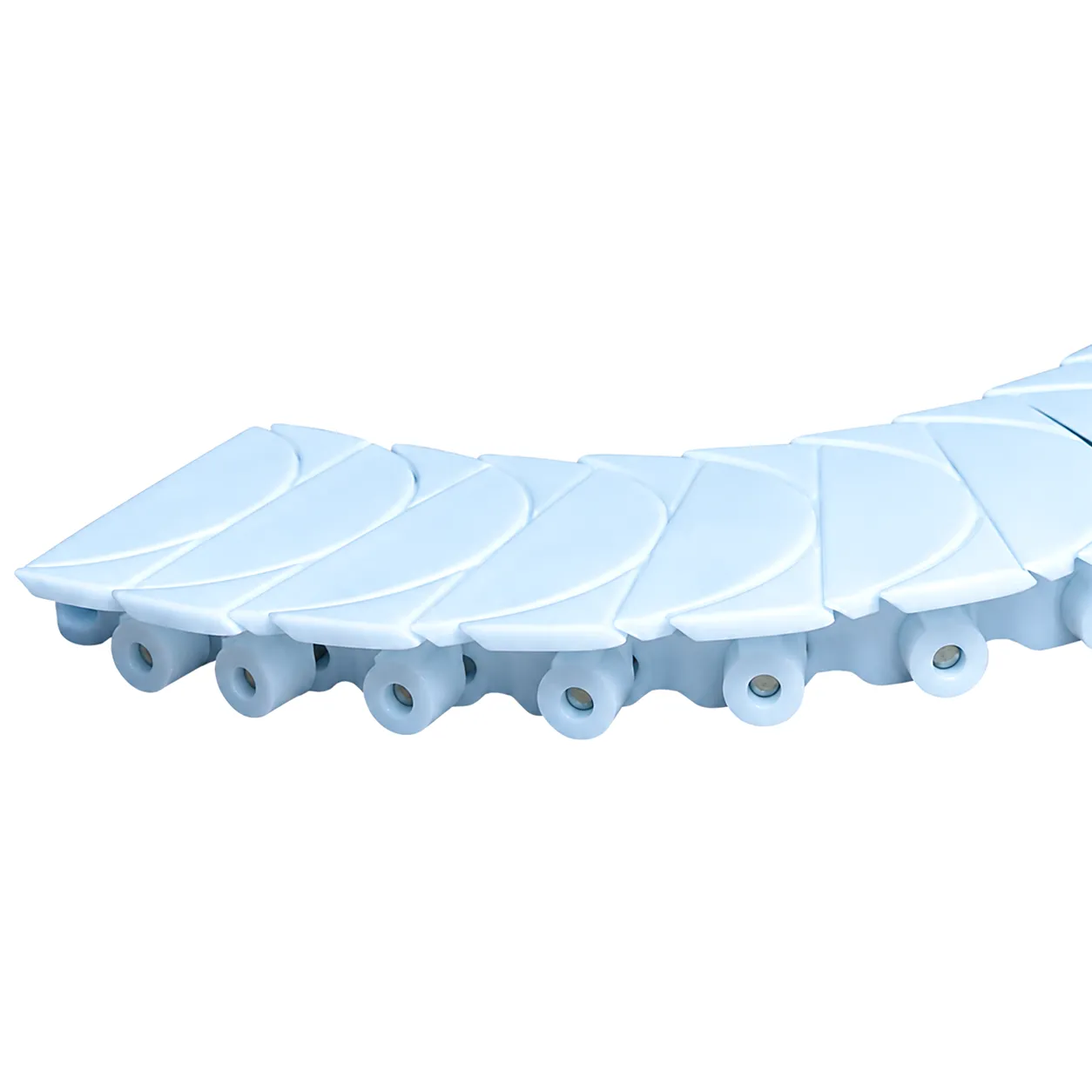
Side-flexing configurations introduce further complexity. A side-flexing plastic modular belt designed to navigate curved conveyor layouts — common in the compact floor-plan requirements of UK retail distribution centres in places like Coventry and Northampton — must accommodate the radial loading distribution that curves impose. In a curved section, the outer modules carry a proportionally higher load than the inner modules, meaning that the belt’s rated load capacity per row must be calculated against the worst-case loaded condition at the outer radius, not the average distributed load.
Many UK food factories built in the 1980s and 1990s — particularly in Yorkshire, Lancashire, and the Scottish Lowlands — have ceiling-height constraints that force conveyor designers to minimise return-path structure height. This makes belt self-weight a critical factor: a heavy plastic modular belt consumes a disproportionate share of the available drive power, leaving less margin for product loading. Specifying an open-grid module design reduces belt self-weight by 15 to 25% compared to solid-top alternatives, materially improving both energy efficiency and available load capacity at the drive without changing the nominal belt width.
The Complete Step-by-Step Calculation Workflow for Engineers
Record maximum product width, length, and height. Note maximum unit mass and density at peak loading. Identify any irregular or fragile items that require wider clearances. Document packaging format (loose product, cartonised, trayed, or palletised sections).
Apply the width formula: product width + (2 x clearance) + lane separators. Add 10 to 15% design margin. Round up to nearest standard increment. Verify the selected width is available in your preferred belt material from Ever Power’s catalogue range.
Determine peak product weight per metre of belt length. Divide by belt width in metres to yield kg/m width. Compare against the material’s rated load capacity at the application temperature. Ensure a minimum safety factor of 2.0 is maintained.
Multiply the static load by the appropriate dynamic factor (1.25 to 1.75 depending on loading method). Add calculated incline tension forces if applicable. This gives the design load — the figure your belt selection must safely exceed at rated working conditions.
Cross-reference the design load against Ever Power’s rated belt specifications. Confirm hinge pin material, module pitch, and drive sprocket compatibility. Issue a detailed specification sheet to the plant integrator for frame and drive motor sizing. Request a formal engineering sign-off before production ordering.
Industrial Application Scenarios: Width and Load Calculations in Practice
Poultry processing facilities across Harrogate and Wakefield typically handle individual carcasses at 2 to 4 kg at a rate of 80 to 120 units per minute. The plastic modular belt must be wide enough to carry product without lateral tipping — generally 600 to 900 mm — and must withstand continuous wash-down with sodium hypochlorite at 35°C. A food-grade PP module with HDPE hinge pins, 600 mm wide, rated at 50 kg/m load capacity, meets this application when a safety factor of 2.5 is applied to account for surge loading during peak production shifts.
Engine block sub-assemblies in Midlands tier-1 supplier plants routinely weigh 35 to 80 kg per unit. The conveyor must carry units end-to-end with 150 mm clearance each side, demanding a belt width of at least 900 mm for the smallest components. POM or Nylon modules are specified to meet the high tensile load requirements, and the hinge pin must be stainless steel to resist contamination from cutting oil mist. Tension loads are calculated to account for 15-degree inclines between assembly levels.
Blister-pack and cartonised pharmaceutical products are relatively light (0.05 to 0.8 kg per unit), but the precision requirements are demanding — products cannot deviate laterally by more than 2 mm during inspection. This demands extremely tight hinge-pin tolerance and a smooth flat-top surface. POM modules, 300 mm wide, rated for up to 20 kg/m at operating temperature of up to 40°C, are standard in cleanroom-adjacent pharmaceutical conveyor lines. The width calculation must allow for 75 mm clearance on each side to accommodate side-rail-mounted vision inspection cameras.
Sheffield’s precision steel component suppliers rely on plastic modular belts rated to the highest end of load specifications — Nylon modules at 900 mm to 1200 mm widths, with stainless steel hinge pins, carrying steel rod bundles and formed sections at 80 to 110 kg/m load intensity. Tension calculations must account for the significant weight of the belt itself (up to 12 kg/m² for heavy nylon modules) as a proportion of the drive load. Conveyor lengths of 15 to 30 m are common in these facilities, meaning accumulated belt return tension is a significant design driver.
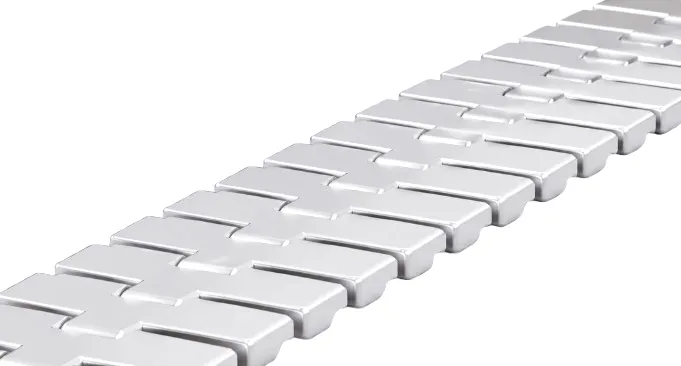
Flat Top Straight Run Belt with Side Guards
Designed for controlled, stable product transport where lateral containment is essential — pharmaceutical, food packaging, and automotive parts. Integrated side guards eliminate the need for separate guide rail fabrication, reducing installation time and frame cost. Widely used across UK systems integrators serving Midlands and Northern England facilities. Available in PP and POM with multiple pitch options.
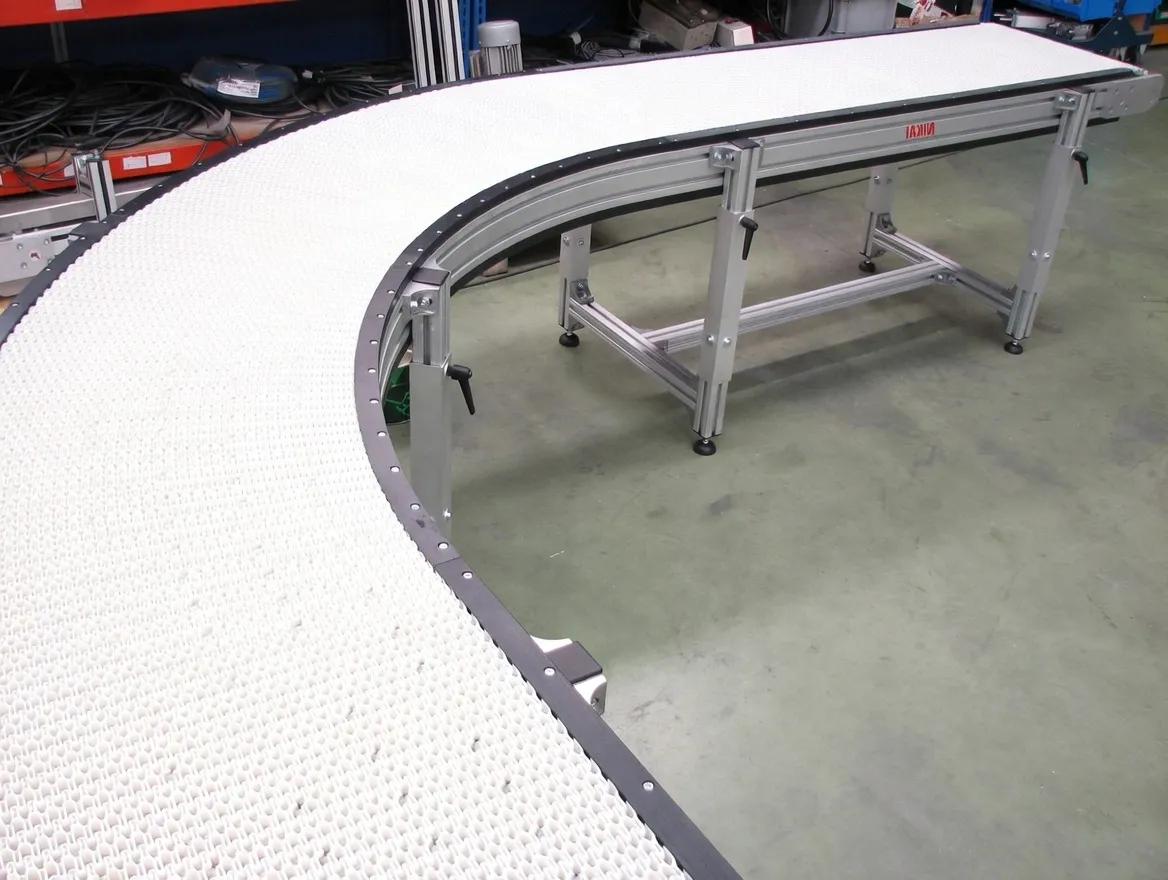 Ever Power operates precision manufacturing facilities with CNC-controlled module forming lines capable of producing plastic modular belts across the full range of widths from 100 mm to 2400 mm, in all four primary engineering polymer families. The width and load calculations described in this guide are not theoretical exercises — they are the daily output of Ever Power’s applications engineering team, who work directly with UK plant engineers, procurement managers, and conveyor OEMs to translate operational requirements into dimensionally precise, load-validated belt specifications.
Customer Success Story: Precision Conveyor Upgrade at a Sheffield Steel Component Manufacturer
A precision-engineered fastener manufacturer based in Sheffield’s Lower Don Valley had been operating a 22-metre straight-run conveyor system using a legacy woven rubber belt for over a decade. As production capacity expanded to accommodate new automotive OEM contracts — driven by the growth of electric vehicle supply chain investment in the Midlands and South Yorkshire — the conveyor team identified a critical problem: the rubber belt was exhibiting uneven load distribution at widths above 600 mm, causing fastener bundles to shift laterally and trigger frequent stoppages at the automated weighing station downstream.
The plant’s maintenance engineer contacted Ever Power’s UK sales desk and submitted a full load specification: steel fastener bundles ranging from 4 to 22 kg, loaded via a drop chute with a nominal fall height of 350 mm, on a 15-degree inclined section between two production floors. The maximum loading density was 64 kg/m at peak shift output. The existing frame width was 620 mm — a non-standard dimension that ruled out most catalogue-standard modular belt options.
Ever Power’s engineering team calculated the design load: static 64 kg/m, dynamic factor 1.65 (drop-chute loading), incline tension component of 340 N at the 15-degree gradient, total design load of 108 kg/m at the most demanding point. A Nylon (PA6) flat-top module with stainless steel hinge pins was selected, manufactured to a custom width of 600 mm (matching the existing frame inner dimension) with 5 mm side clearance each side. The belt was delivered to the Sheffield facility in nine working days. After installation, the weighing station stoppage rate fell from an average of 17 incidents per shift to fewer than two, and the plant achieved a 23% improvement in throughput on the affected line within the first three months of operation. The engineering team subsequently standardised the Ever Power plastic modular belt specification across four additional conveyor lines in the same facility.
“The custom 600 mm Nylon belt Ever Power supplied matched our non-standard frame perfectly — no shimming, no frame modification. The load calculation they provided with the quotation gave our engineering director the confidence to approve the purchase without a lengthy internal review. We have not had a single module failure in over 14 months of continuous operation.”
“We specified a 900 mm POM flat-top belt for our pharmaceutical packaging line in Stevenage. The rated load was more than sufficient, but what impressed us most was Ever Power’s detailed load validation document — it gave us the traceability data our quality team needed for GMP compliance without any additional back-and-forth. Delivery was faster than any EU-based supplier could offer.”
“Running a 26-metre inclined poultry line in North Yorkshire demands a belt that holds its load rating consistently through 3-hour wash-down cycles twice a day. Ever Power’s PP belt has done exactly that for two full production seasons. The documented load capacity calculation gave us everything we needed for our insurance audit, and the pricing was significantly below what UK distributors quoted for the same specification.”
Frequently Asked Questions
Ready to Specify Your Plastic Modular Belt Width and Load Rating?
Send Ever Power your conveyor dimensions, product weight, and application environment. Our engineering team will return a complete width and load capacity specification — with documentation — within one business day.