Περιγραφή
 The 820 conveyor chain drive sprocket and idler wheel is a purpose-built drive component designed specifically for use with 820-series plastic modular belts. Whether you are running a continuous production line in a UK food processing facility, a bottling plant in the Midlands, or a logistics sortation centre in Greater Manchester, the performance of your conveyor system depends directly on the mechanical integrity of your sprockets. These components are manufactured to exacting tolerances, delivering reliable belt engagement, extended operational life, and minimal downtime across demanding 24/7 environments.
Available in both machined and injection-moulded standards, the 820 series sprocket range covers tooth configurations from 19T through 25T, with bore options accommodating shaft diameters of 25, 30, 35 and 40 mm. This flexibility allows system integrators and maintenance engineers across the UK to source the correct drive sprocket without compromise — matching shaft specifications exactly and eliminating costly adaptor arrangements. Each unit is produced under strict quality protocols consistent with international industrial manufacturing standards.
Why the 820 Sprocket Outperforms Standard Drive Components
When conveyor engineers in the UK compare drive sprocket options for modular belt systems, several performance differentiators consistently place the 820 series above generic alternatives. The tooth geometry is calibrated to the exact pitch and drive rod diameter of the 820 modular belt, ensuring smooth belt engagement with minimal vibration and noise — a critical factor in food production environments where hygiene audits are carried out regularly and mechanical noise affects operator wellbeing. Unlike metallic sprockets, the engineering polymer construction resists corrosion from cleaning agents, saline atmospheres and product residues without any surface coating that could chip or contaminate product lines.
⚙️
Precision Tooth Profile
Matched to 820-belt pitch for consistent engagement and reduced belt wear across high-cycle operations.
🧪
Food-Safe Engineering Polymer
Non-corroding material suitable for wash-down environments and direct food contact applications common in UK production sites.
📐
Multiple Bore Configurations
25 / 30 / 35 / 40 mm round bore options accommodate most standard drive shaft sizes without custom machining.
🔩
Dual Manufacture Standards
Machined versions offer tighter tolerances; injection-moulded variants provide cost efficiency for high-volume replacements.
🔄
Drive + Idler Compatibility
Both drive and idler variants share dimensional compatibility, simplifying stock management and reducing warehousing cost.
🇬🇧
UK Stock & Fast Despatch
Standard configurations held in inventory for prompt supply to UK conveyor OEMs and maintenance teams.
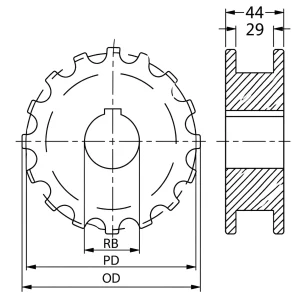
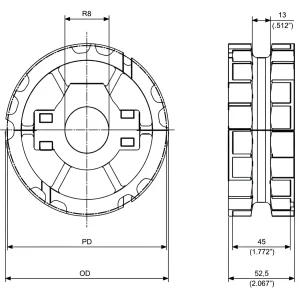
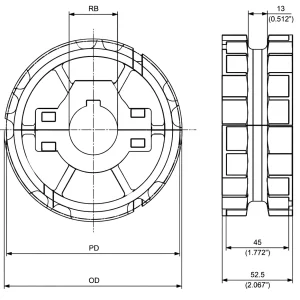
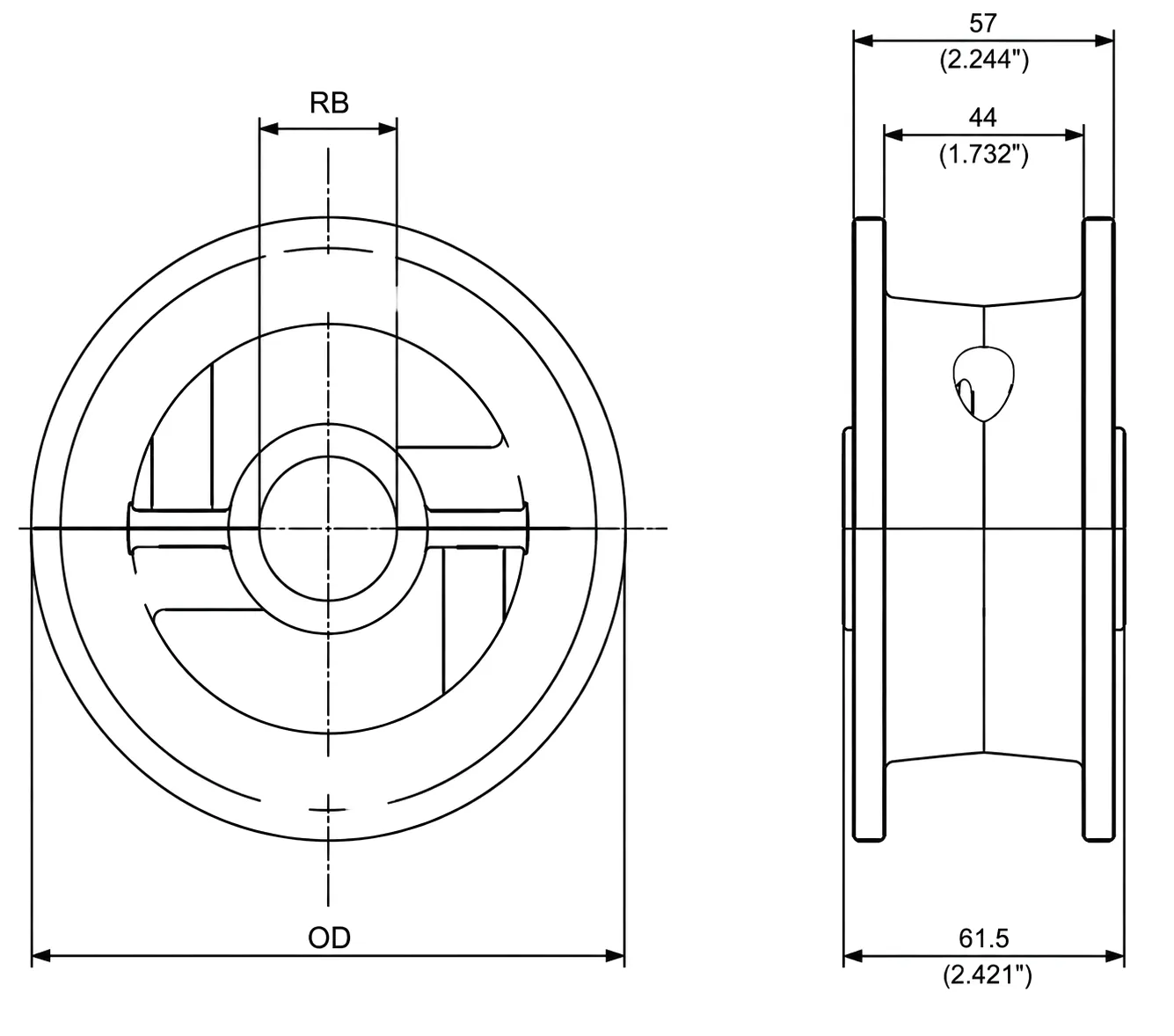
Technical Drawing — EP 820 Series Sprocket
Technical Specifications
All dimensions in millimetres. Round bore configurations shown below. Non-standard models are available — contact our technical sales team for custom bore sizes, keyway arrangements, or special materials.
| Sprocket Type | Number of Teeth | Bore RB (mm) | Outside Diameter OD (mm) | Pitch Diameter PD (mm) | Standard |
|---|---|---|---|---|---|
| Round Bore Configuration | |||||
| 820-19T-CD | 19 | 25 / 30 / 35 / 40 | 117 | — | Machining / Injection |
| 820-21T-CD | 21 | 25 / 30 / 35 / 40 | 130 | — | |
| 820-23T-CD | 23 | 25 / 30 / 35 / 40 | 141.9 | — | |
| 820-25T-CD | 25 | 25 / 30 / 35 / 40 | 154.2 | — | |
* If the sprocket requires a non-standard model, please contact our technical sales team directly.
How the 820 Sprocket System Works
The 820 conveyor chain sprocket operates on a positive-drive engagement principle. Each tooth on the sprocket body slots precisely into the drive rods moulded into the cross-section of the 820-series modular belt. As the drive shaft rotates — powered by a geared motor — the sprocket teeth mesh with the belt rods and pull the belt surface forward at a controlled, slip-free speed. At the return end of the conveyor, the idler wheel fulfils a complementary function: it guides the belt back through its return path without applying any motorised driving force, maintaining belt tension and preventing lateral drift. The result is a mechanically efficient, low-maintenance drive arrangement that handles both straight-running and curved conveyor layouts.
Material selection is central to the performance of the 820 series sprocket. The standard engineering polymer used in these components — typically acetal (POM) or high-density polyethylene (HDPE) depending on the application — offers an excellent combination of stiffness, impact resistance and low coefficient of friction. In food and beverage processing plants throughout England, Scotland and Wales, this material choice means sprockets do not require lubrication, eliminating any risk of lubricant contamination reaching product lines. The polymer also tolerates repeated exposure to high-pressure hot-water wash-down cycles without dimensional change or surface degradation.
Application Sectors
Food & beverage processing · Meat and poultry handling · Bottling & packaging · E-commerce parcel sortation · Pharmaceutical distribution
Επιλογές Υλικών
Standard: Engineering-grade POM (acetal) · HDPE variant available · Custom PA66 (nylon) on request for elevated temperature environments
Operating Environment
Temperature range: -20°C to +80°C (standard) · Wet, dry, and hygienic environments · Chemical resistance to common cleaning agents
Customer Success: Real-World Results
Across the UK, our 820 series sprocket and idler wheels have been integrated into production lines where reliability is non-negotiable. Below is one detailed deployment case alongside direct feedback from customers in different sectors.
Case Study · UK Food Processing · Yorkshire
Poultry Processing Plant Cuts Sprocket Replacement by 68%
A mid-sized poultry processing facility in North Yorkshire was running two continuous deboning lines using stainless-steel drive sprockets on their existing 820-series modular belt conveyors. Although the metal sprockets met load requirements, the plant maintenance team was replacing them every four to five months due to accelerated corrosion from the high-chlorine wash-down regime used to comply with UK Food Standards Agency hygiene requirements. Each unplanned replacement caused approximately six hours of downtime per line and involved specialist maintenance staff.
After switching to the EP 820 engineering polymer sprocket range — specifically the 820-21T-CD with 35 mm bore across eight drive positions per line — the facility reported zero corrosion-related failures over a 14-month follow-up period. Annual maintenance cost on sprocket components was reduced by approximately 68%. The polymer material also eliminated the need for separate corrosion-inhibiting sprays, simplifying the cleaning protocol and removing a potential contamination vector identified during a BRC audit.
⭐⭐⭐⭐⭐
“We’ve been using the 820-23T-CD sprockets on our bottling line for over a year now. Lead times are short, the dimensional accuracy is excellent, and our line efficiency has genuinely improved since switching.”
James H. · Conveyor Systems Engineer
Beverage Manufacturer, West Midlands, UK
⭐⭐⭐⭐⭐
“We needed a custom bore size for an older drive shaft and the technical team turned around a solution within two days. The quality of the finished sprocket was outstanding — tight tolerances throughout.”
Sarah M. · Maintenance Manager
Logistics & E-commerce Fulfilment, Manchester, UK
⭐⭐⭐⭐⭐
“Our pharmaceutical packaging line runs at elevated speeds continuously. Since fitting the 820-19T-CD sprockets with 30 mm bore, we’ve had no tracking issues and belt wear has reduced noticeably. Genuinely impressed.”
Dr. P. Whitmore · Engineering Director
Pharma Packaging OEM, Cambridge, UK
Manufacturing Capability & Custom Sprocket Solutions
Our manufacturing facility operates CNC machining centres and dedicated injection-moulding production lines for sprocket and idler wheel production. With in-house tooling design and a fully equipped quality laboratory, we offer a product customisation capability that extends far beyond adjusting bore diameters. UK buyers working on OEM conveyor designs, system upgrades, or bespoke hygienic plant layouts can request modifications including non-standard tooth counts, alternative polymer grades for elevated temperature or chemical resistance environments, split-hub designs for retrofit installation without shaft disassembly, and custom flange arrangements for lateral belt guidance.
Our engineering team works directly with customers’ design specifications. Whether you supply a drawing, a sample component, or a CAD file, we can reverse-engineer, prototype, and validate a solution before committing to volume production. Minimum order quantities are flexible for custom profiles, and prototype lead times are typically under two weeks for standard polymer grades. For UK conveyor OEMs managing multiple product variants, we also offer dedicated part numbering and Kanban stock arrangements to keep your production schedules on track.
Related Drive Components
Engineers specifying drive components for modular belt conveyors should also consider the 1775 series sprocket range, which covers larger belt pitch applications and higher load-capacity systems. Both components listed below are compatible with the broader EP modular belt ecosystem:
Drive Sprocket
1775 Sprocket Drive Wheel
Positive-drive sprocket wheel engineered for 1775-series plastic modular belts. Suitable for heavy-duty conveying in meat processing and industrial sortation environments.
Idler Wheel
1775 Sprocket Idler Wheel
Return-end idler wheel for the 1775-series belt system, maintaining belt tension and alignment without driving force. Low-friction polymer construction reduces energy consumption.
Συχνές ερωτήσεις
Ready to specify 820 series sprockets for your conveyor project?
plastic-modular-belt.com · [email protected] · UK B2B Specialist · edit by gzl