 Walk the production floor of any major UK soft drink bottling plant — whether it sits in a Midlands industrial estate, occupies a purpose-built site on the outskirts of Bristol, or shares a campus with a brewery in Leeds — and the belt running beneath the bottles is no longer the rubber or woven fabric type that defined the previous generation of conveyor engineering. Today, the plastic modular belt has become the benchmark specification for bottle and can filling lines, not because it is fashionable but because the numbers justify the investment at every point of the asset lifecycle. Line engineers are under constant pressure to reduce microbial risk, compress changeover windows, and recover more uptime from every shift. A well-chosen plastic modular belt addresses all three goals without compromise.
The beverage filling environment is one of the most aggressive applications any conveyor component will ever face. Continuous water spray from rinsers, CIP caustic wash cycles, high-speed accumulation zones where bottles collide repeatedly, wet floors, temperature cycling between cold product and ambient air — these are not edge conditions. They are daily realities. A plastic modular belt, assembled from precision injection-moulded thermoplastic modules linked by stainless steel or polymer rods, is inherently built for exactly this setting. The interlocking module geometry provides dimensional stability under wet conditions. Open-surface variants drain liquid instantly. The modular architecture means a damaged run of links can be replaced in minutes, not hours, without pulling the entire belt from the machine frame.
This guide is written from the perspective of someone who has spent more than eighteen years specifying, commissioning, and troubleshooting plastic modular belt installations across UK and European beverage facilities. It covers material science, belt construction principles, zone-by-zone performance analysis, and the practical procurement considerations that matter most when you are sourcing a modular belt for a live production line — including exactly what to ask your supplier before you sign off a purchase order.
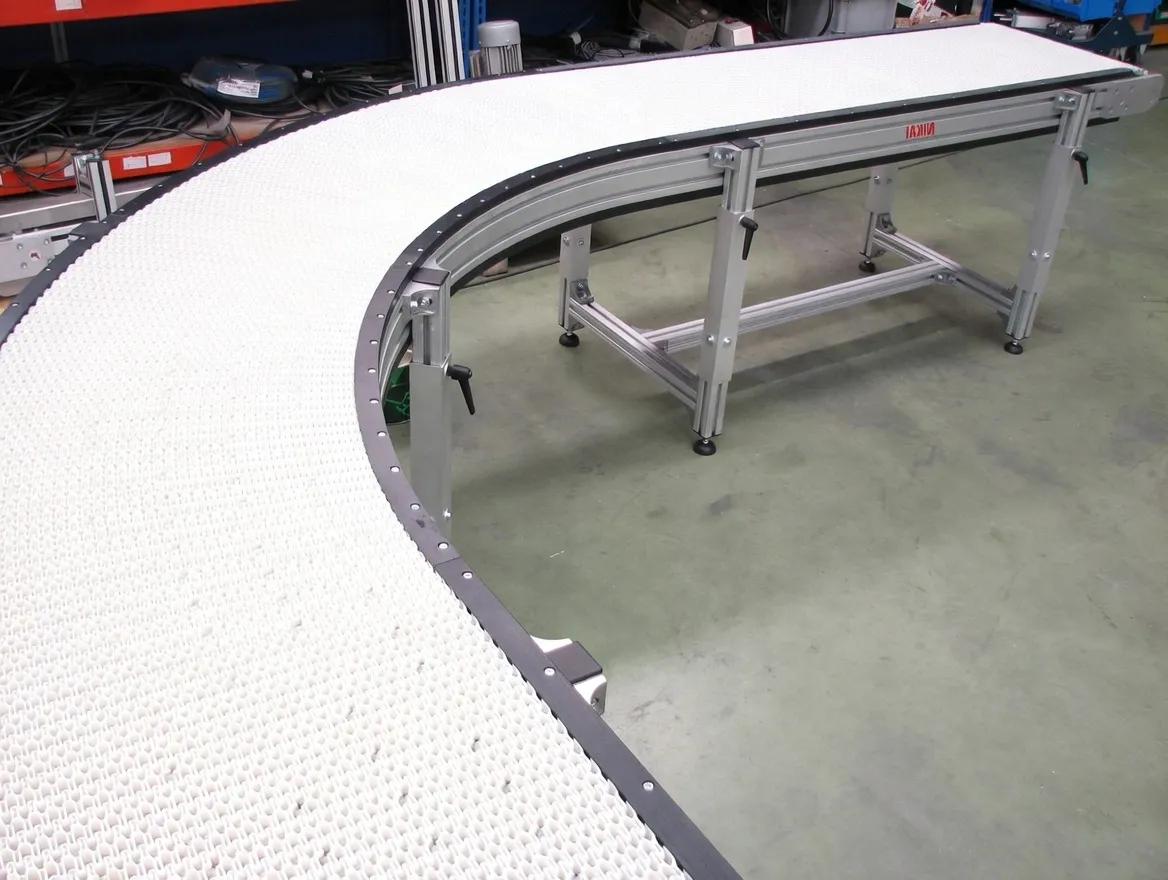
Plastic modular belt in beverage filling line application — blue FDA-grade PP modules with SS304 hinge rods
What Is a Plastic Modular Belt — and Why Does the UK Beverage Industry Rely on It?
Understanding the engineering foundation before specifying any belt system
A plastic modular belt is a conveyor belt constructed from individual, identical thermoplastic modules — each precision injection-moulded and engineered to interlock with its neighbours via a hinge loop system running the full width of the belt. A single rod, passing through these hinge points row by row, holds the structure together. Because each hinge joint acts as an independent pivot, the belt can navigate horizontal radius turns, handle inclines, and even spiral vertically within a single continuous belt body — a flexibility no rubber belt can match. The result is a load-bearing surface that behaves as a seamless platform for product, yet can be disassembled, repaired, or section-replaced at module level with no specialist tooling and no belt removal from the frame.
The modules themselves are injection-moulded from engineering-grade thermoplastics. Polypropylene (PP) covers the majority of UK beverage applications: it offers broad chemical resistance, FDA food contact compliance, and a cost base that makes large-scale replacement economically straightforward. Acetal copolymer (POM-C) provides superior stiffness, lower surface friction, and better dimensional stability under temperature variation — the preferred choice for filler starwheel zones and pasteuriser tunnels. PVDF module grades address the most demanding chemical and thermal combinations, such as aseptic filling environments where peracetic acid and elevated temperatures combine with strict microbiological targets.
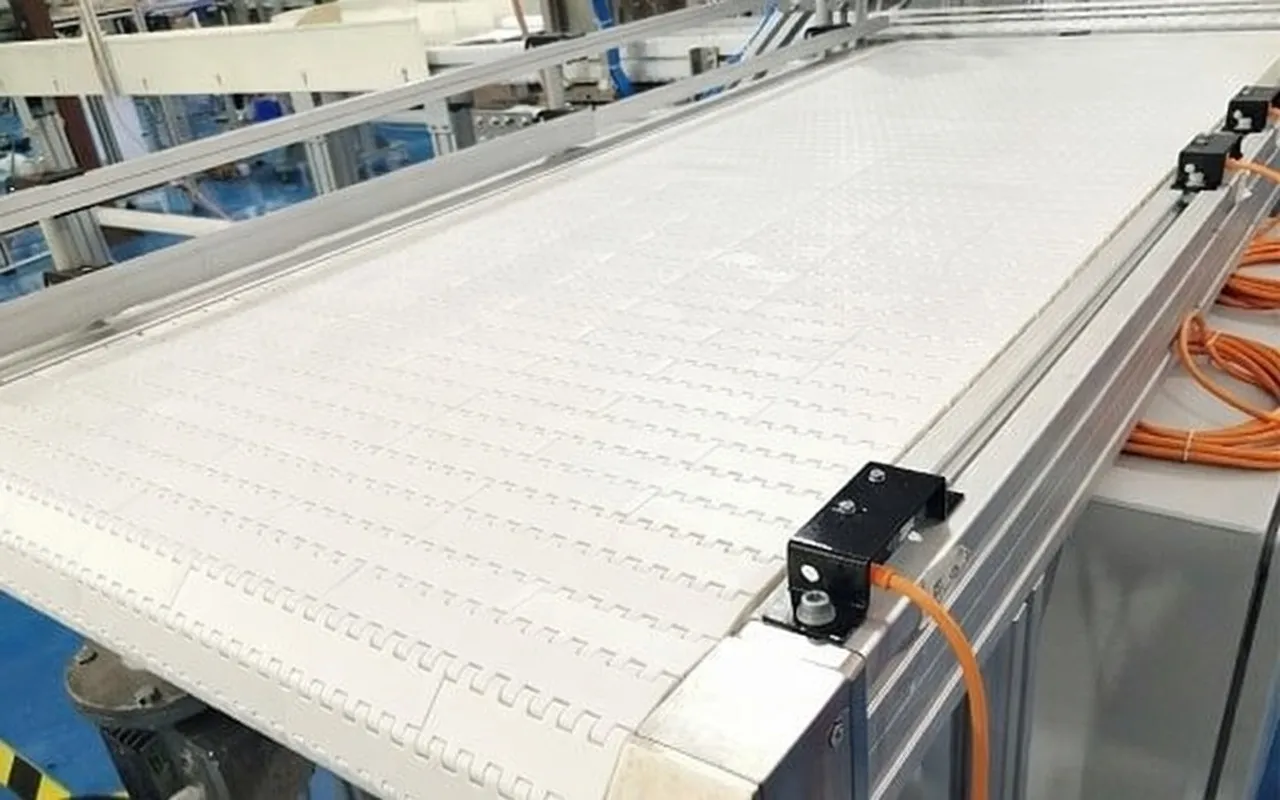
Surface geometry is the specification decision that most directly affects line performance. Flush-grid surfaces maximise drainage in wet zones. Flat-top surfaces provide the lateral stability that high-speed bottle filling requires. Raised-rib variants protect heavy glass bottles from sliding off camber. Friction-top co-injection surfaces prevent container movement on inclined conveyors without requiring additional hold-down mechanisms. Getting this decision right — zone by zone — is where eighteen years of application experience pays for itself many times over in reduced line incidents and faster cleaning cycles.
Technical Performance Parameters
Standard specification range for beverage filling line applications — bespoke parameters available on request
| Parameter | Standard Range | Typical Beverage Spec | Engineering Notes |
|---|---|---|---|
| Belt Width | 100 mm – 2,000 mm | 300 – 600 mm | Non-standard widths manufactured to drawing |
| Module Pitch | 12.7 mm – 101.6 mm | 25.4 mm – 50.8 mm | Fine pitch (12.7 mm) for small PET and cans |
| Operating Temperature | -40°C to +120°C (PP); up to +140°C (POM) | 2°C – 85°C | Covers pasteuriser tunnel full range |
| Max Belt Speed | Up to 100 m/min | 20 – 60 m/min | Subject to product load and pitch selection |
| Chemical Resistance | Acids, alkalis, chlorinated solutions | NaOH 2–4%, HNO₃ 1–2%, PAA 0.1–0.3% | CIP and SIP compatible |
| Tensile Strength (PP) | 35 – 55 MPa | 40 MPa (standard grade) | GF30 grades available for heavy glass bottles |
| Food Contact Compliance | FDA 21 CFR, EC 1935/2004, BfR | FDA 21 CFR + EC 1935/2004 dual cert | Certificates supplied with every shipment |
| Colour Options | White, blue, grey, black, natural | Blue (HACCP zone coding) | Metal-detectable and x-ray grades available |
* Data represents typical ranges. Actual performance is subject to belt series, width, operating conditions, and drive configuration. Contact our technical team for application-specific load calculations.
Zone by Zone: How a Plastic Modular Belt Performs Across the Full Filling Line
Each section of a beverage line presents a distinct engineering challenge — and a distinct belt requirement
🧼
Rinser and Depalletiser Infeed Zone
This zone floods with water almost constantly. Containers arrive in clusters, sometimes carrying condensation and label debris from cold storage. A flush-grid plastic modular belt is the correct specification here — the open-lattice structure allows rinse water, glass fragments, and product residue to fall straight through rather than accumulating under the container base. The modular belt withstands aggressive rinse chemicals without surface degradation, and because it does not stretch like rubber, there is no re-tensioning routine to schedule. High-impact PP grades (30% glass-fibre reinforced) resist cracking under the occasional impact of dropped or toppled bottles without any visible deformation. For UK manufacturers handling glass bottles specifically, this combination of drainage performance and impact toughness is difficult to replicate with any other belt technology at a comparable cost per linear metre.
🏭
Filler and Capper Starwheel Transfer Zone
The transfer zone between the single-lane infeed conveyor and the rotary filler is where product flow control is most critical on the entire line. A plastic modular belt running at precisely controlled speed, combined with adjustable side guides, creates the back-pressure accumulation needed to feed the starwheel infeed screw without surges or gaps. Flat-top surface geometry is essential here — bottles must stand absolutely upright without rocking or sliding. Acetal (POM-C) modules are specified in this zone because their lower surface friction and higher dimensional stiffness allow smooth, precise speed matching between the belt and the rotary filler drive. After the capper, where output speeds on modern UK beverage lines can reach 60,000 containers per hour, the plastic modular belt must redirect product back into multi-lane accumulation without creating the tipping events that generate line stop incidents. Getting the pitch right for your container diameter is the critical engineering detail that separates a good specification from a compromised one.
🌡️
Pasteurisation Tunnel
The pasteurisation tunnel is arguably the most demanding thermal environment in any UK beverage facility. The plastic modular belt is subjected to continuous hot water spray from 60°C up to 85°C, followed immediately by a cold shower section that drops container temperature to 30°C or below. A rubber belt subjected to this thermal cycling deteriorates rapidly, swelling and hardening in unpredictable cycles. Acetal modular belts handle this routine without dimensional change because the rod-and-hinge design accommodates thermal expansion within the clearance of each hinge bore rather than building compressive stress across the belt width. The open structure allows tunnel water to drain freely, preventing stagnant hot water accumulation that would otherwise create the warm, moist conditions bacteria thrive in. For UK craft brewery lines where hop acids combine with elevated temperature, PVDF module grades provide exceptional chemical resistance at an acceptable cost premium that most operations recover within the first annual maintenance cycle.
🏷️
Labelling, Date Coding, and Automated Optical Inspection
Label application equipment and vision inspection cameras demand a surface that delivers exceptional flatness and zero vibration in the belt run. A plastic modular belt with flat-top modules and correctly specified carry-side wear strips achieves this consistently in a way that a rubber belt — which develops surface irregularities over time — cannot. Commissioning engineers on UK beverage lines increasingly note that blue-coloured plastic modular belt modules improve camera contrast in automated optical inspection (AOI) stations checking fill level, closure security, and label placement accuracy. This simple colour-coding detail, easily overlooked during specification, can reduce AOI false-reject rates by a measurable percentage — which on a high-speed line running 24 hours represents significant recovered product value over a year. The non-porous thermoplastic surface also prevents label adhesive residue from penetrating and harbouring the bacteriological contamination that persistently troubled older fabric belt types in this zone.
📦
Case Packing, Shrink Wrapping, and Palletisation Outfeed
The outfeed section of a beverage filling line handles the heaviest product loads across the entire conveyor system. Filled and labelled containers must accumulate, lane-separate, and enter the case packer or shrink wrapper in precise, consistent groupings. Heavy-duty plastic modular belts — often in wider configurations up to 1,200 mm for multi-lane accumulation tables — with SS304 hinge rods and reinforced module sidewalls are the correct specification here. The radius belt module system allows product to turn corners within the belt framework itself, eliminating the separate belt-to-belt transfer points that are historically responsible for the majority of container tipping incidents in this section. On lines that run both glass and PET on the same frame, the friction-top co-injection module variant prevents heavy glass bottles from sliding during case drop-down sequences while maintaining the surface that lighter PET containers can slide onto accumulation without scratching.
Seven Reasons UK Beverage Engineers Specify Plastic Modular Belts
Based on 18+ years of field experience across British food and drink production sites
Superior Hygienic Design
No fabric, no rubber, no surface porosity where bacteria can establish colonies. A plastic modular belt passes BRC and HACCP audit requirements far more readily than any alternative belt technology, and UK retail customer QA programmes are increasingly writing it into their supplier specifications by name.
Row-by-Row Repairability
A damaged section is replaced in under twelve minutes using one operative and no specialist tools. Maintenance teams at UK beverage plants consistently report 60–70% reductions in belt-related downtime after switching from rubber to plastic modular belt technology — a figure that typically appears in the ROI justification within the first three months.
Chemical Resistance to CIP Agents
Caustic soda, nitric acid, peracetic acid, and chlorinated sanitisers used in standard CIP cycles cause zero degradation to PP or POM module grades. The plastic modular belt retains its dimensional and mechanical properties through hundreds of cleaning cycles without surface blistering or swelling.
Dimensional Precision and Stability
Unlike rubber, a plastic modular belt does not elongate or creep under load. Module pitch remains consistent from commissioning day through year five, which means sprocket engagement stays accurate and product tracking stays true — a requirement that is non-negotiable where vision inspection cameras are installed.
Sustainability and Recyclability
Thermoplastic modules are recyclable at end of belt life. For UK beverage producers working towards net-zero supply chain commitments, specifying a plastic modular belt from recycled-content PP grades contributes to Scope 3 carbon reduction reporting — an increasingly mandatory element of major retailer sustainability programmes.
Multi-Format Flexibility
A single plastic modular belt framework handles glass, PET, aluminium cans, and cartons with only guide rail and speed adjustments — no belt change required. UK operations running multiple SKUs on the same line recover changeover time directly from this built-in format flexibility.
Lower Total Cost of Ownership
When you account for reduced belt replacement frequency, shorter CIP cycle times (open surfaces clean faster than solid rubber), lower spare parts inventory requirements (row stock rather than complete belt rolls), and reduced downtime events, the plastic modular belt consistently demonstrates a lower total cost of ownership over any five-year operational horizon than comparable alternatives. This is a calculation that UK beverage finance directors are increasingly including in capital expenditure justification documents, and it consistently supports the business case for conversion.
Material Science and Working Principle
The engineering that makes a plastic modular belt fundamentally different from every other conveyor belt type
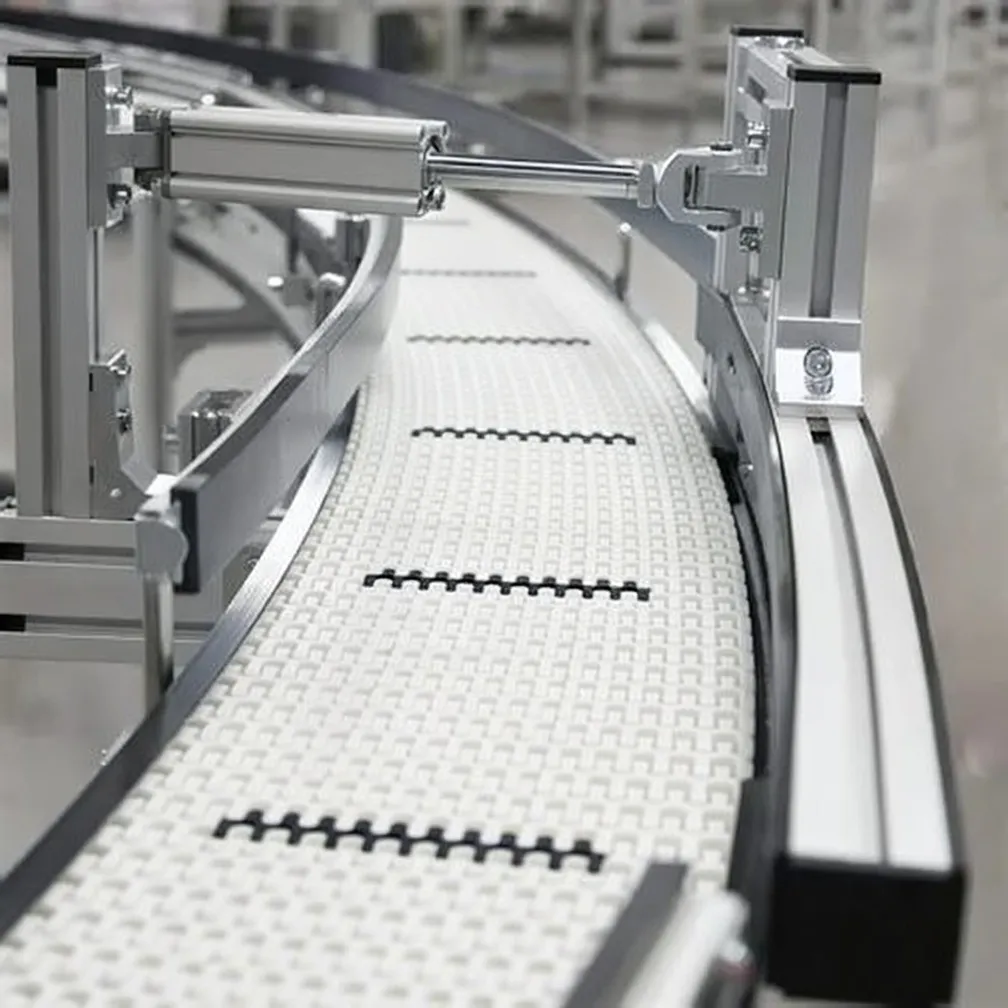 The working principle of a plastic modular belt is deceptively simple. Each module carries a specific number of hinge loops on its leading and trailing edges. Adjacent rows are assembled so that these loops interlock, and a single rod threads across the full belt width through the interlocked hinge bores, holding each row junction together. Because the rod rotates freely within the bore, each hinge joint acts as an independent pivot point. This means the belt can negotiate horizontal curves, transition from flat running to inclined, and even spiral vertically on multi-level conveyor systems — all within a single continuous structure with no secondary components.
The choice of module material defines the performance envelope of the entire belt. Polypropylene homopolymer gives excellent chemical resistance and FDA compliance at a competitive price — the standard selection for most wet beverage zones. Acetal copolymer (POM-C) provides better stiffness at elevated temperatures, lower surface friction, and superior dimensional stability under thermal cycling — making it the preferred grade for pasteuriser and filler transfer applications. For environments where chemical extremes and high temperatures combine simultaneously, polyether-ether-ketone (PEEK) and polyphenylene sulphide (PPS) modules are available, though at a cost premium generally reserved for pharmaceutical-grade beverage production such as nutraceutical drinks and aseptic filling systems.
Hinge rod material selection matters as much as module material for long-term reliability. Stainless steel 304 is standard for the majority of UK beverage applications. SS316 provides higher chloride resistance for coastal UK manufacturing sites or environments where peracetic acid sanitiser is used heavily. Polypropylene rods are specified where metal detection systems could produce false positives on steel rods. PVDF rods address both electrical insulation requirements and extreme chemical exposure simultaneously. Every plastic modular belt that leaves our facility ships with a full material certificate traceable to the raw material production batch — a compliance requirement that UK food safety auditors now include as standard in belt supplier questionnaires.
Where Plastic Modular Belts Are Installed in UK Beverage Manufacturing
From Scottish distillery bottling halls to London craft beer canning lines — sectors served across Great Britain
Craft Brewery Canning Lines
Breweries across London, Leeds, Bristol, and Edinburgh rely on compact plastic modular belt systems for small-batch canning at 1,500–6,000 cans per hour. The modular format allows the same belt to be reconfigured for 330 ml, 440 ml, and 500 ml cans with no belt change.
Soft Drink PET Bottle Lines
High-speed lines across the Midlands and South East run plastic modular belts at 40–60 m/min handling 330 ml and 500 ml PET bottles through rinser, filler, capper, and labeller zones with consistent throughput and zero belt re-tensioning requirements.
Scottish Whisky Bottling Halls
Glass bottle handling in Speyside and Highland distillery bottling halls requires raised-rib PP plastic modular belts to handle heavy filled bottles safely in high-humidity environments with alcohol vapour, while satisfying the stringent hygiene standards of premium spirits production audits.
Dairy and Functional Beverages
Milk, protein shake, and energy drink producers across Wales and Northern England require FDA-grade plastic modular belts for near-aseptic filling environments. Our compliance documentation package supports both domestic BRC audits and export customer requirements simultaneously.
The UK beverage industry operates under some of the most rigorous food safety requirements in the world — combining retained UK food contact materials law (derived from EU Regulation 1935/2004), BRC Global Standards programme requirements, and customer-specific audit programmes from the major supermarket groups. Plastic modular belts certified to both FDA 21 CFR and EC 1935/2004 food contact compliance give UK producers the dual-standard documentation coverage they need for domestic compliance and for continuing export access to EU markets. This is a particularly relevant consideration for manufacturers in Northern Ireland, who must simultaneously satisfy UK regulatory requirements and Republic of Ireland customer supply chain audits under the current post-Brexit trading framework.
Bespoke Plastic Modular Belt Manufacturing: Our Customisation Capabilities
Because no two beverage filling lines are identical — and neither are their belt requirements
Non-Standard Belt Widths
We manufacture plastic modular belts from 100 mm to 2,000 mm width, including any non-standard dimension specified to your conveyor frame drawings. No minimum order applies to width variants within our standard module range — whether you need one belt or one hundred.
HACCP Colour Coding
Custom colour matching to your HACCP zone coding scheme. Metal-detectable blue and x-ray-detectable grades available for facilities running integrated foreign body detection programmes as part of their BRC or retailer audit compliance.
40+ Surface Geometries
Flush-grid, flat-top, raised-rib, perforated, anti-static, and friction-top co-injection surfaces — stocked and ready to dispatch. Custom mould tooling is available for high-volume bespoke applications where an off-the-shelf geometry does not fully address your product contact requirement.
Full Technical Documentation
Every order ships with material certificates, food contact compliance declarations (FDA + EC 1935/2004), dimensional inspection reports, and — on request — FEA load calculations for your specific conveyor span, product load, and drive configuration.
Our manufacturing team operates with a rapid-response mindset. A new belt specification raised today can typically be in production within five working days for standard material grades, with expedited options for UK-based customers facing urgent line requirements. We hold strategic stock of the most common PP and POM module grades and SS304 hinge rods to support emergency replacement orders — because we understand that a stopped beverage filling line costs far more per hour than express freight. UK customers registering their belt specifications in advance qualify for our priority replacement programme with committed dispatch timelines.
Customer Success: West Midlands Soft Drink Producer Cuts Belt Downtime by 68%
A documented operational improvement from a UK carbonated drinks manufacturing facility
The Challenge
A mid-size carbonated soft drink manufacturer based in the West Midlands was operating three filling lines running 330 ml and 500 ml PET bottles at up to 36,000 bottles per hour. Their existing rubber flat belt conveyor systems had become a persistent source of production disruption. CIP cleaning cycles were averaging 55 minutes per belt section because of the need to scrub beneath the belt surface. Belt replacement was occurring every 8–10 months due to chemical swelling and edge fraying. Total belt-related downtime had reached 4.3% of scheduled production hours — a figure the operations director described as “unsustainable given current capacity utilisation targets.” Several BRC audit observation notes had been raised against conveyor hygiene conditions in consecutive years.
The Solution
After a full site visit and zone-by-zone line audit, our application engineering team specified a flush-grid PP plastic modular belt (25.4 mm pitch, 400 mm wide, SS304 hinge rods) for the rinser-to-filler infeed, a flat-top acetal plastic modular belt for the filler outfeed and labeller infeed, and a raised-rib PP plastic modular belt for the multi-lane case packer accumulation table. All three specifications used blue FDA-grade modules for HACCP zone colour coding and to improve AOI camera contrast at the fill-level inspection station. We delivered a one-day hands-on maintenance training session at the customer’s facility, and supplied an initial row-stock kit sized for each belt section based on their projected replacement interval.
The Results
Six months post-conversion, belt-related downtime had fallen from 4.3% to 1.4% of scheduled production hours. Average CIP cycle time per belt section dropped from 55 minutes to 22 minutes. The first module row replacement — triggered by impact damage from a dropped glass bottle on an adjacent packing line — was completed in eleven minutes by one maintenance operative without removing the plastic modular belt from the conveyor frame. The BRC audit observation against conveyor hygiene was closed with no recurrence. The customer subsequently converted all remaining belt sections across their site, citing the ROI calculation as “straightforward and compelling” in their post-project capital expenditure review.
What Our UK Customers Say
Feedback from production operations across Great Britain
“We replaced every rubber belt on our PET filling line with plastic modular belts across a single planned shutdown weekend. The difference in cleaning time alone recovered the investment within four months. The technical support during commissioning was genuinely outstanding — problems were anticipated before they developed.”
“Our BRC audit commentary on conveyor belts went from ‘observation — improvement required’ to ‘no issues noted’ after switching to plastic modular belts. The blue colour-coding throughout the filling hall has been specifically praised by our retail customer QA team on two subsequent site visits. Delivery was ahead of schedule.”
“We needed a non-standard belt width for our whisky bottling carousel that previous suppliers had declined as uneconomical. Ever Power quoted, manufactured, and delivered the custom plastic modular belt within eleven working days. Quality was exactly to specification. We have since standardised on their belts across our entire Speyside operation.”
Frequently Asked Questions
Common questions from UK beverage production engineers, procurement managers, and conveyor line designers
What is the best type of plastic modular belt for a high-speed UK PET bottle filling line running at 40,000 bottles per hour?
For high-speed PET bottle lines in UK beverage facilities running at 40,000 BPH and above, an acetal (POM-C) flat-top plastic modular belt at 25.4 mm pitch with SS304 hinge rods is recommended for the filler-to-capper starwheel transfer section, where container upstanding stability and dimensional precision are non-negotiable. For the rinser infeed and pasteuriser tunnel sections, flush-grid PP modular belts deliver the drainage performance and chemical resistance that the wet and thermally demanding environment requires. An application engineer should confirm belt width, sprocket centres, and carry-side wear strip material based on your specific frame drawings and drive configuration before finalising the specification.
How long does a plastic modular belt typically last on a UK craft brewery canning line, and what affects the service life most significantly?
On a UK craft brewery canning line running two shifts per day with standard CIP protocols, a PP plastic modular belt reliably achieves a service life of five to eight years before full belt replacement is considered. The main factors that reduce service life are: cleaning temperatures that exceed the module material rating, use of undiluted hypochlorite on POM belts, drive sprocket misalignment that concentrates load unevenly across the belt width, and carry-side wear strips allowed to deteriorate below minimum specification. Crucially, the modular construction means individual damaged rows can be replaced while the surrounding belt structure remains fully serviceable — it is not unusual for a well-maintained plastic modular belt to still be running at year seven with only periodic row-level repairs performed along the way.
Where can UK beverage manufacturers get a price quote for a custom-width plastic modular belt suitable for a pasteurisation tunnel application?
UK beverage manufacturers can request a detailed price quotation directly by emailing [email protected] with the following information: required belt width in mm, belt length or conveyor centre-to-centre distance, operating temperature range (including peak pasteuriser zone temperature), CIP chemical types and concentrations, product type, and any food contact compliance certifications required. Proposals are typically returned within 24 to 48 hours. For pasteurisation tunnel applications specifically, the technical team will request your tunnel zone temperature profile and belt speed to confirm the appropriate material grade and verify thermal expansion compatibility with your drive sprocket configuration before quoting.
How does a plastic modular belt compare in cost and performance to a rubber belt for heavy glass bottle handling in a Scottish distillery bottling hall?
In a Scottish distillery bottling hall context, the plastic modular belt outperforms rubber in three critical areas. Cleaning is faster and more thorough because the open module geometry permits spray-through washing without removing the belt from the frame. Chemical resistance is superior — particularly relevant in alcohol vapour environments where peracetic acid sanitisers are routinely used. Load-bearing performance under the weight of heavy filled glass bottles (750 ml spirits bottles at over 1 kg each) is maintained consistently over time, whereas rubber under sustained load eventually softens and deforms. The upfront cost of a plastic modular belt is higher than rubber, but every total cost of ownership analysis across Scottish distillery projects we have supported has shown the modular belt to be the more economical choice across any three-year operational horizon.
Which plastic modular belt material — polypropylene or acetal — should a UK craft brewery choose for their canning line, and is the price difference significant?
For a UK craft brewery canning line, the choice between PP and acetal depends primarily on the zone. Wet sections — depalletiser, can rinser, can washer — are best served by PP modular belts, which offer excellent resistance to caustic wash and warm-water rinse cycles at a competitive price. Transfer sections around the canning machine itself, where can stability and precise speed matching to the rotary valve are critical, benefit from acetal’s lower surface friction and higher stiffness. Acetal modules typically cost 30–45% more than equivalent PP grades in the same belt series. However, for the filler section specifically, most UK craft breweries find the dimensional stability benefit of acetal under temperature variation more than justifies the price premium — especially when viewed against the cost of a single incident where unstable cans jam the infeed screw and stop the line.
What food contact compliance documentation does a UK soft drink manufacturer need from a plastic modular belt supplier to satisfy their BRC Global Standards audit requirements?
For a UK soft drink manufacturer undergoing a BRC Global Standards audit, the minimum documentation required from a plastic modular belt supplier is: a Declaration of Compliance to UK food contact materials regulations (aligned to retained EC Regulation 1935/2004), material safety data sheets for all belt components in contact with the product or processing environment, and confirmation that no restricted substances are present. Major UK retail QA programmes additionally require FDA 21 CFR compliance declarations, which our standard PP and POM belt grades carry as standard. All compliance documentation is supplied at no additional charge with every order, and version-controlled reissues are available on request to support audit preparation — a process we are very familiar with across UK beverage client sites.
How quickly can Ever Power deliver a replacement plastic modular belt to a UK beverage plant that has experienced an unplanned conveyor failure?
For emergency replacement orders covering the most common PP and POM plastic modular belt series in standard widths, dispatch within 24 to 48 hours of order and specification confirmation is typically achievable. We maintain a dedicated UK emergency stock allocation because we understand that a stopped beverage filling line can cost several thousand pounds per hour in lost production — a freight surcharge is trivial by comparison. Customers who provide frame drawings and belt specification in advance can be registered on our priority replacement programme, which commits a dispatch timeline and pre-allocates appropriate stock. For non-standard widths or specialist material grades, lead times run five to ten working days, but we will always confirm this accurately at the quotation stage so you can plan accordingly.
© 2025 Ever Power | Plastic Modular Belt Specialist | UK Beverage, Food & Industrial Conveyor Solutions | [email protected]
επεξεργασία από gzl