
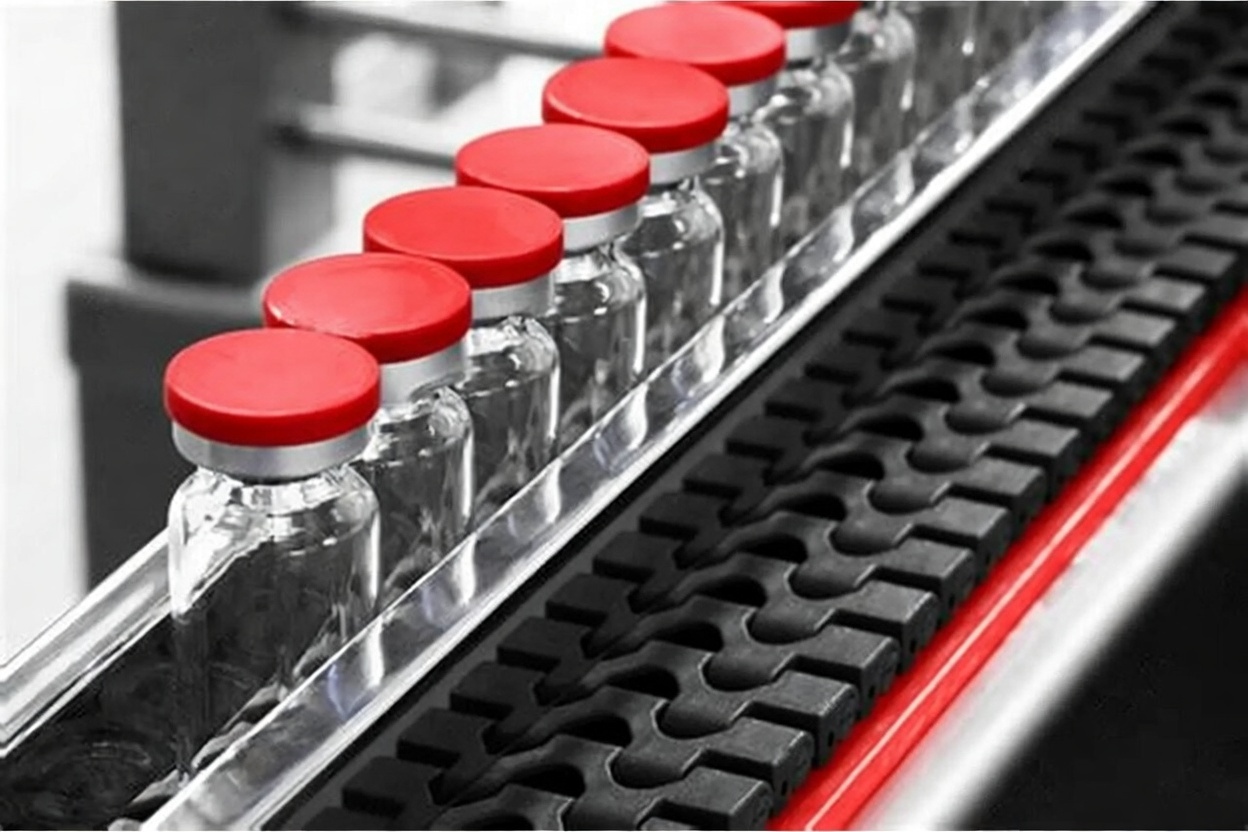
 Plastic modular belt in operation on a chemical product packaging line — Ever Power, UK supply & service
Why Chemical Packaging Demands a Specialist Belt Solution
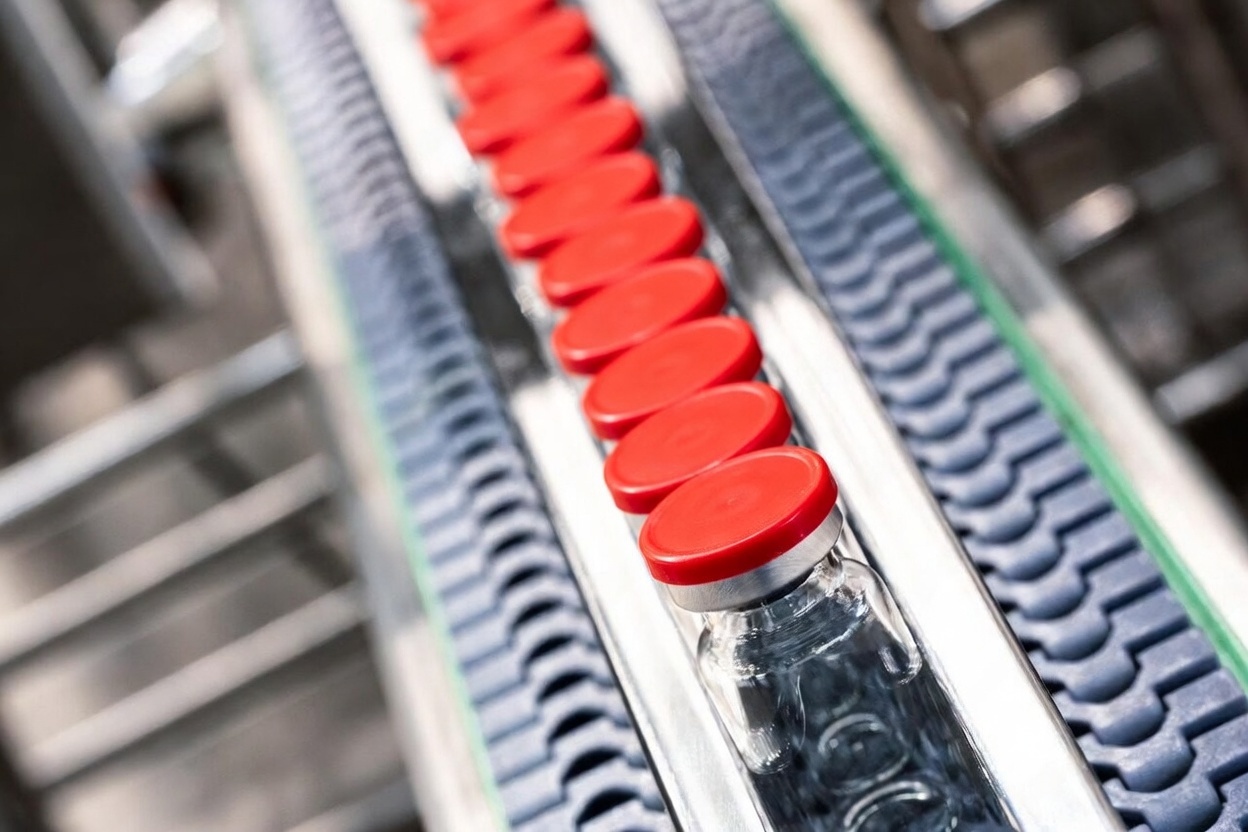 Chemical packaging lines in the United Kingdom operate under pressures that most other manufacturing sectors simply do not face. Every container — whether a 25-litre HDPE drum, a 1-litre spray bottle, or a 5-litre jerrycan — passes through a complex sequence of filling, capping, labelling, inspection, and palletising steps. The conveyor belt connecting each of those stages is not a peripheral component; it is the central nervous system of the entire operation. When that belt fails, corrodes, or introduces contamination risk, the entire line stops and compliance liabilities begin to mount.
Plastic modular belts have emerged as the preferred conveying solution for UK chemical packagers precisely because they address each of those pain points from the ground up. Unlike traditional flat-belt or steel-link systems, a plastic modular belt is assembled from individual interlocking polypropylene or acetal modules. That architecture gives engineers an unusual degree of control: modules can be replaced in minutes without removing the entire belt, the open-hinge design drains spilled chemicals immediately, and the non-metallic construction eliminates galvanic corrosion entirely. For facilities operating under COMAH (Control of Major Accident Hazards) regulations or managing highly acidic and alkaline wash-down environments, these properties are not optional extras — they are baseline requirements.
Over eighteen years of hands-on application engineering across the chemical sector, we have seen the same pattern repeat in Teesside, Merseyside, and the industrial Midlands alike: facilities that switched from PVC flat belts to properly specified plastic modular belt systems typically reduced unplanned downtime by 30–45 percent within the first twelve months. The capital cost difference is real but recoverable within one to two production cycles. This article walks through the engineering rationale behind those gains, with specific reference to chemical packaging line configurations.
Materials & Construction — What Sets Modular Belts Apart
Πολυπροπυλένιο (PP)
Excellent resistance to dilute acids, alkalis, and most solvents used in cleaning operations. Operating temperature up to 120°C continuous. The workhorse material for standard chemical packaging environments.
Ακετάλη (POM)
Higher stiffness and lower friction coefficient than PP. Preferred for high-speed labelling machines where dimensional stability under load directly affects label registration accuracy. Suitable for temperatures up to 90°C.
UHMW-PE Flush Grid
When a flush, low-profile surface is needed for small containers (250 ml bottles, aerosol cans), UHMW-PE flush-grid modules provide an almost solid running surface while retaining the modular replacement advantage.
Stainless Steel Hinge Rods
Grade 316 SS hinge rods are standard on all Ever Power chemical-grade belts. They resist chloride stress corrosion, which is critical in facilities using hypochlorite-based CIP systems.
Παράμετροι Τεχνικής Απόδοσης
| Παράμετρος | PP Standard | Ακετάλη (POM) | UHMW-PE Flush |
|---|---|---|---|
| Belt Pitch | 25,4 χιλ. / 38,1 χιλ. | 25.4 mm | 12.7 mm / 19.05 mm |
| Μέγιστη θερμοκρασία λειτουργίας. | 120°C | 90°C | 80°C |
| Χημική αντοχή | Acids, alkalis, oils | Solvents, oils | Strong acids & alkalis |
| Max Belt Speed | 60 m/min | 80 m/min | 50 m/min |
| Αντοχή σε εφελκυσμό | 15,000 N/m width | 18,500 N/m width | 12,000 N/m width |
| Υλικό ράβδου μεντεσέ | SS 316 / PP | SS 316 | SS 316 |
| Wash-down Rating | IP67 equivalent | IP67 equivalent | IP65 equivalent |
| Colour / FDA | Blue (FDA), White, Natural | White (FDA) | Natural, Blue |
Key Application Scenarios on Chemical Packaging Lines
📦 Drum & Jerry-can Conveying
Heavy-duty 25-litre drums and 5-litre jerry-cans demand a belt with high lateral stability and the ability to cope with static loads during indexing stops. Ribbed-top PP modular belts with side guards prevent tip-over during direction changes on powered curves, a common failure mode on older flat-belt systems.
🌶 Bottle Filling & Capping
Flush-grid and flat-top plastic modular belt variants provide the smooth, vibration-free surface needed to keep 1-litre and 500-ml bottles in lane through rotary filling heads and inline capping spindles. Acetal modules keep friction consistent across the full belt width, eliminating the belt tracking drift that is so common in heated filling environments.
📌 Labelling Machine Feed
Self-adhesive label applicators require precise container spacing and zero belt slip. The low-elongation characteristic of POM acetal plastic modular belts makes them the technically correct choice for timed label applications, where even 2-mm positional error results in off-centre labels and re-work costs.
🕐 Cooling & Cure Tunnels
Hot-fill chemical products (waxes, certain adhesives, bituminous compounds) leave filling nozzles at temperatures that would deform standard PVC belts within weeks. PP modular belts remain dimensionally stable through the full cooling tunnel cycle, which in UK production environments typically means ambient temperatures ranging from 15°C in winter to over 40°C inside the tunnel itself.
🔍 Vision Inspection & Checkweighing
Machine vision systems and checkweighers require a belt that does not generate vibration or lateral oscillation. Open-grid plastic modular belt designs also allow under-belt lighting rigs to illuminate bottles from below, which dramatically improves defect detection rates for fill level, cap seating, and container integrity checks.
📦 End-of-line Palletising
Chemical product cases and shrink-wrapped clusters arrive at the palletiser at rates of 20–80 units per minute. Heavy-duty nose-bar transfers using plastic modular belt technology provide the reliable positive-transfer needed to feed robotic and conventional palletisers without product jams — even when containers are wet from the wash-down zone.
How the Modular Belt Architecture Drives Performance
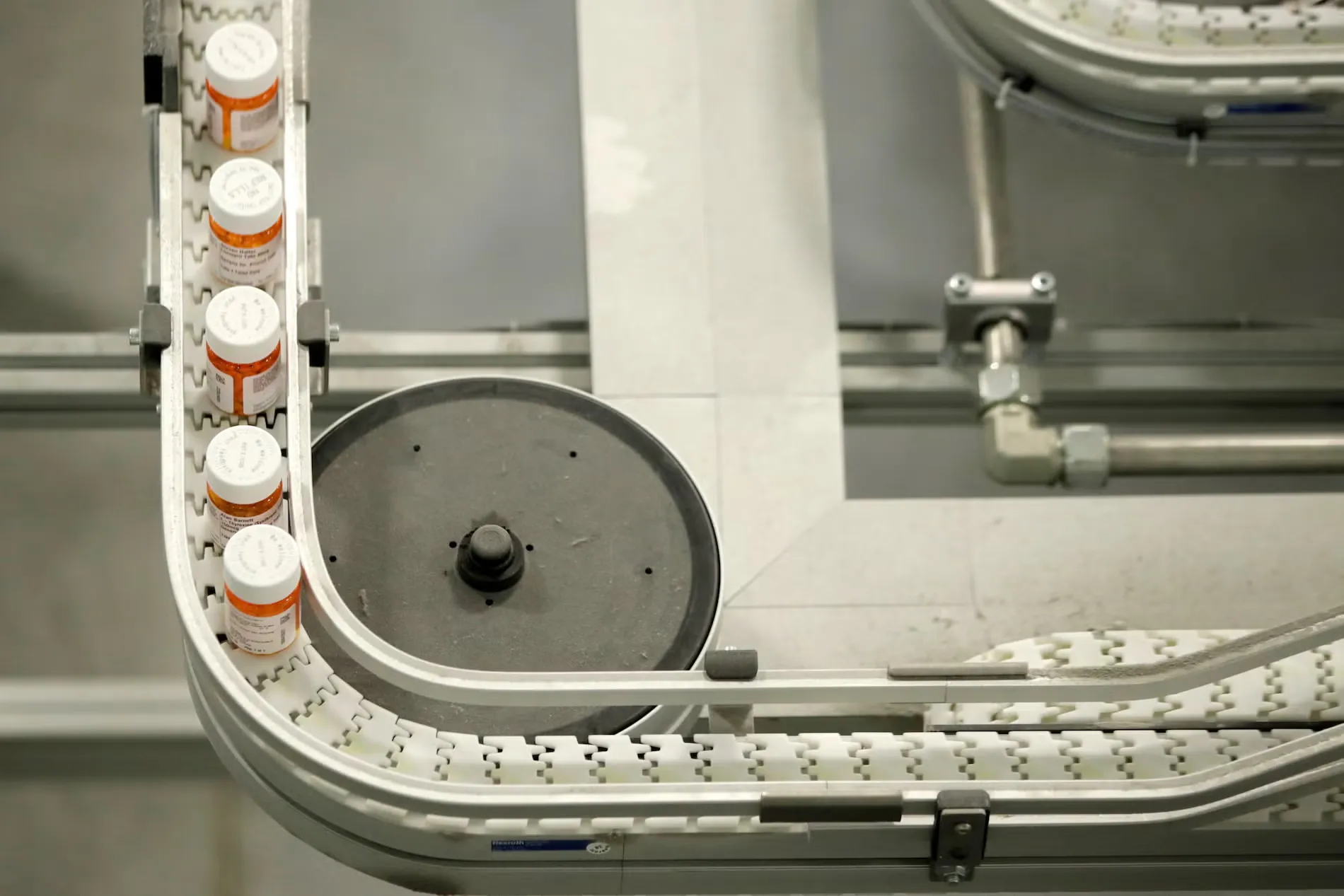 At its core, the plastic modular belt works on a simple but highly effective principle: individual rectangular modules, typically manufactured by injection moulding to tight dimensional tolerances, link together via hinge rods to form a continuous, laterally rigid, but longitudinally flexible belt. Each module is interchangeable with others of the same series, which means a line team in a Warrington chemical plant can carry a small stock of spare modules and replace a worn or chemically damaged section during a scheduled 20-minute break — rather than waiting 48 hours for a replacement flat belt to be spliced.
The geometry of the module — its pitch length, the height of its wearing surface, the percentage of open area in the grid — determines the belt’s functional characteristics. For chemical packaging specifically, a 30–45% open-area grid is typically specified because it allows all spilled product and wash-water to drain through the belt surface without pooling, which would otherwise create slip hazards and cross-contamination risk between product batches. The modular belt’s ability to run on low-friction UHMW-PE wear strips rather than traditional rollers also contributes to reduced running noise, which is increasingly relevant as UK Health and Safety Executive noise exposure guidelines become more rigorously enforced on packaging lines.
Drive is applied through sprockets that engage with the module hinge openings at defined tooth-to-module ratios. This positive drive mechanism eliminates the slippage that plagues friction-driven flat belts when wet — a particularly important point in chemical packaging plants where water is used continuously for cooling, cleaning, and safety systems.
🏆 Customer Success Case Study
Merseyside Industrial Chemical Blender — 40% Downtime Reduction
Industry: Industrial cleaning chemicals | Location: Liverpool, Merseyside, UK | Output: 1,200 units/hour
A well-established Merseyside manufacturer of industrial degreaser and sanitiser products was running a three-lane 500-ml HDPE bottle filling line on aging PVC flat belts. The facility’s aggressive CIP (Clean-in-Place) protocol — involving 2% sodium hydroxide solution at 60°C — was causing belt surface hardening and cracking within four to five months of installation. Combined with frequent mis-tracking on the labelling machine infeed, unplanned stoppages were averaging 6.5 hours per week across the three lanes, costing the business an estimated £95,000 per annum in lost production, labour overtime, and consumable waste.
After an application audit, we specified PP flat-top plastic modular belts with SS316 hinge rods for the filling and capping sections, and POM acetal flush-grid belts for the labelling machine infeed. The installation — carried out over a single planned weekend shutdown — included new low-friction wear strips and redesigned side-guide profiles to accommodate the modular belt’s slightly different running characteristics versus the old flat belt.
Results after 12 months: Unplanned downtime fell to an average of 3.8 hours per week (a 42% reduction). No belt replacements were required during that period — only six individual module swaps. The annual saving was calculated at £61,000 against an equipment investment of £14,800. The maintenance supervisor noted that his team could now manage belt servicing independently without calling in a specialist contractor.
Τι λένε οι πελάτες μας
⭐⭐⭐⭐⭐
“We’ve been running Ever Power modular belts on our corrosive chemical packaging line in Teesside for over two years without a single unplanned belt failure. The difference compared to what we had before is genuinely night and day. The ROI case was straightforward.”
— David R., Engineering Manager Specialty Coatings Manufacturer, Stockton-on-Tees
⭐⭐⭐⭐⭐
“The acetal modular belt on our labelling infeed sorted the label registration problem we’d been chasing for 18 months. The application engineering advice was spot-on — they knew exactly what spec to recommend without us having to run an extended trial.”
— Sarah T., Production Manager Household Cleaning Products, Greater Manchester
⭐⭐⭐⭐⭐
“We needed a non-standard belt width and a custom side-wall height for our drum conveyor. Ever Power’s team turned around a fully custom sample within two weeks. No other supplier came close on lead time or willingness to discuss the technical brief in detail.”
— James W., Operations Director Agricultural Chemical Distributor, East Midlands
🏭 Custom Manufacturing — Built Exactly for Your Line
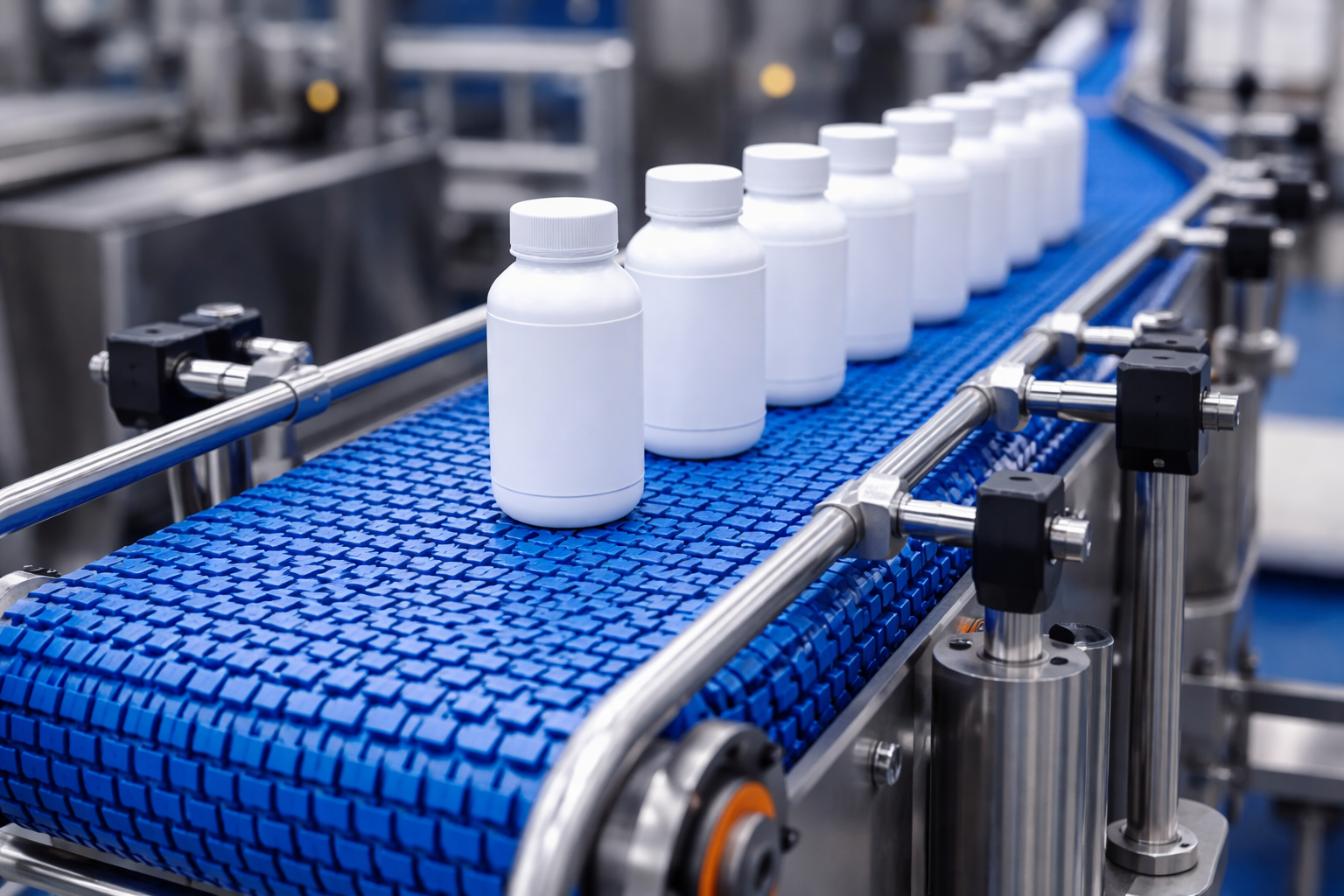 Chemical packaging lines are rarely identical. A facility in Birmingham processing five-litre solvent containers on a 900-mm wide conveyor has fundamentally different requirements from a Yorkshire agrochemical plant running 20-litre drums in a corrosive atmosphere where ATEX Zone 2 certification applies. Ever Power’s manufacturing capability is built around this reality. We do not operate on a catalogue-only basis.
Our production facility operates dedicated injection moulding lines for modular belt components, supported by in-house tooling capability that allows us to produce non-standard module geometries — including extended-pitch modules, raised-edge variants for lateral containment, and punched-top modules for enhanced drainage — without the six-to-eight week lead times that specialist orders typically attract from distributors. Custom belt widths from 150 mm to 2,400 mm are regularly supplied to UK packaging and chemical processing customers, with full dimensional inspection documentation provided as standard.
Our technical team is available to assist with belt selection, conveyor frame modification advice, and on-site commissioning support across mainland England, Scotland, and Wales. We also carry consignment stock at our UK logistics hub for fast turnaround on replacement modules for existing customers — because when a line is down, next-day delivery matters more than any catalogue description.
🇬🇧 Supplying Chemical Packaging Operations Across the United Kingdom
The United Kingdom’s chemical packaging sector is concentrated in several key industrial regions — Teesside and Humberside in the northeast, Merseyside and Greater Manchester in the northwest, the West Midlands corridor, and the Thames Estuary industrial zone in the southeast. Each of those regions presents slightly different operational challenges. Teesside chemical plants often operate in coastal salt-air environments that accelerate metal corrosion; Greater Manchester packaging operations frequently run multi-shift patterns that put very high cycle demands on conveyor components; West Midlands automotive chemical packagers often require chemically resistant belts that can also carry hot containers from thermal shrink tunnels.
We maintain active supply relationships with chemical packaging businesses in all of those regions, and we understand the regulatory landscape that governs them — from REACH compliance for belt materials that may contact product, to PSSR (Pressure Systems Safety Regulations) considerations for integrated belt-and-conveyor systems, to the BS EN ISO 9001:2015 quality management expectations that most UK chemical packagers now require from their supply chain. When you specify a πλαστική αρθρωτή ζώνη from Ever Power, you receive full material traceability documentation, a declaration of conformity, and a recommended installation and inspection schedule aligned with your existing PPM programme.
Συχνές ερωτήσεις
Ready to Upgrade Your Chemical Packaging Line?
Speak to an application engineer with over 18 years of experience in plastic modular belt systems for chemical packaging. We serve customers across England, Scotland, and Wales.
📧 Λάβετε μια προσφορά — [email protected]
επεξεργασία από gzl