 The pharmaceutical manufacturing sector in the United Kingdom demands precision, hygiene and uninterrupted throughput in equal measure. Solid dosage forms — tablets, hard-shell capsules, soft gels and blister-packed units — move through dozens of processing stations before they ever reach a patient’s hand. Every one of those transfer points is a potential source of contamination, product loss or unplanned downtime. Plastic modular belt conveyor systems have steadily become the preferred solution across GMP-regulated UK facilities because they address each of those risks without compromising line speed or flexibility. Unlike traditional flat-wire mesh or rubber belting, a well-chosen plastic modular belt can be sanitised to the level demanded by MHRA guidelines, rebuilt in sections during a shift change rather than replaced wholesale, and configured with open-lattice or flat-top surfaces to suit both dry-coating drums and high-speed blister packaging lines. This guide draws on more than eighteen years of application engineering experience to explain exactly why, where and how plastic modular belts outperform alternatives when pharmaceutical solid dosage is the cargo.
Facilities from Cheshire’s API processing plants to London’s contract manufacturing organisations are already operating plastic modular belt systems on their solid dosage lines. The shift is not merely a purchasing trend — it reflects a genuine change in what production managers expect from their conveying infrastructure. When a single batch of solid dosage product can be worth hundreds of thousands of pounds, every engineering decision on the conveyor line carries significant commercial weight, and choosing the wrong belt type is a risk very few quality teams are willing to accept twice.
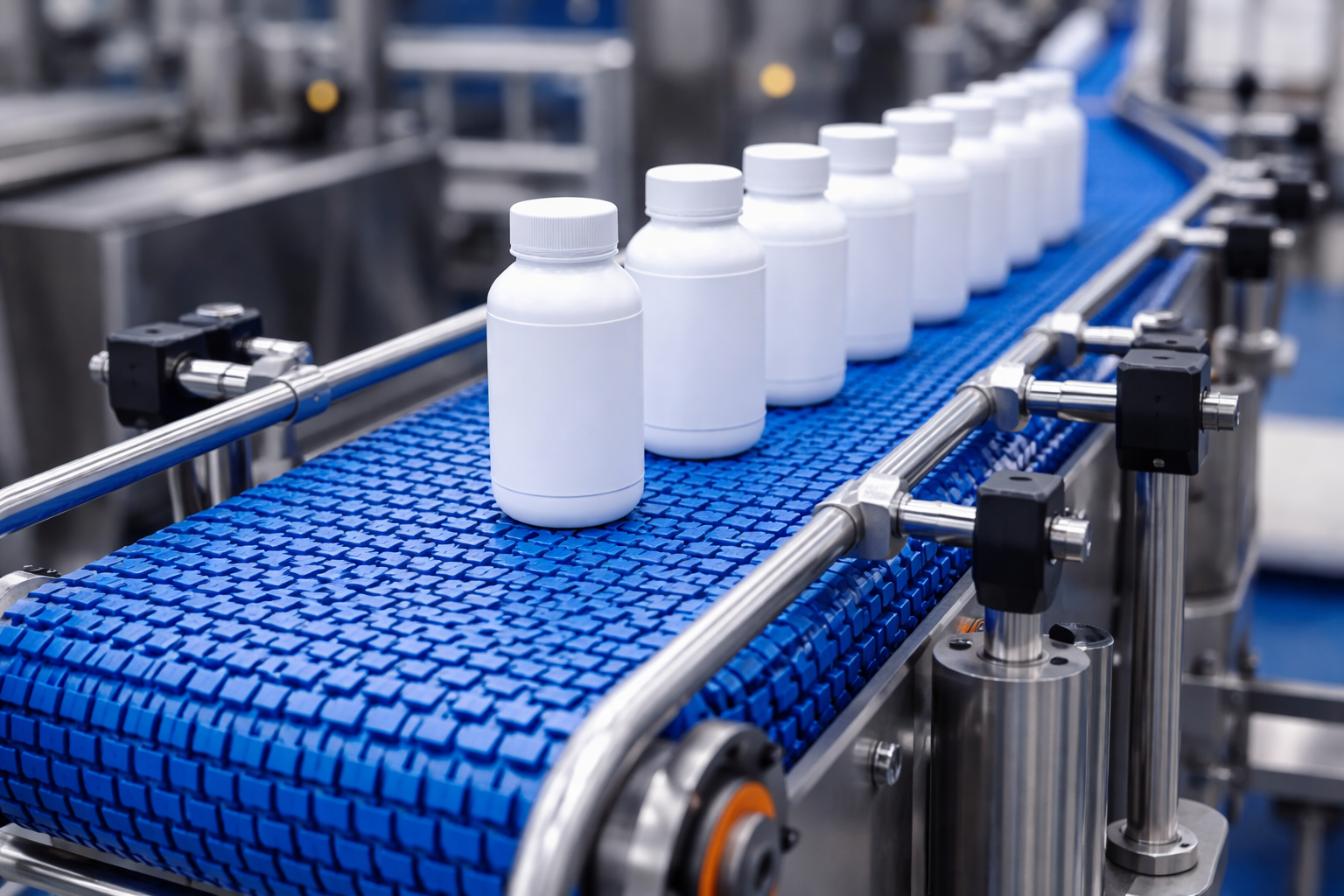
Plastic modular belt system deployed on a GMP-compliant solid dosage tablet conveyor line
Why Pharmaceutical Solid Dosage Lines Demand Modular Plastic Belting
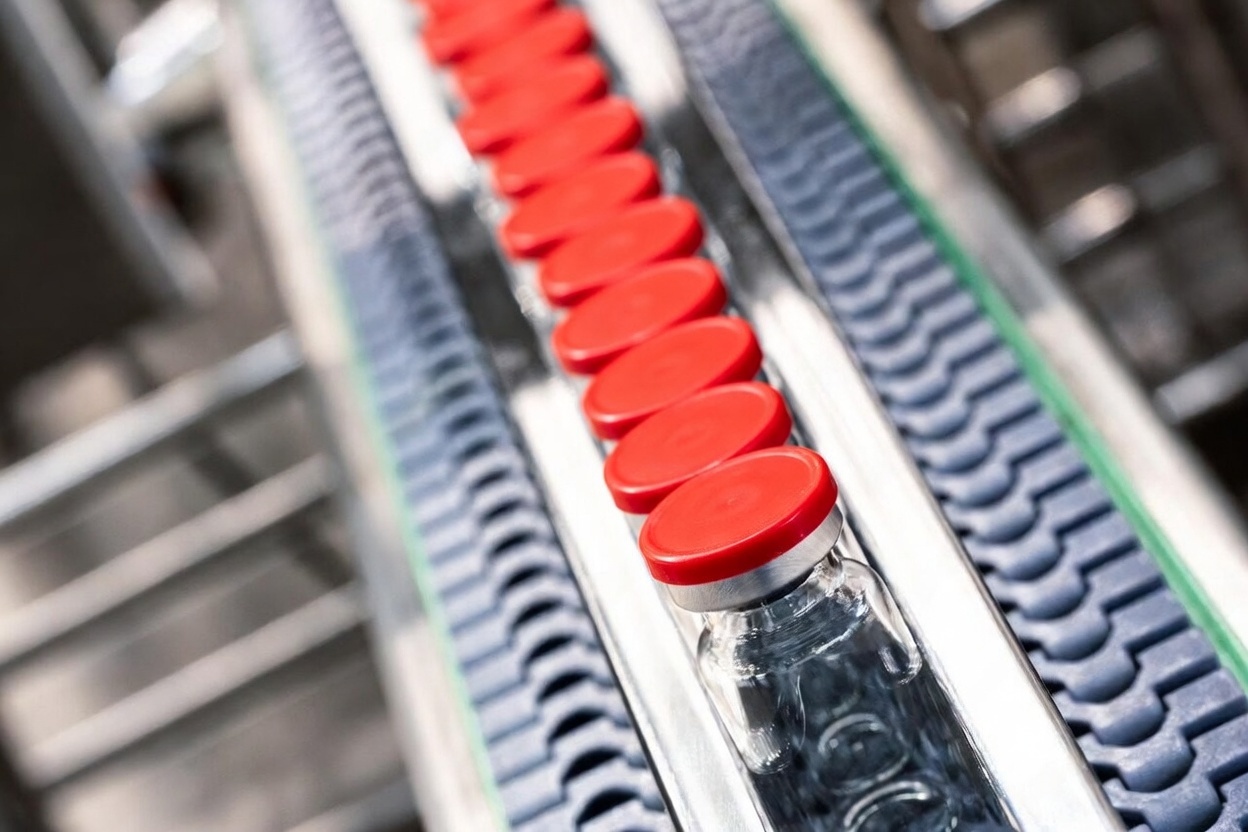 The chemistry of solid dosage manufacturing creates a uniquely hostile environment for conventional conveyor belting. Coating pan exhaust deposits sugar dust and polymer film residues that cling to textured rubber surfaces. Tablet presses generate a continuous fine powder mist that works its way into every crevice of woven wire mesh. When wash-down time arrives, neither of those belt types can be fully dismantled and submerged without risking corrosion, delamination or structural degradation. Plastic modular belts — typically fabricated from polypropylene, acetal or UHMW polyethylene — present none of those weaknesses. Individual modules interlock mechanically, so a maintenance technician can replace a single damaged section in minutes rather than condemning an entire belt run. The smooth, non-porous module surfaces carry no hidden reservoirs for microbial growth, and most food and pharmaceutical-grade compounds are compatible with the standard cleaning agents and CIP (clean-in-place) protocols already in use across British GMP facilities.
Perhaps the most commercially compelling advantage is the direct impact on OEE (Overall Equipment Effectiveness). UK pharmaceutical manufacturers operating under tightly scheduled batch windows cannot afford three-hour belt-replacement jobs during a planned changeover. With a plastic modular belt, a team of two can carry out a full module inspection and replace any worn sections during a standard 45-minute cleaning interval. That kind of maintainability is not a minor convenience — it is a measurable contribution to production capacity. Validated cleaning procedures are also significantly easier to develop around modular plastic surfaces, because regulatory submissions can reference the geometry of individual modules rather than trying to qualify a heterogeneous woven structure that varies slightly with every manufacturing batch from the belt supplier.
GMP-Compliant Hygiene
Non-porous module surfaces, validated CIP compatibility, and no hidden crevices for microbial harbour. Meets MHRA and EU GMP Annex 1 expectations.
Modular Maintainability
Replace individual modules in under 45 minutes, not full belt runs. Dramatically reduces planned downtime and emergency response time on solid dosage lines.
Configurable for Any Dosage Form
Flat-top, open-grid, side-flexing and radius belt variants accommodate tablets, capsules, soft gels, blister packs and sachets on the same infrastructure.
Technical & Performance Parameters
The table below summarises the key performance characteristics of pharmaceutical-grade plastic modular belt configurations suitable for UK solid dosage conveyor lines. Values represent standard catalogue specifications; custom configurations are available on request.
Key Application Scenarios in Solid Dosage Production
The plastic modular belt earns its place on UK pharmaceutical lines not through a single killer feature but through consistent performance across every major solid dosage application. In tablet compression cells, the belt runs directly beneath the outlet chute of the tablet press, accepting a continuous cascade of finished cores. The flat-top module surface prevents tablets from wedging between links — a chronic problem with early-generation wire mesh — while the tightly controlled pitch ensures that single-file counting heads downstream see a uniform product flow rather than the bunching and gapping that degrades count accuracy at speed. Facilities running double-sided presses at 400,000 tablets per hour regularly specify 12.7 mm pitch acetal flat-top belt for exactly this reason.
In film and sugar coating departments, the open-grid variant of the plastic modular belt handles hot exhaust air from the coating drum without retaining heat or moisture, reducing the risk of coating defects caused by condensation on the conveyor surface. The same open architecture makes CIP far more effective, because cleaning fluid penetrates the entire belt cross-section rather than pooling on top of a closed surface. British contract manufacturers who run multiple product families through the same coating equipment particularly value this attribute — cross-contamination validation is markedly simpler when the belt surface has demonstrably no capacity to harbour residue.
Blister-pack feeding lines present a different set of engineering challenges. Aluminium-foil blisters are dimensionally variable and prone to skewing on narrow belts. Side-flexing plastic modular belt configurations allow horizontal curves of 500 mm radius or tighter, which means packaging hall designers can route the conveyor around obstacles without adding expensive transfer points. Every additional transfer point in a blister line is a potential jam location, a potential edge-damage source and a potential regulatory concern. Eliminating even one such point with a curved modular belt section often pays for the belt upgrade within a single quarter’s operation.
Flat-top 12.7 mm pitch belt prevents wedging, supports high-speed counting heads, maintains single-file product flow at up to 400,000 tablets/hr.
Open-grid modules drain hot exhaust moisture, simplify CIP validation, and eliminate cross-contamination harbour points between product changeovers.
Side-flexing radius belts achieve 500 mm horizontal curves, eliminating transfer points and reducing skew-related jams in high-speed blister packaging lines.
UHMW-PE low-friction surface reduces capsule shell abrasion, preserving print quality and maintaining fill weight integrity from filler to checkweigher.
Working Principles, Materials and Engineering Logic
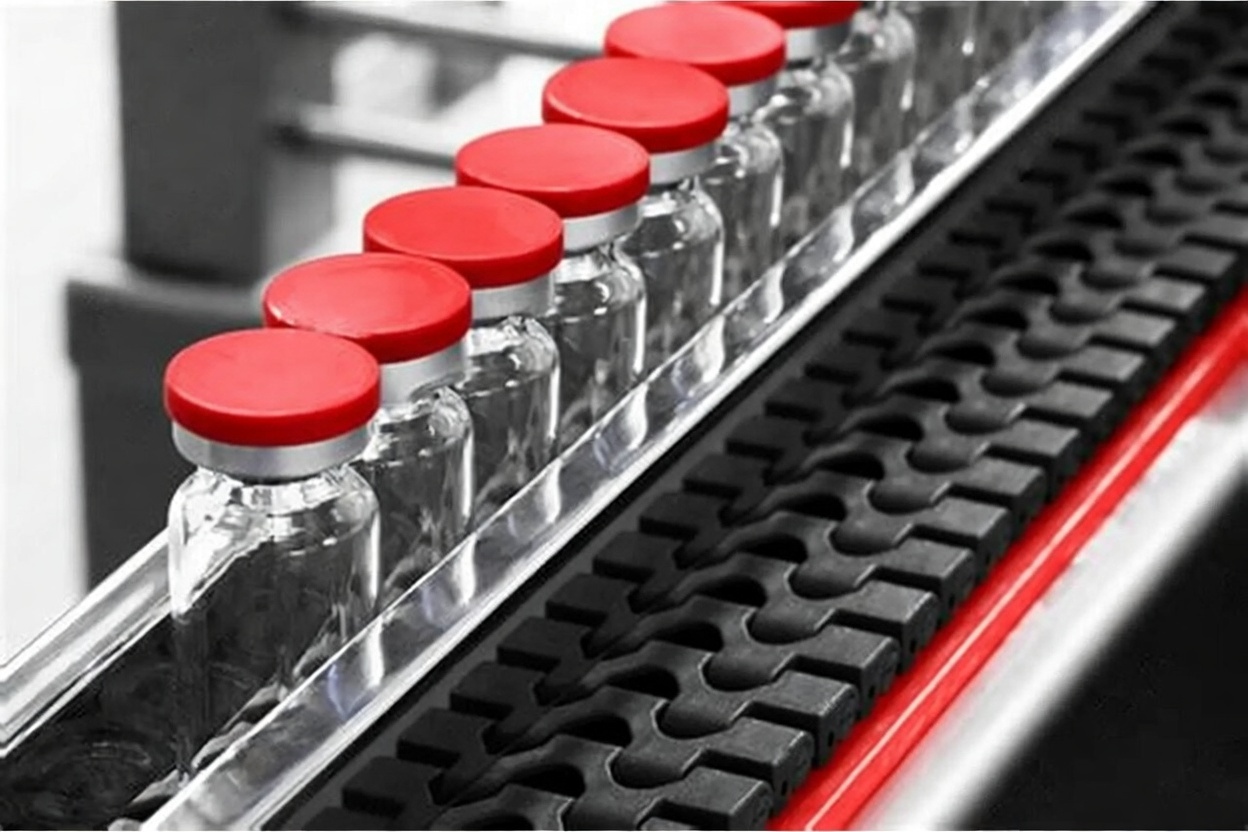 A plastic modular belt functions on a straightforward mechanical principle: individual injection-moulded modules, each typically 25 to 100 mm in length, are connected transversely by stainless steel or plastic hinge rods. As the assembled belt travels around a sprocket, the hinge joints articulate freely. Because the articulation occurs at a precisely defined point — the hinge axis — the belt wraps sprockets with negligible variation in pitch, which is critically important in pharmaceutical applications where even minor speed fluctuations translate to weight variations at dosing stations. The sprocket engagement is positive-drive, meaning the belt cannot slip under load the way a friction-driven rubber belt can. That positive drive characteristic directly supports the process engineer’s target of consistent mass-flow rate through the conveyor system.
Material selection is the single most consequential engineering decision in any pharmaceutical belt specification. Polypropylene remains the workhorse material for ambient-temperature applications — it is chemically resistant to the isopropyl alcohol and sodium hypochlorite solutions used in routine GMP cleaning, and it can be pigmented to the blue or white colours that facilitate visual inspection under facility lighting. Where higher dimensional stability is required, such as on precision counting lines where belt sag could throw off sensor alignment, acetal (polyoxymethylene) modules provide approximately 40% greater stiffness at a modest cost premium. For applications involving temperature extremes — validated cold-store packaging lines serving the UK’s growing biologics sector, or ovens used to dry granules before compression — UHMW-PE grade modules maintain their mechanical properties across the widest temperature window of any standard pharmaceutical belt material. All three materials are available in X-ray and metal-detectable variants, which many UK packaging validation protocols now require as a standard specification.
Customer Success: Northern England Contract Manufacturer
Pharmalex Contract Manufacturing Ltd — Leeds, West Yorkshire, UK
The Challenge: The facility was running a 1,200 mm wide rubber belt conveyor system between its tablet compression suite and primary packaging hall. After every batch cycle, the belt required a minimum of 90 minutes for manual cleaning and inspection. The textured rubber surface repeatedly failed ATP swab tests, requiring full re-cleaning, and on three occasions in twelve months the line was shut down pending an investigation into residual particulate matter detected on the belt surface during environmental monitoring.
The Solution: A full replacement with 1,200 mm wide flat-top acetal plastic modular belt, paired with an integrated CIP spray bar system designed to reach all belt surfaces including the return run. The belt was specified in detectable blue to align with the facility’s colour-coded contamination-control programme and to satisfy packaging validation requirements.
The Outcome: Post-installation, the cleaning cycle reduced from 90 minutes to 38 minutes — a 58% reduction that freed an additional 52 minutes per batch for production. ATP swab test pass rate on the belt surface rose from 71% to 99.4% over the first six months of operation. The facility subsequently expanded the modular belt specification to two additional tablet lines and its entire blister-feeding infrastructure. The initial payback period was calculated at just over nine months based on recovered production capacity alone.
What UK Pharmaceutical Clients Say
“We had been battling cleaning validation failures on our compression outfeed for over a year. Switching to plastic modular belt resolved the issue within the first validation cycle. The team provided full traceability documentation that slotted directly into our quality system.”
— Production Director, OSD facility, Nottingham
“The side-flexing belt configuration on our blister line removed two transfer points entirely. We went from averaging three jams per shift to virtually none. For a site running six-day weeks, that’s an enormous improvement in OEE that went straight to the bottom line.”
— Engineering Manager, Contract Packager, Manchester
“The detectable blue modules were a non-negotiable requirement from our QA team. What impressed us was the speed with which a bespoke width was cut and delivered. Eight working days from purchase order to on-site testing is genuinely exceptional lead time for pharmaceutical capital equipment.”
— Procurement Lead, Tablet Manufacturer, Bristol
Custom Manufacturing & UK Supply Capability
Not every solid dosage line fits a standard belt catalogue. Our manufacturing facility operates dedicated injection moulding lines that can accommodate custom module widths from 50 mm to 1,500 mm, non-standard pitches for legacy drive systems, and special surface geometries including cleated, perforated and textured variants developed in direct collaboration with UK pharmaceutical engineers. Additive colour concentrates, FDA-certified lubricants for hinge rods, and custom hinge rod materials including polypropylene, polyethylene and stainless steel Grade 316L are all available as standard options from stock or short-run custom production. Our quality management system is ISO 9001:2015 certified, and we maintain a dedicated pharmaceutical documentation package that includes full material traceability, CoA (Certificate of Analysis), FDA compliance letters, and REACH declarations, all formatted for direct submission to MHRA dossiers or customer quality systems. For UK customers managing regulatory timelines, we offer dedicated account management and expedited documentation support to keep validation projects on schedule. Lead time for custom-width pharmaceutical belt runs starts at five working days for standard materials.
Serving the UK Pharmaceutical Manufacturing Sector
Britain’s life sciences manufacturing base — from the East Midlands’ established OSD clusters around Nottingham and Leicester, to Scotland’s growing API corridor between Edinburgh and Glasgow, to the dense contract manufacturing network around Manchester and Liverpool — operates under some of the most rigorous quality and regulatory frameworks in the world. When procurement teams in these facilities evaluate conveyor infrastructure, MHRA compliance documentation, GAMP 5-aligned qualification support, and post-sales technical response times are weighted heavily alongside unit cost. Our supply model is structured specifically around these priorities. We hold consignment stock of standard pharmaceutical-grade πλαστική αρθρωτή ζώνη in the United Kingdom, which means emergency replacement modules for critical solid dosage lines can be dispatched same-day to any postcode in England, Scotland or Wales.
Application engineers with direct pharmaceutical sector experience are available to assist UK customers at every stage of a project — from initial conveyor design review and belt selection, through FAT and SAT support, to post-commissioning optimisation. We understand that in a regulated manufacturing environment, a supplier who can provide only hardware is of limited value; what UK pharmaceutical clients need is a partner who can provide hardware, documentation and application knowledge in a single, accountable relationship. That is the service proposition behind every plastic modular belt system we supply to the British market, and it is why a growing number of UK pharmaceutical manufacturers now specify our products as their standard belt platform across all new-build solid dosage lines.
Συχνές ερωτήσεις
Ready to Upgrade Your Pharmaceutical Solid Dosage Conveyor?
Talk to an application engineer with 18+ years of pharmaceutical belt experience. Same-day quotes. Full MHRA documentation package. UK stock available.
© Ever Power Plastic Modular Belt | UK Pharmaceutical Conveyor Specialists | edit by gzl