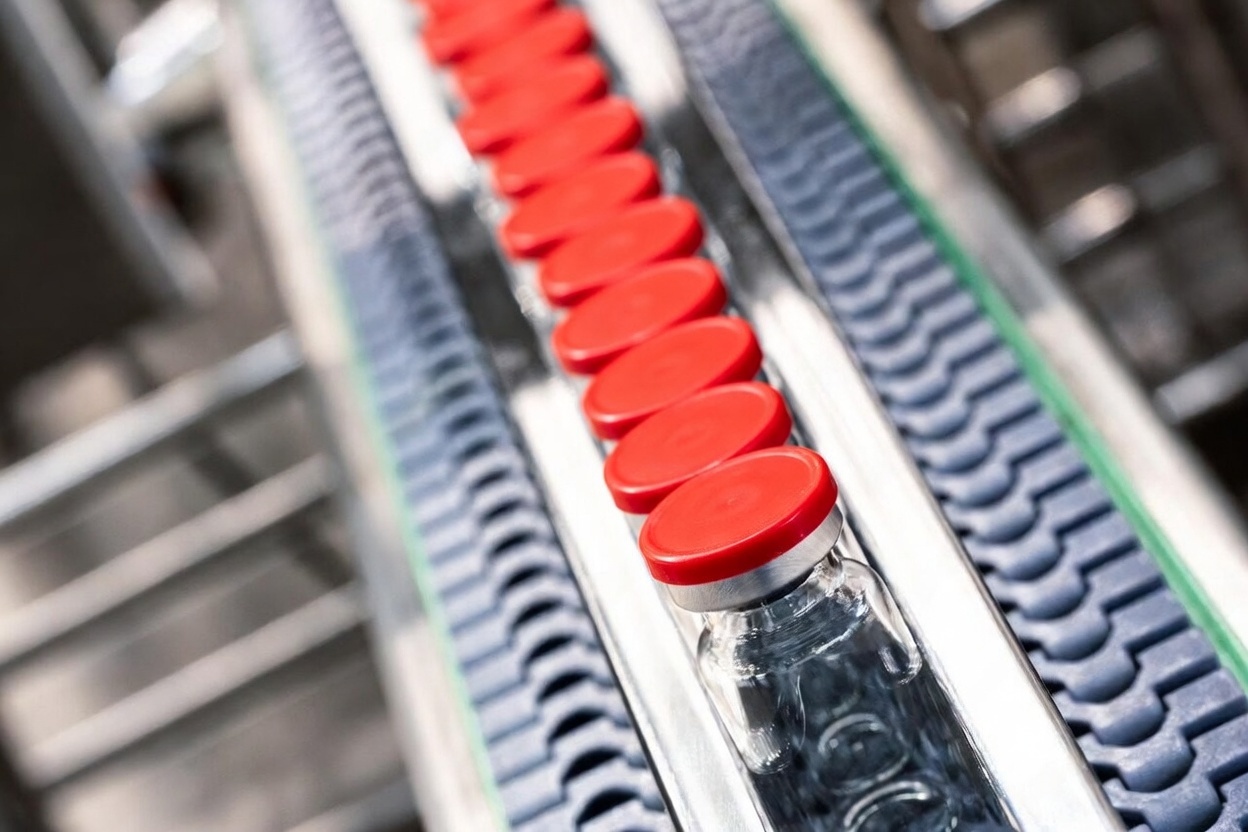
 Walk into any high-throughput pharmaceutical facility in the UK — whether it sits in the Cheshire life-science corridor, a purpose-built GMP site on the outskirts of Manchester, or a contract manufacturing organisation (CMO) near the M4 corridor — and you will almost certainly find plastic modular belt conveyors at the heart of the solid dosage production line. From the compression press outfeed all the way through coating drums, inspection cameras, blister sealing, and cartoning, the plastic modular belt has become the default mechanical backbone that keeps solid dosage forms moving safely, hygienically, and at the pace modern batch sizes demand. Yet the engineering decisions behind belt selection, surface pattern, material grade, and drive configuration are rarely straightforward. This guide draws on more than eighteen years of hands-on application engineering across UK and European pharma sites to give production engineers, maintenance managers, and procurement specialists the depth of information they need to specify — and get the most out of — a plastic modular belt installation on a solid dosage conveying line.
The choice between a plastic modular belt and a traditional flat rubber belt, wire mesh, or roller conveyor is never purely academic. In a GMP-regulated environment, every surface that contacts a product or is exposed to product dust is a potential contamination point, a potential harbour for microbial growth, and a scheduled cleaning task. Plastic modular belt systems, when correctly specified, eliminate many of the failure modes that plague legacy belt types — yet they introduce their own engineering considerations around module pitch, hinge-rod material, belt tracking, and backflex radius. Understanding these trade-offs in the context of solid dosage conveying is exactly what this article sets out to do.
📧 Get a Quote — Pharmaceutical Belt Enquiry
Response within 24 hours · UK & Global Supply · GMP Documentation Available
Why the Pharmaceutical Industry Relies on Plastic Modular Belt Conveyors
Engineering Rationale & Regulatory Context
Pharmaceutical solid dosage manufacturing in the United Kingdom operates under some of the world’s most rigorous regulatory frameworks — MHRA GMP guidelines, EU Annex 1 and Annex 15 requirements, and increasingly, FDA 21 CFR Part 211 expectations for those facilities with US export licences. Within this environment, every piece of process equipment must be demonstrably cleanable, verifiably free from contamination risk, and capable of sustaining consistent performance across validated cleaning procedures. The plastic modular belt delivers against each of these requirements in ways that older conveyor technologies simply cannot match.
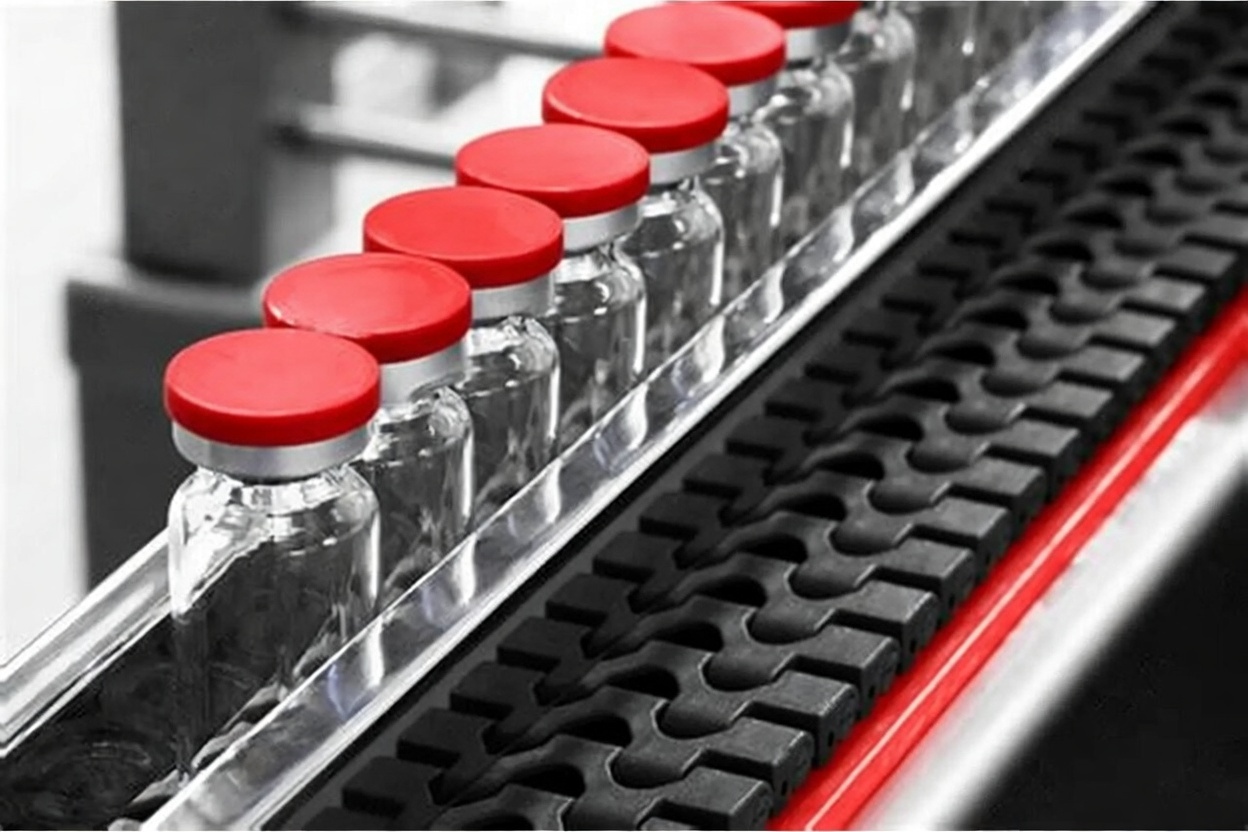
Unlike a rubber flat belt — which degrades under the alkaline cleaning agents common in pharmaceutical CIP protocols, harbours micro-organisms in surface cracks, and cannot be disassembled for inspection — a plastic modular belt is built from individual interlocked modules that can be removed, inspected, and replaced in sections. The open-hinge architecture allows cleaning fluids to penetrate all contact surfaces. FDA-compliant polypropylene (PP) and acetal (POM) module materials resist both acidic and alkaline wash solutions, and they carry no plasticiser compounds that could migrate into pharmaceutical product dust or coating spray droplets.
From a purely mechanical standpoint, the plastic modular belt also offers exceptional design flexibility. Flat-top modules suit tablet transfer between compression and dedust stages. Perforated modules accelerate air flow beneath film-coated tablets emerging from coating pans. Radius belts navigate the tight horizontal curves common in compact pharmaceutical cleanroom layouts. Side-flexing configurations allow a single continuous plastic modular belt run to traverse multiple turns without transfer points — each transfer point being a potential tablet chip, edge-damage, or cross-contamination site.
Technical Specifications & Material Properties
Performance Parameters for Pharmaceutical-Grade Belts
All material grades carry relevant FDA 21 CFR / EU 10/2011 food-contact declarations. SS 316L hinge rods recommended for all wash-down pharmaceutical environments.
Core Product Advantages Over Conventional Belt Types
Engineering Benefits for Pharmaceutical Operations
Δυνατότητα επισκευής σε αρθρωτά μέρη
Replace individual damaged modules in minutes without removing the entire belt. Planned maintenance windows shrink dramatically. Spare-part inventory is minimal — one module type covers any damaged section across belt width.
Superior Hygiene Architecture
Open-hinge construction eliminates hidden cavities that trap product residue. Full disassembly for manual cleaning requires no specialist tools. Validated cleaning protocols accepted by MHRA inspectors.
Ευελιξία Σχεδιασμού
Straight, radius, side-flexing, incline, and spiral configurations all available in the same modular belt platform. Redesign conveying layouts without replacing drive and structural components.
Positive-Drive Precision
Sprocket-driven engagement eliminates belt slip under varying load conditions. Speed accuracy of ±0.5% supports process validation requirements for weight-per-unit-time measurements and camera-system synchronisation.
Lower Lifetime Cost
Section-by-section replacement rather than full-belt replacement means maintenance spend is proportional to actual wear. Typical plastic modular belt service life of 5–8 years versus 18–24 months for rubber flat belts in wash-down pharma environments.
Full Regulatory Documentation
Material certificates, FDA declarations, RoHS compliance, and full traceability documentation provided as standard — supporting IQ/OQ/PQ validation packages required by UK and EU regulatory submissions.
Customer Success: Northgate Pharma UK — Complete Line Retrofit
Real-World Results · UK Contract Manufacturing Organisation
🏭 Contract Pharma Manufacturing
📅 2023 Project
Η Πρόκληση
Northgate Pharma, a mid-sized CMO producing 22 solid dosage products across four production suites, was experiencing escalating downtime costs driven by rubber flat belt failures on its three main tablet packaging lines. Average belt replacement time was 4.5 hours per incident, changeover cleaning validation was consuming 3.2 hours per product switch, and the maintenance team was raising repeated concerns about surface degradation on the existing belts that presented a contamination risk to multi-product operations. A full MHRA inspection in 2022 had included an observation on the state of one belt surface, adding regulatory urgency to what was already a significant operational problem.
The Ever Power Solution
Working with the site engineering team over an eight-week design phase, Ever Power specified a complete plastic modular belt retrofit across all three packaging lines. POM flat-top 25.4 mm pitch belts were installed on the tablet transfer and blister-feed sections, while perforated PP modules were fitted to the post-coating cooling conveyors. SS 316L hinge rods were standardised across all belts to align with the site’s existing corrosion-control cleaning protocol. Custom belt widths were produced to match the existing conveyor frame dimensions, avoiding any structural modifications and keeping the project within approved capital budget.
Measurable Outcomes
Τι λένε οι πελάτες μας
“We had tried two other modular belt suppliers over the years and neither could provide the material traceability documentation our QA team needed for the validation dossier. Ever Power delivered full material certs, FDA declarations, and a comprehensive IQ template within the project timeline — that made all the difference to our regulatory submission.”
“The perforated belt sections on our coating pan outfeed have cut our cooling conveyor length by nearly two metres compared to the previous solid-surface belt. In a cleanroom environment where every metre costs, this was a genuinely significant gain. Product quality on the tablets is measurably better as well — fewer coating micro-cracks from over-warm handling.”
“What sets Ever Power apart is how they approach the customisation conversation. We had a non-standard conveyor frame width — 640 mm — that no catalogue product could match. Their engineering team turned around a custom module drawing for approval within four working days, and the belts arrived dimensionally perfect. That level of responsiveness is rare in belt supply.”
Ever Power: Manufacturing Capability & Custom Belt Engineering
Factory Capacity · Bespoke Solutions · Global Supply
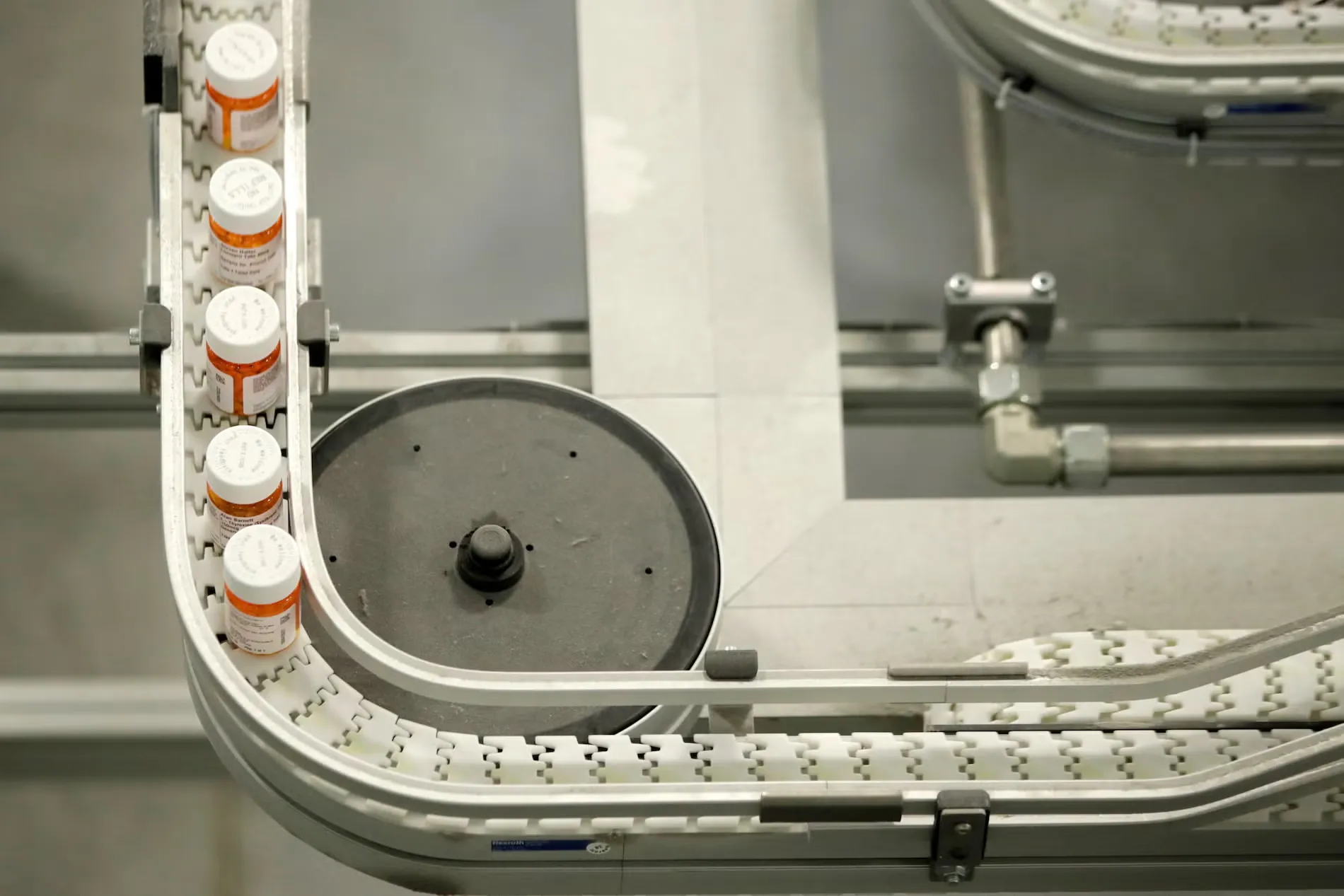 Ever Power operates a purpose-built plastic modular belt manufacturing facility with over 15,000 m² of production floor space, equipped with dedicated injection moulding lines for PP, POM, and UHMWPE module production, precision hinge-rod cutting and inspection stations, and a dedicated quality laboratory with tensile testing, dimensional verification, and material certification capabilities. With ISO 9001:2015 certification and a documented product traceability system, the factory supports the documentation requirements of UK and European pharmaceutical customers without exception.
Custom belt engineering is a core competency — not an occasional exception. The Ever Power technical team works directly with customers’ conveyor design engineers to develop bespoke module geometries, non-standard belt widths (from 100 mm to 2,000 mm), special surface textures for specific product-handling requirements, colour-coded modules for cross-contamination control in multi-product facilities, and custom hinge-rod materials for aggressive chemical environments. Lead times for standard pharmaceutical-grade πλαστική αρθρωτή ζώνη are typically 10–15 working days. Custom-engineered belts are delivered within 20–30 working days depending on complexity. UK stock of common pharmaceutical belt types is maintained for emergency replacement supply.
Συχνές ερωτήσεις
Pharmaceutical Belt Application · UK Buyer Questions
Ready to Upgrade Your Pharmaceutical Conveying Line?
Get a tailored plastic modular belt specification with full GMP documentation from our engineering team. UK pharmaceutical enquiries answered within one business day.
Get a Quote · [email protected]
Ever Power · Pharmaceutical-Grade Plastic Modular Belt · Supplying UK, Europe & Global
επεξεργασία από gzl