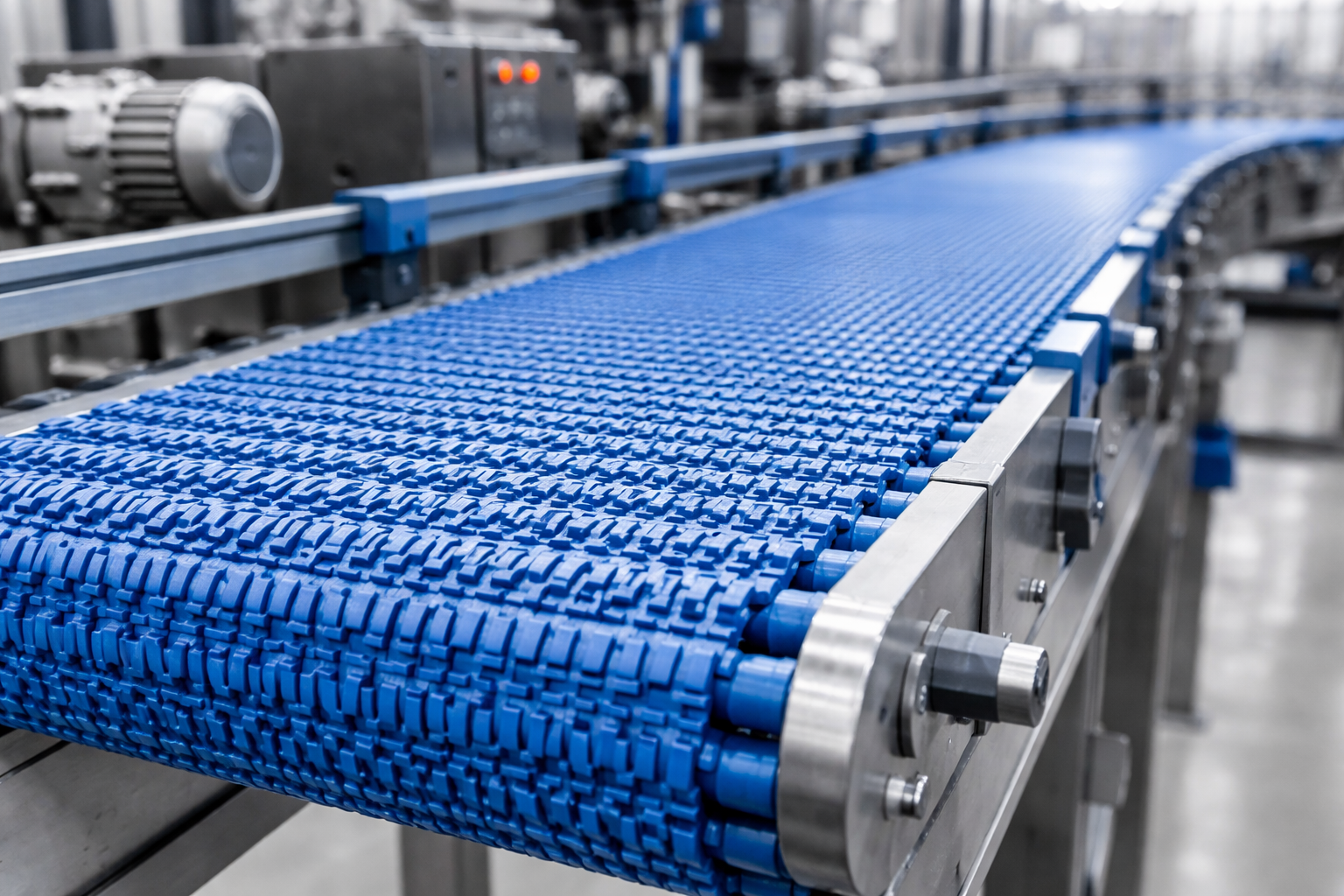
 The British parcel delivery market processed an estimated 4.3 billion parcels in 2024, and that volume is climbing. Behind every next-day delivery promise sits a network of sortation machines that must operate without hesitation — 20 hours a day, 365 days a year. At the mechanical heart of those systems, the plastic modular belt has quietly become the engineering standard of choice for forward-thinking logistics engineers across the UK. Unlike traditional flat belts or roller conveyors, a modular belt is constructed from interlocking thermoplastic modules assembled onto a common hinge pin, creating a continuous, highly customisable surface that can be tailored to precise dimensional requirements with no field splicing required.
This structure gives the plastic modular belt a unique advantage in high-intensity sortation environments: individual modules can be replaced in minutes without removing the entire belt from the line, scheduled preventive maintenance windows shrink dramatically, and the belt surface itself can be engineered with specific friction values, open-area percentages, and lateral-flex geometry to handle everything from rigid cardboard boxes to soft polybag shipments. The following article draws on more than 18 years of hands-on application experience to explain exactly how and why plastic modular belts are specified for express parcel sortation lines — and what UK operators need to know before making a procurement decision.
How a Plastic Modular Belt Actually Works Inside a Sortation System
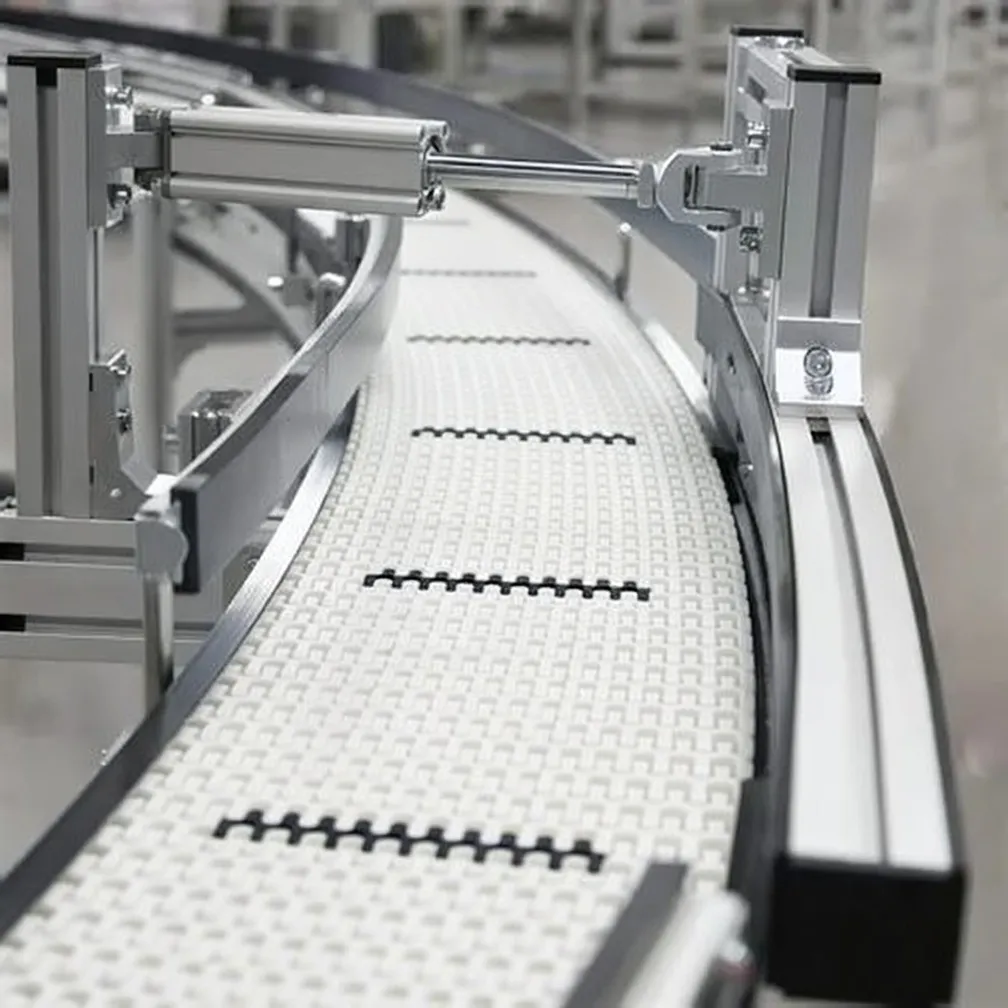 A plastic modular belt on a main sortation conveyor operates on a positive-drive principle. Sprockets engage with the belt’s module pitch — typically 25.4 mm, 38.1 mm, or 50.8 mm depending on load requirements — driving the belt forward with minimal slippage compared to friction-driven flat belts. The modular structure spans across a series of wearstrips or a solid bed depending on the application’s hygiene and noise requirements, and the hinge pins — generally manufactured from stainless steel or acetal — transmit the tension uniformly across the full belt width.
For express parcel sortation specifically, two belt geometries dominate: the flat-top module for stable parcel transport and accumulation zones, and the raised-rib or roller-top module for the divert sections where parcels need to transfer laterally onto chutes or destination spurs. A well-engineered sortation line uses flat-top plastic modular belts along the primary trunk conveyor and transitions to roller-top or omni-directional roller modules at the divert points, giving the system both high throughput on the trunk and smooth, low-impact lateral deflection at the sort station — critical for protecting fragile e-commerce goods. The belt material itself is usually polypropylene (PP) for general-duty lines or acetal (POM) where higher dimensional stability and lower friction on the wearstrips are required; both are fully compatible with the damp-wipe cleaning regimes common in UK distribution centres.
Positive Drive Mechanism
Sprocket-to-module engagement eliminates belt slip under variable load — essential when parcel weight varies from 50 g envelopes to 30 kg cartons on the same line.
Module-Level Replacement
A damaged section can be swapped by one technician in under 15 minutes using standard tools — no belt splicing, no specialist contractor, no extended line shutdown.
Surface Engineering Flexibility
Flat-top, roller-top, raised-rib, and open-grid surfaces can be mixed within a single conveyor run, optimising each zone for its specific handling task.
Technical Performance Parameters — Sortation-Grade Plastic Modular Belt
| Παράμετρος | Standard PP Grade | Βαθμός ακετάλης (POM) | Notes |
|---|---|---|---|
| Βήμα ενότητας | 25,4 χιλ. / 38,1 χιλ. / 50,8 χιλ. | 25,4 χιλ. / 38,1 χιλ. | Finer pitch for lighter parcels |
| Θερμοκρασία λειτουργίας | -10 °C to +80 °C | -20 °C έως +90 °C | Suitable for chilled DC environments |
| Max Belt Speed | Up to 2.5 m/s | Up to 3.0 m/s | High-throughput sortation certified |
| Max Load per Module | Up to 12 kg distributed | Up to 18 kg distributed | Per 305 mm x 305 mm module area |
| Διαθέσιμο πλάτος ζώνης | 300 mm – 2,400 mm | 300 mm – 1,800 mm | Custom widths on request |
| Αντοχή σε εφελκυσμό | ≥ 3,800 N / m width | ≥ 5,200 N / m width | Tested to EN ISO 527-2 |
| Coefficient of Friction (top) | 0.18 – 0.35 (flat-top) | 0.12 – 0.28 (flat-top) | Friction-modified grades available |
| Συμμόρφωση | FDA / EU 10/2011 food-contact | FDA / EU 10/2011 food-contact | RoHS compliant; REACH verified |
Six Key Application Zones Where Plastic Modular Belt Proves Its Worth
Ζώνη 01
Induction / Singulation
High-friction flat-top plastic modular belt surfaces hold parcels stable during the acceleration phase from manual induction to the scan tunnel, preventing skewing that causes barcode read failures and jam events.
Ζώνη 02
Main Trunk Conveyor
The primary high-speed trunk relies on a wide, low-friction acetal modular belt running at up to 3.0 m/s. The positive-drive system maintains consistent speed regardless of varying parcel density along the belt.
Ζώνη 03
Divert & Transfer
Roller-top and omni-directional roller modules embedded within the plastic modular belt framework allow precise lateral transfer to destination chutes with minimal parcel tumbling — protecting fragile or premium goods.
Ζώνη 04
Accumulation Zones
Zero-pressure accumulation sections use low back-pressure open-grid plastic modular belt running beneath driven rollers, allowing parcels to queue without contact pressure damage — important for light polybag shipments.
Ζώνη 05
Returns Processing
Heavier, often irregularly shaped return items demand a wider-pitch, higher-strength plastic modular belt. Flat-top POM grades with raised side guides prevent returns from rolling off at corners on inclined conveyor sections.
Ζώνη 06
Loading Bay Output
At the outbound loading bays, inclined plastic modular belt conveyors bridge the gap between sortation chute and trailer floor. The positive drive holds heavy loaded roll-cages securely on inclines of up to 30°.
Why Logistics Engineers in the UK Specify Plastic Modular Belt Over Alternatives
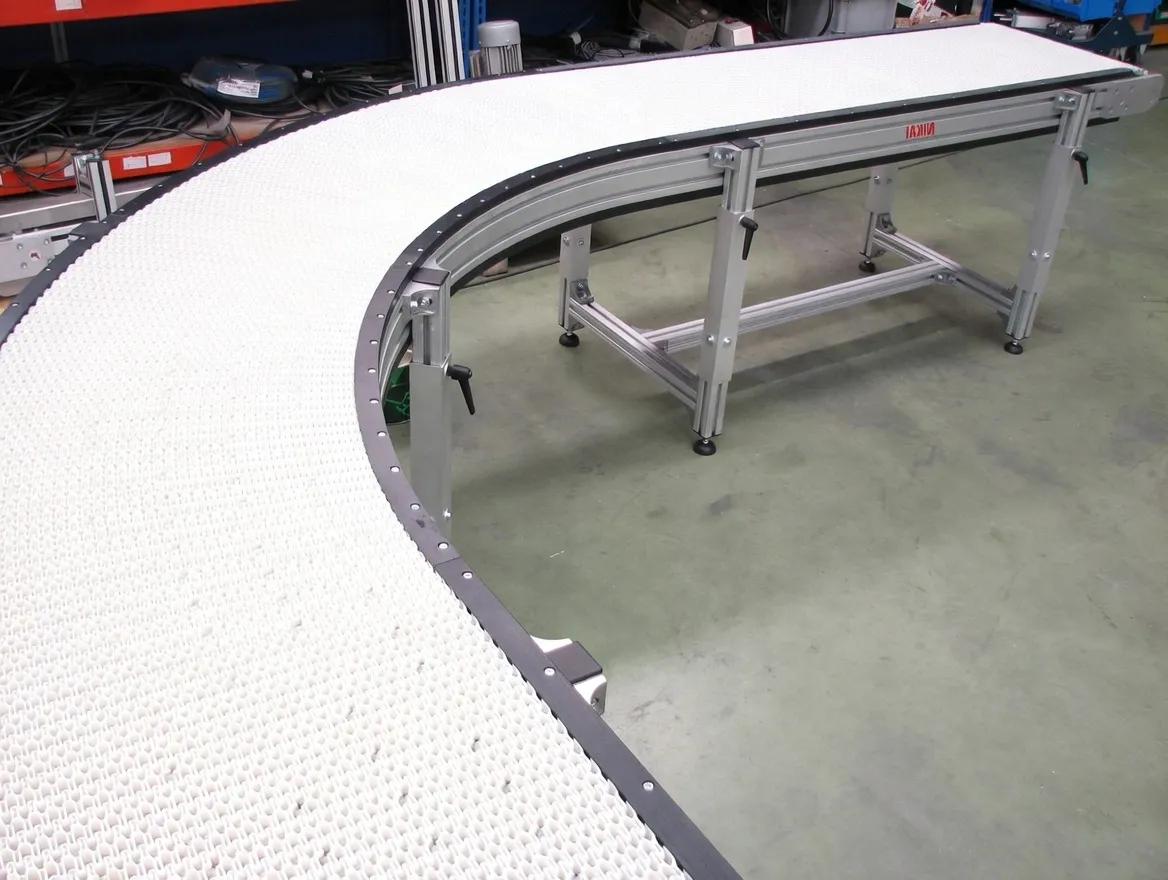 The case for plastic modular belt in express parcel sortation is built on a combination of operational economics and engineering performance that traditional flat belts or slat conveyors simply cannot match. When maintenance teams at UK distribution hubs quantify the total cost of a conveyor belt over a five-year lifecycle — accounting for replacement parts, labour, unplanned downtime, energy consumption, and cleaning consumables — plastic modular belt consistently outperforms. The modular construction means that a 600-metre primary loop might only ever require replacement of perhaps 3–5% of its modules per year, compared to a full belt replacement on a flat rubber belt system. At a major Midlands parcel hub running two shifts, that difference can represent tens of thousands of pounds in annual operational savings.
Rapid Module Swap
A single damaged module is swapped in 8–15 minutes. No vulcanising, no belt press, no overnight wait.
Consistent Positive Drive
No slippage under peak demand. Throughput consistency is maintained even during Black Friday volumes.
Corrosion-Free Design
Fully plastic construction with stainless hinge pins resists the damp, high-wash environments of modern British DC operations.
Wide SKU Compatibility
Handles everything from 50 g envelopes to 30 kg cartons on the same line without product damage or jams.
Temperature Resilience
Operates from -20 °C chilled warehouse zones to +90 °C industrial thermal tunnels — one belt family covers all zones.
Hygienic Construction
FDA / EU 10/2011 food-contact certified modules meet the strictest hygiene audits required by UK retail and pharmaceutical logistics.
Customer Success: How a UK E-Commerce Courier Reduced Belt Downtime by 73%
Case Study · UK Express Courier · East Midlands Hub
Replacing Legacy Flat Belts with Plastic Modular Belt on a 420-metre Primary Sortation Loop
A rapidly growing British parcel carrier operating a major hub in the East Midlands was experiencing chronic unplanned downtime on its primary sortation loop during the Q4 peak season. The existing rubber flat-belt system was suffering from progressive edge wear, heat-induced stretching, and regular full-belt replacements that each required a 4–6 hour line shutdown. With volumes exceeding 180,000 parcels per day during peak periods, every hour of lost capacity had significant commercial consequences, including missed SLA windows and customer compensation costs.
After a detailed application review, the engineering team — in partnership with Ever Power — specified a 1,050 mm wide acetal flat-top plastic modular belt across the entire 420-metre primary loop, with roller-top module sections at each of the 24 divert points. The belt was engineered to a 38.1 mm pitch to balance throughput speed (2.4 m/s operational) against the load spectrum, which ranged from lightweight polybag apparel to 25 kg heavy-goods parcels. Installation was completed over a planned 36-hour maintenance window, and the system went live at the start of the following operating week.
Over the subsequent 12 months, unplanned belt-related downtime fell from an average of 47 minutes per week to just 13 minutes — a 73% reduction. Total module replacement cost for the year was less than 8% of what had been spent on flat-belt replacements in the prior year. The site’s head of engineering reported that maintenance technicians now carry a stock of spare modules in their on-site parts kits and can address any belt surface issue during a scheduled break rather than calling an emergency shutdown.
Μείωση χρόνου διακοπής λειτουργίας
73%
Belt Maintenance Cost
-92%
Peak Throughput
180k+
parcels/day maintained
What Industry Professionals Are Saying
★★★★★
“We had been through three different flat-belt suppliers in five years and still couldn’t crack the downtime problem on our sortation loop. The plastic modular belt from Ever Power changed everything. Our maintenance team loves it — module swaps take minutes, not hours.”
— Simon R., Head of Engineering
Express Courier Hub, Northamptonshire, UK
★★★★★
“The roller-top modules at our divert points have essentially eliminated the parcel tumbling we were seeing on polybag shipments. Customer damage claims dropped noticeably within the first quarter after installation. The ROI on this belt investment was less than nine months.”
— Karen T., Operations Director
3PL Fulfilment Centre, West Yorkshire, UK
★★★★★
“We operate a mixed ambient and chilled DC in Scotland and sourcing one belt solution that works across both temperature zones was a challenge. Ever Power’s acetal plastic modular belt handles -15 °C in our cold store and the ambient sortation hall without any thermal cracking. Impressive product quality.”
— Derek M., Maintenance Manager
Grocery Retail DC, Central Scotland, UK
Ever Power: Engineering-Led Custom Plastic Modular Belt Manufacturing
Ever Power’s manufacturing facility is built around total flexibility. Where many belt suppliers stock a limited range of standard widths and module pitches, our factory operates a made-to-order philosophy that covers every dimension and configuration a UK logistics engineer could specify. Our in-house tooling capability means we can produce custom module geometries — including proprietary rib profiles, bespoke hinge-pin diameters, and non-standard module widths — without the 12–16 week lead time that external tooling typically demands. For sortation applications, we routinely produce belts with mixed module populations in a single width, such as flat-top modules across the central 80% of belt width combined with edge-support cleats on both sides, all produced as a single seamless assembly.
Our engineering team works directly with UK system integrators and end-users during the specification phase, providing CAD drawings, load analysis calculations, and prototype samples before a full production order is committed. We hold certified stock of all principal module materials — including standard PP, acetal, HDPE, nylon, and specialist anti-static grades — enabling rapid response to urgent replacement requirements. All production is compliant with ISO 9001:2015 quality management standards, and our materials traceability documentation meets the requirements of UK retail and pharmaceutical sector supply chain audits.
18+
Years Experience
200+
Module Configurations
ISO
9001:2015 Certified
UK
Logistics Ready
Custom Capability Highlights
- ✓ Custom module pitch from 12.7 mm to 101.6 mm
- ✓ Belt widths 150 mm to 3,000 mm (bespoke)
- ✓ Mixed surface module types in single belt run
- ✓ Anti-static, FDA, and flame-retardant grades
- ✓ CAD + load-analysis engineering support
- ✓ Rapid prototype samples within 5 working days
Serving UK Logistics Hubs from Scotland to the South East
The United Kingdom’s logistics infrastructure is concentrated in a series of well-defined parcel hub corridors: the East Midlands triangle anchored by Coventry, Leicester, and Northampton; the major South East nodes around Heathrow, Tilbury, and the M25 arc; the growing Yorkshire and North West clusters; and the strategic Scottish hubs serving the Edinburgh–Glasgow–Aberdeen triangle. Ever Power’s πλαστική αρθρωτή ζώνη products are actively specified and operating across all of these regions, and our application engineering team is familiar with the specific conveyor OEM platforms most commonly found in British distribution infrastructure — including Dematic, Vanderlande, Beumer, Interroll, and Hytrol-based systems. When you contact us for a quote, we ask for the conveyor OEM and model where possible, allowing us to cross-reference module geometry to the exact sprocket pitch of your existing drive shafts and eliminate any compatibility risk before supply.
UK logistics operators face particular challenges that our product range directly addresses. British DCs tend to operate very long planned maintenance windows given the country’s predominantly overnight-to-morning delivery model, meaning that belt replacements must be achievable within a 4–6 hour window. Our plastic modular belt’s module-level serviceability makes that realistic even on the longest installed loop. The UK’s fashion and health-beauty e-commerce sectors — both heavily centred in the East Midlands — also generate an unusually high proportion of polybag shipments, which are notoriously difficult for traditional conveyor systems. Our anti-static flat-top module range prevents polybags from sticking to or wrapping around belt edges, a recurring problem at high-volume apparel fulfilment sites across Derbyshire and Leicestershire.
| UK Region | Primary Logistics Sector | Typical Belt Application | Recommended Module Grade |
|---|---|---|---|
| East Midlands | Fashion & apparel fulfilment | High-speed polybag sortation | Anti-static PP flat-top |
| Greater London / South East | Express courier & e-commerce | Primary trunk & divert conveyor | Acetal flat-top + roller-top |
| Yorkshire & North West | Retail 3PL & grocery | Ambient & chilled accumulation | Acetal open-grid low-temp |
| Central Scotland | Mixed ambient/chilled retail DC | Cold-store sortation | POM acetal -20 °C grade |
| West Midlands | Automotive parts & industrial | Heavy-load incline conveyor | Heavy-duty PP 50.8 mm pitch |
Συχνές ερωτήσεις
Ready to Specify Plastic Modular Belt for Your UK Sortation Line?
Our application engineering team will review your conveyor layout, parcel mix, and throughput targets — and provide a fully specified belt recommendation with pricing within 24 hours.
επεξεργασία από gzl