
 Inside every major UK parcel sorting centre, thousands of packages travel at speed across conveyor systems where a single belt failure triggers delays that cascade across an entire regional network. The choice of conveyor belt technology is not a minor procurement decision — it is a critical infrastructure call. Over the past decade, plastic modular belt technology has moved from a niche alternative to the default engineering choice for high-throughput parcel sorting lines, and the reasons are rooted in measurable operational performance rather than marketing language.
Plastic modular belts offer a unique combination of structural rigidity, chemical resistance, and field-repairability that traditional flat belts or rubber conveyor systems simply cannot match in the demanding environment of a 24/7 express logistics facility. Whether you are commissioning a new distribution hub in the East Midlands or retrofitting an existing system at a South-East England fulfilment centre, understanding how plastic modular belts perform on parcel sorting conveyor lines is essential knowledge for any procurement engineer or operations director.
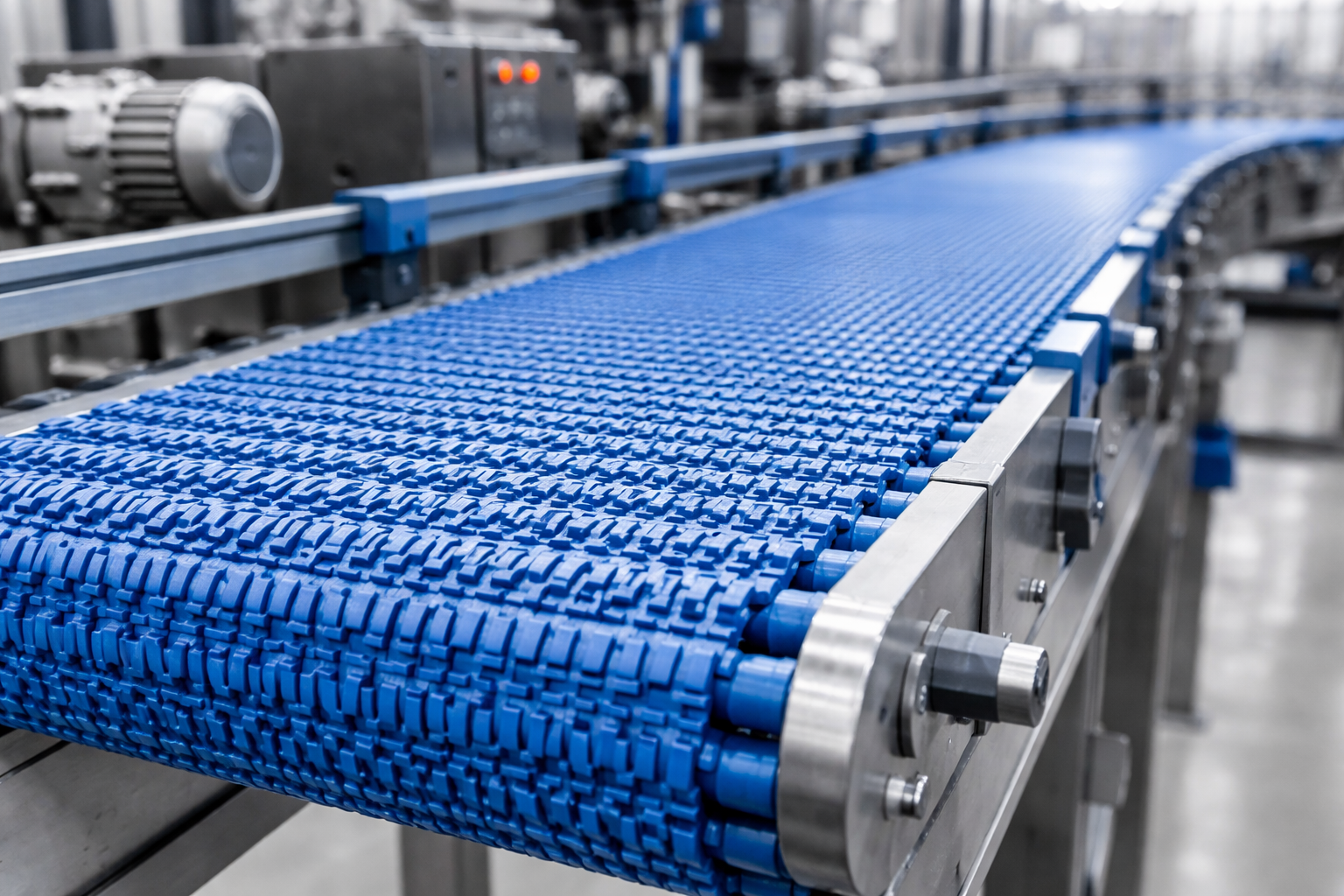
Plastic modular belt running on a high-speed parcel sorting conveyor line — Ever Power Engineering
What Makes Plastic Modular Belt the Right Choice for Parcel Sorting?
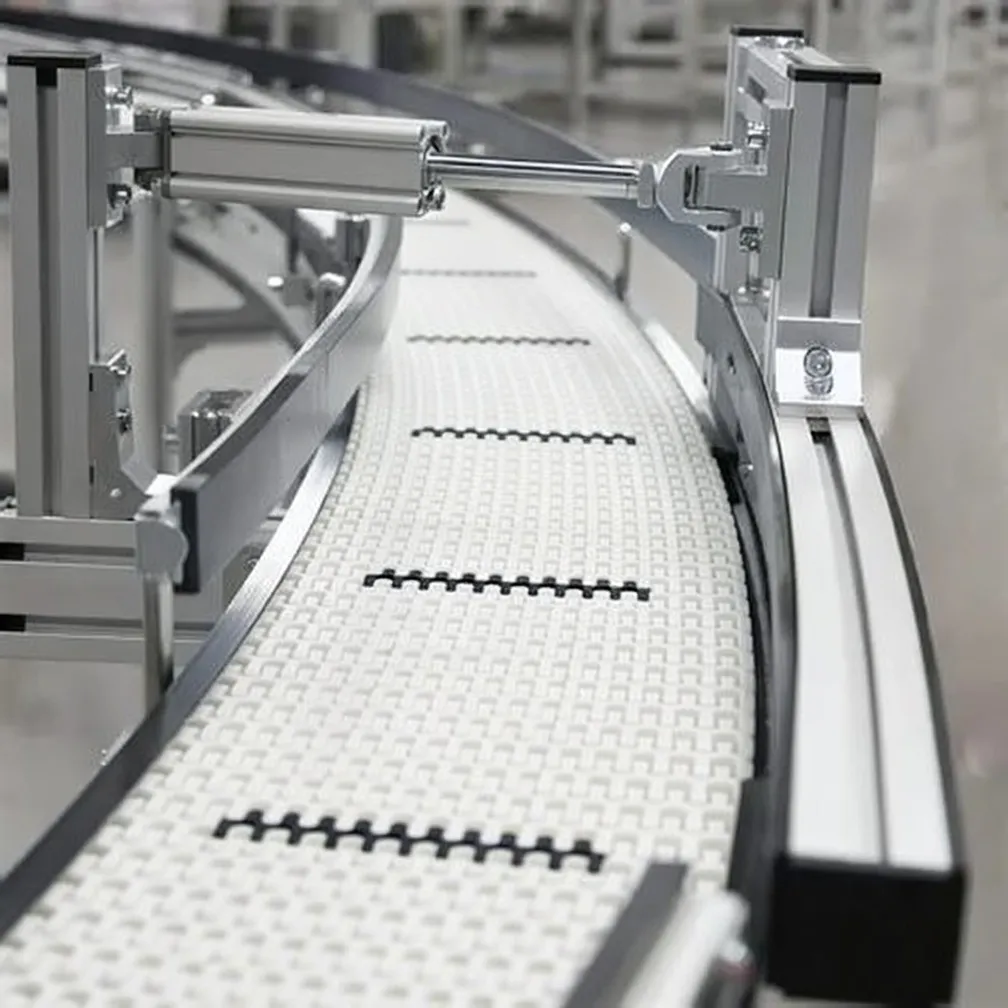 A plastic modular belt is constructed from interlocking thermoplastic modules — typically moulded from polypropylene (PP), polyethylene (PE), or acetal (POM) — that are linked by hinge rods running the full width of the belt. This architecture gives the belt an open or closed surface depending on specification, and crucially, allows individual modules to be replaced on-site without removing the entire belt from the conveyor frame. In a parcel sorting environment where downtime translates directly to missed delivery windows and financial penalties, that field-serviceability is a fundamental operational advantage.
The interlocking module design distributes tension evenly along the belt width, which eliminates the edge-tracking and mistracking failures that plague flat belt systems in high-speed divert operations. When parcels ranging from small polybags to heavy cartons are diverted across pop-up wheels, sliding shoes, or cross-belt sorters, the dimensional stability of a plastic modular belt ensures consistent surface contact and reliable package control throughout the sort sequence.
Furthermore, the modular construction supports a wide variety of surface textures and accessories — friction top inserts, flights, cleats, and side guards — that can be integrated directly into the belt structure. This configurability enables engineers to tailor a single belt specification to multiple zones within the same sorting conveyor line, reducing the number of different spare parts that need to be held in inventory.
Technical Parameters & Material Specifications
The table below summarises the key performance parameters of Ever Power’s plastic modular belt range as applied to parcel sorting conveyor lines. These figures represent typical operating values and can be adjusted through custom module geometry, material selection, or surface finish to meet specific project requirements.
How Plastic Modular Belts Work on a Parcel Sorting Conveyor Line
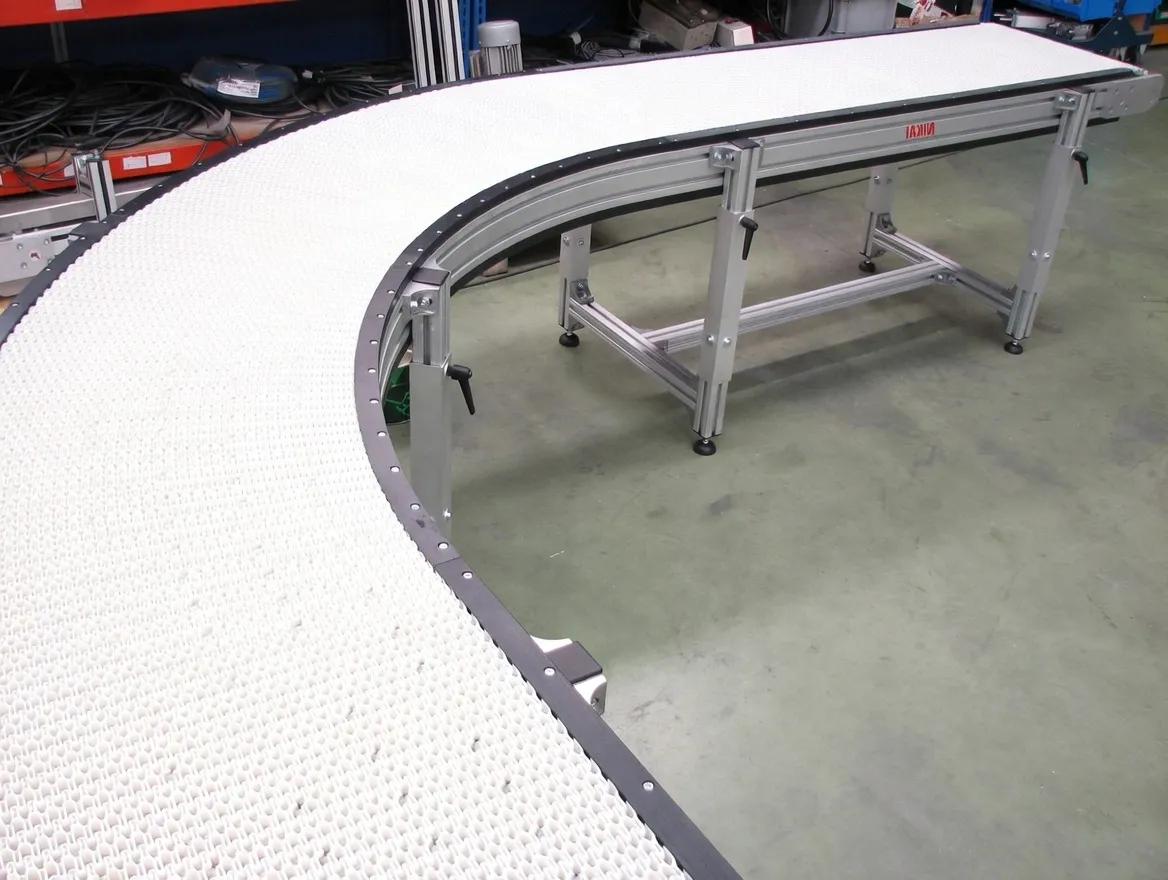 The operating principle of a plastic modular belt on a parcel sorting line relies on the distributed interlocking of thermoplastic modules across the full width of the belt. Each module engages with adjacent rows via precision-moulded hinge eyes that accept a stainless steel or acetal hinge rod. The result is a belt structure that behaves as a single rigid surface under load, yet retains the flexibility necessary to wrap around drive and tail sprockets with a minimum bend radius typically between 30 mm and 150 mm depending on module pitch.
Drive is transmitted through moulded drive pockets or tooth profiles on the underside of the belt, which engage directly with plastic or stainless steel sprockets mounted on the drive shaft. This positive-drive mechanism eliminates the slippage that is inherent in friction-driven flat belt systems — a critical consideration at sorting conveyor speeds above 2 m/s where consistent package positioning directly influences scan read rates and divert accuracy. With a scan read failure rate commonly targeted at below 1% in modern UK express hubs, the dimensional precision of positive-drive plastic modular belts contributes meaningfully to hitting that performance benchmark.
The wearstrip support system underneath the belt — typically UHMWPE (Ultra High Molecular Weight Polyethylene) slide strips mounted on a steel or aluminium frame — provides low-friction guidance that minimises drive power requirements while supporting the belt against deflection under parcel loads of up to 30 kg or more in heavier-duty sorting applications.
Application Scenarios in Express Logistics & Parcel Sorting
The plastic modular belt’s versatility means it appears in multiple zones across a modern parcel sorting conveyor line, each with distinct performance demands. Below are the core scenarios where plastic modular belts deliver measurable value in UK logistics operations.
Induction & Singulation
Friction-top modular belts at the induction station create the controlled surface friction needed to singulate randomly-stacked parcels into a single-file stream at speeds up to 2.5 m/s. The consistent belt surface geometry ensures repeatable parcel spacing for barcode scanning systems.
Main Sorting Conveyor
The primary loop of a sliding shoe or tilt tray sorter uses plastic modular belt sections to transport parcels between divert points. The dimensional stability and positive-drive design maintain precise inter-parcel gaps that divert logic depends upon, enabling sort rates exceeding 10,000 items per hour in large UK hubs.
Divert & Merge Zones
Open-grid modular belts beneath pop-up divert wheels allow the divert mechanism to protrude through the belt surface cleanly, transferring parcels laterally without the belt interference issues that plague solid flat belt designs. This architecture underpins virtually all modern pop-up wheel divert systems deployed in UK distribution centres.
Chute Outfeed & Loading Dock
At the outfeed end of sort chutes, low-friction belts with gentle accumulation characteristics buffer sorted parcels before manual cage or trolley loading. The robust module structure resists impact damage from heavy or irregularly shaped parcels dropping from chute exits, a common failure mode for flat belt systems.
Recirculation & Exception Handling
Parcels that fail to scan or receive a sort destination are redirected onto a recirculation loop where modular belts with positive tracking ensure no items are lost or jammed. The lightweight module construction reduces the total system inertia, making start-stop operation on exception handling loops energy-efficient and mechanically gentle.
Key Advantages for UK Parcel & Express Logistics Operations
✅ On-Site Module Replacement
A single damaged module can be replaced in under 15 minutes without removing the belt from the conveyor frame, reducing planned maintenance windows and enabling rapid corrective action during operational shifts.
✅ Positive-Drive Accuracy
Sprocket-driven engagement eliminates belt slippage under variable parcel loads, maintaining consistent conveyor speed across the full operating cycle — directly supporting high barcode scan rates and reliable sort divert timing.
✅ Long Service Life
Thermoplastic modules resist abrasion, impact, and moisture far more effectively than rubber or fabric belts. In continuous 24/7 sorting operations, plastic modular belts routinely achieve service lives of 3–7 years before wholesale replacement is required.
✅ Width & Length Flexibility
Modular belts can be assembled to virtually any width by adding or removing belt lanes, and any length by splicing module rows. This means a single belt specification can be adapted to different conveyor widths across a site without tooling changes.
✅ Hygienic Surface Options
Open-grid designs allow debris, tape, and label backing paper to fall through rather than accumulate on the belt surface, reducing the frequency and duration of belt cleaning cycles in high-volume sorting operations.
✅ Low Total Cost of Ownership
When module replacement cost, reduced maintenance labour, extended service intervals, and avoided downtime penalties are combined, plastic modular belts consistently demonstrate a lower total cost of ownership than alternative belt technologies over a 5-year operational horizon.
Customer Success: Major UK Parcel Hub Retrofit
A documented case study from a national express carrier’s East Midlands distribution centre
Η Πρόκληση
A leading national express parcel carrier operating from a 65,000 sq ft distribution centre near Nottingham was experiencing progressive flat belt failures on their main induction and merge conveyors. Belt mistracking during peak operational periods — particularly the pre-Christmas volume surge — was causing scan failures that forced manual intervention and created downstream sort errors. Maintenance teams were replacing complete belt sections every four to six months, with each intervention requiring a 4-hour planned shutdown window. The total annual cost of belt replacement and associated downtime was calculated at approximately £180,000.
Η Λύση
Ever Power Engineering supplied a complete retrofit package of acetal (POM) friction-top plastic modular belts across 14 conveyor sections covering the induction zone, main sort loop, and three merge conveyors. Belt widths ranged from 600 mm to 1,200 mm with a 38.1 mm pitch specification selected to balance load capacity with minimum bend radius requirements on the existing conveyor frames. The installation was phased across six weekend maintenance windows to avoid disrupting weekday operational commitments, with Ever Power’s technical engineers supporting each installation phase on-site.
The Results (12-Month Review)
| Metric | Before (Flat Belt) | Μετά (Πλαστική αρθρωτή ζώνη) |
|---|---|---|
| Scan Read Failure Rate | 3.8% | 0.6% |
| Belt Replacement Frequency | Every 4–6 months | No full replacement in 12 months |
| Unplanned Downtime (belt-related) | 34 hours/year | 2 hours/year |
| Annual Belt & Maintenance Cost | ~£180,000 | ~£38,000 |
| Sort Accuracy | 96.2% | 99.4% |
Τι λένε οι πελάτες μας
“We’ve been running Ever Power’s modular belts on our Leicester hub for eighteen months without a single unplanned belt stoppage. The module replacement process is so straightforward that our own maintenance technicians handle it in minutes. We won’t be going back to flat belts.”
“The customisation support from Ever Power was excellent. They helped us specify an open-grid belt with the exact pitch and hinge rod material for our pop-up divert application. Technical drawings were back within 48 hours and sample belts arrived within two weeks. Really professional service.”
“We source plastic modular belts from Ever Power for fulfilment centres across three European countries and the UK. Consistent quality batch to batch, competitive pricing, and their custom colour-coding service for zone identification has been genuinely useful for our maintenance teams on multi-site deployments.”
Ever Power Manufacturing & Custom Belt Solutions
Ever Power Engineering operates a dedicated πλαστική αρθρωτή ζώνη manufacturing facility equipped with precision injection moulding lines, specialist assembly tooling, and a full materials testing laboratory. Our engineering team holds over 18 years of accumulated application knowledge across logistics, food processing, automotive parts, and pharmaceutical conveyor systems. That depth of experience feeds directly into our product development process and our custom belt design capability.
For UK parcel sorting and logistics customers, our customisation services cover every dimension of belt specification. We produce belts to non-standard widths, create custom surface textures for specific friction requirements, supply hinge rods in stainless steel 304, 316, or acetal depending on the chemical environment, and manufacture flights and side guards in heights from 15 mm to 150 mm to suit different product containment needs. We also offer custom belt colouring for zone identification — a service that has proven particularly valuable for multi-site operators who want visual differentiation across different conveyor zones without relying on labelling.
Our quality control process covers dimensional verification of every module against CAD-controlled tolerances, tensile testing of assembled belt sections to verify rated load capacity, and hygroscopic expansion testing for belts specified in wet or humid environments. Batch traceability documentation is provided as standard for customers operating under quality management systems. Lead times for custom belt orders are typically 10–21 working days depending on complexity, and we hold a rotating stock of standard specification belts for immediate dispatch to UK addresses.
Serving Parcel Sorting & Logistics Conveyor Projects Across the UK
The United Kingdom’s logistics infrastructure has expanded significantly over the past decade, driven by the sustained growth of e-commerce and the development of large regional distribution hubs at strategically located sites. Major conveyor and sorting system installations in the East Midlands logistics corridor — encompassing Nottingham, Derby, Leicester, and Corby — as well as new-build facilities in Yorkshire, the North West, and around the M25 orbital, represent the core demand base for plastic modular belt technology in the UK market.
Ever Power supplies plastic modular belts to conveyor original equipment manufacturers (OEMs) based in the UK, to systems integrators managing retrofit projects for established parcel carriers, and directly to in-house engineering teams at large fulfilment centre operators who maintain their own conveyor assets. Our technical sales team has direct familiarity with the specifications and operational demands common to UK parcel sorting facilities, including the Health and Safety Executive (HSE) requirements applicable to conveyor belt maintenance procedures and the BSEN ISO standards relevant to plastic conveyor belt materials.
For organisations across Greater London, the South East, the Midlands, the North of England, Scotland, Wales, and Northern Ireland considering plastic modular belt specification for new build or retrofit sorting conveyor projects, our technical team is available to review your existing system drawings, propose belt specifications, and supply sample sections for testing ahead of full order placement. We understand that procurement timelines in UK logistics infrastructure projects can be tight, and we have structured our supply chain to support both urgent replacement requirements and longer-term planned projects.
Συχνές ερωτήσεις
Voice-search friendly answers to the questions UK logistics professionals most commonly ask about plastic modular belt for parcel sorting conveyor lines.
Ready to upgrade your parcel sorting conveyor with plastic modular belt technology?
Speak with an Ever Power application engineer — custom solutions, fast UK delivery, competitive pricing.
[email protected] · Ever Power Engineering · Plastic Modular Belt Specialists