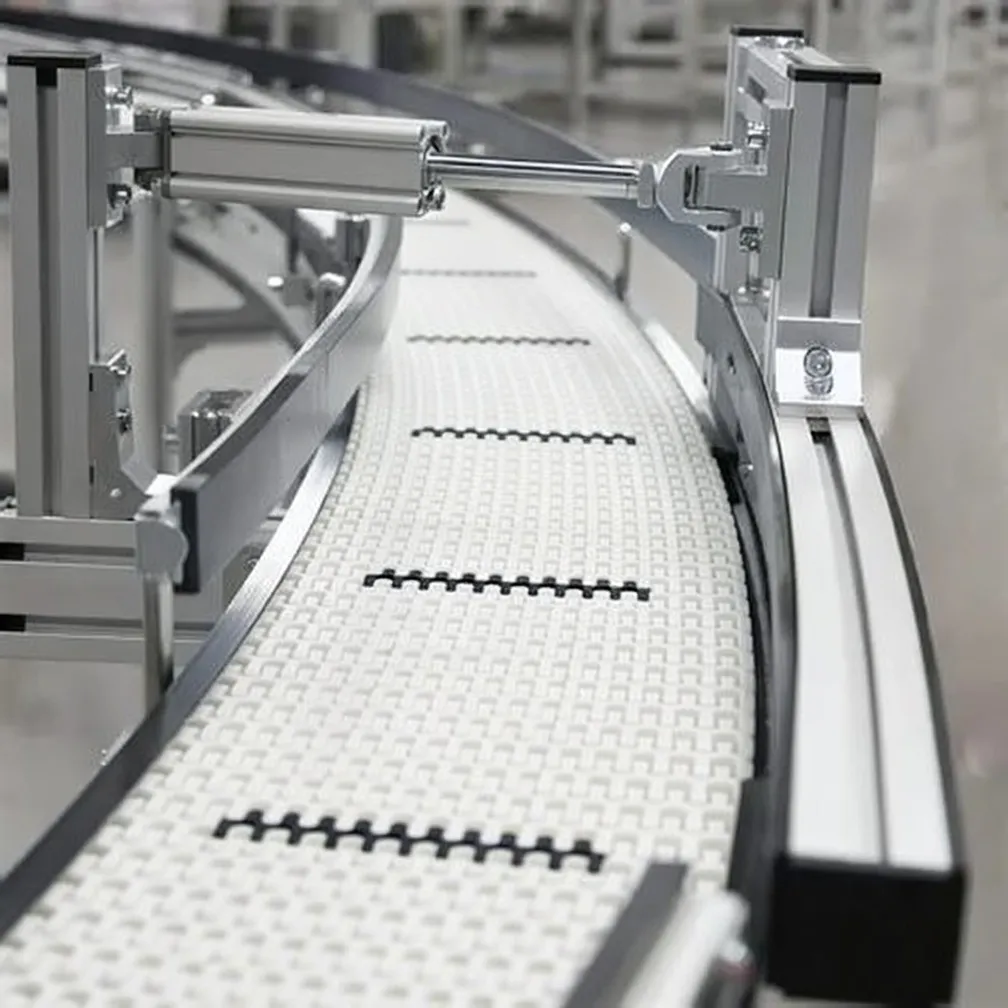
 Walk through any modern snack food production facility in the United Kingdom — whether it processes crisps in Birmingham, peanut-coated confections in Leeds, or extruded corn snacks in Manchester — and one component quietly underpins the entire workflow: the conveyor belt. Yet not all conveyor belts are created equal. Where traditional fabric belts and metal mesh once dominated, the plastic modular belt has steadily displaced them as the preferred conveyor solution across high-care snack food environments. The reasons are deeply practical and consistently proven across hundreds of production installations.
A plastic modular belt is built from interlocking thermoplastic modules — typically moulded from food-grade polypropylene, polyethylene, or acetal — that snap together to form a continuous, flexible belt surface. Unlike a single-piece belt that must be replaced as a whole when damaged, modular segments can be individually removed and swapped in minutes. That single characteristic changes the economics of snack food processing completely, because unplanned downtime in a high-speed crisps or popcorn line carries a very real cost, often measured in thousands of pounds per hour. The plastic modular conveyor belt is, at its core, an uptime management tool as much as a transport device.
Ever Power plastic modular belts running on a UK snack food processing line — hygienic, modular, and built for continuous operation.
Why Snack Food Processing Demands Specialised Conveyor Belts
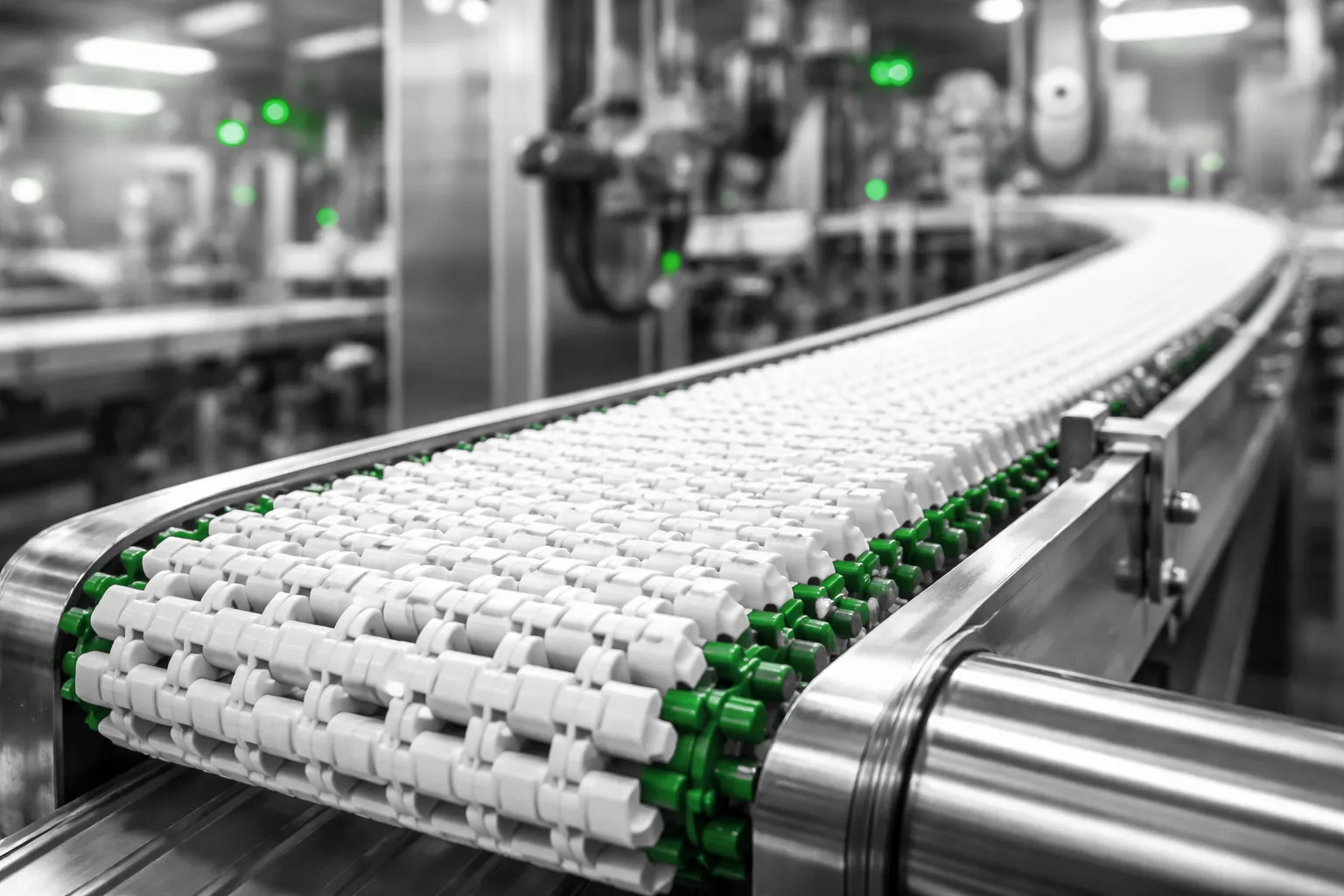 The snack food industry operates under a unique combination of mechanical, thermal, and regulatory pressures that make conveyor belt selection critically important. Unlike general logistics conveyors, belts in snack production must handle hot, oily, seasoned, and highly abrasive products — often simultaneously. Think of a freshly extruded corn curl leaving a cooking die at over 150 °C, landing on a conveyor running at 60 metres per minute, coated immediately in flavour oils and powders, then transferred through a tumble drum, a cooling tunnel, and a check-weigher, all within a matter of seconds. Each transition point places a different mechanical demand on the plastic modular belt surface.
There is also the matter of hygiene. The UK Food Standards Agency and retailers’ audit standards — particularly the BRCGS Global Standard for Food Safety, which many UK manufacturers must comply with — demand rigorous conveyor hygiene. Open-hinge modular belt designs allow wash-water and cleaning chemicals to penetrate the belt structure, dramatically reducing the risk of pathogen harborage compared with sealed, solid-surface belts. When a plastic modular conveyor belt can be flat-panel cleaned in place and inspected for residue in minutes, it becomes a compliance asset as much as a production asset.
Then there is the question of product quality. Snacks are sold by appearance. Broken crisps, scuffed coated nuts, or crushed pretzels reduce pack-fill efficiency, trigger rejection at checkweighers, and ultimately damage brand perception on retail shelves. A plastic modular belt engineered with the correct pitch, surface texture, and open-area percentage will handle fragile snack products gently, maintaining product integrity from fryer exit all the way to the packaging machine infeed.
Core Advantages of Plastic Modular Belts in Snack Production
Engineering benefits that translate directly to lower operating cost and higher output
Hygienic Open Design
Interlocking modules with open-hinge geometry allow complete water penetration and drainage during CIP washdowns — meeting BRCGS and BRC higher-level hygiene standards without additional equipment modification.
On-Line Segment Repair
A single damaged module can be replaced in under 10 minutes without specialist tools, eliminating the need to shut down an entire production line for a belt change — a critical advantage when running 16-hour snack production shifts.
Thermal Stability
Food-grade polypropylene and acetal grades handle continuous operating temperatures from -30 °C (freezing tunnels) to +120 °C (post-fryer conveyors), maintaining dimensional stability and avoiding the thermal fatigue that degrades fabric belts.
Custom Configurations
Available in flat-top, raised-rib, perforated, flush-grid, and side-flexing variants, a single platform can be configured to match every station from raw ingredient in-feed through seasoning drums to packaging line accumulation tables.
Materials, Construction and Technical Parameters
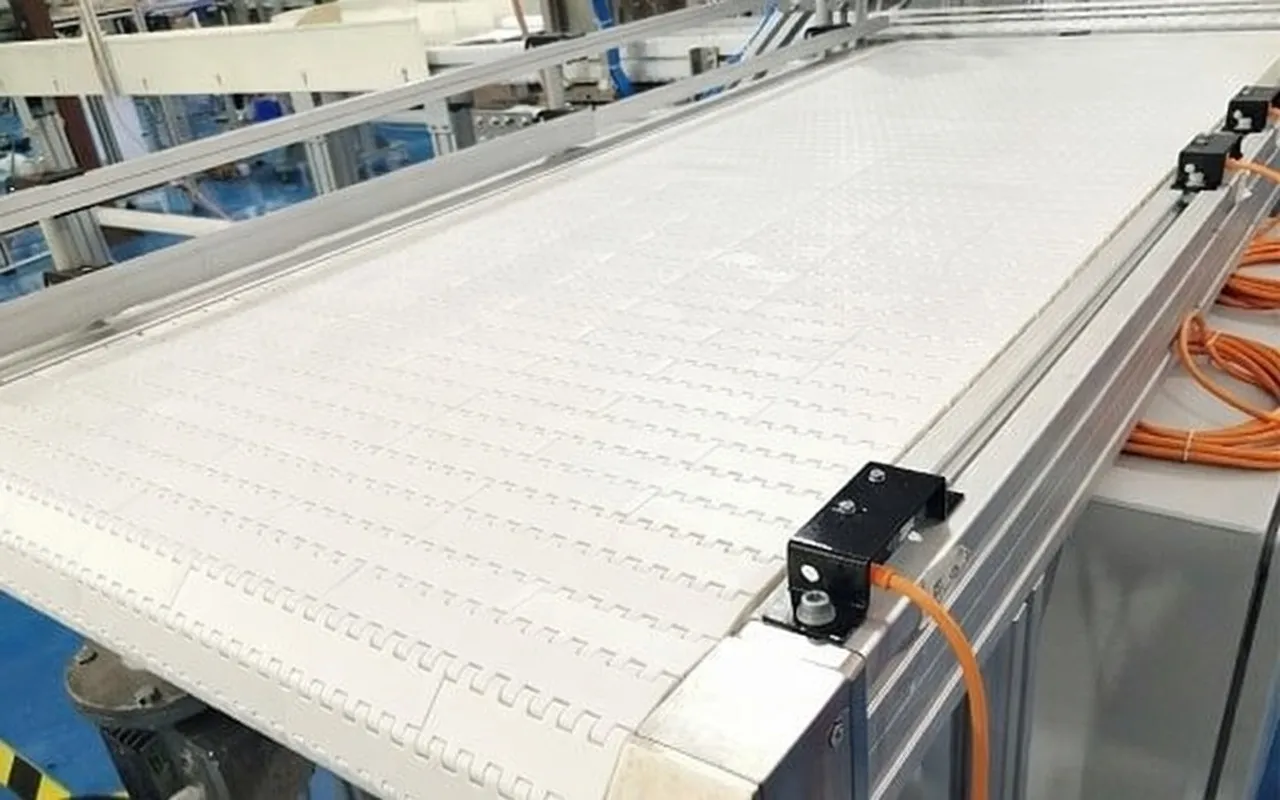 The performance of a plastic modular belt is determined almost entirely by its material composition and module geometry. Three primary thermoplastic families cover the broad spectrum of snack food processing requirements. Polypropylene (PP) dominates because of its excellent resistance to food-grade oils, cleaning agents, and flavouring chemicals. Acetal (polyoxymethylene, POM) is chosen for its superior dimensional stability and hardness where precision transfer is needed — particularly at packaging machine infeeds where even 0.5 mm of belt elongation can cause misregistration. High-density polyethylene (HDPE) excels in freezing applications where low temperatures would embrittle standard PP grades. The table below provides a structured reference for specifying the right plastic modular belt for each snack processing application.
| Παράμετρος | PP Grade | Ακετάλη (POM) | HDPE Grade | Notes |
|---|---|---|---|---|
| Θερμοκρασία λειτουργίας. | -10 °C to +120 °C | -40 °C to +100 °C | -50 °C to +80 °C | Continuous operation |
| Επιλογές βήματος ζώνης | 25,4 χιλ. / 38,1 χιλ. | 25,4 χιλ. / 50,8 χιλ. | 38,1 χιλ. / 50,8 χιλ. | Finer pitch = better product support |
| Μέγιστο πλάτος ιμάντα | Up to 3,000 mm | Έως 2.400 mm | Έως 2.400 mm | Custom widths available |
| Open Area % | 10% – 52% | 12% – 48% | 15% – 45% | Higher = better drainage/airflow |
| Αντοχή σε εφελκυσμό | Up to 250 kN/m | Up to 320 kN/m | Up to 200 kN/m | Per metre of belt width |
| Food Compliance | EU 10/2011, FDA 21 CFR | EU 10/2011, FDA 21 CFR | EU 10/2011, FDA 21 CFR | All grades food-contact safe |
| Drive Type | Sprocket positive drive | Sprocket positive drive | Sprocket positive drive | No slip, consistent indexing |
| Ταχύτητα ιμάντα | Up to 100 m/min | Up to 120 m/min | Up to 80 m/min | Application-dependent |
Plastic Modular Belt Applications Across Every Stage of a Snack Food Line
A complete snack food processing line — from raw ingredient handling through to secondary packaging — typically includes between eight and fifteen distinct conveyor transfer points. Each stage carries its own requirements, and the versatility of the plastic modular belt platform means that a single product family can satisfy all of them with appropriate variant selection. The following stage-by-stage breakdown reflects real-world application experience in UK snack manufacturing environments.
① Raw Ingredient In-Feed
Potatoes, maize grits, and raw nuts arrive at the in-feed stage covered in moisture, soil residues, and irregular shapes. A flush-grid or raised-rib plastic modular conveyor belt with high open-area percentage (38–52%) provides drainage while the positive-drive sprocket system delivers consistent speed control essential for feeding slicers and extruders at accurate rates. The belt’s stiffness prevents sagging under bulk loads, while polypropylene’s chemical resistance handles potato starches and enzyme cleaners without swelling or degradation.
② Fryer Exit and Thermal Transfer
Continuous fryers operate at oil temperatures of 160–185 °C, and product exiting a fryer belt still carries residual heat of 100 °C or above. The post-fryer transfer conveyor must handle this thermal load without belt elongation or module distortion. Food-grade polypropylene with stabiliser additives retains its mechanical properties at sustained temperatures up to 120 °C, making a plastic modular belt in PP the standard choice at this critical transfer point. A perforated flat-top design here allows excess oil to drain back into the fryer collection tray, reducing product greasiness and improving yield at the checkweigher.
③ Seasoning Drum and Coating
After frying or baking, snacks enter rotary seasoning drums where powdered flavours — salt, vinegar, paprika, cheese powder — are applied. The in-feed and discharge conveyors of these drums operate in environments saturated with fine flavour dust and adhesive oil mists. A plastic modular belt with closed-top surface prevents powder accumulation between modules, while the material’s non-reactive chemistry ensures that acidic flavour compounds (vinegar, citric acid) cause no belt degradation over extended production campaigns. Maintenance teams report that flat-top PP belts in seasoning areas last up to 40% longer than the fabric alternatives previously installed.
④ Cooling Tunnel and Air-Blast Zones
Snacks must reach a stable low temperature before packaging to prevent moisture migration inside sealed bags. Cooling tunnels use forced-air or refrigerated air-blast systems that blow cold air through the product bed. A perforated plastic modular conveyor belt with 35–50% open area allows maximum air circulation both above and below the product, reducing cooling dwell time and enabling faster line speeds. Because PP is dimensionally stable across both hot and cold temperature excursions, the same belt specification used on the fryer exit can traverse the cooling tunnel without re-tensioning adjustments, simplifying maintenance planning.
⑤ Checkweigher and Metal Detection Infeed
Regulatory compliance and retailer specifications require every snack pack to pass through a checkweigher and metal detector before release. These machines demand ultra-precise, vibration-free product presentation. Acetal (POM) plastic modular belt modules, with their superior dimensional consistency and low coefficient of friction, provide the smooth, controlled product transfer these inspection machines require. Critically, acetal is non-magnetic and has low metallic content, minimising false-positive metal detector triggers that disrupt production flow and generate unnecessary waste rejection.
⑥ Packaging Machine Accumulation
Before vertical form-fill-seal (VFFS) or multihead weigher in-feed, snacks are accumulated in a buffer zone to absorb speed differentials between upstream processing and downstream packaging. Side-flexing plastic modular belt configurations allow curved accumulation tables to be built within a minimal factory footprint — a significant advantage in UK snack facilities where floor space carries a high premium. The modular architecture allows conveyor width to be varied at the table exit to match the multihead weigher bucket geometry precisely, reducing broken product and improving fill accuracy.
Customer Success: Northern England Crisps Manufacturer
Real-world installation results from a Yorkshire-based snack food producer
A mid-sized crisps manufacturer based in West Yorkshire, supplying own-label product to three major UK retail chains, was experiencing persistent belt failures across their two-fryer production facility. The existing woven wire conveyor belts on the post-fryer transfer sections were failing every 8–12 weeks due to oil-impregnated wire fatigue, requiring full line shutdowns of 4–6 hours per replacement. Each shutdown event was costing an estimated £11,000 in lost production value. The maintenance team was also spending approximately 30 hours per month on belt tension adjustments and hygiene audit remedial actions related to wire belt harborage points.
Ever Power specified PP flat-top plastic modular belts with 38 mm pitch for the fryer exit and post-fryer transfer sections, and perforated PP modular belts for the cooling tunnel. Within the first 90 days, unplanned stoppages attributable to conveyor belt failure dropped by 68%. The site’s BRCGS audit score for conveyor hygiene improved from a ‘C’ observation to zero hygiene-related non-conformances. The total project cost was recovered within 14 months, and the site has since converted a third production line to the same plastic modular belt platform.
“We used to dread fryer belt change days. With the Ever Power plastic modular belt, one person can replace a damaged section during a scheduled break. The whole team’s attitude to maintenance has shifted because it’s no longer a crisis event.”
“The hygiene performance of the plastic modular conveyor belt system was immediately obvious at our next BRC audit. The auditor specifically noted the open-hinge design as best practice for preventing oil residue accumulation. It directly contributed to our Grade A certification.”
“We specified Ever Power modular belts across our new extruded snack line in Scotland. The lead time for custom-width belt sections was shorter than any other supplier we evaluated, and the technical support during commissioning was genuinely impressive. We haven’t had a single belt-related downtime event in 18 months of operation.”
Ever Power: Custom Plastic Modular Belt Manufacturing and UK Supply
Ever Power operates dedicated production facilities equipped with precision injection moulding machinery and automated belt assembly lines. Where standard catalogued belt specifications cover the majority of snack food applications, the factory’s genuine competitive advantage lies in its deep customisation capability — a differentiator that matters enormously to UK food manufacturers whose production lines often have non-standard conveyor widths inherited from earlier equipment investments. The engineering team works directly with customer technical teams to specify custom module geometries, bespoke open-area patterns, and specific surface textures that standard off-the-shelf belt suppliers simply cannot match.
Custom colour coding — a standard requirement in many UK high-care food facilities to prevent cross-contamination between production zones — can be accommodated across the full range of materials. Blue food-grade polypropylene, a colour favoured in UK food manufacturing because it is immediately visible in product streams during visual inspection, is available as a standard option across all belt series. Custom sprocket configurations, modified hinge-pin materials (including detectable stainless steel for metal-detectable applications), and belt sections pre-assembled with integrated side guides are all part of the factory’s standard service offering.
Lead times for standard plastic modular belt specifications are typically 5–10 working days to UK delivery addresses. Custom-specified sections generally require 15–25 working days depending on complexity. The company maintains a consignment stock programme for high-volume UK accounts, ensuring that critical replacement modules are held in-country for immediate despatch — typically available for next-day delivery to England, Scotland, and Wales via established logistics partners.
Plastic Modular Conveyor Belts for UK Snack Food Manufacturers
The United Kingdom has one of Europe’s most concentrated snack food manufacturing sectors, with major production hubs in Yorkshire, the East Midlands, the North West, and Scotland. These facilities operate under some of the most stringent retailer standards in the world — BRCGS, SALSA, and individual retailer codes of practice from Tesco, Sainsbury’s, Asda, and Morrisons all impose specific conveyor hygiene requirements that drive specifiers toward open-structure plastic modular belt solutions. Ever Power has extensive experience supplying both replacement belts and complete belt specifications for new-build facilities across these UK regions.
For UK food manufacturers operating under the post-Brexit regulatory framework, material compliance documentation aligned with both retained EU regulation and UK-specific food safety legislation is supplied as standard with every order. The company’s technical support team includes engineers familiar with UK food industry audit requirements, and documentation packages for BRCGS audit evidence — including material declarations, migration test data, and certificate of conformity documents — are available digitally within 24 hours of order placement.
Whether you are specifying conveyor belts for a greenfield snack production facility in Manchester, upgrading an existing fryer line in Birmingham, or sourcing replacement modules for an established crisp production operation in Norfolk, Ever Power’s technical team can provide local-specification support and competitive pricing tailored to UK market requirements.
Συχνές ερωτήσεις
Answers to the questions UK snack food manufacturers ask most
Ready to Upgrade Your Snack Production Conveyor System?
Our engineers are available to discuss plastic modular belt specifications for UK snack food applications. Request a free technical consultation today.
✉ Get a Quote: [email protected]
επεξεργασία από gzl