
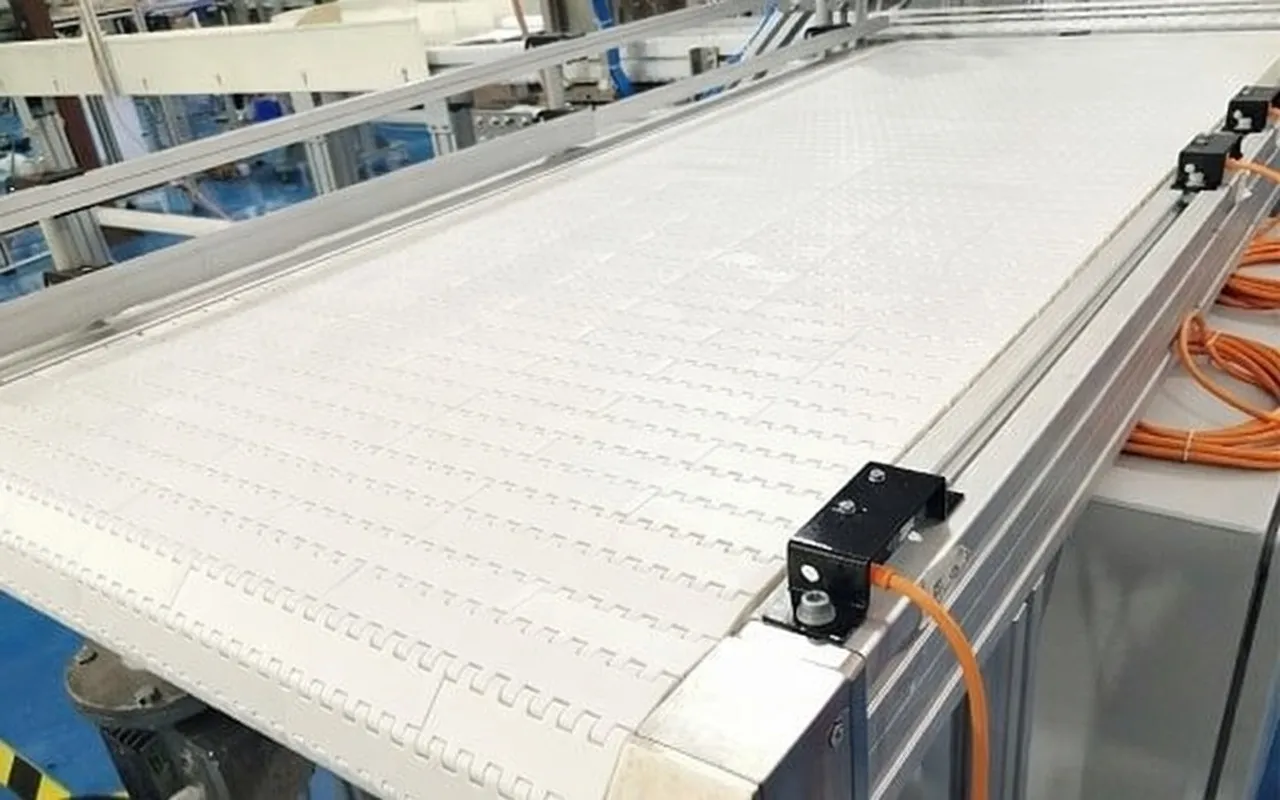
 Walk into any high-volume snack food facility in the UK — from a crisps line in the East Midlands to a biscuit packaging hall in Yorkshire — and you will almost certainly encounter plastic modular belt conveyor systems at the core of the operation. Over the past two decades, these engineered thermoplastic conveyor solutions have quietly displaced older flat-belt and stainless-steel chain systems because they offer something those legacy technologies simply cannot match: a combination of mechanical flexibility, wash-down resilience, and food-safety architecture that is built precisely for the demands of the modern snack industry.
A plastic modular belt is not a single product — it is a platform. Individual interlocking modules, typically manufactured from engineering-grade polymers such as acetal (POM), polypropylene (PP), or polyethylene (PE), are assembled into a continuous, self-supporting belt surface that can be configured in an almost unlimited variety of open-grid, solid-top, friction-top, and specialised surface geometries. The result is a conveyor surface that can be customised to the exact requirements of a given snack processing application — whether that means draining oil after frying, providing controlled grip on an incline conveyor transporting bagged crisps, or ensuring gentle product handling for fragile pretzels and crackers.
For UK food manufacturers operating under the Food Safety Act 1990, BRC Global Standards, and increasingly rigorous retailer codes of practice, the ability to strip a plastic modular belt down to individual modules for deep cleaning — without specialist tools, in minutes — is not a luxury. It is an operational and regulatory necessity. This guide explores why plastic modular belts have become the default choice across snack and leisure food processing lines, how they work at a technical level, and what UK buyers should consider when selecting or upgrading a conveyor belt system for their facility.
📧 Get a Free Quote — Contact Our Engineers
Reply within 24 hours | UK & International Supply | Custom Belt Design Available
How Plastic Modular Belts Actually Work on a Snack Processing Line
Mechanics, materials, and motion — demystified
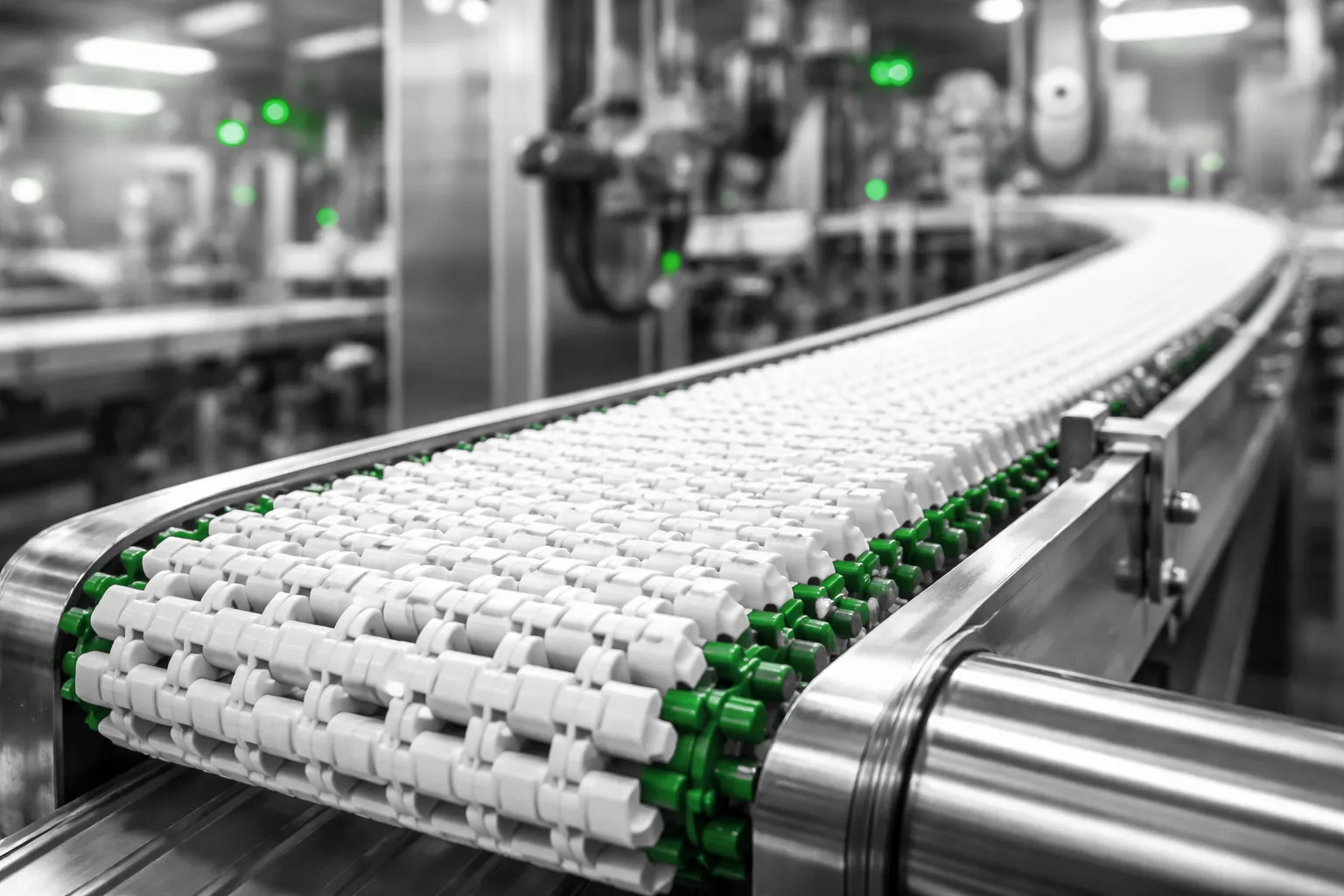
 The engineering principle behind a plastic modular belt is elegantly simple, yet the execution demands precision. Each module — typically 25 mm to 50 mm in pitch — interlocks with adjacent modules via a series of hinge rods. These rods, usually manufactured from stainless steel (304 or 316L grade) or glass-filled polypropylene for fully non-metallic applications, run the full width of the belt and act as the articulation point around drive sprockets and return rollers. Because each module is a discrete, replaceable component, a damaged section of belt can be replaced in minutes on the factory floor without removing the entire belt from the conveyor frame.
Drive is applied through moulded sprockets — again, typically polymer or stainless steel — that mesh with the drive links on the underside of the belt. This positive-drive arrangement eliminates belt slippage, a persistent problem with flat belts operating in high-humidity or oil-contaminated conditions that are routine in snack food environments. The belt runs on support rails or a flat wear strip, and because the modular structure distributes load evenly across the width, modular belts can handle heavier products per unit width than equivalent flat-belt systems without excessive deflection.
| Module Material | Common Name | Temp. Range | Key Property | Ideal Snack Application |
|---|---|---|---|---|
| Ακετάλη (POM) | Delrin / Hostaform | -40°C to +90°C | Low friction, high stiffness | Biscuit & cracker conveying |
| Πολυπροπυλένιο (PP) | PP-Natural / PP-FDA | -10°C έως +120°C | Chemical resistance, lightweight | Nut roasting, oil-drain after frying |
| Polyethylene (PE-UHMW) | UHMW-PE | -80°C to +80°C | Impact resistance, self-lubricating | Fragile snack product handling |
| Νάιλον (PA6 / PA66) | Polyamide | -20°C to +130°C | High tensile strength | Heavy-load packing lines |
| POM-Blue (Detectable) | Metal-detectable polymer | -40°C to +90°C | X-ray & metal detector compatible | HACCP CCP points, retail snack lines |
Παράμετροι Τεχνικής Απόδοσης
Specification reference data for plastic modular belts used in UK snack food environments
| Παράμετρος | Τυπικό εύρος | High-Performance Range | Notes |
|---|---|---|---|
| Belt pitch (module length) | 25,4 χιλ. / 38,1 χιλ. | 12.7 mm (mini-pitch) | Smaller pitch = tighter turn radius |
| Max. belt width | Up to 1,200 mm | Up to 3,600 mm (wide-body) | Custom widths available on request |
| Permissible load (kg/m²) | 50–150 kg/m² | Up to 400 kg/m² (reinforced) | Depends on belt material & span |
| Operating speed | 0.05 – 1.5 m/s | Up to 3.5 m/s (high-speed lines) | VFD drive recommended above 1 m/s |
| Incline / decline capability | Up to 18° | Up to 35° (friction-top surface) | Rubber-top modules for steep angles |
| Open area (% for drainage) | 0% (solid-top) – 35% | Up to 54% (max open-grid) | Critical for oil drainage on fryer exits |
| FDA / EC compliance | FDA 21 CFR, EC 1935/2004 | BRC-ready, HACCP-documented | Full material certificates available |
Why UK Snack Manufacturers Choose Plastic Modular Belts Over Legacy Systems
A direct comparison of operational benefits
Module-Level Repair
Replace only the damaged modules, not the entire belt. Maintenance teams report 60–80% reduction in spare parts cost compared to flat belt replacements. A complete repair typically takes under 20 minutes, even during a production shift.
Superior Wash-Down Performance
The open-hinge architecture of plastic modular belts allows high-pressure water and CIP cleaning chemicals to reach every surface. BRC auditors consistently rate modular belt hygiene as superior to flat-belt systems because there are no hidden pockets for biofilm accumulation — a critical factor on allergen-sensitive snack lines.
Longer Service Life
A well-maintained plastic modular belt in a snack food environment typically achieves 3–5 years of service life before a full rebuild is needed. POM and PP are inherently resistant to the oils, salt, and acid seasonings common in snack production, unlike rubber belts which degrade rapidly in fatty acid environments.
Positive Drive — No Tensioning
Because plastic modular belts are driven by meshing sprockets rather than friction, there is no need for belt tensioning systems. This eliminates a significant source of maintenance calls and reduces the drive motor load in wet or oily conditions where flat belts slip and stall — a problem that causes costly unplanned downtime on busy UK packaging lines.
Side-Flexing for Curved Layouts
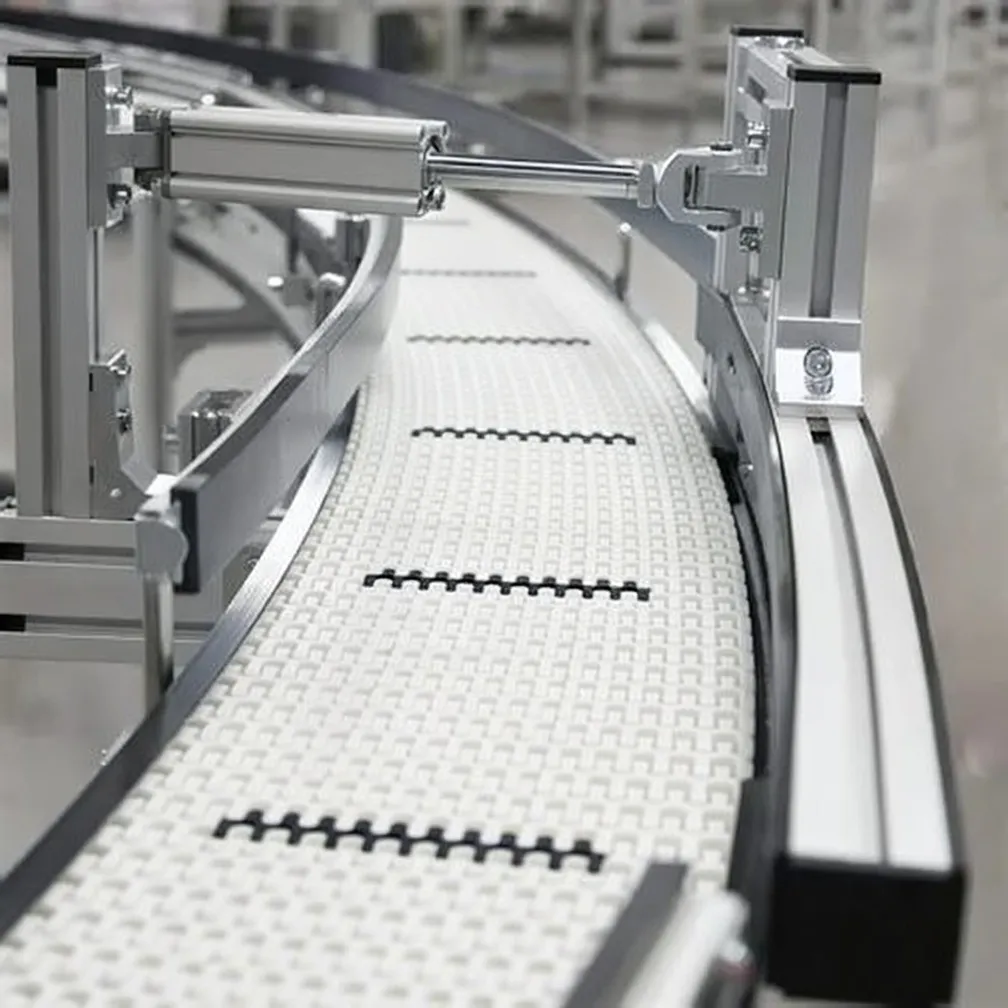
Side-flexing plastic modular belt variants navigate horizontal curves of 30°, 45°, 90°, or 180° without a transfer point. For UK snack factories dealing with constrained floor plans, this means conveyor layouts can wrap around obstacles and follow building geometry, cutting the number of product transfers that damage fragile snacks and create contamination risk.
Retrofittable to Existing Frames
In most cases, a plastic modular belt can be retrofitted onto existing conveyor frames with only minor modifications to the drive shaft and sprocket arrangement. UK food factories can therefore upgrade their conveyor hygiene performance without replacing the entire conveyor structure — significantly reducing capital expenditure and installation downtime.
Customer Success: Real Results from the UK Snack Industry
How UK food manufacturers have transformed their production lines
NorthBite Snacks Ltd, Leeds — Fryer Exit & Seasoning Line Overhaul
NorthBite Snacks Ltd, a mid-sized crisps and savoury snack manufacturer based in Leeds, West Yorkshire, had been running a 12-metre continuous fryer exit conveyor using ageing stainless steel slat chain belts. The chains required lubrication every 8 hours, created significant noise on the factory floor, and their solid-slat design prevented oil drainage, meaning a secondary drip tray conveyor was needed — doubling the footprint. BRC audit reports consistently flagged the chain link geometry as a hygiene risk due to grease and oil trapping.
After consulting with Ever Power engineers, NorthBite specified a 38.1 mm pitch, 45% open-area polypropylene plastic modular belt across three conveyor sections: fryer exit, seasoning infeed, and cooling tunnel outfeed. The positive-drive design eliminated lubrication entirely; the open area exceeded the drainage requirements without a secondary conveyor; and the blue detectable PP modules allowed the client to satisfy their Morrisons and Asda supplier specification for detectable foreign body control at the HACCP critical control point upstream of the checkweigher.
We trialled three different belt suppliers before selecting Ever Power’s plastic modular belt for our popcorn cooling tunnel. The open-area percentage was exactly what our thermal engineer specified, the material certificates were provided within 24 hours, and the first belt has been running continuously for over two years without a single module failure. The price point was also considerably better than equivalent UK-stocked alternatives.
Our BRC auditor specifically commented on the improved hygiene access of the new modular belt on our biscuit line. Getting into the hinge rods during CIP is so much easier than the old flat belt, and the audit report reflected that. Ever Power also supplied a bespoke belt width that our old conveyor frame required — something most other suppliers told us wasn’t possible at our volume.
We run a nut roasting and coating line in Manchester and the combination of high heat, oil, and aggressive seasoning had destroyed every flat belt we’d ever tried. The Ever Power PP open-grid modular belt has been a revelation — it handles 110°C exit temperatures, drains perfectly, and the blue detectable modules satisfy our Tesco COP requirement. Lead time on our first order was 9 days, which for a custom width was exceptional.
Ever Power: Plastic Modular Belt Manufacturer & Custom Engineering Partner
Bespoke conveyor belt solutions for UK food manufacturers
Ever Power operates state-of-the-art manufacturing facilities with a dedicated plastic modular belt production line that combines precision injection moulding, in-house assembly, and rigorous QA testing. Unlike distributors who hold standard stock sizes, Ever Power manufactures to order — which means UK snack food clients can specify exact belt widths, pitches, surface textures, module colours, hinge rod materials, and open-area percentages to match their precise application requirements. There is no minimum order penalty for custom belt dimensions, and our engineering team routinely works with clients’ own conveyor frame drawings to confirm compatibility before manufacture begins.
Ready to Spec Your Next Plastic Modular Belt?
Send your conveyor drawings and product specifications to our UK-focused engineering team. We will prepare a detailed belt specification and quotation within 24 hours — no obligations, no sales pressure.
Serving the United Kingdom’s Snack Food Manufacturing Sector
From Lincolnshire crisps plants to Scottish biscuit facilities
The United Kingdom has one of the most developed and demanding snack food manufacturing industries in the world. With major production clusters in the East Midlands (particularly Nottinghamshire and Lincolnshire for potato-based snacks), West Yorkshire (biscuits and cereal bars), the North West (nuts and confectionery coating), and Scotland (biscuits and shortbread), UK snack manufacturers face a unique combination of high retail buyer standards, strict BRC hygiene requirements, and the operational complexity of running multiple SKUs through a single production line. Ever Power’s πλαστικές αρθρωτές ζώνες have been specified across all of these regions, and our engineering team has direct experience of the compliance challenges facing UK food manufacturers operating under both BRC Global Standard Issue 9 and the requirements of major retailer codes of practice.
Post-Brexit, many UK food manufacturers have been reviewing their supply chains for conveyor components, seeking suppliers who can provide DDP (Delivered Duty Paid) pricing without hidden customs charges. Ever Power ships plastic modular belts to UK addresses on DDP terms as standard, meaning the price quoted is the price paid — no additional import duties, no VAT surprises at the point of delivery. All shipments are accompanied by full customs documentation, and our average delivery time to mainland UK addresses is 8–12 days for custom belt specifications, with standard-stock items available considerably faster.
Συχνές ερωτήσεις
Common questions from UK snack food engineering and procurement teams
Need a plastic modular belt for your UK snack food processing line?
Get a Quote → [email protected]
επεξεργασία από gzl