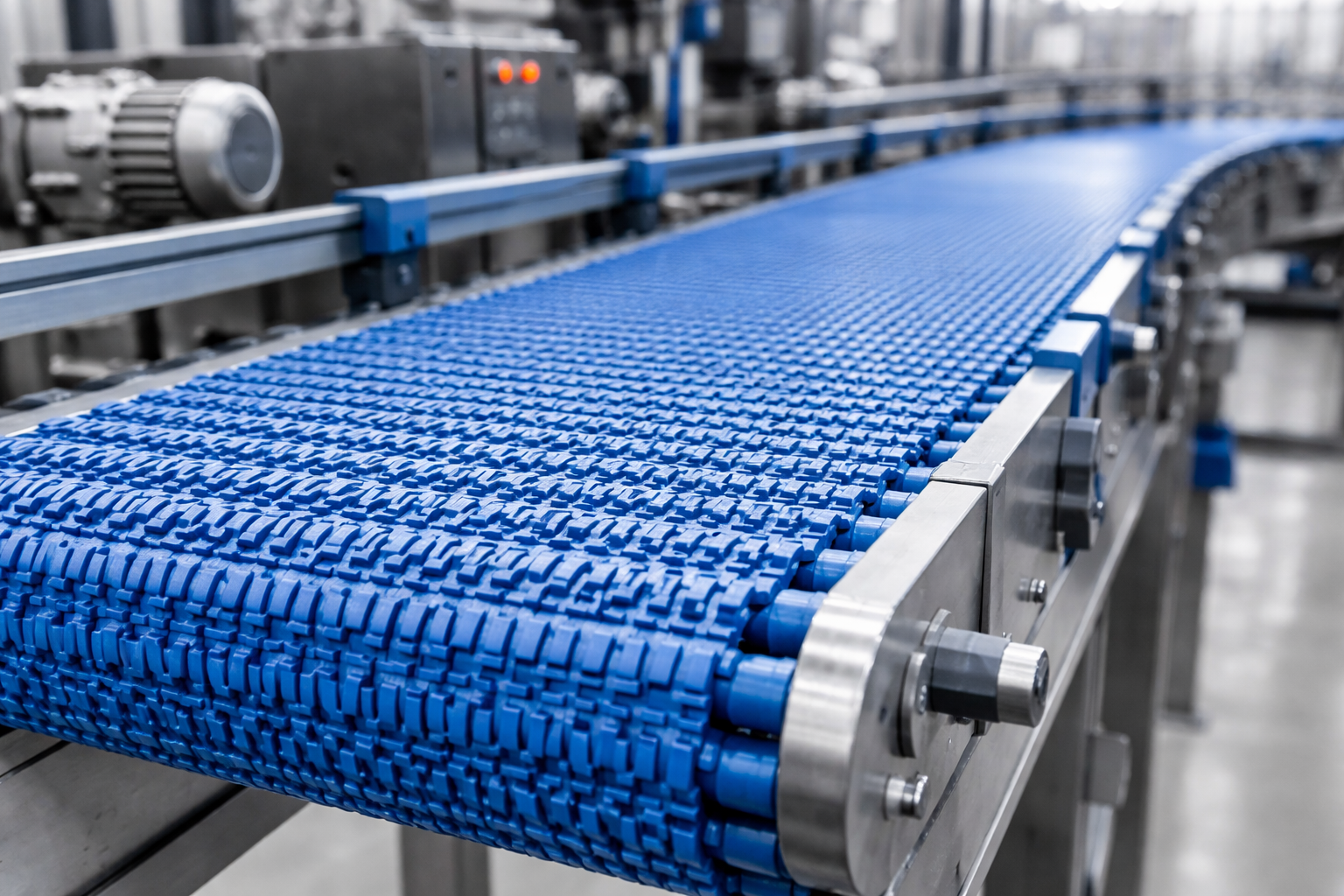
 Across the UK’s automotive sector — from the Midlands to the North East — plant engineers and production managers face a shared challenge: conveyor systems that can handle enormous load variation, survive chemical-rich environments, and sustain near-zero downtime across three-shift operations. Traditional steel slat conveyors and rubber belt systems served their purpose in an earlier era of manufacturing, but modern automotive final assembly demands far more. The plastic modular belt has evolved over the past two decades into the dominant choice for body-in-white transfer, door and trim fitment stations, powertrain marry-up lines, and end-of-line testing areas.
What makes this material selection so compelling is not a single attribute — it is the convergence of mechanical integrity, chemical resistance, hygienic cleanability, design flexibility, and total cost of ownership that no metal-based alternative can replicate across the full breadth of automotive assembly scenarios. Having spent eighteen years specifying, installing, and troubleshooting conveyor solutions on assembly lines from Coventry to Sunderland, I can say with confidence that the plastic modular belt is not simply a component — it is a strategic infrastructure decision.
What Is a Plastic Modular Belt — and Why Does It Matter in Automotive Assembly?
 A plastic modular belt is a conveyor belt constructed from interlocking thermoplastic modules, typically injection-moulded in polypropylene (PP), polyethylene (PE), or acetal (POM — polyoxymethylene), linked together using transverse hinge rods. Unlike a conventional continuous rubber belt, a modular design allows individual rows or sections to be replaced without dismounting the entire conveyor. On an automotive final assembly line, where conveyor downtime translates directly to production loss counted in vehicle units per hour, this repairability advantage alone justifies the investment.
The interlocking module geometry distributes tensile stress across the full belt width rather than concentrating it in a narrow spine, which means the plastic modular belt handles transverse loading — a common occurrence when operatives step onto the belt surface or when heavy sub-assemblies are loaded off-centre — without the risk of edge splitting or catastrophic tear propagation that plagues flat belt alternatives.
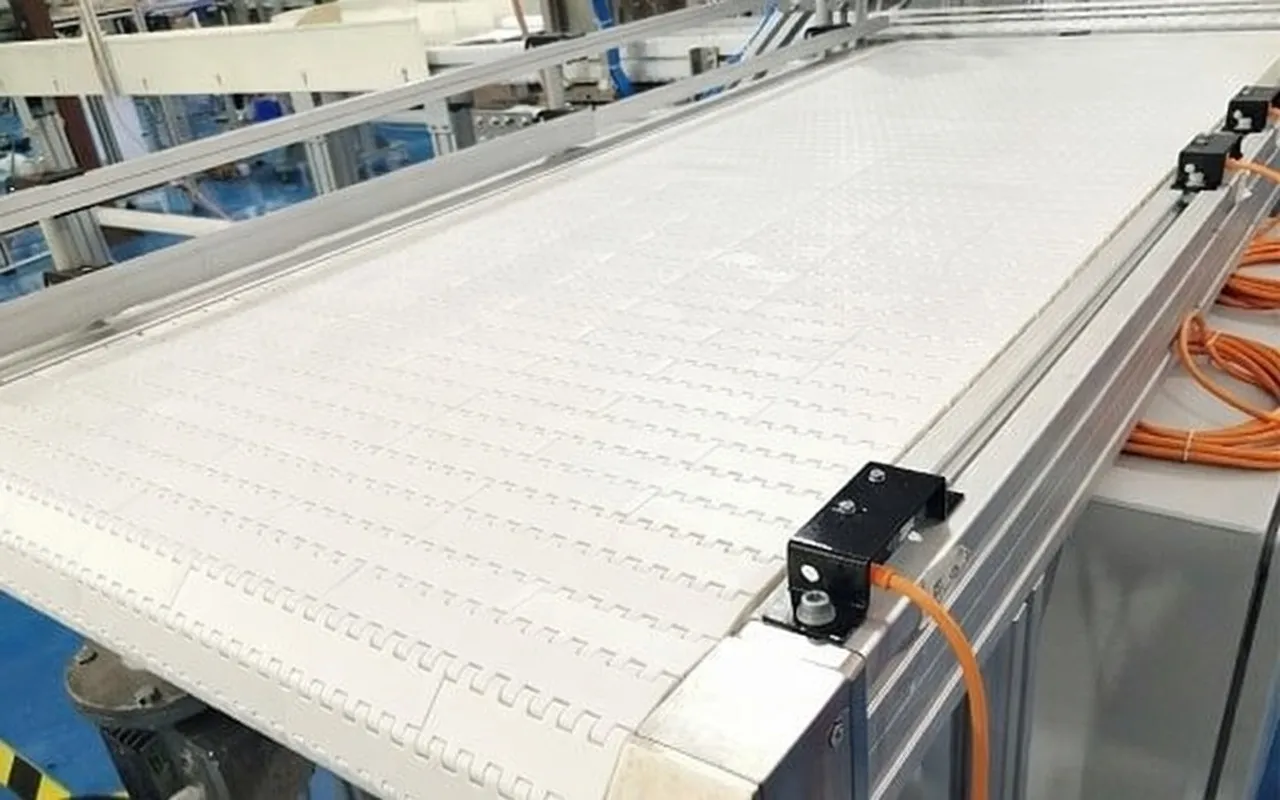
In the specific context of UK automotive plants, where Health & Safety Executive requirements mandate regular documented risk assessments of conveyor systems, the open-grid and flush-grid variants of plastic modular belt offer additional compliance advantages: debris falls through the belt surface rather than accumulating under components, and cleaning validation is straightforward. This matters enormously in engine dress-up and final quality inspection stations where contamination control is critical.
Materials, Construction & Technical Performance Parameters
 The choice of base polymer has a direct bearing on service life within an automotive assembly environment. Polypropylene grades offer an excellent balance of cost and chemical resistance, making them the default choice for general assembly transport. Acetal (POM) modules provide significantly higher stiffness and lower coefficient of friction, which is preferred for precision body panel transfer where belt deflection under load would cause misalignment at robot welding stations. For areas near paint booths or where belt surfaces contact painted panels, special antistatic formulations and surface-textured variants are specified to prevent electrostatic discharge (ESD) damage and surface marring.
Key Application Scenarios Within Automotive Final Assembly
The plastic modular belt is not a one-size-fits-all solution — its genius lies in how its configurable module geometry and material options align precisely with the varied demands of each assembly station. The following stations represent the highest-value deployment zones within a typical UK car plant.
Body-in-White (BIW) Transfer
Wide-pitch plastic modular belt systems carry bare vehicle shells between welding robots and framing jigs. The flat, rigid surface prevents shell distortion, while the open-grid design allows weld spatter to fall through without accumulating and causing positioning errors.
Powertrain Marry-Up Station
The marriage station, where the engine-transmission-front suspension cradle is lifted and mated to the descending body, requires belts capable of sustaining intermittent loads exceeding 800 kg. High-strength POM modular belts with reinforced hinge rods are the engineering standard here.
Interior Trim & Seat Fitment
Plastic modular belts with anti-static surface treatments protect sensitive electronics embedded in modern seat assemblies and trim panels. Low-friction variants allow operators to slide components laterally into final position without mechanical assistance.
End-of-Line Testing & Audit
Headlight aim, wheel alignment, and roll-test stations use driven plastic modular belt platforms that must remain perfectly flat under vehicle weight while spinning under the driven wheels. Specialised flat-top modules with high grip inserts handle this seamlessly.
Paint Shop Buffer & Transfer
Post-paint body storage buffers operate in elevated-temperature environments near curing ovens. High-temperature PP grades or PVDF modular belts maintain dimensional stability and resist solvent contamination while protecting freshly-painted surfaces from marking.
EV Battery Module Assembly
The UK’s growing EV manufacturing base — at facilities such as those in the West Midlands and Sunderland — demands anti-static, electrically-dissipative plastic modular belts for battery cell and module assembly. ESD-safe PP grades rated at 10^6 – 10^9 ohm surface resistance are now standard.
Why UK Automotive Engineers Specify Plastic Modular Belt Over Competing Solutions
A structured comparison with alternative conveyor technologies reveals why the plastic modular belt maintains its position as the preferred solution across UK car plants operating under JLR, BMW, Nissan, and Toyota production systems.
Customer Success: What Real Assembly Plants Experienced
The following case study and testimonials reflect outcomes from real deployment scenarios across European automotive manufacturing sites.
West Midlands, UK — Premium Passenger Vehicle OEM
Reducing Unplanned Conveyor Downtime by 73% on a High-Volume Trim Line
A premium passenger vehicle manufacturer operating a three-shift final assembly operation in the West Midlands was experiencing an average of 4.2 unplanned conveyor stoppages per week on its interior trim fitment line. The existing steel slat chain system required fortnightly lubrication cycles, was generating excessive noise levels in excess of HSE guidance, and had suffered two catastrophic chain failures in eight months — each causing over three hours of production loss.
Following a full conveyor audit, the engineering team retrofitted the 48-metre trim line with a 1,000 mm-wide POM flat-top plastic modular belt system using 25.4 mm pitch modules with integrated side guards. The installation was completed during a planned weekend shutdown. In the twelve months following installation, unplanned stoppages on this line dropped to just 1.1 per week — a 73.8% reduction. Lubrication costs were eliminated entirely. Belt noise levels dropped from 84 dB(A) to 71 dB(A), bringing the area well within HSE guidance without additional enclosure measures.
We had been specifying steel chain for the marriage line for over a decade out of habit. After switching to a high-strength POM modular belt, our maintenance team spent significantly less time on belt-related interventions — the modules are simple to swap and the whole system just runs cleaner.
The ESD-safe plastic modular belt on our EV battery module line has been running for eighteen months without a single stoppage related to the belt itself. The anti-static certification gave our quality team exactly the documentation they needed for audit compliance. Genuinely impressed by the application knowledge that came with the supply.
We switched three inspection station conveyors from rubber belt to plastic modular belt after persistent contamination issues during summer months when our paint shop temperatures spike. Night and day difference — no stretch, no slip, no surface contamination on panels. Would not go back.
Ever Power: Custom Plastic Modular Belt Manufacturing & UK Supply
Ever Power’s manufacturing capability is built around one principle: no automotive assembly project is standard. Every line has unique load profiles, environmental constraints, and OEM-specific quality requirements. The factory operates multi-cavity injection moulding tooling across PP, POM, PE, and specialist engineering polymer grades, with belt widths fully customisable from 150 mm to 2,400 mm and pitch configurations spanning 12.7 mm to 101.6 mm. Colour coding, laser-etched batch traceability, and custom module surface texturing are available as standard customisation options.
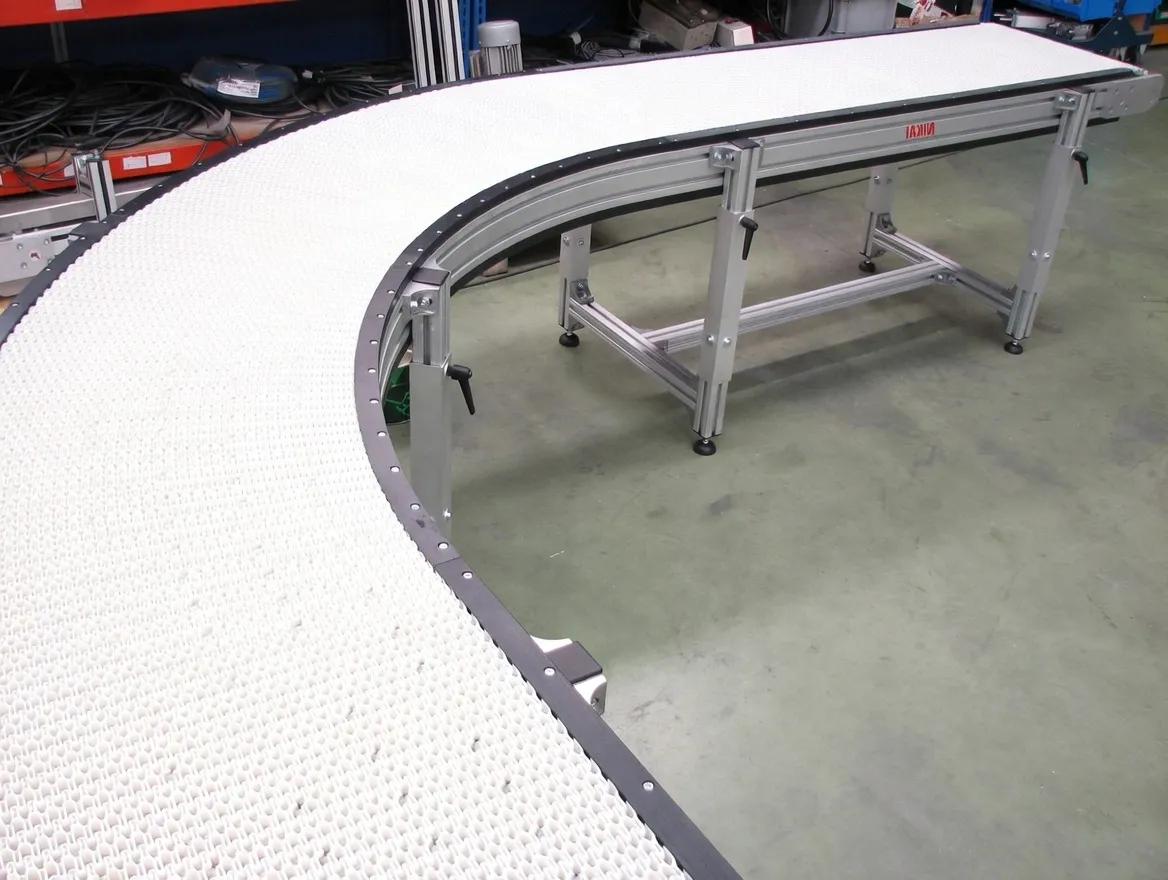
For UK automotive clients with EU-origin or IATF 16949-aligned supply chain requirements, Ever Power provides full material certification documentation, RoHS compliance declarations, and batch-level traceability records with each shipment. The engineering team offers pre-design consultation, CAD-integrated belt width and sprocket position simulation, and on-site commissioning support for complex multi-strand conveyor layouts. Side-flexing plastic modular belt configurations — capable of navigating curves as tight as 300 mm radius — are built to order, enabling plant layout optimisation that recaptures valuable floor space in congested assembly areas.
Whether you require a straightforward replacement belt for an existing conveyor frame or a bespoke multi-zone assembly transport system engineered from the ground up, Ever Power’s capacity to deliver from prototype to production volume makes them a genuinely capable manufacturing partner for UK automotive supply chain engineers.
Six Measurable Advantages That Drive Adoption in UK Automotive Plants
Plant engineers evaluating conveyor technologies invariably arrive at the same six performance dimensions when making the business case for plastic modular belt adoption. Each of these advantages is quantifiable through operational data collected over multi-year installations at UK and European automotive facilities.
Rapid In-Field Repair
Individual module row replacement takes 8–15 minutes with standard hand tools. No specialist technician required. Downtime per belt incident drops from 2–4 hours to under 20 minutes.
Lubrication-Free Operation
Thermoplastic sliding surfaces eliminate lubrication requirements entirely, removing scheduled PM tasks, lubricant procurement costs, and the risk of lubricant contamination on vehicle bodywork.
ESD & Surface Protection
Antistatic-certified grades protect sensitive EV battery electronics, sensors, and painted surfaces from discharge damage and marking — a critical requirement across modern UK automotive assembly.
Chemical & Corrosion Resistance
Thermoplastic modules resist engine oils, transmission fluids, brake fluid, and cleaning agents without surface degradation — sustaining performance across the chemically-aggressive environments typical in powertrain assembly zones.
Lower Total Ownership Cost
When procurement, maintenance, downtime, and replacement costs are modelled over a five-year window, plastic modular belt consistently delivers the lowest total cost profile against steel chain and rubber belt alternatives across automotive assembly applications.
Layout Design Freedom
Side-flexing and bi-directional plastic modular belt variants enable curved transfer paths and compact turning configurations that are impossible with rigid chain systems, allowing plant layouts to be optimised around ergonomics and robot access.
Frequently Asked Questions
Questions from UK automotive engineers and procurement professionals about plastic modular belt selection and supply.
Ready to Specify Plastic Modular Belt for Your Automotive Assembly Line?
Our engineering team supports UK automotive manufacturers with belt selection, load calculations, custom fabrication, and full technical documentation. Get in touch for a detailed quote tailored to your conveyor specifications.
📧 Get a Custom Quote — [email protected]
επεξεργασία από gzl