
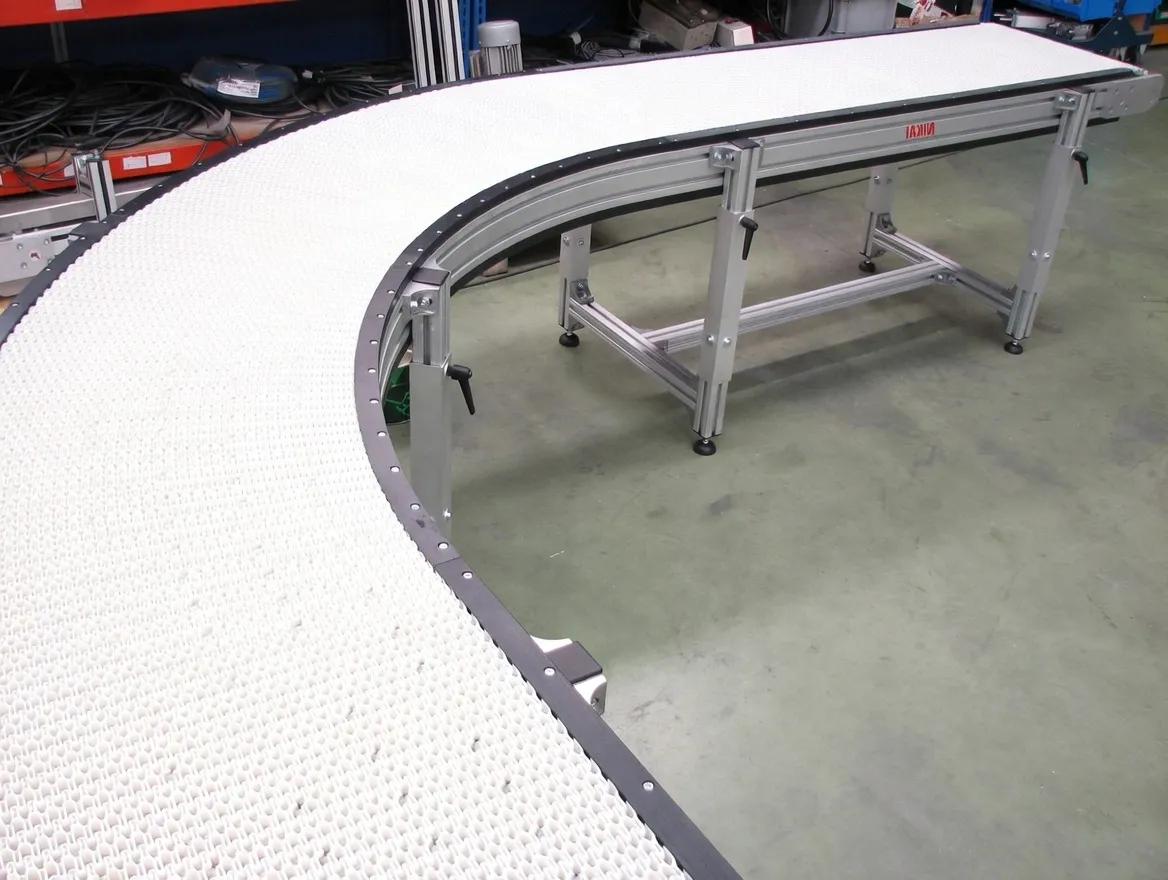
 Walk through any modern UK airport terminal and the baggage reclaim carousel looks deceptively simple. Bags glide, merge, divert, and sort without visible effort. Behind that seamless experience is an engineered ecosystem where the plastic modular belt plays the central mechanical role. Unlike the rubber or PVC flat belts that dominated airport conveyor design twenty years ago, today’s interlocked plastic modular conveyor belt offers a fundamentally different architecture — one built from individual polypropylene or acetal modules that click together like structural brickwork, creating a surface that can flex around tight curves, drain away spills instantly, and be repaired mid-shift without pulling the entire system offline.
Airport baggage handling is one of the most demanding industrial conveyor environments on the planet. You have hard-sided Samsonites, oversized golf bags, dense pallet-checked freight, and the relentless time pressure of a sixty-minute turnaround. The belt itself must handle all of this without contaminating sensors, jamming diverter arms, or allowing surface moisture from rain-wet bags to create slip hazards at merge points. The plastic modular belt, when correctly specified, meets every one of these challenges — and that is why facility managers at Heathrow, Gatwick, Manchester, and Edinburgh have made it their default specification for new-build and refurbishment projects alike.
Ever Power plastic modular belt deployed in a UK airport baggage sortation line — engineered for 24/7 operational continuity.
What Exactly Is a Plastic Modular Belt?
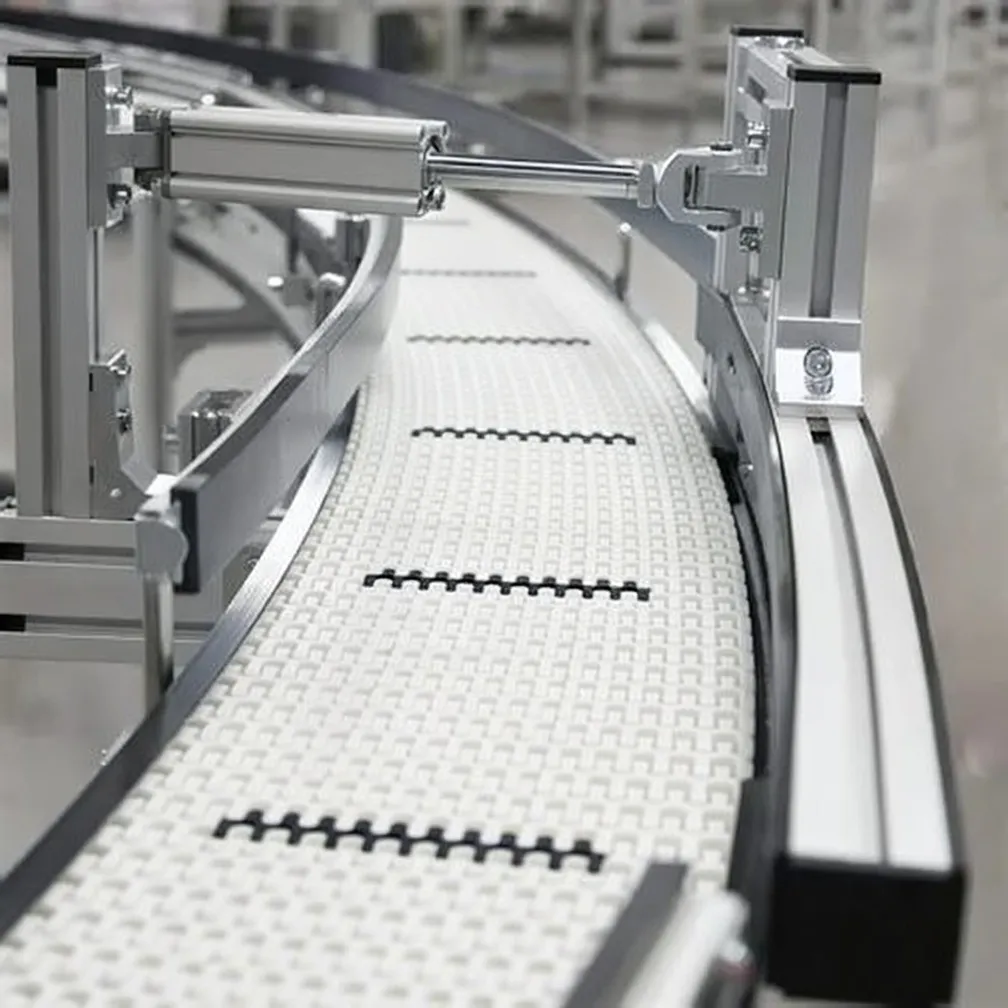 A plastic modular belt is an interlocking conveyor belt constructed from individual rigid modules — typically manufactured from polypropylene (PP), acetal (POM), polyethylene (PE), or nylon (PA) — that are assembled row by row and held together by transverse hinge rods. Each module measures between 25 mm and 100 mm in pitch depending on the application, and the assembled belt can run on standard conveyor frames without requiring custom sprockets or proprietary drive components. The structural geometry means the belt distributes load across hundreds of contact points rather than relying on the tensile integrity of a single continuous strip.
In an airport baggage handling context, this matters enormously. A 32-kilogram hard-shell suitcase dropped at an induction station imparts a sudden impact load that a PVC flat belt absorbs unevenly, leading to accelerated edge cracking over time. The plastic modular conveyor belt, by contrast, absorbs that impact across the full module width and transfers it into the supporting frame structure. The result is a dramatically longer service interval and a measurable reduction in unplanned downtime — a metric that airport operations teams track obsessively given the penalty costs associated with delayed baggage delivery under UK aviation regulations.
The open-grid variants of the plastic modular belt allow liquid from wet bags, cleaning operations, and de-icing residue to drain directly through the belt surface rather than pooling and creating hygiene or slip risks. Closed-surface variants with textured top plates are used at check-in induction zones where passengers load bags directly onto the belt, providing grip without being abrasive to luggage shells. This versatility — swapping belt surface type within the same drive frame — is something no flat-belt system can match.
Technical Specification Overview
How the Plastic Modular Belt Works Inside a Baggage Handling System
 The journey of a checked bag through an airport’s baggage handling system (BHS) involves between eight and fourteen distinct conveyor segments before reaching either the aircraft hold or the reclaim carousel. Each segment has different mechanical demands — and the plastic modular belt adapts to all of them. At the check-in induction station, a wide flat-surface module provides the friction needed to hold a stationary bag while the system reads its barcode. The belt then accelerates the bag into the main sortation loop, where the same modular architecture in a narrower width moves the bag at 2.0–2.5 m/s past scanner tunnels and diverter gates.
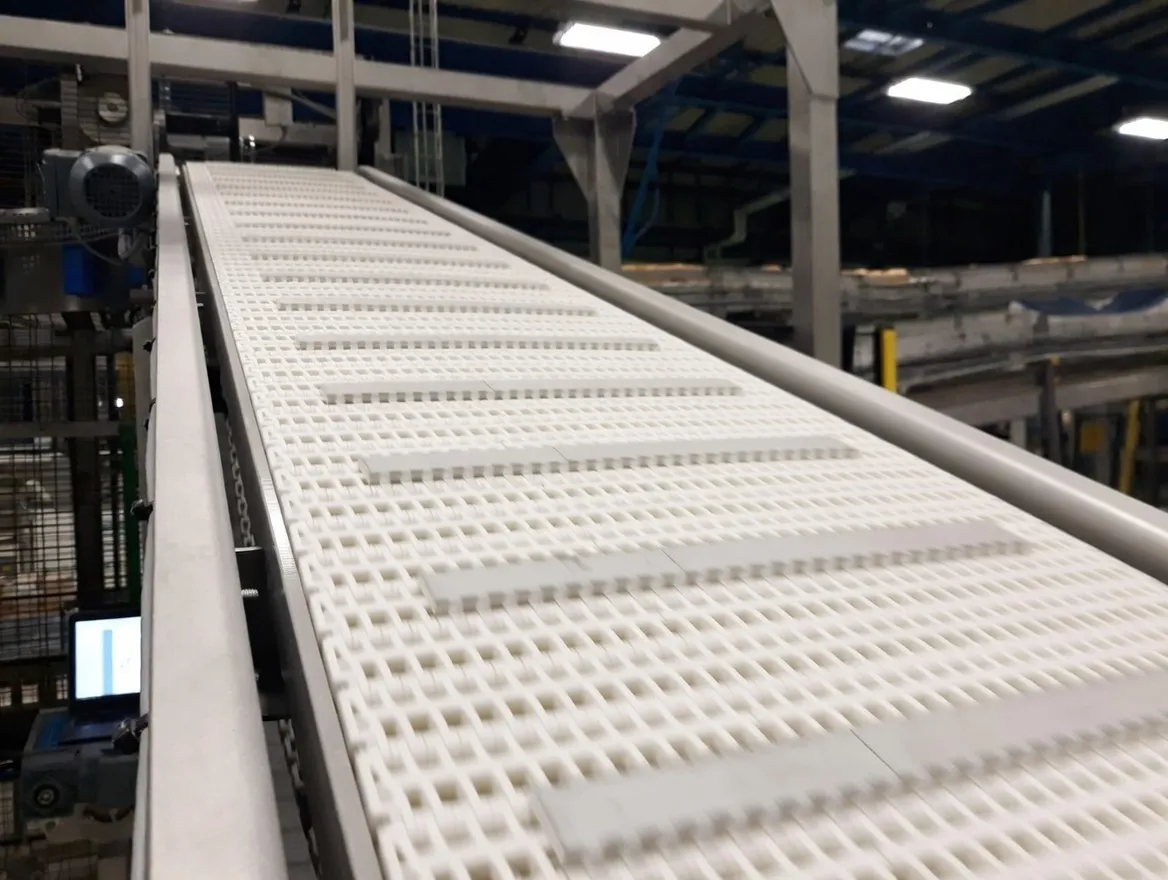
Diverter push-arm systems — whether paddle diverters or tilt-tray mechanisms — require a belt surface that responds predictably. The consistent modular geometry of the plastic modular conveyor belt means the diverter timing can be calibrated once and maintained without drift, unlike a flat belt that stretches unevenly over its service life. On incline segments feeding bags up to elevated make-up carousels, ribbed or cleated module variants prevent back-sliding on gradients up to 30 degrees. The hinge rod locking mechanism, typically a stainless-steel or fibreglass-reinforced rod, does not corrode in the humid, jet-wash-drenched environment of a below-deck baggage hall — a chronic failure mode with legacy metal-hinged systems.
Maintenance crews particularly value the modular design during the inevitable mid-shift incident. If a zipper pull or luggage strap jams a section, a technician can remove the affected row of modules in under four minutes using only a hinge rod extraction tool — no cutting, no belt clamps, no waiting for a new roll to arrive. The replacement module slots in immediately. The plastic modular belt’s maintainability is not an abstract advantage; for a Tier 1 UK airport processing 1,200 bags per hour, four minutes versus forty minutes of downtime represents the difference between a recoverable delay and a missed flight for dozens of passengers.
Key Performance Advantages
Ταχεία αντικατάσταση μονάδας
Individual modules replaced in minutes without removing the entire belt. Airport maintenance teams reduce reactive downtime by up to 70% compared to flat belt systems.
Superior Drainage
Open-grid plastic modular belt variants allow full liquid drainage — critical in UK airport environments where wet bags, cleaning routines, and fire suppression systems demand a non-pooling surface.
Tight-Radius Curves
Side-flex modular belt variants navigate inside radii as tight as 600 mm, enabling compact sortation layouts that maximise usable floor space in constrained terminal basements.
Ευρύ φάσμα θερμοκρασίας
Operating reliably from -40°C to +120°C, the plastic modular conveyor belt functions equally well in sub-zero airside baggage bays and heated terminal reclaim halls throughout the UK winter.
Anti-Static Options
Conductive and static-dissipative module grades protect sensitive electronics in passengers’ carry-on-equivalent items and comply with airport safety requirements for ESD-sensitive baggage handling zones.
Heavy Load Capacity
Structured module geometry distributes point loads evenly across the belt width, accommodating oversized baggage items of 50 kg and above without deformation or accelerated wear on the hinge rods.
Application Scenarios Across the Baggage Journey
The plastic modular belt’s versatility means a single product family covers nearly every segment of the baggage handling flow. At check-in induction, wide-pitch flat-surface modules provide the controlled friction needed to smoothly receive bags from passengers without snagging wheels or protruding zips. These same modules interface cleanly with the weighing platform, since the belt’s consistent thickness avoids the measurement variability that worn flat belts introduce over time. Moving downstream, the bag enters the main high-speed sortation loop — often running at 2.2 m/s — where a slat-top or low-friction module variant minimises bag rotation, keeping the barcode label oriented correctly toward the scanner array.
In the hold baggage screening (HBS) tunnel, the plastic modular belt must interface with X-ray and CT scanning equipment without introducing metallic artefacts into the image. Polypropylene and acetal modules are entirely radiolucent, ensuring the screening algorithm receives a clean signal uncontaminated by belt structure. Post-screening, where HBS Level 2 and Level 3 alarms require manual intervention, the belt slows and stops precisely — modular belts exhibit minimal belt-slip on the drive sprockets compared to worn flat belts, which is a measurable safety improvement in a security-critical environment.
The make-up carousel itself — the large oval loop where ground handlers load bags onto trolleys — is increasingly built with plastic modular belt sections replacing the older rubber-skirted flat belt. The modular format allows the carousel to include integrated diverter lanes for priority and fragile baggage without additional frame modifications. Reclaim carousels in the passenger terminal use the same belt type but with a softer-surface module variant to protect bag exteriors and produce a quieter, more passenger-friendly operation — a design detail that airport operators increasingly include in their terminal specification documents.
Μελέτη περίπτωσης επιτυχίας πελάτη
Regional Airport · United Kingdom
Manchester Airport Terminal 2 BHS Refurbishment — 2023
Manchester Airport’s Terminal 2 expansion project required a full replacement of the legacy rubber flat belt system across 2.4 kilometres of baggage conveyor. The facility engineering team specified Ever Power’s acetal plastic modular belt in 800 mm width across the primary sortation loops and open-grid PP modules for the make-up carousel sections. The project required a staged replacement over fourteen weeks to maintain operational continuity, with only two-hour maintenance windows available per segment during overnight low-traffic periods.
Within six months of commissioning, the maintenance team recorded a 63% reduction in belt-related stoppages compared to the previous twelve months under the old flat belt system. Average module replacement time dropped to under six minutes per incident. The open-grid sections at the carousel level eliminated the standing water complaints that had been a persistent issue through the UK autumn and winter seasons, reducing slip-hazard incident reports to zero in the first operational year.
What Clients Say
“We had chronic flat belt failures every wet season. Since switching to the plastic modular belt on our induction and HBS lines, we have not had a single belt-caused stoppage in over 400 operational days. The maintenance team calls it the best infrastructure decision we have made this decade.”
— Head of Baggage Infrastructure, Regional UK Airport
“Ever Power’s team worked closely with our engineers to select the right module pitch and surface type for each BHS zone. The customisation options were far beyond what any other supplier offered at this price point. Delivery lead times were tight but they hit every milestone.”
— Procurement Manager, BHS Systems Integrator, Birmingham
“The open-grid modular belt on our make-up carousels has essentially eliminated the drainage maintenance routine we used to run every morning. Our ground-handling staff report fewer bag snag incidents and the overall noise level in the baggage hall is noticeably lower. It is a straightforward win.”
— Operations Director, Ground Handling Contractor, Scotland
Product Customisation Capability — Engineered for Your Airport
Ever Power operates fully integrated manufacturing lines dedicated to plastic modular belt production, giving us direct control over every stage from raw material selection through to belt assembly and quality testing. This vertical integration is not simply a cost advantage — it is the foundation of our customisation capability. Our engineering team works directly with airport BHS designers, systems integrators, and facility management teams to specify the exact belt configuration demanded by each project, whether that is a non-standard width, a custom module colour for sensor contrast, an anti-static compound grade, or a cleat height matched to a specific gradient requirement.
Our factory capacity supports minimum order quantities as low as 10 metres for replacement parts and replacement module procurement, up to full project quantities of several thousand metres for major BHS installations. Sample belts for physical testing and fit-check purposes can be despatched within five working days of specification confirmation. We provide full material certification documentation, including raw material traceability, tensile test data, and operating temperature validation — all required for airport authority technical submissions in the UK. For projects that involve integration with automated sortation systems, our engineers can provide CAD geometry files of the belt profile for inclusion in conveyor design models.
Clients frequently tell us that what distinguishes Ever Power from other plastic modular belt suppliers is not just price or lead time — it is the depth of application knowledge we bring to the conversation. An engineer who has spent eighteen years working with modular belt systems in airport, food processing, automotive, and parcel sortation environments will ask questions about your BHS design that a sales team following a product catalogue simply will not think to raise. Those questions — about belt tension under maximum load, about the interaction between module pitch and diverter arm timing, about the cleaning regime that the airport’s hygiene contractor uses — are what prevent specification errors that cause problems eighteen months after installation.
Συχνές ερωτήσεις
Commonly asked questions from UK airport facility engineers, procurement managers, and BHS systems integrators.
Ready to upgrade your airport baggage handling conveyor?
Contact Ever Power — Custom Plastic Modular Belt for UK Airports
επεξεργασία από gzl