 The automotive assembly line is one of the most demanding conveying environments on the planet. Body panels, door assemblies, instrument clusters, drivetrains — every component must travel precisely, reliably, and without contamination across hundreds of metres of production floor. Operators in Midlands manufacturing plants and across the UK supply chain know this pressure well. A single conveyor failure during peak production can cascade into thousands of pounds of downtime losses within the hour.
That is why the plastic modular belt has become the backbone of modern automotive conveying. Unlike traditional rubber or steel chain belts, plastic modular belt systems offer a unique combination of mechanical precision, chemical resistance, and modular repairability that directly addresses the pain points of high-volume vehicle production. This guide covers everything from belt materials and load ratings to real-world applications at UK assembly facilities — giving procurement and engineering teams the data they need to specify the right solution.
 Ever Power — Custom Belt Solutions
Need a belt spec’d for your line?
Our application engineers work directly with UK automotive clients to select pitch, material, and module geometry — matched to your exact load, speed, and environment requirements.
What Makes Plastic Modular Belt Different in Automotive Use?
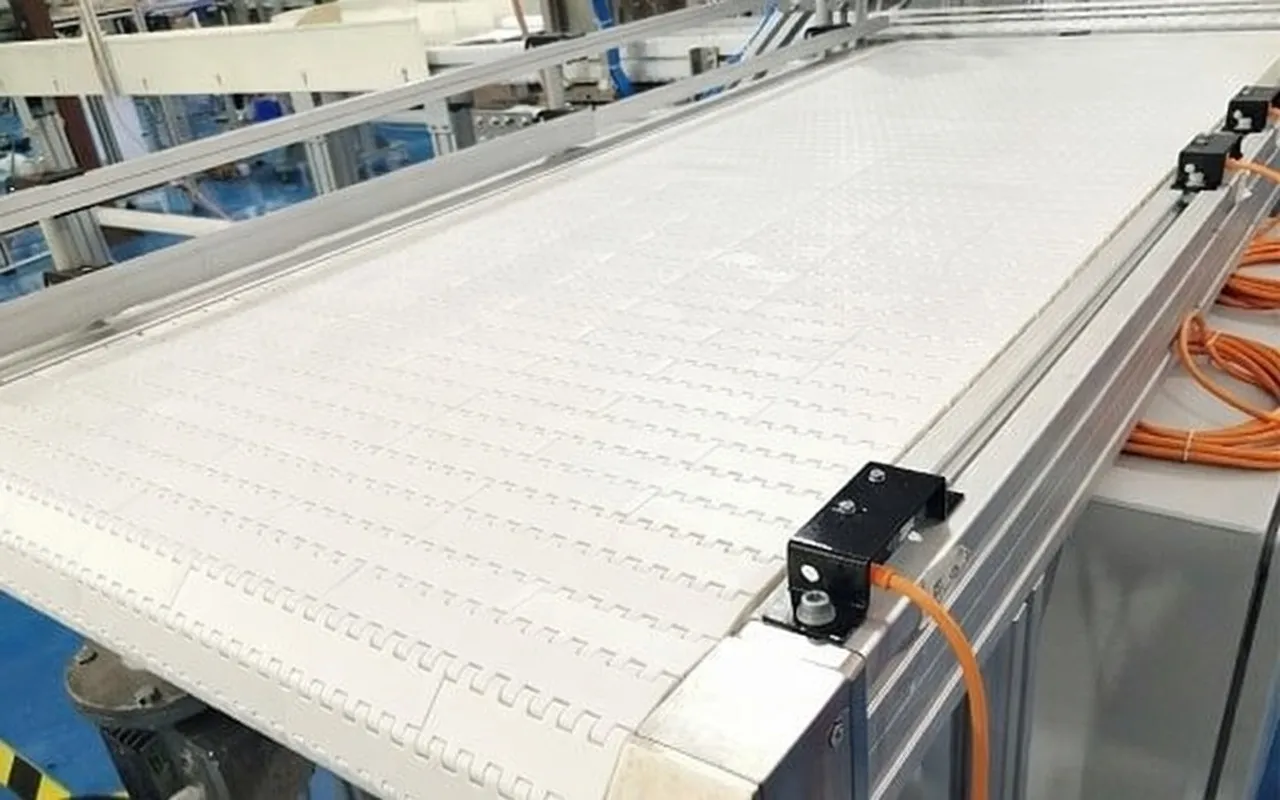
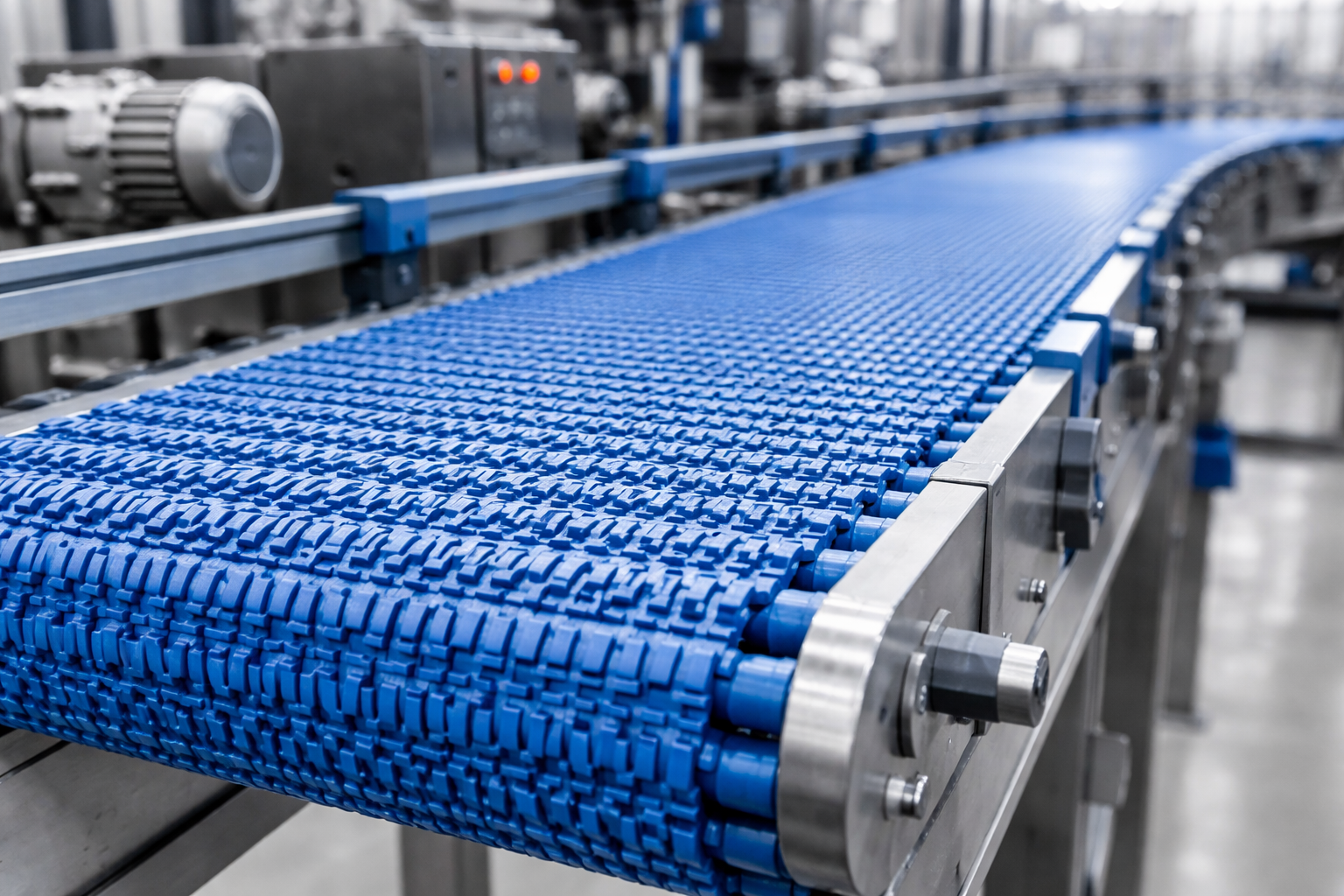 A plastic modular belt is constructed from interlocking thermoplastic modules — typically moulded from acetal (POM), polyethylene (PE), or polypropylene (PP) — joined by transverse rods to form a continuous flat or hinged surface. The modular architecture is the key engineering differentiator: when one section sustains damage, maintenance crews replace only the affected modules in minutes rather than splicing or replacing an entire belt run. On an automotive assembly line where conveyor lengths routinely exceed 150 metres, this maintainability advantage translates directly into production uptime.
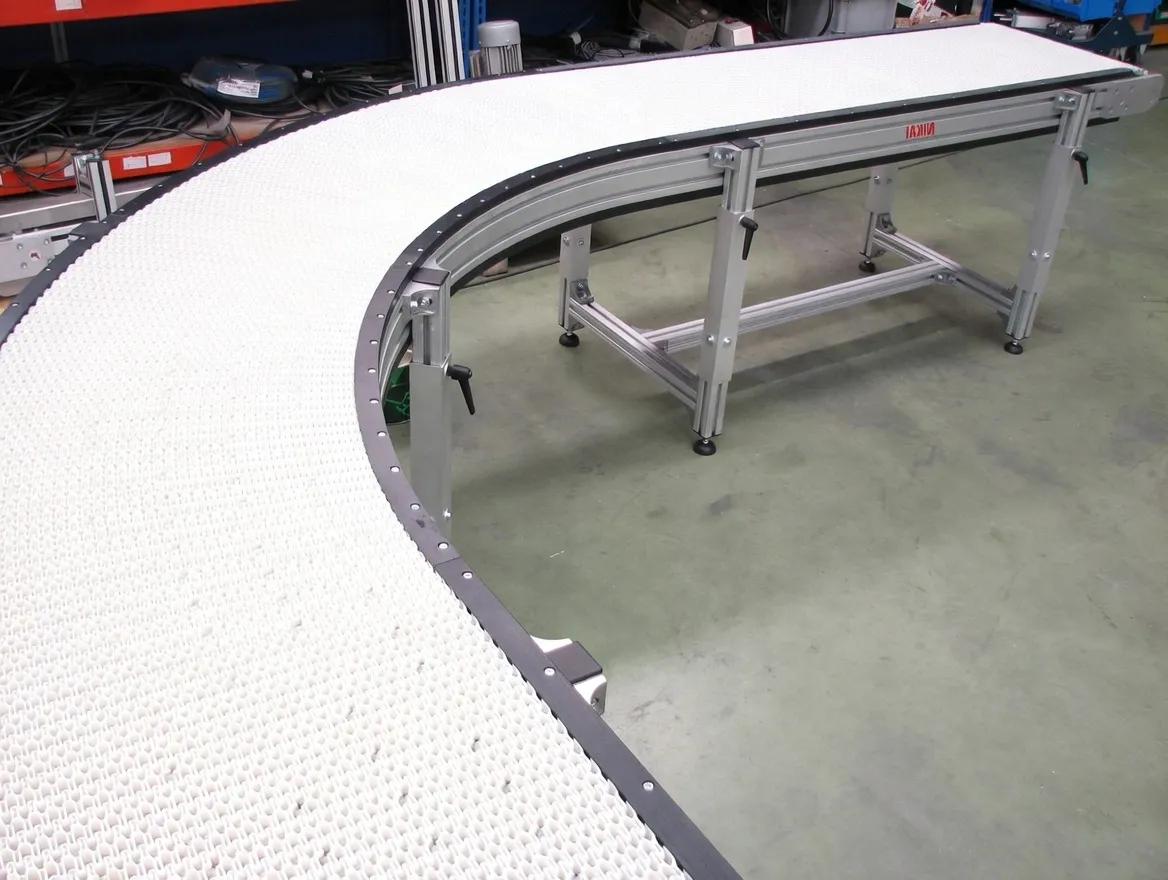
The surface texture of a plastic modular belt can be specified to match the product being conveyed. Friction-top variants grip painted body panels during incline sections; flush-grid belts allow coolant or washing fluids to drain freely in engine component lines; radius flat-top modules navigate tight 90-degree turns without the belt wandering or generating edge wear. This configurability is simply not available with rubber flat belts or steel slat conveyors.
UK automotive suppliers operating under IATF 16949 quality management requirements also benefit from the traceability of thermoplastic materials. Each batch of modules carries a material specification and lot number, supporting audit trails that rubber belts cannot easily provide. For Tier 1 suppliers feeding plants across the Midlands, South Wales, and the North East, this documentation capability has become a procurement requirement rather than a bonus feature.
Belt Principle, Materials & Operating Mechanics
Drive & Tensioning
Plastic modular belts are positively driven by sprockets that engage the module hinge rods. This eliminates slip, maintains accurate positioning, and allows back-tension adjustment without specialist tools — crucial on automotive lines where stop-start indexing is common.
Material: Acetal (POM)
Acetal modules deliver a low coefficient of friction (0.15–0.25 dry), high stiffness, and dimensional stability from -40 °C to +90 °C. Ideal for underbody assembly, brake component handling, and paint-shop conveying where surface contamination must be zero.
Material: Polypropylene (PP)
PP modular belts resist most acids, alkalis, and coolants encountered in engine and transmission washing lines. Food-grade compliant grades suit canteen or component-cleaning sections. Light weight reduces motor load on long-span conveyors.
Module Geometry Options
Flat-top, raised-rib, friction-top, perforated, side-flexing radius, and bi-directional flat modules each serve distinct automotive tasks — from smooth-surface transport of trim panels to gripping tyre assemblies on inclined transfer lines.
Six Key Application Scenarios on the Automotive Assembly Line
1. Body-in-White (BiW) Transfer
Flat-top plastic modular belt conveyors carry welded body shells between stamping presses and welding robots with sub-millimetre positional repeatability. The rigid surface prevents flexing that would misalign tooling fixtures.
2. Paint Shop Overhead & Floor Conveying
In paint booths where solvent resistance is mandatory, acetal-grade plastic modular belts withstand pre-treatment chemicals and oven temperatures during the primer and clearcoat stages, eliminating the belt degradation seen with rubber alternatives.
3. Engine & Transmission Wash Lines
Perforated PP plastic modular belt allows high-pressure wash water to drain immediately through the belt surface, preventing pooling and reducing micro-organism growth. These lines operate in continuous wet conditions that would destroy a rubber belt within weeks.
4. Tyre & Wheel Assembly
Heavy-duty friction-top plastic modular belt with raised rubber inserts supports tyre-and-wheel assemblies of up to 45 kg per station on inclined transfer sections, preventing rollback and maintaining line cadence during torque-tightening operations.
5. Trim & Interior Component Feeding
Smooth flat-top plastic modular belt transports delicate door cards, dashboard assemblies, and headliner panels without scratching painted or fabric surfaces. Low-noise belt profiles reduce operator fatigue in enclosed trim halls.
6. End-of-Line Testing & Dispatch
During final inspection, side-flexing radius plastic modular belt navigates the 90-degree turns typical of compact end-of-line test cells, connecting emissions testing bays, headlight alignment rigs, and roll-out zones without transferring vehicles to cross-belt sorters.
Why UK Automotive Engineers Choose Plastic Modular Belt
Rapid Module Replacement
Damaged sections swap out in under 15 minutes without tools — compared to 2–4 hours for rubber belt splicing. Unplanned downtime drops significantly.
Zero Stretch, Zero Retensioning
Thermoplastic modules do not elongate under load. Unlike rubber belts that require monthly tensioning, a plastic modular belt maintains its geometry throughout a full service cycle.
Wide Temperature Range
From sub-zero tyre storage warehouses to 85 °C oven curing tunnels, plastic modular belt material grades can be matched to extreme thermal profiles unavailable to rubber or steel chain systems.
Hygienic & Easy to Clean
Open-hinge designs allow pressure washing without belt removal. Critical on coolant-wetted machining lines and component cleaning stations that must meet plant hygiene protocols.
Customisable Width & Profile
Belts can be built to almost any width by combining standard-width modules side-by-side, making it straightforward to retrofit existing conveyor frames without structural modifications.
Reduced Long-Term Cost
Module-level replacement instead of full-belt changeovers can reduce consumable spend by 40–60% over a 5-year horizon on a typical automotive assembly conveyor operating 3 shifts per day.
What Our Clients Say
“We retrofitted three conveyor lines at our Derby plant with plastic modular belt from Ever Power. The lead time was short, the technical support was excellent, and the belt performance has exceeded our original specification. Highly recommended for any UK automotive operation.”
James H.
Engineering Manager — Derby Transmission Plant, UK
“The application team reviewed our exact load profile and recommended a 50.8 mm pitch acetal belt for our body panel transfer section. The belt has been running continuously for over two years. Our previous rubber belt never lasted more than eight months in the same conditions.”
Sarah R.
Production Director — Sunderland Vehicle Body Press, UK
“We supply to Jaguar Land Rover and the quality requirements are very strict. Ever Power’s custom-width plastic modular belt passed all our PPAP documentation requirements first time. Delivery to our Solihull logistics centre was on schedule, which matters enormously when we’re tied to JIT production cycles.”
Michael T.
Procurement Lead — JLR Tier-1 Supplier, Solihull, UK
Serving UK Automotive Manufacturers from the Midlands to Scotland
The United Kingdom remains one of Europe’s most significant automotive manufacturing destinations. The West Midlands automotive cluster — stretching from Coventry through Birmingham to Wolverhampton — houses dozens of OEMs, Tier-1 and Tier-2 suppliers who depend on reliable conveying infrastructure to meet just-in-time delivery commitments. Ever Power supplies plastic modular belt systems to plants throughout this corridor, as well as to facilities in Sunderland, Ellesmere Port, Halewood on Merseyside, and the growing EV manufacturing hubs developing across South Wales and the North East of England.
The accelerating adoption of electric vehicles across UK plants introduces new conveying challenges that plastic modular belt is uniquely positioned to address. Battery tray assembly lines require ESD-safe conveying surfaces to prevent electrostatic discharge damage; our anti-static acetal belt grades meet IEC 61340-5-1 requirements. Pouch cell handling lines demand non-scratch surfaces and configurable lane widths that adapt as cell formats evolve — our modular design makes width changes achievable at the module level without new belt frames.
Whether you are specifying a new conveyor during a greenfield EV facility build in North Wales, retrofitting an existing ICE assembly line in the Midlands for increased throughput, or sourcing replacement πλαστική αρθρωτή ζώνη for a wash line in a Scottish transmission plant — our engineering and commercial teams are ready to support your project from initial specification through to first production run.
Frequently Asked Questions
What is the best plastic modular belt for an automotive assembly wash line in the UK where coolants and alkaline detergents are present?
For automotive engine and component wash lines handling alkaline detergents, cutting oils, and coolant residues, a polypropylene (PP) perforated plastic modular belt is typically the most cost-effective specification. PP offers outstanding resistance to acids and alkalis at continuous operating temperatures up to 110 °C, while the perforated surface allows wash water to drain freely. For lines operating above 90 °C or where dimensional precision is critical, acetal (POM) modules with a flush-grid open surface are the preferred alternative. We are happy to review your specific wash chemistry and temperature profile to confirm the optimal material grade.
How much does a custom plastic modular belt for an automotive conveyor cost, and how quickly can Ever Power deliver to a plant in the Midlands?
Pricing for custom plastic modular belt depends on belt width, pitch, module type, material grade, and total length required. Standard configurations in stock pitches and materials are generally more competitive than bespoke geometries. We encourage you to contact our sales team at [email protected] with your drawings or belt specification — we will prepare a formal quote within 24 hours. For UK Midlands customers, standard stock-module orders typically dispatch within 3–5 working days. Complex custom orders requiring new-geometry moulds carry a longer lead time; our team will advise at quotation stage.
Where can I find a reliable supplier of plastic modular conveyor belts for automotive Tier-1 suppliers in the UK who also provide application engineering support?
Ever Power is a specialist plastic modular belt manufacturer and application engineering partner serving UK automotive Tier-1 and Tier-2 suppliers. Unlike belt distributors, our in-house engineering team can review your conveyor layout, advise on pitch and module geometry selection, calculate belt pull, and confirm sprocket specifications — all before you place an order. We have supplied plants in Coventry, Derby, Sunderland, Solihull, Ellesmere Port, and across South Wales. Reach us at [email protected] to discuss your project.
How do I replace a damaged section of plastic modular belt on a running automotive assembly line without shutting down the entire conveyor?
One of the most significant operational advantages of plastic modular belt is the ability to replace individual modules or rows without removing the entire belt. To carry out a mid-run repair, slow the conveyor to a safe crawl speed, locate the damaged row, and use a hinge-rod extraction tool to slide out the connecting rods on either side of the affected module. Snap in the replacement modules, reinsert the connecting rods, and the belt is ready to resume full speed. The full procedure typically takes 10–20 minutes depending on belt width and accessibility. We recommend keeping a small stock of spare modules in your maintenance stores — our team can advise on a suitable spares holding quantity based on your belt length and shift pattern.
What pitch plastic modular belt is most commonly specified for body panel transfer conveyors at UK automotive plants, and which module surface type is recommended?
For body panel transfer on horizontal or low-incline sections, 38.1 mm pitch flat-top acetal plastic modular belt is the most widely specified option in UK automotive plants. The flat-top surface provides a smooth, consistent contact area that protects painted and primed surfaces from marking. On inclined sections where panel slip is a concern, a 38.1 mm pitch friction-top module with rubber grip inserts is the standard choice. For wide-body panels requiring lateral support, raised-rib modules at 50.8 mm pitch offer additional edge guidance. Our application engineers can review your panel dimensions and incline angles to confirm the most appropriate specification.
When should an EV battery assembly plant in the UK switch to an anti-static plastic modular belt, and which material grade meets IEC 61340 requirements?
Any UK EV battery assembly line handling unencapsulated pouch cells, prismatic cells, or battery management system (BMS) circuit boards should use an ESD-safe conveying surface. Static discharge events as low as 100 V can damage MOSFET gates and BMS components. Our anti-static acetal plastic modular belt is formulated with carbon-black additives to achieve a surface resistivity of 10^5 to 10^9 ohms, meeting the dissipative zone of IEC 61340-5-1 and EN 61340-5-1. We recommend ESD-safe belt for all conveyor sections within 3 metres of unshielded cell or electronics handling points. Contact our team for a site-specific ESD risk assessment and belt specification recommendation.
Ready to Specify the Right Plastic Modular Belt for Your Automotive Line?
Send us your conveyor drawings or specifications. Our engineers respond within 24 hours with a technical recommendation and competitive quote — no obligation.
📧 Get a Quote — [email protected]
επεξεργασία από gzl