
 There is a moment at every UK airport that almost no passenger notices: the instant a bag placed on a check-in desk begins its journey through several kilometres of automated conveyor infrastructure, passing through security screening, sortation, and ramp-level make-up before appearing on the arrivals carousel. That entire journey — sometimes lasting 40 minutes — is carried almost entirely on plastic modular belt. Not because it is the cheapest solution, but because it is the one that genuinely survives the punishing combination of continuous duty, heavy impact loading, aggressive cleaning chemical exposure, and the zero-tolerance downtime environment that modern UK airport operators impose on their handling contractors.
Drawing on more than 18 years of specification and commissioning work across UK baggage handling projects, this guide covers everything an airport engineering team, BHS integrator, or procurement manager needs to understand about selecting, ordering, and maintaining plastic modular belt in an airport environment. The information here reflects actual project data and real failure modes observed on live systems — not laboratory test conditions.
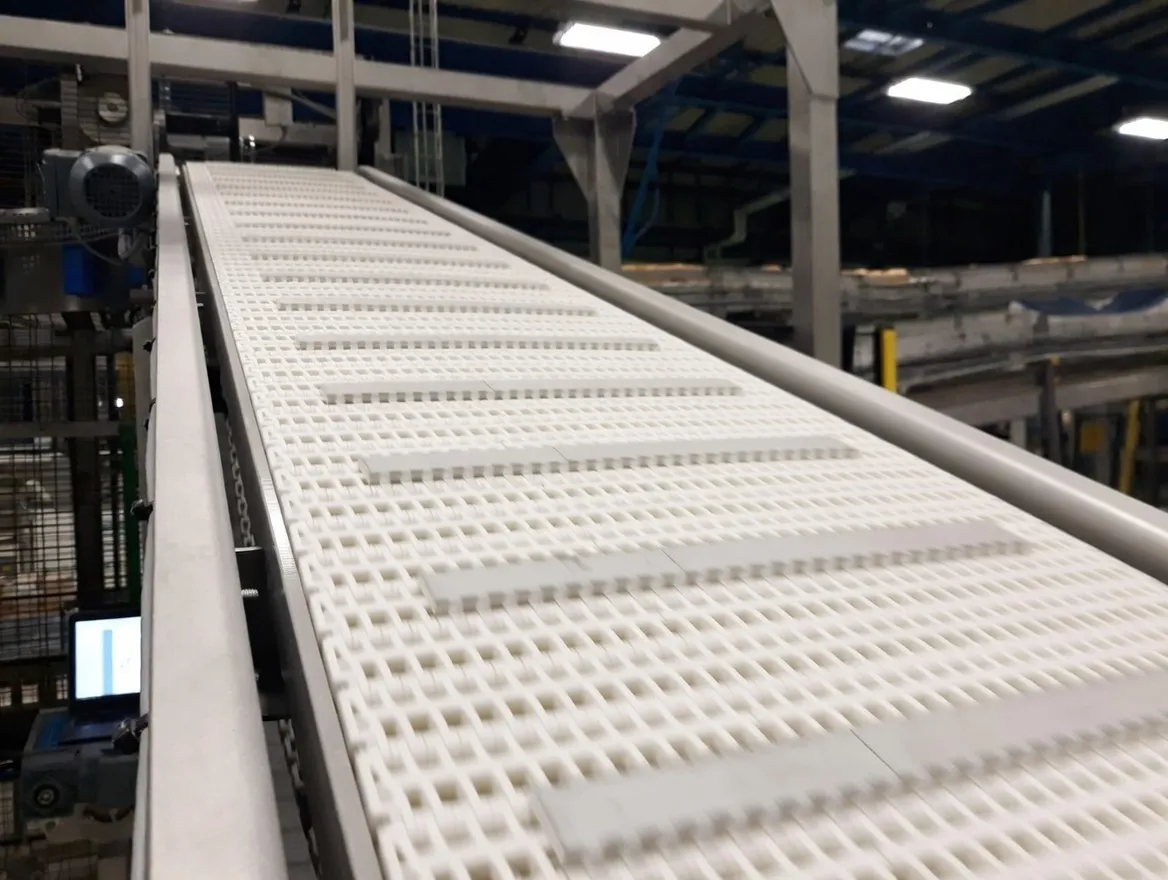
Plastic modular belt installed in a UK airport baggage handling conveyor — Ever Power custom specification
What Makes Plastic Modular Belt the Standard Choice for UK Airport Baggage Systems
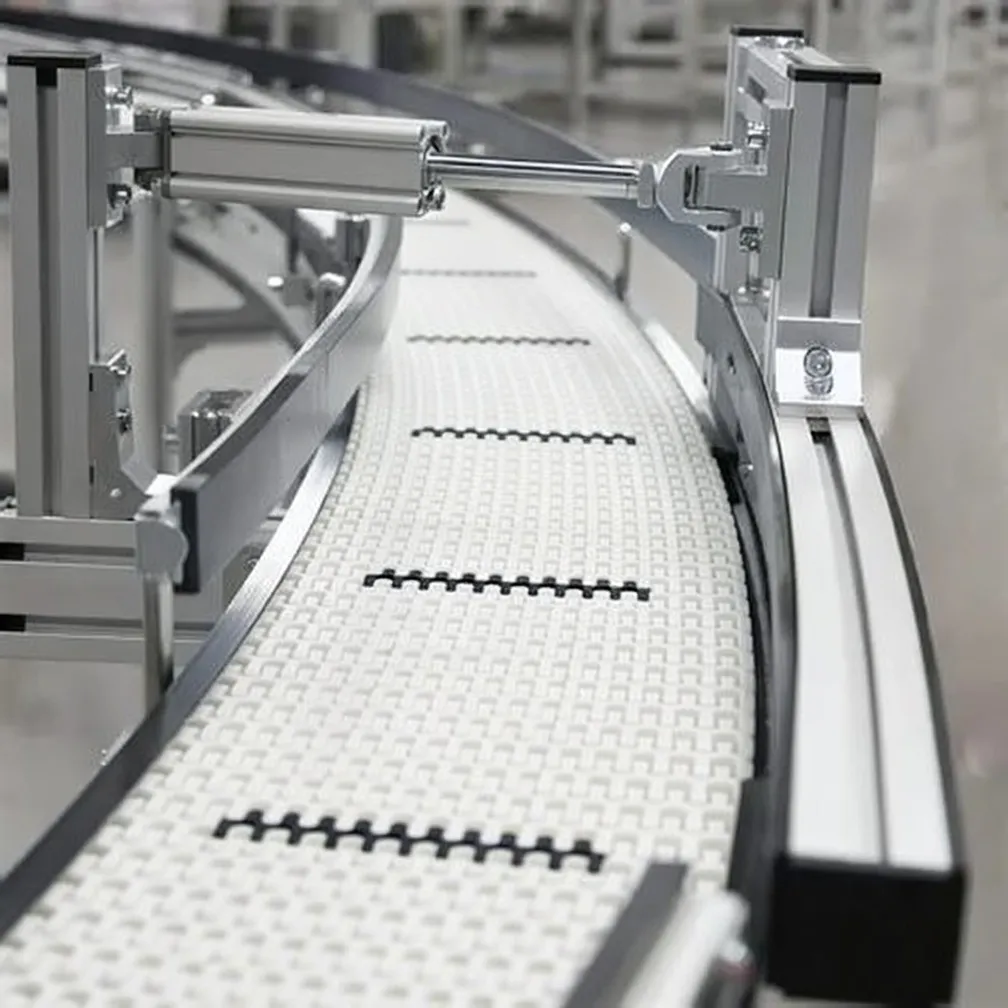 UK airport baggage handling operates under a set of conditions that few industrial environments replicate simultaneously. Conveyors must run continuously for 18–22 hours daily, handle luggage ranging from 2 kg soft bags to 32 kg rigid hardshell cases dropped from counter height, tolerate daily washdown with chlorine-based cleaning agents, and allow rapid in-situ repair when a component fails on a live terminal floor. The design architecture of plastic modular belt — injection-moulded thermoplastic modules linked by full-width hinge rods and driven by distributed sprockets — addresses each of these demands in a way that rubber flat belts and steel-slat conveyors simply cannot match at scale.
The core engineering advantage comes from the distributed drive load. Because sprocket teeth engage with moulded drive holes across the full belt width rather than at a central point or edges, there is no tensile stress concentration that leads to belt cracking or longitudinal splitting under heavy loads. This distributed engagement also means the belt tolerates accumulated bag pressure at transfer points — a routine occurrence in busy sortation halls — without the sudden belt-walk or tooth-skip events that plague rubber belts on the same conveyor geometry.
Δυνατότητα επισκευής σε αρθρωτά μέρη
Individual modules replaced in under 25 minutes on a live conveyor. No full belt shutdown needed — critical for airside operations running to departure schedules.
Hygiene & Washdown
Non-porous polypropylene surface resists biofilm growth. Handles 80°C hot water pressure washdown without delamination — meeting UK airport operator hygiene schedules.
ESD-Safe Grades
Carbon-filled acetal modules dissipate static charge inside CT and X-ray screening tunnels — eliminating sensor interference that standard PP belt generates in dry UK winter conditions.
All-Temperature Stability
PP module geometry holds dimensional tolerances from -10°C to +80°C. Outdoor ramp conveyors in Scotland maintain consistent belt pitch through mid-winter ground frost conditions.
Performance Parameters: Plastic Modular Belt in Airport Baggage Applications
The parameters below represent the working specification envelope that engineering teams at UK baggage handling system integrators and airport authorities use when evaluating plastic modular belt for new projects and replacement programmes. These are not manufacturer-claimed peak figures — they are the conservative operating limits verified through commissioning and monitoring data on UK airport installations over multiple seasons.
| Παράμετρος | Available Range | Airport Recommended | Engineering Rationale |
|---|---|---|---|
| Pitch | 12.7 – 50.8 mm | 25,4 χιλ. / 38,1 χιλ. | 25.4 mm prevents tag ingestion; 38.1 mm on flat runs reduces module count |
| Πλάτος ζώνης | 100 – 2.400 χιλιοστά | 600 – 1,200 mm | 800 mm standard for most bag profiles; 1,000+ mm for oversized item lanes |
| Max Belt Speed | up to 3.0 m/s | 0.5 – 2.0 m/s | Incline sections above 1.5 m/s require anti-slip rubber inserts |
| Working Load | up to 90 kg/m² | up to 65 kg/m² | Safety margin covers accumulated bag packs at transfer merge points |
| Module Material | PP, POM, PE, Nylon | PP (general) / POM (wear zones) | POM acetal for check-in and HBS entry — higher impact toughness |
| Surface Pattern | Flush, Open, Perforated, Anti-slip | Flush solid / Anti-slip insert | Anti-slip inserts mandatory on conveyor inclines exceeding 8° |
| Temperature Range | -40°C to +120°C | -10°C to +60°C | Covers outdoor UK ramp exposure in winter frost conditions |
| Hinge Rod | PP, SS 304, SS 316 | SS 316 stainless | 316 grade resists chloride-based airport cleaning agents without pitting |
| Colour Options | White, Grey, Blue, Black, Custom | White / Light Grey | Lighter colours simplify visual wear and contamination inspection |
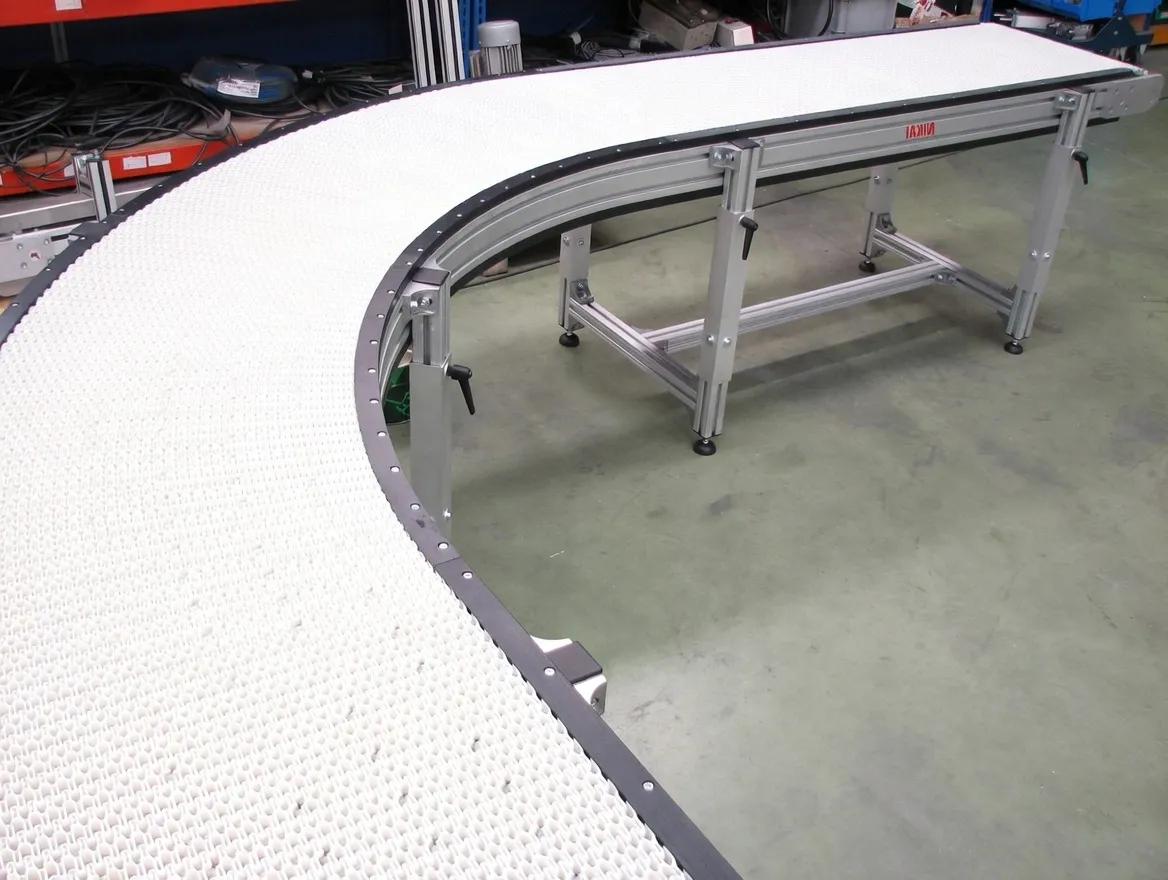
| Min Curve Radius | 200 mm (side-flex) | 500 – 1,500 mm | Side-flexing plastic modular belt handles compound horizontal curves in sortation halls |
Materials, Engineering Principles, and How the Belt Actually Works
Understanding why plastic modular belt performs so reliably in airport baggage handling requires a brief look at the underlying engineering. Each module is a precision injection-moulded part — typically 25–50 mm in conveyor travel direction — with a series of hinge eyes projecting from both the leading and trailing edges. Adjacent rows of modules interlock at these hinge eyes, and a single-piece hinge rod passes through the full belt width, locking the rows together while allowing the belt to flex around the drive sprockets. The completed belt assembly is entirely self-supporting on the conveyor wearstrips and requires no external tensioning system — a fundamental difference from rubber belt conveyors that must maintain a carefully controlled tension to prevent slip on the drive pulley.
Material selection begins with polypropylene (PP) for the majority of airport baggage system runs. PP combines the right balance of impact resistance — absorbing the repeated shock of bags dropped from counter height — with chemical compatibility against the alkaline and chlorine-based cleaning solutions used in UK airport terminal washdowns. For the highest-impact zones such as check-in induction and the entry throat of HBS screening conveyors, polyoxymethylene (POM) acetal provides meaningfully higher surface hardness and wear resistance. In CT tunnel applications, a carbon-filled ESD-dissipative variant of acetal is specified to prevent electrostatic discharge events from interfering with detector electronics. Hinge rods are almost universally specified in 316-grade stainless steel for airport use because the combination of chloride cleaning agents, condensation on steel conveyor frames, and the elevated humidity inside baggage halls creates a corrosion environment that rapidly degrades standard-grade or plastic rods, leading to stiff hinge joints and accelerated module wear on the hinge eye faces.
Πολυπροπυλένιο (PP)
General sortation, transfer conveyors, arrival carousels. Excellent chemical resistance. FDA-compliant grades available. Operating range -10°C to +100°C. Most cost-efficient airport belt material.
Ακετάλη / POM
Check-in induction, HBS entry/exit, high-impact zones. Superior surface hardness and dimensional stability under cyclic loading. Measurably longer service life in wear-intensive positions.
ESD Acetal
CT/X-ray screening tunnel belts. Carbon-filled or steel-fibre reinforced. Dissipates static to below 10^9 ohm surface resistivity. Recommended by UK HBS system integrators for Level 4 and Level 5 installations.
Anti-Slip Inserts
Rubber or UHMW-PE inserts moulded into PP modules for incline conveyor sections over 8°. Essential on ramp-level inclines transporting heavy checked baggage to aircraft loading areas.
Where Plastic Modular Belt Is Used Inside an Airport Baggage System
A modern integrated baggage handling system routes each piece of luggage through a distinct sequence of functional zones, and each zone places different mechanical demands on the plastic modular belt running through it. Getting the specification right for each zone — rather than applying a single belt specification throughout — is what separates high-performing installations from those that generate repeated maintenance calls within the first two years of operation.
Check-In Induction Conveyor
The check-in induction zone is where bags first contact the belt and where impact loading is highest. Bags of all weights — including 32 kg oversize cases — are placed directly onto a moving belt surface, and the impact energy must be absorbed without cracking the module. POM acetal modules at 25.4 mm or 38.1 mm pitch with a flush solid top surface handle this without surface damage across hundreds of thousands of bag cycles. Belt width at this position is typically 800–1,000 mm to accommodate ski bags and pushchairs alongside standard luggage.
Hold Baggage Screening (HBS) Tunnel
HBS CT scanner tunnels require controlled belt speed — typically 0.3–0.8 m/s through the aperture — and minimal electromagnetic interference from the belt surface. ESD-dissipative acetal plastic modular belt prevents the static discharge events that occur when standard polypropylene runs over non-conductive wearstrips in low-humidity UK winter conditions. Belt pitch accuracy is also critical because some CT systems use belt position encoders for image synchronisation, and module-to-module pitch variation greater than ±0.3 mm can corrupt scan reconstruction.
Automated Sortation Hall
The sortation hall is the busiest section of the entire baggage system — multiple conveyor lines running at 1.5–2.0 m/s, merging and diverging through a network of horizontal curves and divert mechanisms. Side-flexing plastic modular belt handles curve radii as tight as 500 mm without the bag tracking instability that rubber belts exhibit on curved conveyor frames. The narrow hinge gap of a 25.4 mm pitch belt also prevents bag straps, luggage tags, and zip pulls from being drawn into the belt structure — a leading cause of baggage damage claims and passenger complaints at UK airports still operating older slat conveyor systems.
Ramp-Level & Outdoor Baggage Make-Up
Outdoor and semi-enclosed tarmac-level conveyor sections at UK airports experience temperatures ranging from below -5°C on Scottish winter mornings to above 35°C during peak summer periods. Standard polypropylene plastic modular belt maintains consistent module pitch and drive engagement through this temperature range, unlike rubber belts that stiffen in cold conditions — causing drive slip — and soften in heat, producing belt sag and uncontrolled elongation. Anti-slip rubber inserts in the module surface are specified for all incline sections above 8° to prevent heavy bags sliding back against the direction of travel.
Arrivals Baggage Reclaim Carousel
The reclaim carousel is the passenger-facing conclusion of the baggage journey, and belt appearance matters here as much as mechanical performance. White flush-solid plastic modular belt presents a clean, professional surface that projects well against the polished interior environments of modern UK terminal buildings. The smooth module-to-module surface transition handles ski bags, pushchairs, and bulky sports equipment without snagging, and the belt’s non-absorbent surface wipes clean during the nightly washdown regime that all UK airport carousels follow.
The Operational Advantages That UK Airport Engineers Report After Switching to Plastic Modular Belt
These are not promotional statements drawn from a product brochure. They are the operational improvements that UK airport engineering managers and BHS maintenance teams have documented in project reviews and post-implementation reports following plastic modular belt upgrades over the past decade.
60–75% Less Planned Downtime
Module-level repair during live terminal operation replaces the 3–4 hour overnight shutdown required to replace a full rubber belt run on the same conveyor. A trained four-person crew replaces a 10-module section in under 25 minutes without stopping the adjacent conveyor lanes.
No Belt Tensioning Requirement
Plastic modular belt requires no take-up mechanism and no re-tensioning over its service life. This removes a routine maintenance task that generates an average of two maintenance interventions per year on each rubber belt conveyor in a busy UK airport sortation hall.
Bag Damage Claims Reduced by 80%+
The narrow 25.4 mm pitch hinge gap and smooth flush module top surface prevent zip pulls, bag tags, and luggage straps from being drawn into the belt structure — the primary mechanical cause of baggage damage claims at airports still operating older slat or wide-pitch belt systems.
8–12 Year Service Life
On 18-hour daily operating cycles typical in UK airports, a properly specified plastic modular belt runs for 8–12 years before full belt replacement is needed. Individual module swap-outs extend effective service life indefinitely in high-wear positions.
Simplified Spare Parts Inventory
Carrying a stock of individual modules costs a fraction of holding full rubber belt spares. A single pallet of replacement modules covers maintenance needs across an entire terminal, freeing warehouse space and releasing capital previously tied up in belt stock for 12–15 conveyor runs.
Full Curve & Incline Versatility
One belt type — side-flexing plastic modular belt — replaces three or four different belt types required on a traditional rubber belt installation to cover flat runs, horizontal curves, and incline sections. This simplification reduces procurement complexity and training requirements for maintenance staff.
Case Study: Birmingham Airport — Terminal Expansion HBS Upgrade, 2024
BHS Integrator Client | West Midlands, United Kingdom | Completed Q1 2024
Background: A specialist baggage handling system integrator based in the West Midlands was awarded the BHS upgrade contract for Birmingham Airport’s new Terminal Check-in Zone C, which included four new check-in banks, two HBS Level 5 CT screening lines, and a complete sortation hall expansion connecting to the existing early-bag store. The original specification called for rubber flat belt throughout, following the legacy infrastructure already installed in older terminal areas.
Challenge: The CT screening lines required belt material compatibility with the new-generation scanner systems’ ESD sensitivity requirements. The sortation hall geometry included three 90-degree horizontal curves with minimum radii of 650 mm — a constraint that ruled out rubber flat belt without costly custom conveyor frames. The engineering team was also working under a construction programme that allowed only 14-day windows for belt installation and commissioning in each zone.
Solution: The integrator switched the full specification to plastic modular belt across all zones — 25.4 mm ESD acetal for the two CT tunnel lines, 25.4 mm PP flush solid for the sortation hall curves, and 38.1 mm PP with anti-slip inserts for the three incline sections connecting the sortation hall to the ramp level. All belt assemblies were supplied with 316 stainless steel hinge rods. Ever Power delivered the full project order in 12 working days, phased across the three construction zones to align with the on-site programme.
Outcome: Zero belt-related failures in the first 16 months of operation. The HBS engineering team confirmed that the ESD false-alarm rate — previously a recurring problem on an existing PP belt scanner line in Terminal B — was not observed on the new CT installations. The airport’s maintenance manager reported that routine belt inspection time per shift dropped by approximately 35% compared with the rubber belt sections in the older terminal, because the visual condition of plastic modular belt is immediately apparent during walkthrough inspections without removing guarding.
What Engineers and Operations Teams Across the UK Say
“The move to plastic modular belt across our sortation hall reduced our belt-related call-outs from an average of three per week to essentially zero over the following eight months. The module swap concept sounds simple in theory but genuinely transforms how you plan maintenance on a live system.”
Tom Hargreaves
“Specifying ESD acetal plastic modular belt in our CT tunnel approach was the right call. The false-alarm issue that had plagued the previous system in winter disappeared completely. The technical support from the supplier in working through the right grade was very thorough — they clearly know airport applications in detail.”
Catriona Muir
“We refurbished all six reclaim carousels at Bristol Airport with white flush plastic modular belt and the passenger reaction has been noticeably positive. The carousels look premium and clean up beautifully after the overnight shift. Twelve months on and not one belt fault call — that is genuinely exceptional on a 19-hour daily operation.”
Rachel Pemberton
Covering UK Airport Baggage Infrastructure from London to Glasgow
The United Kingdom’s commercial airport network spans more than 40 operational facilities, from the scale of London Heathrow — handling over 79 million passengers annually — to regional gateways in Inverness, Newquay, Derry, and Humberside. Each of these airports requires plastic modular belt that can be sourced with reliable short lead times, supported by application engineering before purchase, and maintained by local maintenance teams who do not have access to specialist belt technicians. Our UK-held stock programme enables emergency next-day dispatch to any mainland UK airport, removing the supply chain risk that has historically led engineering teams to over-stock belt spares to cover lead time uncertainty.
We work directly with UK airport authorities, BHS integrators, and Tier 1 handling contractors across England, Scotland, Wales, and Northern Ireland. Our documentation package for UK projects includes CE-marked belt assembly declarations, full material traceability certificates, RoHS compliance records, and COSHH data sheets for all belt materials — covering the compliance requirements of airport procurement frameworks from CAA-regulated facilities down to smaller aerodromes under ATOL operator management.
| Airport / Region | Primary Belt Application | Typical Specification |
|---|---|---|
| London Heathrow (LHR) | Multi-level sortation, HBS CT tunnels | 25.4 mm PP / ESD POM CT zones |
| Gatwick (LGW), West Sussex | Carousel refurbishment, curve sections | 38.1 mm side-flex PP, white flush |
| Manchester (MAN) | T2 HBS Level 5, sortation expansion | 25.4 mm ESD POM, SS316 rods |
| Edinburgh (EDI) | Outdoor ramp inclines, winter exposure | 38.1 mm PP anti-slip insert, SS316 |
| Birmingham (BHX) | Check-in induction, HBS entry | 25.4 mm POM acetal, solid flush top |
| Bristol, Leeds Bradford, Belfast | Carousel, transfer, full-system upgrade | 25.4 / 38.1 mm PP to project spec |
Custom Plastic Modular Belt Manufacturing — Built to Your Airport Project Specification
At Ever Power, our manufacturing capability goes well beyond supplying standard catalogue belt assemblies. Our dedicated plastic modular belt production facility operates injection moulding lines configured to produce non-standard module pitches, bespoke belt widths trimmed to the exact conveyor frame dimension specified in your drawings, and custom colour schemes for zone identification — including airport authority-mandated colour coding for airside safety compliance. We machine custom belt widths from 100 mm up to 2,400 mm in a single assembly, eliminating the need to run adjacent parallel belt sections where a single wide belt is the correct engineering solution.
Our application engineering team reviews your conveyor drawings, load case, and operating environment before issuing any quotation. We verify sprocket spacing and shaft diameter compatibility, identify module material grades for each conveyor zone, and provide installation guidance drawings that airport maintenance teams can use directly without reverse-engineering the belt assembly from catalogue data. For large airport refurbishment programmes, we offer phased delivery schedules that align with your planned maintenance windows and construction programme dates — reducing the on-site storage burden in constrained airside logistics environments. Sample sections for physical fit-check and load testing are available on request at no charge for confirmed project enquiries.
Request a Belt Specification Review
Send us your conveyor drawings and bag load data. Our application engineers respond with a full belt specification recommendation and quotation within 48 hours — project or emergency order.
Συχνές ερωτήσεις
Airport & Baggage Handling Engineers — United Kingdom