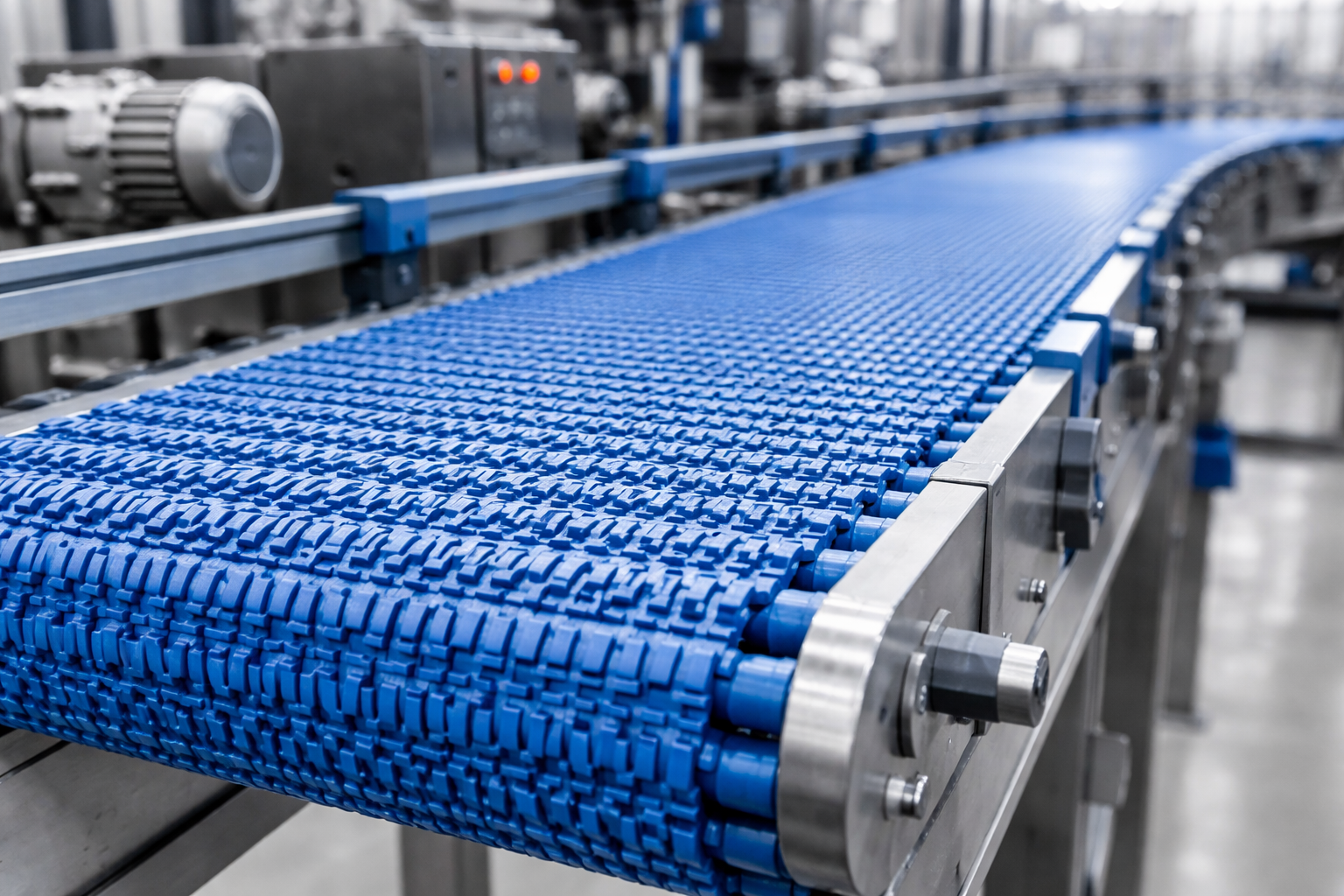
 Walk the shopfloor of any tier-one automotive plant built or refurbished in the last decade — Jaguar Land Rover in Solihull, Nissan in Sunderland, Toyota in Derby — and you will almost certainly find plastic modular belt conveyors working silently beneath the noise of torque guns and robot welders. These belts do not attract headlines the way collaborative robots do, but the engineering story behind them is genuinely fascinating, and the operational impact is measurable down to tenths of a percent on OEE dashboards. Over eighteen years of specifying, installing, and troubleshooting conveyor systems across European and UK automotive plants, I have watched plastic modular belt technology mature from a niche alternative into the default choice for final assembly, engine dress, and instrument panel fit stations. This article explains why, with real-world parameters and the kind of detail that plant engineers and procurement managers can actually use.
The transition is not merely about material substitution. Choosing a plastic modular belt over a traditional steel slat chain or roller conveyor changes how you plan maintenance windows, how you handle product variants on a mixed-model line, and how confidently you can quote a five-year total cost of ownership to a finance director. Each of those dimensions deserves close examination.
Plastic modular belt conveyor on an automotive trim assembly station — Ever Power installation, UK
Why Automotive Final Assembly Demands a Different Conveyor Philosophy
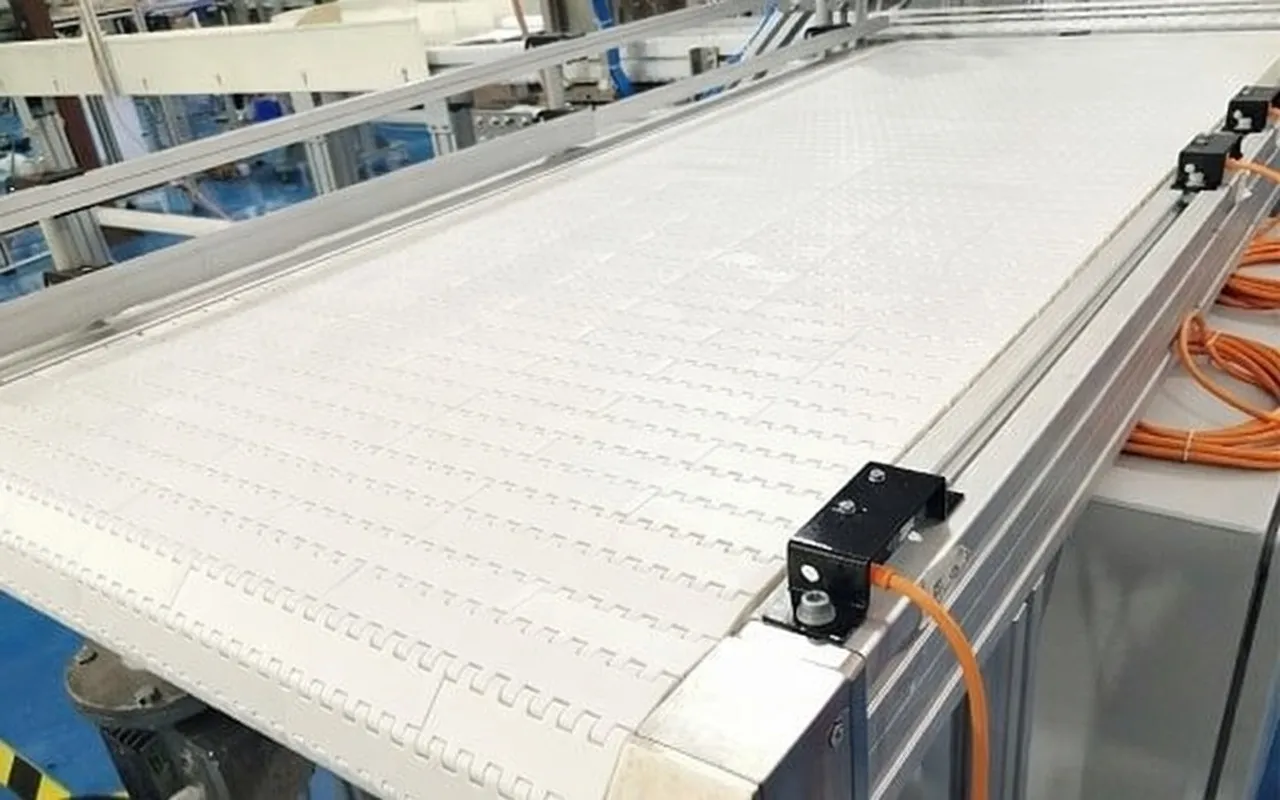 A vehicle final assembly line is one of the most demanding conveyor environments in manufacturing. Unlike a food or pharmaceutical line — where loads are relatively homogeneous and light — an automotive line carries incomplete vehicle bodies that can weigh between 400 kg and 1,800 kg depending on segment, and those bodies must travel at precisely controlled speeds through dozens of consecutive build stations without a single surface scratch, misalignment, or unexpected stop. The stakes are high: one minute of unplanned downtime on a UK automotive line producing 60 jobs per hour translates directly to lost production value exceeding £8,000–£12,000 in final vehicle revenue, depending on model mix. Against that backdrop, the engineering argument for plastic modular belt is not philosophical — it is economic.
Steel slat conveyors dominated automotive final assembly for decades, and their robustness under heavy load was never in question. What eroded their dominance was not a single failure point but an accumulation of operational frustrations: the need for constant lubrication, the noise generated by metal-on-metal contact, the difficulty of retrofitting line changes when model variants required different pitch spacings, and the corrosion risk in paint-shop adjacent zones where humidity and airborne chemicals accelerate wear. Plastic modular belt addresses every one of those pain points through its fundamental architecture — individual interlocking modules made from engineering-grade polymers, assembled onto a common hinge rod, and driven by standard sprocket systems that require no dedicated infrastructure beyond what most plants already have.
The modular nature is the key insight. When a section of a traditional steel slat conveyor fails, replacement typically involves shutting down the entire line, sourcing a matched steel component from a supplier with potentially weeks of lead time, and involving specialist fitters. When a section of plastic modular belt fails — which in a well-maintained installation happens far less frequently — a maintenance technician can replace individual modules in minutes using standard hand tools, often without stopping the line if the failure is isolated to one row. UK automotive plants operating Lean maintenance programmes report that this shift in repair philosophy alone reduces conveyor-related downtime by 40–65% over a three-year horizon.
Material Science & Engineering Principle
Acetal (POM)
The workhorse polymer for dry automotive environments. POM offers a tensile strength of 60–70 MPa, a continuous operating temperature of -40°C to +90°C, and a coefficient of friction against steel typically below 0.20. It resists automotive fluids including gear oil, brake fluid, and mild cleaning detergents — all present in trim and chassis assembly zones.
Polypropylene (PP)
Selected where chemical resistance to alkaline wash solutions is paramount — common in underbody and engine bay assembly where cleaning protocols are aggressive. PP grades with UV stabilisers are specified for any section near roof openings or overhead skylights, preventing brittleness from solar exposure over multi-year service life.
Nylon (PA6 / PA66)
Preferred for high-load zones such as engine mount stations where localised point loads can exceed 800 kg per linear metre. PA66 with glass-fibre reinforcement extends the load ceiling further, and its inherent lubricity reduces drive energy consumption — a measurable advantage when calculating the annual electricity cost of a 200-metre assembly loop running three shifts.
Interlocking Module Principle
Each module is injection-moulded to tight dimensional tolerances (typically ±0.1 mm on hinge-rod bore diameter). Modules link via stainless steel or high-strength polymer hinge rods across the belt width. Drive is transmitted via sprocket engagement at the module eye openings — no adhesive, no welding, no special tooling required for assembly or field repair.
Technical Performance Parameters — Automotive Grade
| Parameter | Standard Grade | Heavy Duty (Automotive) | Unit |
|---|---|---|---|
| Belt Width Range | 100 – 600 | 200 – 1,500+ | mm |
| Max Distributed Load | up to 500 | up to 2,000 | kg/m² |
| Operating Temperature | -20 to +80 | -40 to +110 | °C |
| Belt Speed (typical) | 0 – 30 | 0 – 12 (controlled) | m/min |
| Module Pitch Options | 25.4 | 25.4 / 38.1 / 50.8 | mm |
| Coefficient of Friction (POM/Steel) | 0.20 – 0.30 | 0.15 – 0.22 | µ (dry) |
| Min. Curve Radius (flush grid) | 600 | 900 – 1,200 | mm |
| Lube Requirement | Minimal / periodic | Dry run — no lube needed | — |
Parameters vary by belt series and polymer grade. Contact Ever Power for application-specific sizing.
Automotive Assembly Zones Where Plastic Modular Belt Performs Best
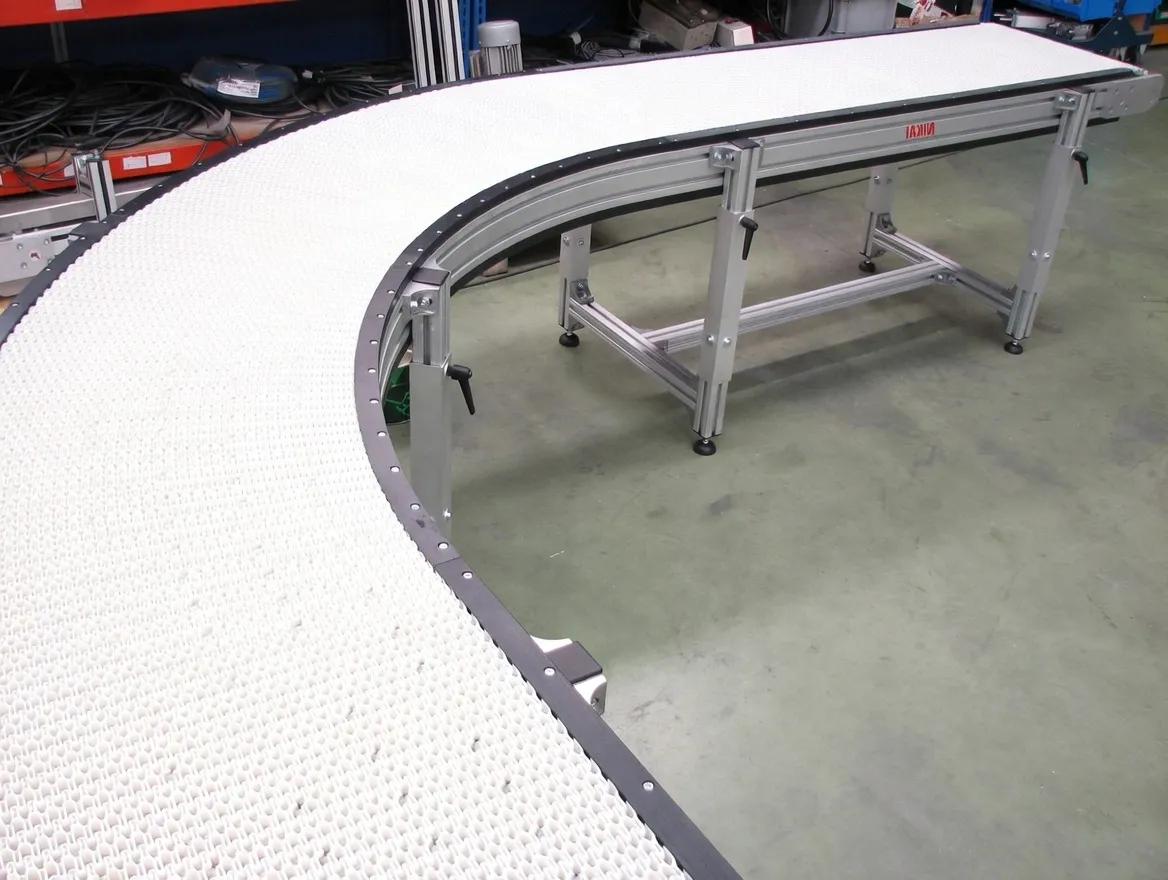 Every zone in a vehicle assembly plant has a distinct set of demands, and part of engineering with plastic modular belt is understanding which belt series and polymer combination belongs where. The following breakdown reflects what UK and European automotive engineers currently deploy across typical final assembly architectures.
🚗 Body-in-White (BIW) Transport
Body shells exiting the welding shop travel on wide-format plastic modular belts (typically 1,000–1,500 mm) at very low speeds — often under 3 m/min — to allow weld inspection and process checks. The belt’s flush-grid surface supports the body sill points accurately, and the non-scratch polymer surface protects primed surfaces that will later accept topcoat paint.
🔩 Trim & Final Fit Station
This is the most labour-intensive section of any assembly line, and belt reliability directly affects takt time. Operators working alongside the moving vehicle need the belt surface to be consistently level, non-slip for tool placement, and quiet. Plastic modular belt in PA6 or anti-static POM grades meets all three criteria simultaneously, and the open-hinge structure allows easy cleaning between shifts.
⚙️ Powertrain & Engine Dress
Engine assemblies are heavy, often contaminated with oil, and moved through tight turn radii as they travel from engine build to vehicle marriage. Polypropylene or glass-filled nylon modules resist oil degradation, and radius belt configurations allow the 90-degree turns common in U-shaped powertrain lines without a transfer table, reducing capital cost and eliminating a potential reliability failure point.
💡 EV Battery Pack Assembly
This is where the next decade of automotive plastic modular belt growth is happening. Battery packs require anti-static belt grades (surface resistance 10^6–10^9 Ohm) to prevent electrostatic discharge events near cell stacks. Humidity-controlled zones in battery assembly benefit from PP’s low moisture absorption, and the modular belt’s cleanability supports the ISO 14644-compliant cleanliness levels that battery assembly increasingly demands.
7 Operational Advantages That Matter to UK Plant Engineers
TOOL-FREE MODULE REPLACEMENT
Individual modules replaced in under 2 minutes with standard tools. No specialist fitter required on-shift.
SIGNIFICANTLY QUIETER OPERATION
Polymer-on-polymer contact reduces conveyor noise by 8–15 dB(A) vs. steel chain. Important for UK COSHH/HSE compliance.
LUBRICATION-FREE RUNNING
Eliminates lube points, reduces contamination risk to painted surfaces, and removes a maintenance cost centre entirely.
LOWER DRIVE ENERGY
Lower belt weight and friction coefficient reduce motor sizing requirements. A 200 m loop can save 4–8 kW of installed drive power.
MIXED-MODEL FLEXIBILITY
Width changes and lane additions are reconfigured in hours, not days. Critical for UK plants running 3–6 body styles on one line.
SUSTAINABILITY CREDENTIALS
Recyclable polymer grades align with Scope 3 emissions reduction targets. Multiple UK OEMs now require this in supplier sustainability audits.
CUSTOM SURFACE GEOMETRY
Flights, cleats, rubber inserts, and lane dividers are moulded directly into modules. No secondary fabrication or adhesive bonding required.
Customer Success Case Study
Tier-1 Automotive Supplier, West Midlands, UK — Engine Subassembly Line Retrofit
The Challenge
A West Midlands-based Tier-1 supplier producing petrol and hybrid engine assemblies for three separate OEM customers was running a legacy steel slat chain conveyor installed in 2006. By 2022, the system required lubrication every 40 operating hours, generated noise exceeding 78 dB(A) at operator positions (approaching UK HSE action level), and had accumulated over £60,000 in reactive maintenance expenditure over the preceding 24 months. A planned shutdown for model changeover provided the retrofit window the plant’s engineering manager had been waiting for.
The Solution
Ever Power supplied a custom-width (820 mm) PA66 GF30 plastic modular belt in 38.1 mm pitch across a 115-metre loop incorporating two 90-degree radius sections. Custom locating fixtures were moulded directly into the belt modules to accommodate the sump pans of both the petrol and hybrid engine variants without separate tooling changeovers. Installation was completed during the planned 12-day plant holiday, with zero overrun. The belt was commissioned alongside a new VFD drive arrangement that reduced installed motor power from 22 kW (two drives) to 11 kW (single drive with soft start).
Measured Outcomes (12-month post-install review)
| KPI | Before (Steel Chain) | After (Plastic Modular Belt) | Improvement |
|---|---|---|---|
| Conveyor-related downtime | 48 hrs / year | 7 hrs / year | –85% |
| Annual maintenance cost | £28,400 | £4,200 | –85% |
| Operator noise exposure | 78 dB(A) | 63 dB(A) | –15 dB(A) |
| Drive energy consumption | 22 kW installed | 11 kW installed | –50% |
| ROI payback period | — | 18 months | Including capital cost |
What UK & European Automotive Engineers Say
“We retrofitted two trim lines at our Coventry plant with Ever Power plastic modular belts during our summer shutdown. The lubrication-free operation alone saved us an estimated 6,000 litres of chain oil per year. Our HSE team was also happy — noise levels dropped noticeably enough that we removed mandatory hearing protection from one station.”
— Senior Conveyor Engineer, Tier-1 Body Systems Supplier, Coventry, UK
“What impressed me most was the customisation capability. We needed a very specific cleat profile to hold battery module trays at a 12-degree incline without slipping, and Ever Power’s engineering team came back with a moulded solution within two weeks. Other suppliers told us it would require a bespoke steel fixture — much more expensive and slower.”
— Manufacturing Engineering Manager, EV Battery Pack Assembly, North East England
“We run a mixed-model line producing three different commercial vehicle chassis widths. The ability to simply remove and reposition lane guides within the belt structure when we switch production runs has cut our changeover time from 4 hours to 35 minutes. That is a direct OEE improvement that shows up immediately in our weekly KPI pack.”
— Production Operations Director, Commercial Vehicle OEM, West Yorkshire, UK
Ever Power: Custom Plastic Modular Belt Manufacturing & Supply to the UK
Ever Power operates a purpose-built plastic modular belt manufacturing facility with over 40 injection moulding lines, dedicated to producing belt modules, hinge rods, sprockets, and supporting hardware for demanding industrial applications. For automotive customers across the UK — from the West Midlands manufacturing heartland to Nissan’s Sunderland site and Toyota’s Burnaston plant — Ever Power offers an end-to-end custom design and supply service that few other global suppliers can match at comparable lead times and price points.
Our in-house engineering team handles full application analysis — from load calculations and belt tension modelling to thermal expansion allowance in heated build tunnels — and translates that analysis into a belt specification that is optimised for your specific line conditions. Custom module geometries, non-standard widths, hybrid polymer combinations, and integrated fixture features are all available as standard service offerings, not special order exceptions. When a UK automotive plant needs a specific belt variant in response to a model change or a quality finding, we can typically design, tool, produce, and ship within 4–8 weeks.
Beyond manufacturing, we provide installation consultation, commissioning support, and UK-stocked spare module inventory under framework supply agreements — so your plant’s maintenance team always has critical spares on the shelf before they are needed. We understand that lead time is not a number on a purchase order — it is the difference between a 2-minute module swap and a 4-hour line stoppage.
Frequently Asked Questions
What is the typical price range for a custom plastic modular belt for a UK automotive assembly line, and where can I get a supplier quote?
Pricing for πλαστική αρθρωτή ζώνη in UK automotive applications varies considerably based on belt width, polymer grade, loop length, and any custom moulded features. A straight-run PA66 belt for a mid-size trim station typically falls in the range of £8–£22 per linear metre (installed), while heavier-duty BIW or battery assembly specifications with custom geometry can reach £30–£50+ per linear metre. The most accurate approach is to request a formal quotation from a specialist supplier like Ever Power ([email protected]) with your application parameters — load, speed, width, environment, and any special surface requirements.
Which plastic modular belt material is best for automotive final assembly lines in the UK where oil contamination from engines is present?
For zones where engine oil or gearbox lubricant contact is possible, polypropylene (PP) or glass-fibre reinforced PA66 are the preferred choices. Both materials resist degradation from petroleum-based fluids and mild alkaline cleaning agents commonly used in UK engine assembly plants. PP offers excellent chemical resistance with moderate load capacity, while PA66 GF handles heavier loads. POM (acetal), though excellent in dry environments, can swell marginally when exposed to certain petroleum products over extended periods, so its use in oily zones should be reviewed application by application.
How long does it take to replace a damaged section of plastic modular belt on an active automotive production line in the UK?
Individual module replacement on a plastic modular belt is typically a 2–5 minute task for a trained maintenance technician using standard hand tools — often a hinge rod removal pin and a flathead screwdriver or mallet. Unlike steel chain, there is no need to source matched replacement components from an external supplier with a multi-day lead time. UK automotive plants that hold a modest on-site spare parts inventory (typically 2–5% of total belt length per production line) report that conveyor-related downtime events resolved within a single scheduled micro-stop, without consuming any planned maintenance downtime budget.
Are there anti-static plastic modular belt options suitable for electric vehicle battery assembly plants in the UK Midlands?
Yes, anti-static and electrically dissipative plastic modular belt grades are a rapidly growing segment driven precisely by UK and European EV battery assembly expansion. These belts are manufactured with carbon-black or conductive polymer compound incorporated into the base resin during moulding, achieving a controlled surface resistance in the 10^6–10^9 Ohm range that prevents electrostatic charge accumulation near lithium-ion cell stacks. Ever Power supplies anti-static modular belt to battery gigafactory projects and Tier-1 battery module assemblers across the UK, and can provide IEC 61340 compliance documentation as part of the technical data pack.
How does the total cost of ownership for plastic modular belt compare to steel slat chain conveyor over five years in a UK automotive plant?
Based on independent lifecycle analyses conducted at UK automotive sites, plastic modular belt typically achieves a 30–50% lower total cost of ownership than steel slat chain over a five-year operating period, when the full cost picture includes capital installation, lubrication consumables, reactive and preventive maintenance labour, scheduled component replacement, and downtime-associated production loss. The crossover point — where cumulative plastic modular belt savings offset any higher initial module cost — typically occurs between months 18 and 28 in a three-shift automotive environment. For specific financial modelling using your plant’s actual downtime rates and maintenance cost structure, contact Ever Power for a TCO analysis service.
Where can automotive manufacturers in Sunderland, Solihull, or Derby source custom plastic modular belt with UK delivery and technical support?
Ever Power supplies plastic modular belt to automotive customers across all major UK manufacturing regions, including the West Midlands (Solihull, Coventry, Birmingham), the North East (Sunderland, Gateshead), the East Midlands (Derby, Nottingham), Yorkshire, and South Wales. Standard lead times from order confirmation to UK delivery are typically 3–6 weeks for standard series belts and 6–10 weeks for fully custom-engineered specifications. Technical application support from Ever Power’s engineering team is available throughout the project, from initial belt selection to post-installation commissioning. Enquiries: [email protected].
Ready to upgrade your automotive assembly line with plastic modular belt?
Talk to an application engineer who has 18+ years’ experience in UK automotive conveyor systems.
Contact Ever Power — Get a Quote Today
[email protected] | plastic-modular-belt.com | Serving UK Automotive Since 2006
επεξεργασία από gzl