
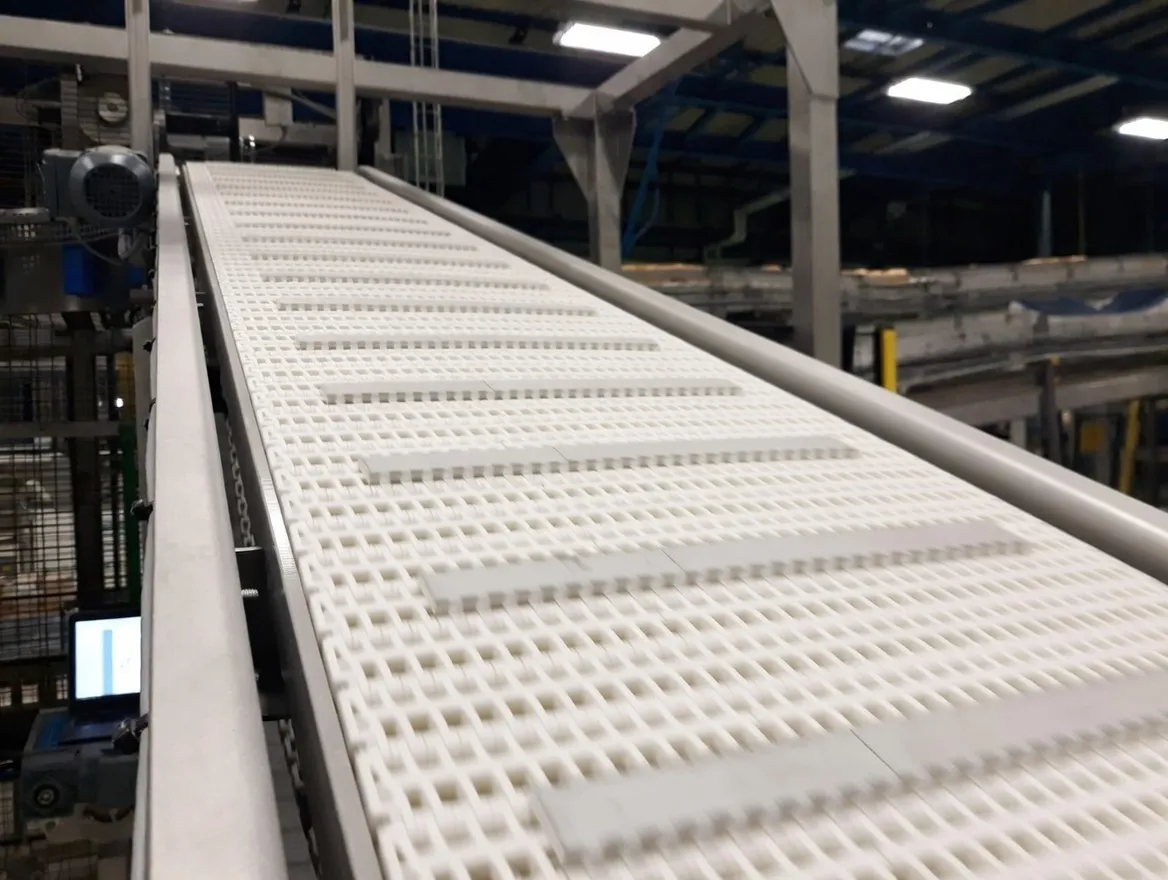
 Spend any time talking to facilities engineers at UK airports and one theme surfaces repeatedly: the real cost of baggage line downtime is not the repair bill itself — it is the knock-on penalty from delayed departures, missed connections, and the airline SLA payments that follow. The conveyor belt sitting at the centre of a baggage handling system is rarely glamorous infrastructure, yet its reliability determines whether an airport keeps its performance metrics or haemorrhages penalty costs through a busy summer season. That operational reality is precisely why plastic modular belt technology has replaced legacy rubber flat belts as the dominant conveying solution across the UK’s aviation sector over the past decade.
Unlike a conventional flat belt — which must be replaced as a full-length run the moment it fails — a plastic modular belt is constructed from individual interlocking thermoplastic modules. When a single module cracks under the impact of a heavy bag dropped onto the induction conveyor, a trained technician can remove and replace just that module in under ten minutes, with standard tools, without taking the line offline. That single engineering distinction has a measurable commercial value for every airport operating a 24/7 baggage schedule.
📷 Product Image — Plastic Modular Belt / Airport Baggage Conveyor
Need a plastic modular belt for your airport baggage handling or conveyor project?
Free Engineering Consultation · Custom Quote Within 24 Hours
Why UK Airports Choose Plastic Modular Belt Over Conventional Systems
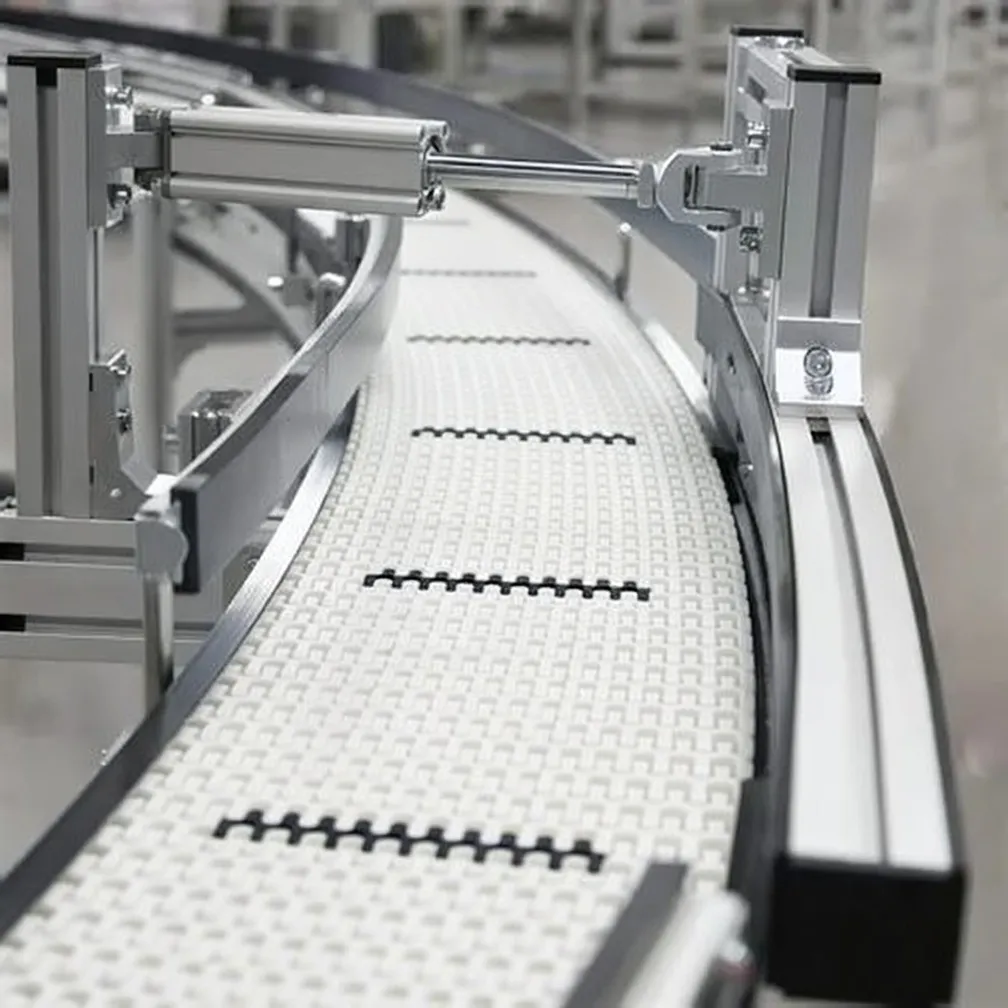 The shift toward plastic modular belt technology in UK airport baggage handling has been driven by a very practical set of operational and financial pressures. Airport ground handling contractors operating under strict uptime SLAs cannot afford the full-shutdown repair model that legacy flat belt systems demand. Modular construction changes the maintenance model entirely: individual module replacement during live operation, no special lifting equipment required, no full belt retensioning after repair. The cumulative maintenance labour saving across a medium-sized UK airport running six or more sortation lines can be substantial — engineering teams consistently report reductions of 60% to 70% in scheduled and corrective maintenance hours once they transition to plastic modular belt infrastructure.
Surface engineering is the other dimension that makes plastic modular belt so well-suited to baggage applications. The range of available surface profiles — flat-top, flush-grid, raised-rib, open-grid, side-grip — means a different belt variant can be correctly specified for each functional zone within the same system. Flat-top surfaces deliver stable, snag-free transport for diverse bag shapes on check-in induction lines. Open-grid variants allow fine debris to fall through on post-screening lines, reducing cleaning cycle frequency. Side-flexing configurations handle the tight-radius curves of automatic divert mechanisms without the lateral tension fatigue that destroys flat belts within weeks of installation at those sections.
Module-Level Repair
Replace individual cracked or damaged modules in under 10 minutes during live operation — no full-line shutdown, no retensioning, no specialist lifting gear required.
Tight-Radius Curves
Side-flexing plastic modular belt variants navigate curves as tight as 500mm radius — essential for automatic divert sections in HBS sortation systems.
Washdown Hygiene
Open-grid and flush-grid surface designs support high-pressure washdown cleaning, meeting airport hygiene protocols without requiring belt removal.
Wide Temperature Range
UV-stabilised PP and acetal grades operate reliably from -30°C cold storage areas through to +80°C ramp-level environments in peak UK summer conditions.
Anti-Static Options
Carbon-loaded anti-static module grades available for sensitive airport zones near fuel handling areas or avionics storage where ESD control is required.
Custom Width Up to 2,400mm
Oversized baggage lines at major UK airports require wide belts. Plastic modular belt widths from 300mm to 2,400mm configured to exact frame and sprocket specifications.
Technical Parameters: Plastic Modular Belt for Baggage Handling Applications
The specification table below summarises the core performance parameters across the Ever Power plastic modular belt range for airport baggage handling applications. Custom configurations outside these ranges are available — see the factory section below.
Engineering Principle, Materials and Construction
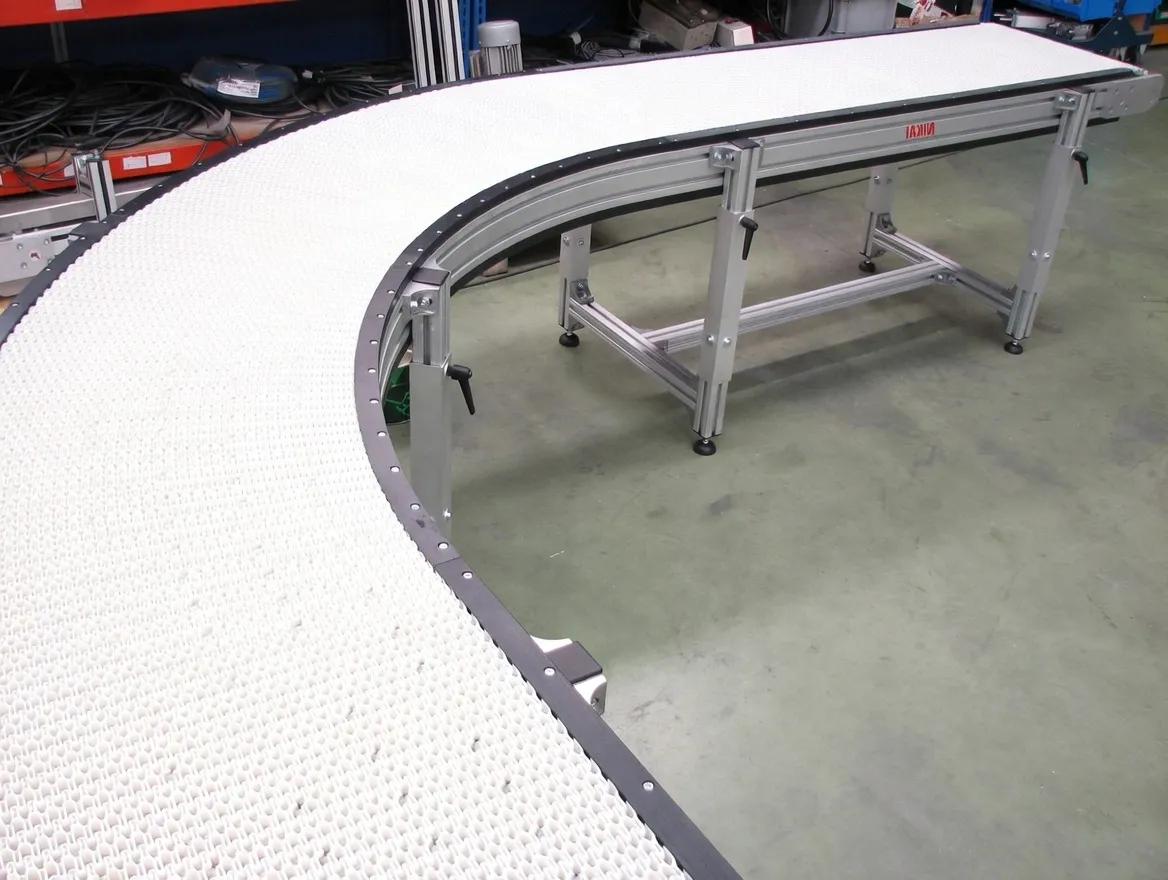 The mechanical operating principle of a plastic modular belt is straightforward but elegantly robust. Each thermoplastic module contains integral hinge eyes on its leading and trailing edges. A transverse connecting rod — typically made from stainless steel or a food-grade polymer — passes through the aligned hinge eyes of adjacent modules to create a chain-like structure across the full belt width. Drive is transmitted through toothed sprockets that engage directly with the underside drive geometry moulded into each module. This positive drive system eliminates the belt slip and tension-related failures that commonly afflict friction-drive flat belts, particularly in variable-load airport environments where bag weights can range from 2kg hand luggage to 32kg checked cases arriving in rapid succession.
Material selection is where the engineering gets genuinely nuanced for baggage handling applications. Polypropylene (PP) is the standard workhorse grade — cost-effective, chemically resistant, dimensionally stable, and available in a broad palette of colours for zone identification compliance. Where a specific application requires lower surface friction — typically transfer sections where bags need to glide smoothly across belt-to-belt junctions during divert operations — acetal (POM) modules provide measurably better performance due to their higher stiffness and lower coefficient of friction against polished steel wear strips. For airport zones with defined anti-static requirements, carbon-loaded AS-grade modules in both PP and POM base materials discharge static electricity safely, preventing accumulation in sensitive environments. UV-stabilised outdoor grades extend service life on ramp-level installations exposed to direct sunlight and the thermal cycling that characterises UK weather through the seasons.
PP · Polypropylene
Standard grade. Best value, excellent chemical resistance, wide colour range. Used on most straight-run baggage conveyor sections.
POM · Acetal
Higher stiffness, lower friction. Preferred for high-speed transfer sections and divert plates where bag-surface sliding characteristics are critical.
Carbon AS Grade
Anti-static PP or POM. Prevents ESD accumulation in sensitive zones near aircraft fuel handling or avionics storage areas.
UV-Stabilised
Outdoor and ramp-level use. Resists UV degradation and thermal cycling from sub-zero UK winters to summer ramp temperatures.
Where Plastic Modular Belt Performs Best Inside a Baggage Handling System
A bag’s journey from check-in desk to aircraft hold — and back again at the reclaim carousel — passes through a sequence of mechanically distinct conveying zones. Each zone has its own load profile, speed requirement, directional geometry, and environmental condition. Plastic modular belt technology addresses each of these zones through targeted surface and material selection, which is why systems integrators building baggage handling infrastructure at UK airports increasingly specify it as the standard across the full system rather than reserving it for problem areas alone.
Customer Success: Northern England Airport Cuts Baggage Line Downtime by 65%
Case Study · UK Regional Airport · Ground Handling Operations · 2023–2024
Background: A regional airport in the north of England processing approximately 4.2 million passengers annually had been running persistent downtime issues on its three primary outbound baggage sortation lines. The incumbent rubber flat belt system required complete line shutdown for any repair event, with an average incident recovery time of 3.5 hours. During peak summer operations, these events were generating direct airline SLA penalty costs and contributing to a measurable deterioration in on-time departure performance metrics reported to the CAA.
Solution: After a technical review by the airport’s facilities contractor and Ever Power’s UK application engineering team, a full belt retrofit was specified across all three lines using plastic modular belt modules: flat-top PP on straight main runs, side-flexing variants through all 90-degree divert sections, and flush-grid modules on post-screening transfer sections for improved cleanability. Belt width was standardised at 800mm. Blue-coloured modules were specified throughout the HBS screening zone to support visual compliance inspection protocols under the airport’s security management plan.
Outcome: Recorded belt-related downtime incidents fell by 65% in the 12 months following installation. The average incident recovery time dropped from 3.5 hours to under 25 minutes, as maintenance technicians replaced individual failed modules without taking lines offline. Full capital cost recovery on the retrofit project was achieved within 14 months, primarily through avoided SLA penalty payments and a 68% reduction in maintenance labour hours dedicated to baggage belt upkeep.
“We had been fighting that old flat belt system across two summer seasons. The moment we switched to plastic modular belt on the main sortation line, the difference in repair time was immediately obvious to the whole maintenance team.”
James T.
Head of Ground Operations · Regional UK Airport
“The Ever Power engineering team understood our HBS line geometry before we even finished the project brief. The side-flexing modules through the divert sections track reliably and we have recorded zero mistrack incidents in eight months of continuous operation.”
Sandra M.
Project Engineer · Baggage Systems Integrator, Midlands UK
“We needed a 1,200mm-wide belt at a non-standard pitch to match our existing sprocket spacing on the oversized baggage line at our Scottish hub. Ever Power turned a custom configuration around faster than any other supplier we approached, and at a competitive price.”
Robert H.
Procurement Manager · Airport Ground Services, Scotland
Ever Power: Custom Plastic Modular Belt Manufacturing for UK Airport Projects
Ever Power’s manufacturing facility operates with a level of customisation capability that goes well beyond filling catalogue orders. For UK airport and baggage handling projects — where belt widths, module pitches, surface profiles, and material grades must align precisely with existing conveyor frame geometry, sprocket spacing, and operational environment — the in-house engineering team works directly with airport facilities managers, ground handling contractors, and OEM conveyor manufacturers to develop application-specific configurations from the ground up.
The customisation scope covers every dimension of belt specification. Width increments can be configured in 25mm steps from 300mm to 2,400mm. Pitch options include 12.7mm, 25.4mm, and 38.1mm as standard, with bespoke pitches engineered for retrofit projects where legacy sprocket spacing cannot be changed without costly frame modifications. Surface profile selection — flat-top, open-grid, flush-grid, raised-rib, or combination zoned belts — can be mixed within the same belt run where a single conveyor passes through multiple functional zones. Every custom project receives a complete load and fatigue analysis prior to production release, with full material traceability documentation available to satisfy CAA and IATA audit requirements at UK airport sites. The company’s experienced technical team is reachable directly for application consultations, with typical quote turnaround of 48 hours for standard configurations and 5 working days for fully custom projects.
300+
Belt configurations
18+
Years airport experience
48h
Standard quote turnaround
100%
Custom width and pitch
Speak to our UK-facing application engineers about your baggage handling belt requirement.
Frequently Asked Questions
Questions from UK airport engineers, ground handling procurement teams, and baggage system integrators.
Upgrade Your Airport Baggage Conveyor System — Talk to Ever Power Today
Whether you are retrofitting existing sortation lines at a regional UK airport, specifying new baggage handling infrastructure, or sourcing replacement plastic modular belt modules for an urgent maintenance window, the Ever Power engineering team is ready to help. We serve airport projects across Heathrow, Gatwick, Manchester, Edinburgh, Birmingham, Bristol, and every regional UK aviation hub.
✉ Contact Ever Power: [email protected]
edit by gzl