
✍ Written by Ever Power Engineering Team | 📅 Updated June 2025 | 🇬🇧 Serving UK Airport Infrastructure & Material Handling Industries
 Walk through any major UK airport — Heathrow, Gatwick, Manchester, Edinburgh — and beneath the polished floors and automated check-in kiosks lies a sophisticated mechanical circulatory system that most passengers never see. The baggage handling system (BHS) is arguably the most operationally critical infrastructure in any terminal, responsible for sorting, routing and delivering thousands of bags per hour with minimal delay and near-zero error. At the heart of this invisible infrastructure, the plastic modular belt has quietly become the engineering standard of choice for conveyor segments throughout the entire BHS network.
Unlike traditional rubber flat belts or steel slat conveyors, plastic modular belts are assembled from interlocking individual modules — typically manufactured from engineering-grade polypropylene (PP), polyethylene (PE) or acetal (POM) — that can be snapped together without tools, reconfigured on-site and replaced section by section rather than as an entire belt length. This modular architecture translates directly into tangible advantages in an airport environment where downtime is measured in financial penalties, passenger dissatisfaction scores and — in extreme cases — regulatory scrutiny from the Civil Aviation Authority.
Over the past eighteen years working with conveyor applications across food processing, pharmaceuticals, automotive assembly and airport logistics, one consistent pattern emerges: airport operators who switch from legacy belt technology to plastic modular belt conveyor systems report measurable improvements in three areas — mean time between maintenance interventions, cleaning and washdown efficiency, and the ability to adapt belt geometry to evolving terminal layouts without full conveyor replacement. This article examines precisely how and why, with detailed technical guidance relevant to UK airport operations.
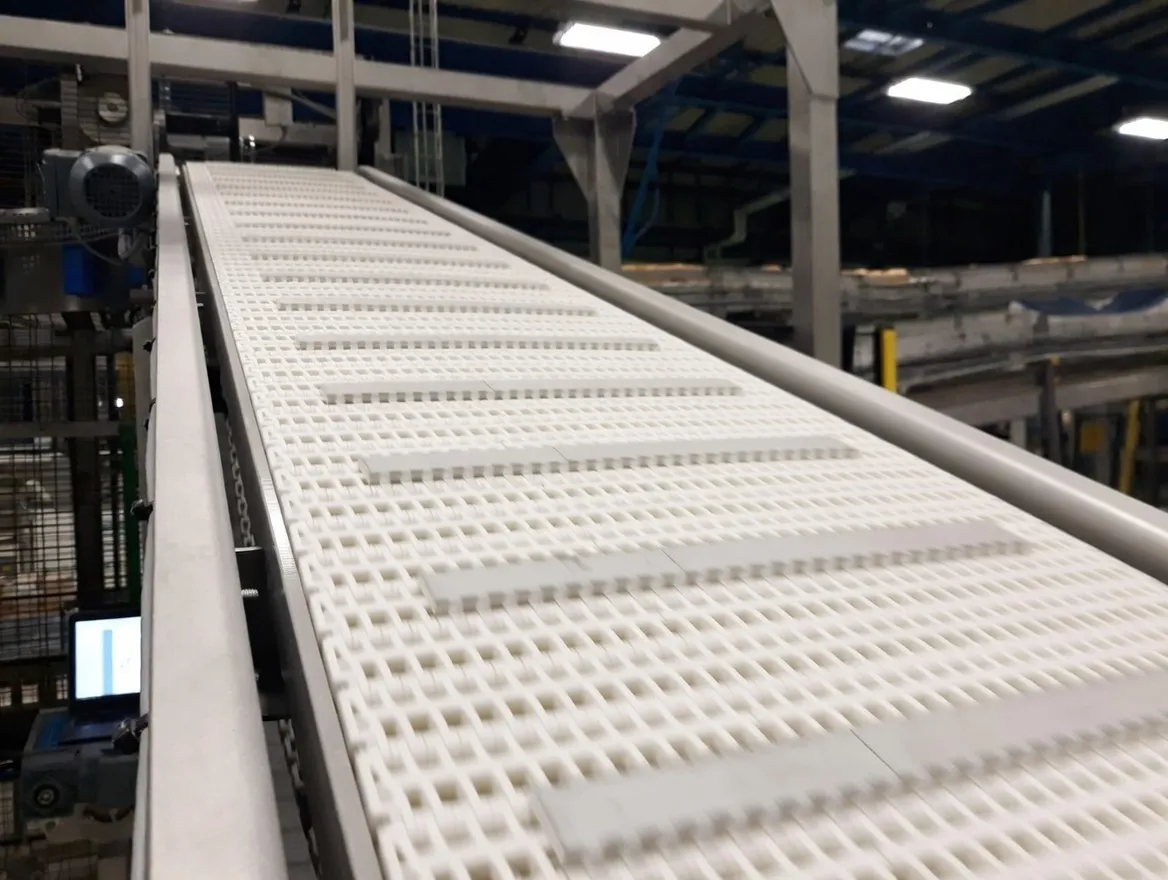
Ever Power plastic modular belt conveyor installed in airport baggage handling system — engineered for 24/7 high-throughput airport operations in the UK.
What Makes Plastic Modular Belt Technology Different in a Baggage Hall?
A conventional rubber belt is manufactured as a single continuous loop. When it tears, stretches or degrades, the entire belt section must be removed, the conveyor disassembled and a new belt tensioned and tracked — a process that can take a skilled engineer several hours on a straightforward run, and considerably longer on inclined or curved sections common in multi-level baggage carousels. In a busy UK airport operating round-the-clock, that window of opportunity rarely exists without impacting flight schedules.
The plastic modular belt works differently at a structural level. Each module is an injection-moulded thermoplastic unit with integral hinge rods connecting laterally adjacent modules into rows, and rows connecting longitudinally to form the belt surface. Damaged modules are located, hinge rods withdrawn, and the specific modules replaced in minutes — without removing adjacent modules or dismantling the conveyor frame. For a baggage handling engineer working under time pressure between flights, this represents a significant operational shift.
Material selection matters enormously here. Polypropylene modules offer outstanding chemical resistance and are excellent for areas requiring frequent washdown with alkaline detergents — critical in baggage areas where biohazard contamination protocols may apply. Acetal (POM) modules provide superior wear resistance and dimensional stability across temperature variations, making them ideal for high-load trunk conveyor sections that carry bags continuously from check-in through to hold loading. High-density polyethylene variants are frequently specified for outdoor baggage transfer areas exposed to the unpredictable British weather, offering resistance to UV degradation and moisture absorption.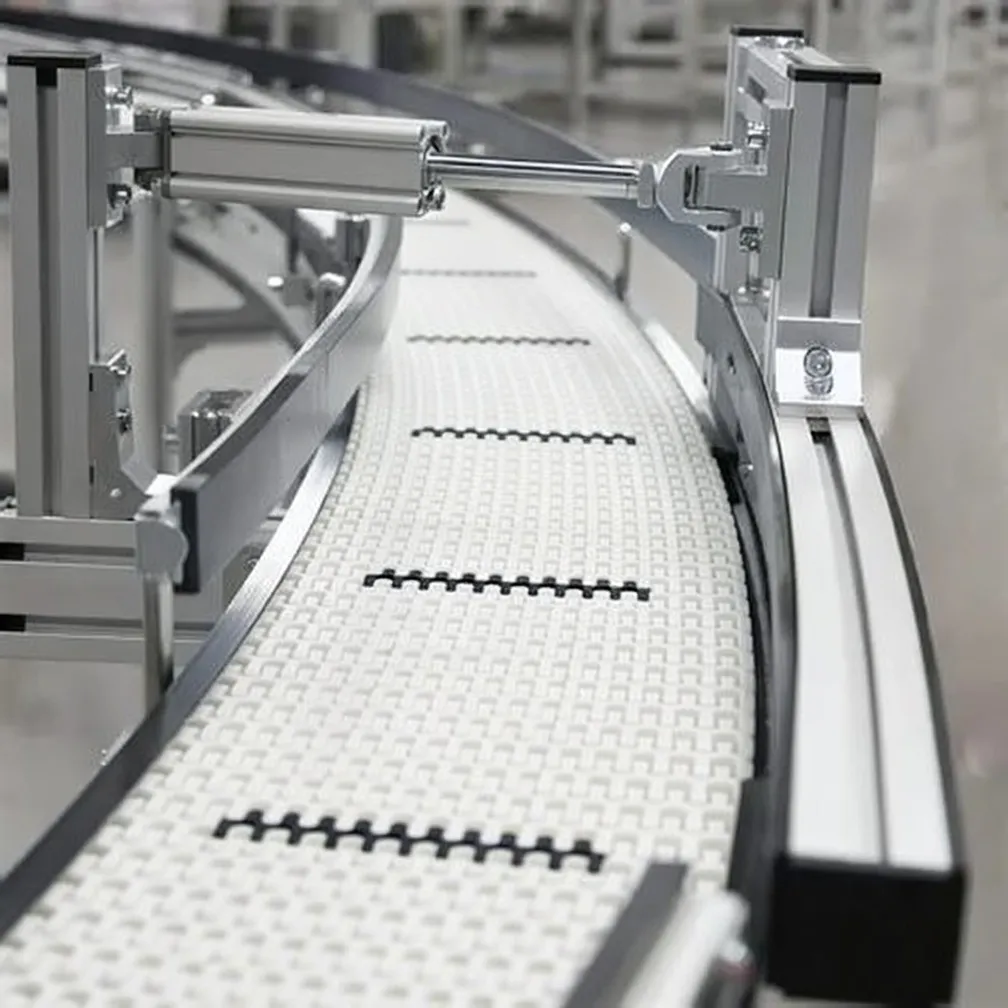
Technical Performance Parameters — Ever Power Plastic Modular Belt for Airport BHS
| Parameter | PP (Polypropylene) | POM (Acetal) | HDPE |
|---|---|---|---|
| Operating Temperature | -10°C to +90°C | -40°C to +120°C | -50°C to +80°C |
| Belt Pitch Options (mm) | 25.4 / 38.1 / 50.8 | 25.4 / 38.1 | 38.1 / 50.8 |
| Max Working Load (kg/m²) | Up to 350 | Up to 450 | Up to 300 |
| Belt Width Range (mm) | 300 – 1,200 | 300 – 1,000 | 400 – 1,200 |
| Surface Open Area (%) | 0% – 45% | 0% – 38% | 0% – 42% |
| Typical Belt Speed (m/min) | Up to 60 | Up to 80 | Up to 55 |
| Chemical Resistance | Excellent (acids/alkalis) | Good (solvents) | Excellent (all) |
| Minimum Radius — Curves (mm) | From 300 (side-flexing) | From 350 (side-flexing) | From 400 (side-flexing) |
ⓘ All parameters are indicative. Exact specifications depend on application load profile, drive configuration and terminal environment. Contact Ever Power for a project-specific assessment.
Where Plastic Modular Belts Are Deployed Within Airport Baggage Handling Systems
Modern airport baggage handling is not a single conveyor run — it is a multi-zone, multi-process logistics network where different areas impose very different engineering demands. Understanding which type of plastic modular belt suits which zone is critical to achieving the performance targets that UK airport operators require.
Check-in & Injection Points
At check-in conveyors, bags enter at irregular intervals with varying weights up to 32 kg. Flat-top solid PP modular belts provide a stable, non-slip surface. The belt’s ability to handle impact loading without deformation is critical here, as bags are placed rather than placed gently.
HBS Security Screening Zones
Hold Baggage Screening (HBS) conveyor systems feeding CT or X-ray equipment require precise belt control to maintain consistent gap spacing between items. Open-grid plastic modular belt variants allow X-ray penetration where in-line imaging is used, while solid variants work with overhead scanner configurations. Temperature resistance is also relevant around high-powered CT equipment.
Trunk & Transfer Conveyors
The high-speed trunk conveyor network — running at speeds up to 2.5 m/s in major terminals — demands belts with exceptional tensile strength and dimensional stability. POM (acetal) modular belts deliver the lowest friction coefficients and highest wear resistance, directly reducing motor power consumption on long horizontal runs while maintaining accurate tracking under loaded conditions around the clock.
Early Baggage Storage (EBS)
Early Baggage Storage systems hold bags checked in hours before departure. These loop-storage conveyor systems run at low speed for extended periods, placing cyclic stress on belt hinge joints. PP modular belts with reinforced hinge rods are the standard specification for EBS loops, with documented service lives of 5+ years under continuous duty in UK airport installations.
Make-up Carousel & Reclaim
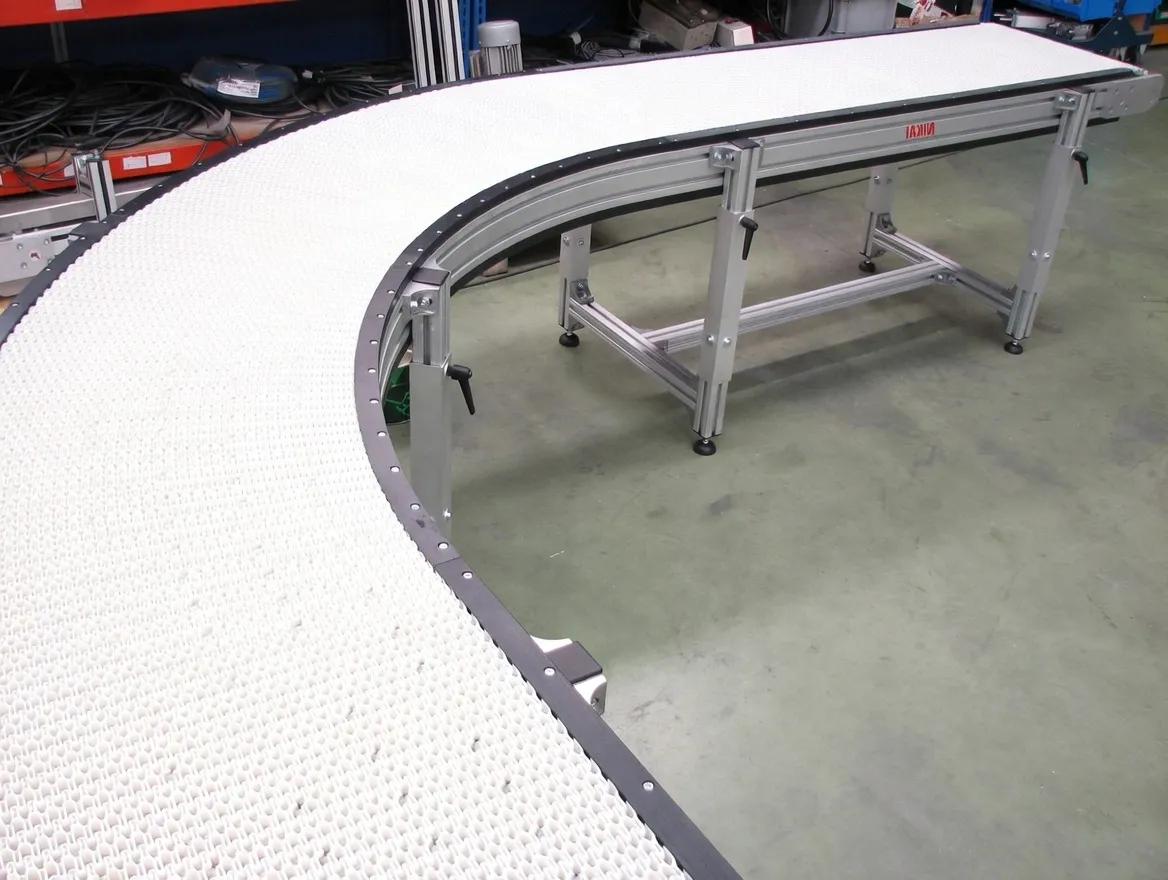
At the airside make-up carousel and landside reclaim carousel, side-flexing plastic modular belt designs navigate tight horizontal curves without drive shaft realignment. Raised-rib surface variants prevent bags from sliding on inclined sections feeding the carousel. The ability to replace individual modules on a live carousel during overnight maintenance windows is a capability uniquely suited to the modular construction.
Oversized & Special Baggage
Wide-belt conveyor sections handling pushchairs, sports equipment and oversized items require belt widths up to 1,200 mm with reinforced transverse rigidity. HDPE modular belts in wide-pitch configurations deliver the structural load capacity required, while HDPE’s natural self-lubricating properties reduce maintenance intervals even under the irregular loading patterns typical of oversized item routes.
The Real Operational Advantages of Plastic Modular Belt in UK Airport BHS
The operational case for replacing legacy conveyor belts with plastic modular belts in airport environments is built on multiple interlocking advantages that compound over time. In our experience supporting UK airport projects, the total cost of ownership calculation almost always favours the modular approach — even when the upfront per-metre cost appears higher than conventional alternatives.
Rapid Module Replacement
Damaged sections replaced in under 10 minutes per module. No belt removal, no re-tensioning, no re-tracking. Single engineer task.
Hygiene & Compliance
Smooth module surfaces and open-grid options support high-pressure washdown without belt delamination. Fully compliant with UK Border Force bio-security protocols.
Reduced Energy Draw
POM modules reduce running friction by up to 30% versus rubber belts on equivalent conveyor runs, directly reducing drive motor power consumption — a meaningful saving in 24/7 terminal operations.
Layout Flexibility
Side-flexing modular belt types navigate curves down to 300 mm radius. Terminal expansions and gate reconfigurations can adapt existing conveyor infrastructure rather than replacing it wholesale.
Long Service Life
Engineering-grade thermoplastics resist abrasion, corrosion and fatigue. Documented service life of 5–8 years on trunk conveyor applications under continuous 24/7 airport duty.
Sustainable Materials
Thermoplastic modular belts are 100% recyclable. For UK airports committed to net-zero operations roadmaps, this supports both Scope 3 reporting and responsible end-of-life material management.
How Plastic Modular Belt Construction Works — Engineering Principle
 The structural principle behind a plastic modular belt conveyor is deceptively simple but the engineering tolerances required are tight. Each individual module is injection-moulded to precise dimensional tolerances — typically ±0.1 mm on hinge bore diameter — to ensure consistent pitch length across the assembled belt. Pitch consistency directly determines tracking accuracy on the conveyor frame, which in turn determines how reliably the belt runs centrally without edge contact that causes premature wear.
Rows of modules are assembled by inserting stainless steel or plastic hinge rods transversely through aligned hinge bores. The rod-in-bore joint creates the articulating hinge that allows the belt to flex around drive and return sprockets. For side-flexing variants used on curved sections, the modules are designed with tapered leading and trailing faces that allow lateral curvature while maintaining constant pitch on the inner edge — the principle that enables curves without belt tracking problems or edge compression.
Drive is transmitted from sprocket teeth engaging positively with drive openings moulded into each module row — not through friction as with flat rubber belts. This positive engagement eliminates slip under high load conditions and allows precise speed control, which is critical in baggage sortation systems where timed merge and divert operations depend on exact belt velocity.
① Module Injection Moulding
High-pressure injection moulding of thermoplastic pellets into precision metal tooling produces dimensionally consistent modules at scale.
② Rod Assembly
Modules are connected into rows via hinge rods inserted through aligned hinge bores, with rod retainers preventing lateral migration.
③ Belt Assembly on-site
Belt is assembled directly on the conveyor frame, eliminating the need for lifting equipment used with heavy rubber belt rolls.
④ Sprocket Drive Setup
Drive sprockets engage belt drive openings positively. No tensioning, no tracking adjustment required during normal operation.
★ Customer Success Case Study
UK Regional Airport Achieves 40% Reduction in BHS Maintenance Downtime with Ever Power Plastic Modular Belt
Client: Regional airport operator, East Midlands, United Kingdom
Application: Full BHS belt replacement — check-in injection, trunk conveyor, HBS zone, EBS loops, reclaim carousel
Previous Technology: Heavy-duty rubber flat belts, 3–4 year replacement cycle
Belt Specified: Ever Power PP flat-top (check-in / EBS), POM open-grid (HBS), POM side-flexing (carousel)
The airport’s existing rubber belt BHS had been installed during the original terminal construction and was approaching end of service life. An increasing frequency of belt failures — particularly on the inclined sections leading to the HBS level — was causing average unplanned downtime of approximately 4.2 hours per month, triggering delayed departures and increased operational costs. The engineering team evaluated three belt technologies before specifying Ever Power plastic modular belt systems following a detailed site survey and load profile analysis conducted by our UK applications team.
Installation was phased across three turnaround windows spread over six weeks, with each zone commissioned sequentially to maintain continuous BHS operation throughout. The modular belt assembly approach proved particularly valuable during installation: each zone’s belt was assembled directly on the conveyor frames by a two-person team without heavy lifting equipment, and hand-over to operations occurred within hours of assembly completion rather than days.
| Performance Metric | Before (Rubber Belt) | After (Ever Power Modular) |
|---|---|---|
| Monthly unplanned downtime | 4.2 hrs avg | 2.5 hrs avg (–40%) |
| Belt section replacement time | 3–6 hrs per section | 15–30 min per zone |
| Annual belt material cost | Baseline | –28% YoY (module-only replacement) |
| Drive motor energy consumption | Baseline | –22% on trunk sections |
Eighteen months post-installation, the airport’s engineering manager confirmed that no full belt replacements had been required — only isolated module replacements following belt strike incidents from oversized items. The predictable maintenance intervals and the ability for on-shift engineers to perform repairs without specialist contractors has fundamentally changed the operational cost model for the BHS team.
What Customers Are Saying
❝
We replaced legacy rubber belts on our trunk conveyor runs with Ever Power plastic modular belts two years ago. The maintenance team can now handle a belt repair during a single aircraft turnaround — that was simply impossible before.
James R., BHS Engineering Manager
Regional Airport, East Midlands, UK
❝
The HBS conveyor zones we specified with open-grid plastic modular belt from Ever Power have exceeded our performance expectations. CT scanner integration is cleaner, washdown compliance is straightforward, and we have not had a belt-related security screening delay in over 14 months.
Sarah T., Terminal Operations Director
International Airport, Scotland, UK
❝
Sourcing plastic modular belt from Ever Power was a straightforward decision — competitive pricing, genuine technical support from engineers who understand airport BHS rather than just the belt catalogue, and rapid delivery of replacement modules to the UK. We would specify them again without hesitation.
Mark D., Procurement Lead
Airport Infrastructure Services Provider, London, UK
Ever Power Custom Plastic Modular Belt Manufacturing — Built for Your Specification
No two airports share identical conveyor layouts, loading profiles or maintenance access constraints. This is why Ever Power’s approach to plastic modular belt supply begins with engineering rather than catalogue selection. Our manufacturing facility operates dedicated injection moulding lines for airport and heavy logistics belt specifications, with the tooling depth to produce non-standard module geometries, custom surface profiles and bespoke colour-coding systems — all available in production lead times of 15–25 working days for UK destinations.
Our custom product development capability covers: belt widths outside standard sizing increments (important for refurbishment projects matching legacy conveyor frames); surface friction modifications using texture moulding for specific belt gradients; lane-marking colour differentiation built into the module rather than applied as wear-prone surface coatings; and specific hinge rod materials — including titanium and glass-reinforced nylon — for particularly demanding chemical or electromagnetic environments.
UK airport and airport services procurement teams benefit from our dedicated technical sales engineering support, factory audit availability for approved vendor list processes, and full traceability documentation — material certificates, dimensional inspection reports, and test run data — supporting both CAA audit requirements and ISO-based quality management systems.
🛠 Custom Module Geometry
Non-standard pitches, surface patterns, lane colours and friction modifications available from tooling.
📋 Full Traceability
Material certs, dimensional reports and batch traceability supporting AVL and CAA audit requirements.
✈ UK Airport Delivery
15–25 working day production. Expedited runs available. Spare module kits held on consignment for emergency supply.
Serving UK Airport Infrastructure From London to Edinburgh
The United Kingdom operates more than 40 licensed civil airports, from London Heathrow — handling over 80 million passengers annually and running one of the world’s most complex baggage handling networks — to regional airports such as Leeds Bradford, Bristol, Cardiff and Inverness, where tight maintenance windows and limited in-house engineering resources make the simplicity of plastic modular belt maintenance especially valuable.
UK-specific regulatory context matters for belt specification. Airports operating under CAA and DfT oversight face stringent security screening requirements under Department for Transport aviation security directives. Conveyor systems in HBS and passenger screening zones must support rapid clearance and decontamination protocols. The washdown compatibility and non-porous surface properties of thermoplastic modular belts directly support these compliance requirements in ways that older belt technologies struggle to match.
Beyond regulatory compliance, the UK’s commitment to achieving net zero in aviation — with organisations like Sustainable Aviation coordinating industry roadmaps — creates increasing internal pressure on airport operators to reduce energy consumption throughout terminal infrastructure. The measurable drive power reductions associated with plastic modular belt conveyor replacement programmes contribute directly to Scope 1 and Scope 2 carbon reduction targets, providing a sustainability narrative alongside the engineering and financial case.
Frequently Asked Questions
Answers to common questions from UK airport engineering teams, BHS contractors and procurement specialists.
Ready to Upgrade Your Airport BHS Conveyor System with Plastic Modular Belt?
Talk to Ever Power’s applications engineering team about your specific UK airport conveyor requirements. Custom specification, competitive pricing, rapid UK delivery and full technical documentation included as standard.
This article covers plastic modular belt applications in airport baggage handling systems, written by Ever Power engineering specialists serving the UK market. 🇬🇧 United Kingdom | 📅 2025 | Ever Power Plastic Modular Belt | edit by gzl