Why the Chemical Packaging Sector Demands More from Its Conveyor Belts
 Walk the factory floor of any UK chemical plant — from agrochemicals in the Humber estuary to industrial cleaning product lines in the West Midlands — and the challenge is immediately obvious. Conveyor systems must survive continuous contact with corrosive liquids, UV-stabilised packaging lines, varying pH environments, and the relentless demands of high-throughput filling machinery. Traditional PVC flat belts crack, delaminate, and harbour bacteria in their seams. Rubber belts swell and degrade when splashed with solvents or detergents. Steel-link conveyors corrode quietly until a failure shuts down an entire line mid-shift.
The plastic modular belt has fundamentally changed the equation. Built from interlocking polypropylene (PP), polyethylene (PE), or acetal (POM) modules snapped onto a standard drive shaft, these belts combine the open-structure washability of a chain with the smooth product-carrying surface of a flat belt. For chemical packaging lines specifically, that combination is decisive. Corrosive splash-back drains through the open hinge area rather than pooling beneath an impermeable surface. CIP (Clean-in-Place) cycles take minutes rather than hours because every link can be individually pressure-washed or autoclaved without dismounting the entire run. When a hinge pin breaks — an event that takes seconds to diagnose on a modular belt — the operative replaces a single module rather than waiting for a specialist engineer to vulcanise a new rubber belt section.
This guide draws on two decades of field experience installing and optimising plastic modular belts across hazardous-goods packaging lines in the UK and Europe. The aim is practical: to give production engineers, procurement managers, and plant directors the technical depth they need to specify correctly, avoid common installation errors, and calculate the real total-cost-of-ownership compared with legacy belt types. Every performance claim in these pages is grounded in documented site data and materials science — not marketing glossy-sheet language.
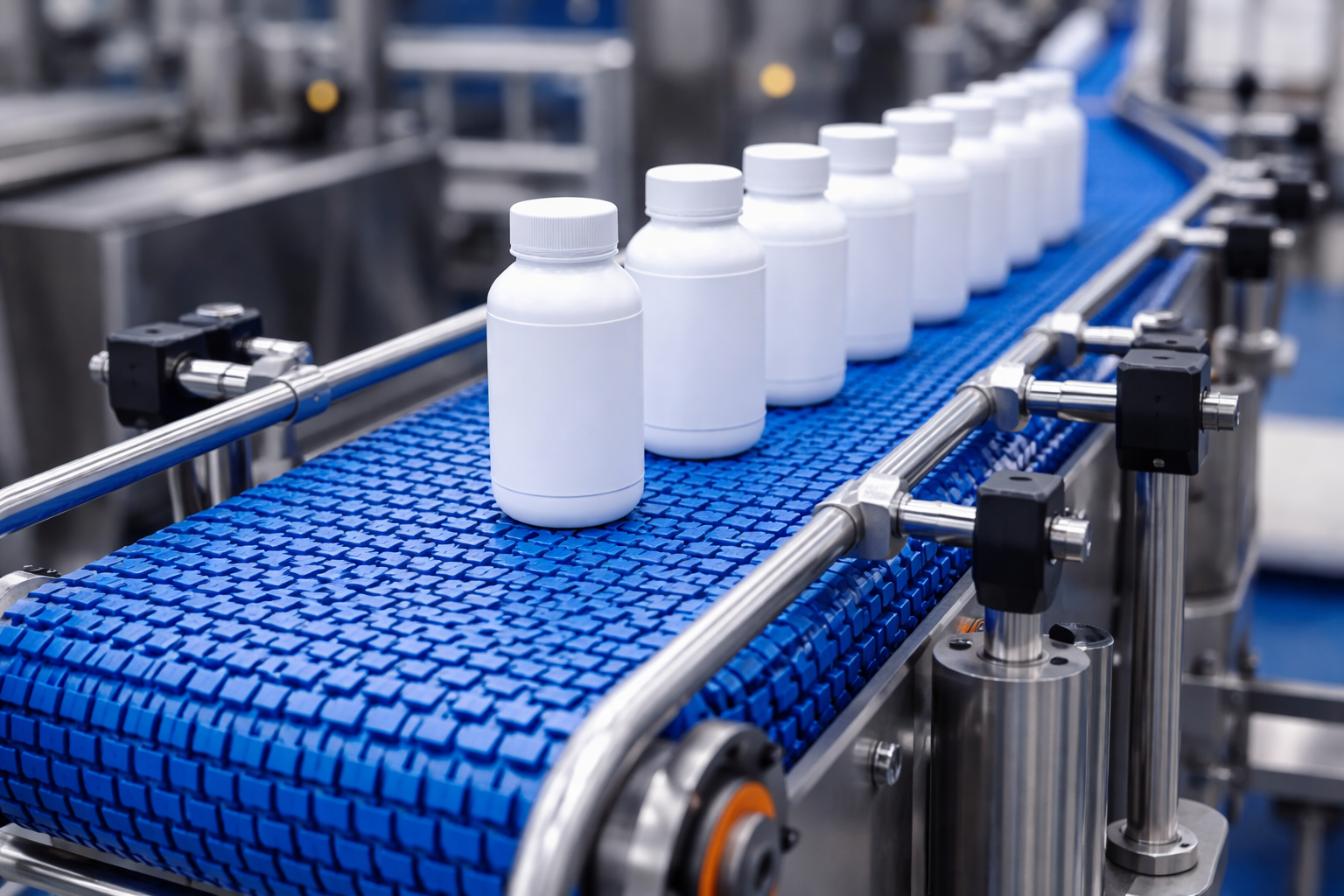
Plastic modular belt system installed on a chemical bottle filling and capping conveyor — Ever Power, UK
How the Plastic Modular Belt Actually Works: Materials, Structure, and Operating Principle
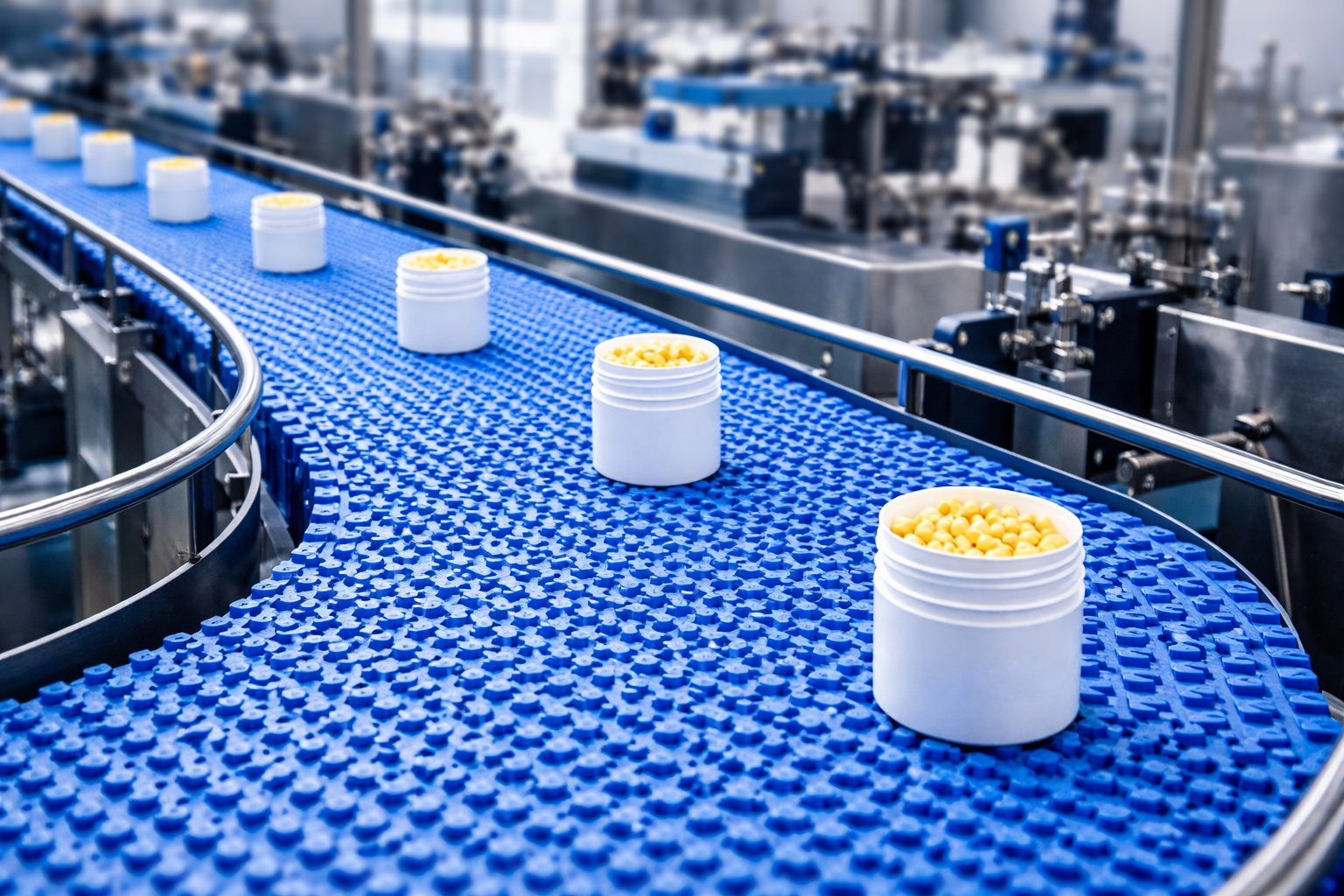 Each plastic modular belt is assembled from individual moulded links — typically 25 mm to 100 mm wide per module — that interlock transversally and are held together by smooth-bore hinge rods. The drive is transmitted through sprockets that engage moulded drive pockets on the belt’s underside, eliminating the tracking problems that plague flat belts on long, wet, or cambered runs. The open-grid variants used most heavily in chemical packaging allow up to 45% of the belt surface area to be open, making them self-draining in washdown environments and dramatically reducing the surface on which corrosive residues can accumulate.
Material selection is where the engineering becomes nuanced. Polypropylene (PP) offers excellent resistance to a wide range of acids and alkalis at moderate temperatures, making it the default choice for detergent bottle lines, agricultural chemical packaging, and water treatment additive conveyors. Acetal (POM) provides higher rigidity and lower friction coefficients, which is beneficial on inclined runs where filled containers could slide back. High-density polyethylene (HDPE) grades with antistatic compounding are increasingly specified for solvent-based product lines where static buildup represents an ignition risk under ATEX-classified zones. For lines operating above 80°C — uncommon in chemical packaging but relevant on certain wax-emulsion lines — glass-filled nylon (PA6-GF30) modules retain their dimensional stability where PP would begin to deform.
The interlocking geometry also enables something that fixed-pitch flat belts cannot: precise radius turns. Plastic modular belts with side-flexing modules negotiate horizontal curves from 300 mm radius upward without the twist-and-scrape degradation that shortens the life of woven mesh belts on curved sections. In a typical UK chemical packaging plant with filling, labelling, capping, and palletising stations arranged in an L or U shape, this capability alone eliminates the need for dead-plate transfers, reducing product tip-over incidents and the associated downtime for cleanup and container waste.
| Parameter | PP Grade | POM (Acetal) | HDPE Antistatic | PA6-GF30 |
|---|---|---|---|---|
| Operating Temp (°C) | -10 to +80 | -40 to +90 | -50 to +70 | -30 to +120 |
| Acid Resistance | Excellent | Moderate | Excellent | Good |
| Alkali Resistance | Excellent | Poor | Excellent | Moderate |
| Max Belt Speed (m/min) | 60 | 80 | 50 | 80 |
| Open Area (%) | Up to 45% | Up to 38% | Up to 45% | Up to 30% |
| FDA / EU Food Contact | Available | Available | Available | Available |
| Antistatic Option | Yes (PP-ESD) | Yes | Standard | Yes |
| Typical Service Life (yrs) | 5 – 8 | 6 – 10 | 4 – 7 | 7 – 12 |
Key Application Scenarios on Chemical Packaging Lines
⚡ Bottle Filling and Capping Conveyors
Filling stations for liquid chemicals — bleach, detergents, lubricants, acid-based descalers — are inherently messy. Nozzle drip, overfill, and splash during high-speed capping all deposit corrosive material directly on the belt surface. A plastic modular belt with an open-grid PP module configuration drains this liquid through its structure rather than accumulating it. Combined with polyurethane side guides, the belt maintains positive product positioning at up to 50 m/min without the bounce and vibration that causes filled containers to tip on smooth PVC belts. UK sites report CIP cycle times falling from 45 minutes to under 12 minutes after converting from rubber to plastic modular belts on filling lines — a direct gain of 33 minutes of production time per washdown event.
🏷 Labelling and Coding Conveyor Sections
Self-adhesive label applicators and inkjet coders demand a conveyor surface that holds containers absolutely flat and still at the moment of application. Plastic modular belts with flush-grid tops — where the module surface is completely planar — eliminate the surface irregularities that cause pressure-sensitive labels to wrinkle or bubble. The dimensional stability of acetal (POM) modules means the belt pitch does not vary with ambient temperature fluctuations in unheated UK warehousing environments, which translates directly to consistent label register accuracy. For GHS-compliant chemical labelling, where print position tolerances are legally mandated, this consistency is not merely convenient — it is a compliance requirement.
🛒 End-of-Line Palletising Accumulation
Before a robotic or manual palletiser can pick a layer of chemical containers, they must be accumulated and aligned with precision. Plastic modular belts with low-friction top surfaces — achieved through acetal modules or UHMWPE inserts — allow containers to slide smoothly into accumulation zones without abrasive contact that could scratch or deform HDPE bottles. On heavier containers such as 25-litre jerricans, the higher tensile strength of glass-fibre-reinforced belt modules (typically rated above 6,000 N/m width) prevents the stretch-and-slip that would put filled containers out of register with the palletiser gripper. This is a detail that separates correctly specified plastic modular belt systems from off-the-shelf solutions purchased purely on price.
🔥 ATEX Zone Handling for Flammable Products
When the packaging line handles solvent-based adhesives, alcohol-based sanitisers at scale, or petroleum-derivative products, static charge accumulation on the belt surface becomes a genuine ignition hazard. ATEX-compliant plastic modular belts manufactured from carbon-black-compounded PP or HDPE with a surface resistivity below 10^9 ohms dissipate electrostatic charge continuously to earth through the conductive frame. This eliminates the periodic grounding strap maintenance burden associated with standard belts and provides continuous, verifiable compliance with DSEAR 2002 requirements relevant to UK-based chemical packaging operations. Ever Power supplies full ATEX material certification with every antistatic belt configuration, which is a practical requirement for insurance assessments on UK chemical sites.
Six Decisive Advantages Over Traditional Belt Systems
Module-Level Repairability
A single damaged module is replaced in under three minutes without tools, compared with a minimum two-hour vulcanising or re-splicing job for rubber belts. Over a five-year period on a high-throughput UK line, this difference typically represents savings of over £12,000 in direct maintenance labour.
Zero Corrosion, Zero Rust
All-plastic construction eliminates the ferrous contamination risk associated with steel-link belts that corrode when exposed to acidic cleaning agents. This is a critical advantage for chemical packaging lines that must pass routine environmental and quality audits under ISO 14001 and REACH.
Reduced Drive Energy Consumption
The low-friction contact between acetal modules and UHMWPE wear strips reduces drive motor amperage compared to heavier steel-link or rubber belts. On conveyor runs of 10 m or more, measured energy savings of 15–22% are routinely recorded after conversion to plastic modular belt systems — directly relevant to UK businesses managing rising energy costs.
Customisable Width and Pitch
Standard pitch options from 12.7 mm to 101.6 mm accommodate both narrow-pitch precision transport of small containers and wide-pitch open-grid drainage belts for heavy-duty jerricans. Ever Power’s UK technical team designs belt configurations matched precisely to existing drive shaft dimensions, eliminating the conveyor frame modifications that make belt conversions costly on legacy lines.
HACCP and Hygiene Compliance
Although primarily engineered for chemical applications, the hygienic design of plastic modular belts — no hollow hinge pins, no crevices deeper than 0.5 mm — also complies with HACCP principles relevant to chemical companies that co-pack household and personal care products governed by EU Cosmetics Regulation. Food-contact PP grades are available where cross-contamination controls are documented in the site COSHH risk assessment.
Long-Term Price Stability
Unlike natural-rubber belts whose price is directly linked to volatile commodity markets, polypropylene and acetal resin pricing is significantly more stable. UK procurement teams on multi-year supply contracts benefit from predictable maintenance budgets. Ever Power’s forward-stocking of common module sizes at our UK distribution partner network ensures next-day delivery availability for emergency replacements across England, Scotland, and Wales.
Ever Power: End-to-End Custom Belt Manufacturing for UK Chemical Lines
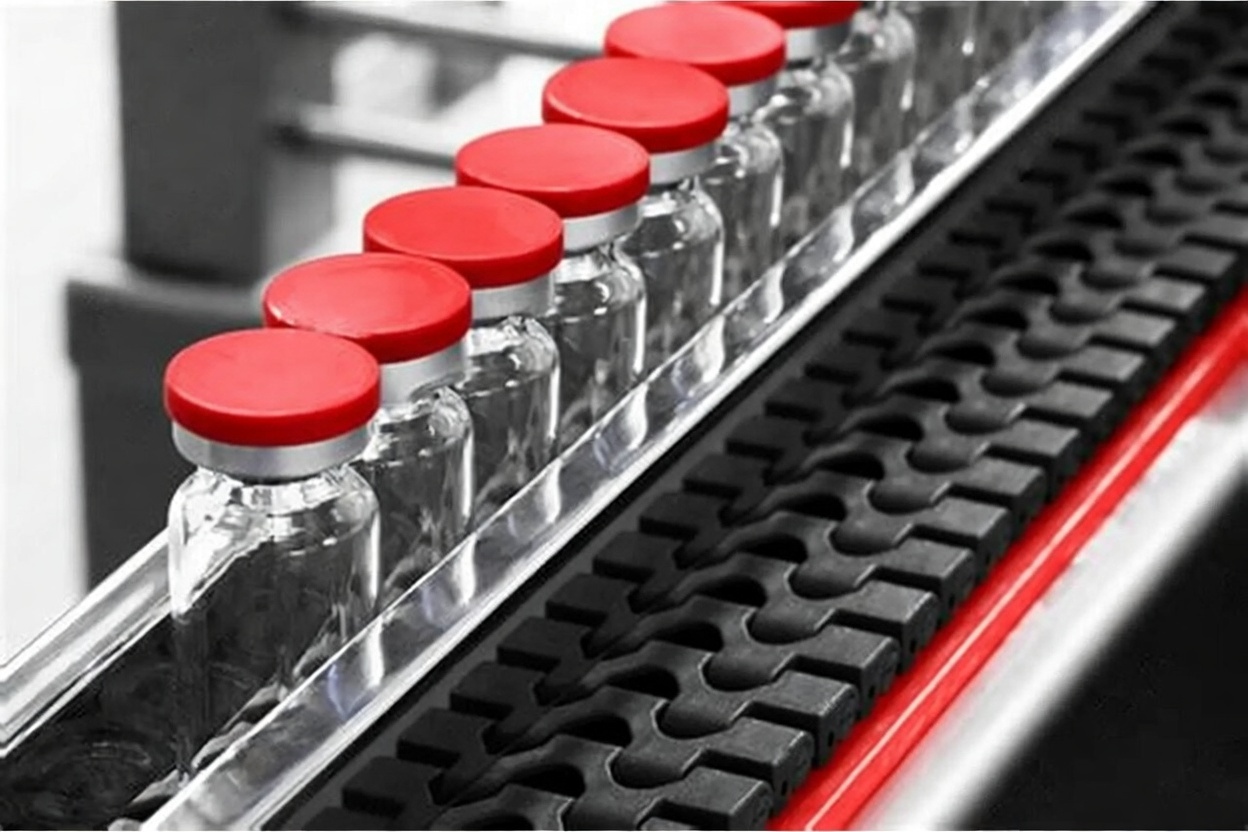 Off-the-shelf belt configurations cover perhaps 60% of chemical packaging conveyor requirements. The remaining 40% — non-standard widths, unusual chemical exposure combinations, ATEX zones, extreme pH washdown protocols, or line layouts inherited from 1980s-era factory builds — require genuine custom engineering. Ever Power’s manufacturing facility operates injection moulding presses capable of producing belt modules in widths from 80 mm to 1,200 mm in a single piece, in any of fourteen base polymer compounds, with optional steel-reinforced hinge pins, integrated side-seal strips, and surface texture profiles ranging from smooth FDA to high-grip diamond.
Our UK application engineering team reviews your conveyor drawings, capacity requirements, and chemical exposure data, then produces a formal belt specification — with chemical compatibility sign-off against your specific product list — before manufacture begins. For complex conversions, we offer on-site survey visits across the UK, including the major chemical manufacturing clusters in Teesside, Cheshire, Hampshire, and the Thames Estuary. Minimum order quantities are flexible, with stock-and-release programmes available for high-volume OEM customers and replacement belt contracts for facilities management organisations.
Customer Success Case Study: Agrochemical Packaging, Yorkshire, UK
Client: Verdana Agri-Pak Ltd — North Yorkshire, England
Verdana Agri-Pak Ltd packages a range of liquid herbicides and fungicides in HDPE containers from 500 ml to 20 litres at their North Yorkshire site. The existing conveyor system — a combination of rubber flat belts and stainless steel wire mesh — was experiencing average downtime of 11.4 hours per month across three filling lines, primarily driven by rubber belt tracking failure in the washdown environment and wire mesh corrosion at the acid-wash CIP stations. The maintenance cost, inclusive of materials and unplanned labour, was running at approximately £38,000 per year across the three lines.
Ever Power’s application team conducted a full site survey and recommended a PP open-grid plastic modular belt for the filling and capping sections, transitioning to flush-top acetal modules through the labelling zone, and a glass-fibre PA6 belt at the accumulation tables feeding the robotic palletiser. The conversion took place during a scheduled two-week maintenance shutdown in Q1 2023.
Results at 12-month review: Conveyor-related downtime fell to 1.8 hours per month across all three lines — a reduction of 84%. Annual maintenance cost dropped to £9,200. CIP time per line was reduced by 28 minutes per washdown cycle. The total investment in belt conversion paid back in 8.4 months. Verdana Agri-Pak subsequently commissioned a fourth line installation using the same belt specification.
“We had written off the idea of running open-grid belts because our previous supplier said the modules would degrade too quickly in our sulfuric acid washdown. Ever Power matched us with the right PP grade and provided chemical compatibility test reports. Fourteen months on, the belts look almost new. We will not go back to rubber.”
— Production Manager, Industrial Cleaning Products Manufacturer, West Midlands
“The custom belt widths were critical for us — we run an unusual 680 mm wide conveyor inherited from a German line. Ever Power manufactured to that exact width and delivered in three weeks. The antistatic certification was also provided without any chasing, which is rare. Our ATEX audit was straightforward as a result.”
— Engineering Director, Solvent-Based Adhesive Packaging, Hampshire
“Our procurement team did a full three-year TCO comparison between four plastic modular belt suppliers for our Teesside plant. Ever Power came in with competitive pricing but stood out on the depth of technical documentation and the responsiveness of their application team. When you are buying for a COMAH site, the paperwork matters as much as the product.”
— Senior Procurement Manager, Specialty Chemicals, Teesside
Frequently Asked Questions
❓ What is the best plastic modular belt material for a UK chemical packaging line handling strong acids?
For lines handling strong acids such as hydrochloric or sulphuric acid at concentrations above 10%, polypropylene (PP) or HDPE modules are the recommended choice. Both materials offer excellent acid resistance up to 80°C and are available with full UK-compliant material certifications. POM (acetal) should be avoided in high-alkali or strong-acid environments as it undergoes hydrolysis, leading to premature cracking and hinge pin wear. Ever Power’s chemical compatibility team provides documented resistance sign-off specific to your product list before belt specification is finalised.
❓ How much does it typically cost to convert a rubber flat belt conveyor to a plastic modular belt system in the UK?
Conversion costs vary based on conveyor length, width, and existing frame condition. For a standard 6–10 m filling line conveyor in the UK, total supply and installation typically ranges between £2,500 and £7,000. For wider or longer runs, or where frame modifications are required to accommodate the new sprocket pitch, project costs may reach £12,000–£18,000. Most UK chemical plants recoup this investment within 6–14 months through reduced maintenance labour, shorter CIP cycles, and eliminated belt-related production stops. Ever Power provides a formal ROI calculation with every quotation.
❓ Which plastic modular belt supplier in the UK offers antistatic ATEX-certified belts for solvent packaging lines?
Ever Power supplies ATEX-compliant antistatic plastic modular belts in carbon-compounded PP and HDPE grades, with full surface resistivity test reports (below 10^9 ohm) and DSEAR 2002 compliance documentation. These are confirmed suitable for ATEX Zone 1 and Zone 2 classified chemical packaging areas across the UK. Full material certificates, SDSs for module material, and test protocol documentation are supplied as standard with every antistatic belt order — a requirement commonly raised during HSE and insurance authority site assessments.
❓ How long does a plastic modular belt last on a high-throughput chemical bottle filling line running three shifts?
Under continuous three-shift operation with weekly CIP cycles using alkaline and acid cleaning agents, correctly specified PP plastic modular belts achieve 5–8 years of service life in documented field deployments. Acetal (POM) modules on drier accumulation sections often exceed 10 years before the first planned module replacement. Key factors affecting longevity include CIP chemical concentration, wash temperature, belt speed, and whether the belt is running fully loaded. Ever Power’s application team calculates an expected service life range for your specific conditions as part of the pre-sale specification process.
❓ Where can I get a same-week quote for custom-width plastic modular belt modules for a chemical packaging line in northern England?
Ever Power’s UK application engineering team provides detailed belt specifications and pricing within 24–48 business hours. Email [email protected] with your conveyor width, required belt pitch, chemical exposure details, and operating temperature range. For complex or ATEX-classified lines, site surveys are available across northern England including Yorkshire, Lancashire, and Teesside, typically arranged within five working days of initial enquiry.
❓ Can plastic modular belts be used on inclined conveyors in a hazardous goods packaging facility?
Yes, and this is a common configuration on UK chemical and agrochemical sites where filling takes place at floor level and containers must be elevated to labelling or palletising height. Plastic modular belts with cleated or raised-rib top surfaces maintain positive container grip on inclines up to 25 degrees. For ATEX-classified inclined runs, antistatic cleated modules in PP-ESD or HDPE-ESD grades are available. Ever Power regularly engineers inclined belt configurations for drum-filling elevators and jerrican palletising lines across England, Scotland, and Wales.
Ready to Upgrade Your Chemical Packaging Conveyor System?
Speak directly with an Ever Power application engineer who has worked on chemical packaging lines across the UK. We will review your existing conveyor specification, identify the correct plastic modular belt configuration, and provide a full technical and commercial proposal — typically within two working days.
Ever Power · Plastic Modular Belt Solutions · Serving UK Chemical & Packaging Industries
edit by gzl