
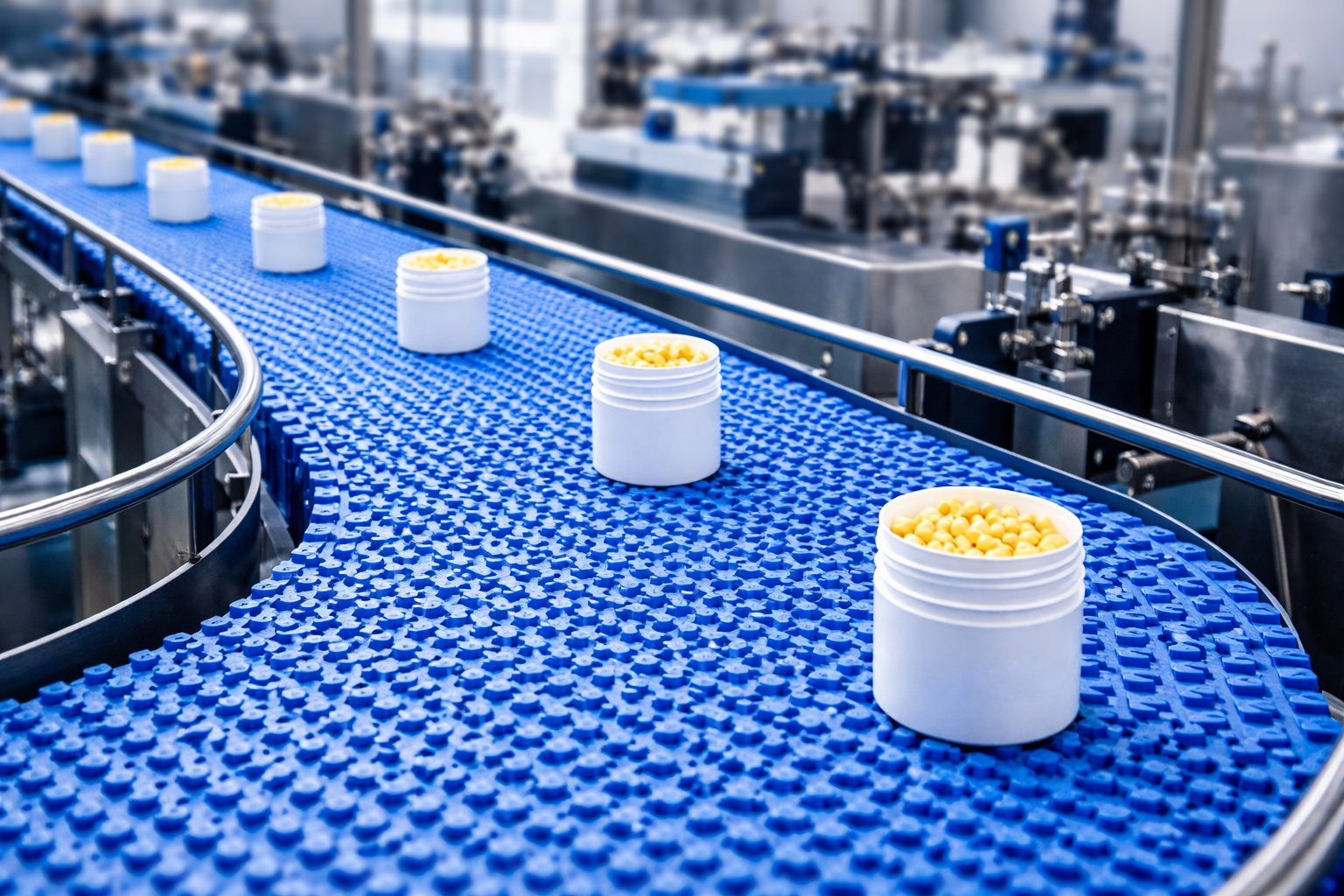
 Chemical packaging is among the most demanding conveyor environments in UK manufacturing. Bottles of bleach, containers of industrial solvents, drum-sized vessels of agricultural chemicals — each product imposes a unique set of mechanical, chemical, and regulatory challenges on the conveyor system beneath it. Steel belts corrode. Rubber degrades under prolonged chemical exposure. Fabric belts harbour contamination in their weave. That is precisely why so many plant engineers across Britain are specifying plastic modular belt as the default platform for new chemical packaging line builds and retrofit projects alike.
A plastic modular belt is constructed from interlocking thermoplastic modules — most commonly polypropylene (PP), acetal (POM), or polyethylene (PE) — linked by stainless steel or plastic hinge rods to form a continuous, articulating surface. Unlike a flat belt that must be spliced, a plastic modular belt can be assembled, disassembled, and repaired module by module on the production floor, dramatically reducing downtime. For a UK chemical packaging operation running 16 to 24 hours a day, that repairability alone can justify the capital investment.
This guide draws on more than 18 years of application engineering experience across chemical, pharmaceutical, and FMCG packaging sites throughout England, Scotland, and Wales. It covers material science, belt selection criteria, regulatory compliance under UK COSHH and ATEX requirements, real installation data, and the questions we hear most often from procurement managers and maintenance engineers before they place a specification order.
Need a plastic modular belt solution tailored for your chemical packaging line? Get a fast, no-obligation quote from our UK-experienced engineering team.
Why Chemical Packaging Lines Destroy Ordinary Conveyor Belts
The case for purpose-built modular belt solutions
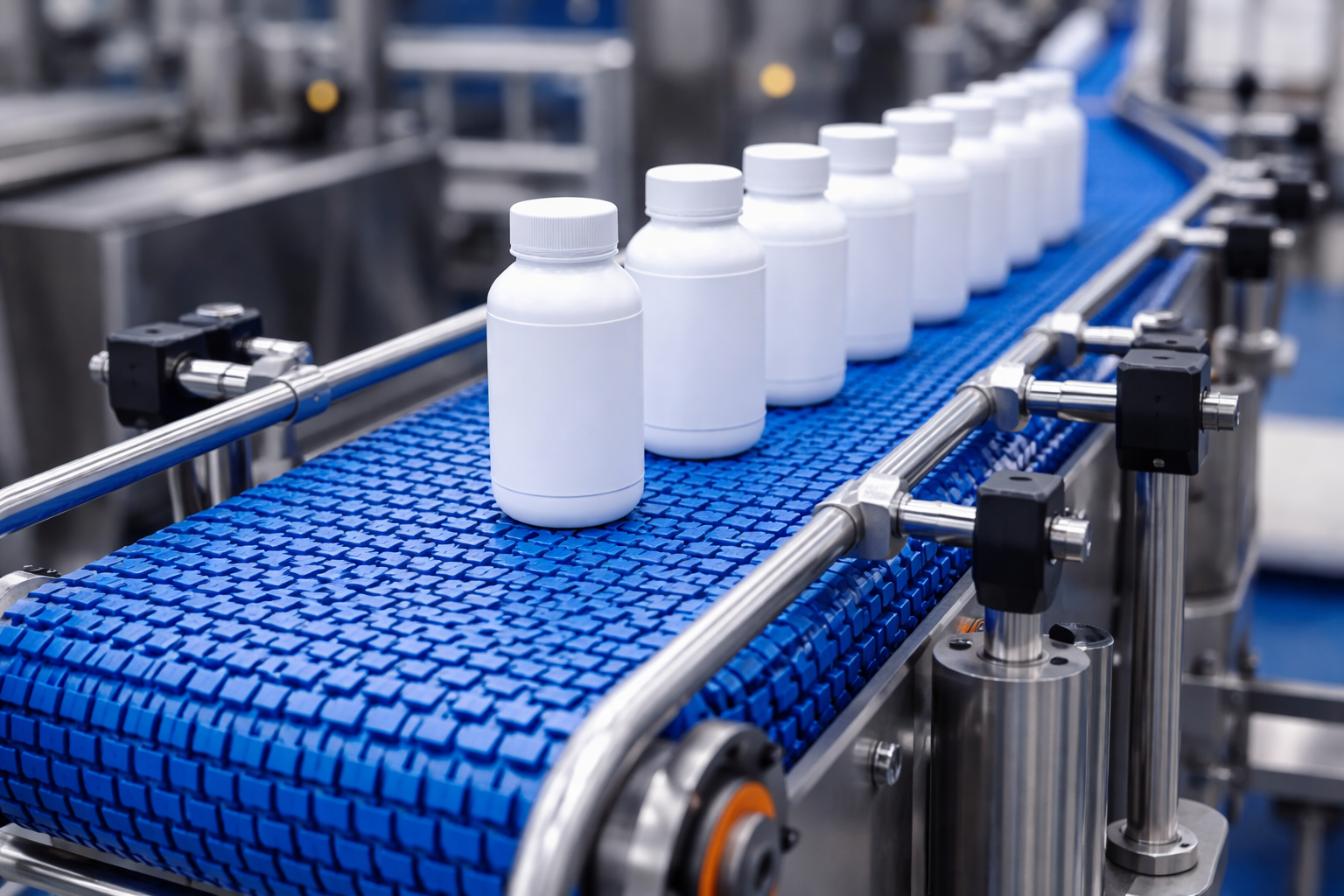 Walk through any chemical filling and sealing operation — household cleaning products in Coventry, agrochemical drum lines in Yorkshire, industrial lubricant bottling in the Midlands — and you will see the evidence of belt failure almost everywhere: rust stains bleeding into product zones, cracked rubber edges, frayed fabric seams coated in chemical residue. These are not failures of maintenance teams; they are failures of specification. Standard conveyor belts were simply not designed for environments where dilute acids, alkalines, oxidising agents, and surfactants contact the belt surface daily.
A plastic modular belt built from the right polymer grade resists this chemical attack at a molecular level. Polypropylene, for example, offers excellent resistance to most acids, alkalis, and oils at ambient temperature. Acetal (polyoxymethylene) provides exceptional dimensional stability and low moisture absorption — critical when belts must maintain precise pitch under constant washdown. High-density polyethylene variants handle cold-store chemical packaging environments below 0°C without embrittlement. No steel equivalent can offer this spectrum of chemical compatibility without either expensive alloy selection or post-treatment coatings that eventually fail under abrasion.
Beyond chemistry, there is the structural argument. Chemical containers — especially aerosols, trigger sprayers, and industrial HDPE carboys — have irregular bases, low centres of gravity, and vary enormously in weight during a single shift as filling lines transition between SKUs. A plastic modular belt with correctly configured surface texture (e.g., raised ribs, friction-top tiles, or side-guard modules) keeps these containers stable without additional guide rails, reducing the risk of toppling incidents that trigger costly product spillage and HSE notifications.
Technical Performance Parameters
Key specifications for plastic modular belt on chemical packaging conveyors
Where Plastic Modular Belt Excels in Chemical Packaging
Six proven application zones in UK chemical packaging facilities
Filling & Dosing Conveyors
At the filling station, containers stop and start repeatedly. A plastic modular belt with friction-top tiles grips container bases during indexing, preventing the lateral drift that triggers fill-level errors and spillage. The open-hinge design allows spilled liquids to drain away from the belt surface rather than pooling.
Labelling & Inspection Zones
Self-labelling machines require millimetre-accurate positioning. Acetal modular belts maintain their pitch dimension to within ±0.1 mm even after extended use in humid or solvent-laden air. Vision systems and label applicators installed above the belt surface benefit from the flat, non-reflective top surface typical of good-quality PP modules.
ATEX / Flammable Zones
Lines handling flammable solvents or aerosol propellants in the UK require conveyor components that meet ATEX Zone 2 at minimum. Anti-static plastic modular belt formulations dissipate electrostatic charge to below 100 V, preventing spark risk in acetone, IPA, or LPG aerosol environments. Always verify surface resistivity certification from your supplier.
CIP Washdown Environments
Chemical packaging facilities using Clean-in-Place procedures expose conveyor belts to hot caustic washes at 70–85°C, typically twice per shift. Thermoplastic modular belt withstands repeated sodium hydroxide and phosphoric acid CIP cycles without swelling, pitting, or structural fatigue — a durability that standard PVC or rubber belts cannot match over a 3-year horizon.
Carton & Tray Packing
Downstream from the primary packaging machine, carton-erecting and tray-packing lines run heavy secondary packaging at high speed. Wide-pitch flat-top plastic modular belt provides the robust load-bearing platform required, while side-flexing belt configurations can negotiate the tight radius turns common in compact UK factory layouts where floor space is at a premium.
End-of-Line Palletising
Robotic palletisers and layer-forming conveyors demand precise pallet lane alignment. A heavy-duty plastic modular belt with 50.8 mm pitch and stainless steel hinge rods handles loads up to 120 kg/m² continuously — well within the requirements of stacked chemical container pallets destined for warehouse storage or UK distribution logistics.
Core Advantages Over Conventional Belt Systems
Why plant engineers across the UK are switching to plastic modular belt
Field Repairability
Individual modules snap out and back in within minutes, without specialist tools. A maintenance fitter can carry replacement modules in a pocket and execute a repair mid-shift, keeping the line running rather than waiting for a full belt replacement consignment from a supplier.
Chemical Inertness
PP, POM, and HDPE materials resist a broader pH range than metal or rubber at far lower cost. For facilities handling both acidic and alkaline products on the same line through different shifts, a single belt grade often serves both product families without grade changes.
Hygienic Design
Smooth module surfaces and open hinge geometry eliminate the crevices and fabric interstices where chemical residues and bacterial biofilms accumulate. For dual-use chemical and personal care packaging sites operating under GMP guidelines, this surface hygiene is a compliance requirement, not just a preference.
Lower TCO
When total cost of ownership is calculated over a 5-year period — including belt replacement, downtime, labour for changeovers, and energy consumption — plastic modular belt consistently outperforms both rubber flat belts and stainless steel mesh in chemical packaging environments. The modular replacement model alone typically cuts annual belt material spend by 40–60%.
Customisable Geometry
Unlike extrusion-based flat belts that are manufactured to fixed widths and lengths, a plastic modular belt can be built to exact width in 12.7 mm increments. Curved sections, inclines, and multi-tier configurations are all achievable with standard module families, removing the need for custom conveyor frames in retrofit projects.
Regulatory Alignment
UK COSHH regulations require employers to prevent or adequately control worker exposure to chemical substances. A plastic modular belt that drains spillage efficiently and resists absorption reduces surface contamination levels and supports the risk assessment documentation that HSE inspectors increasingly request during planned inspections at chemical packaging sites.
Customer Success: Household Chemical Manufacturer, West Midlands
Real-world retrofit project — conveyor replacement on a multi-SKU bleach and detergent packaging line
A well-established household chemical manufacturer based in the West Midlands — producing bleach, bathroom cleaner, and multi-surface spray products for major UK supermarket own-label contracts — approached us in mid-2023 with a recurring problem. Their existing PVC flat belt conveyor on the primary filling line was failing every 8 to 12 weeks due to surface blistering and edge delamination caused by hypochlorite vapour exposure. Each replacement required a full 6-hour line shutdown, involving two maintenance technicians and a costly emergency belt order from their existing supplier.
After a site survey and chemical compatibility audit, our engineering team specified a 600 mm wide PP plastic modular belt in natural colour (food-contact grade, confirmed safe for incidental chemical contact) with friction-top tiles at the filling station indexing zone and flat-top modules through the labelling and capping sections. Stainless steel 304 hinge rods were selected over standard plastic rods to handle the elevated belt tension required by the existing drive arrangement.
Installation was completed in a single planned weekend shutdown. Eighteen months later, the belt remains in service without module replacement. The site engineering manager reports annual maintenance cost savings of approximately GBP 14,000 against the previous belt replacement schedule, and the production team has eliminated the unplanned stoppages that were regularly impacting daily output targets. A retrofit of the adjacent detergent line using the same specification is now being planned for Q3 2025.
What Our Clients Say
“We had three belt failures in six months on our aerosol packaging line. Since fitting the plastic modular belt, we have had zero unplanned stoppages. The on-site repair capability means our team can fix a broken module in ten minutes without calling in a specialist.”
James H.
Engineering Manager · Aerosol Contract Packer, Yorkshire
“We needed a belt that could handle both NaOH cleaning cycles and IPA sanitisation on the same line. The PVDF modular belt recommendation was spot on — eighteen months in and not a single module has needed replacing. The technical support from the engineering team was genuinely impressive.”
Priya S.
Operations Director · Specialty Chemical Manufacturer, Manchester
“The custom side-flexing belt for our spiral accumulator was delivered in three weeks and fitted our existing frame perfectly. The technical team measured our existing conveyor dimensions remotely and the belt arrived ready to install. That level of service from a belt supplier is rare in the UK.”
Tom W.
Maintenance Supervisor · Agrochemical Packaging, East Anglia
How Plastic Modular Belt Works: Materials, Construction and Drive Principles
Understanding the engineering beneath the surface
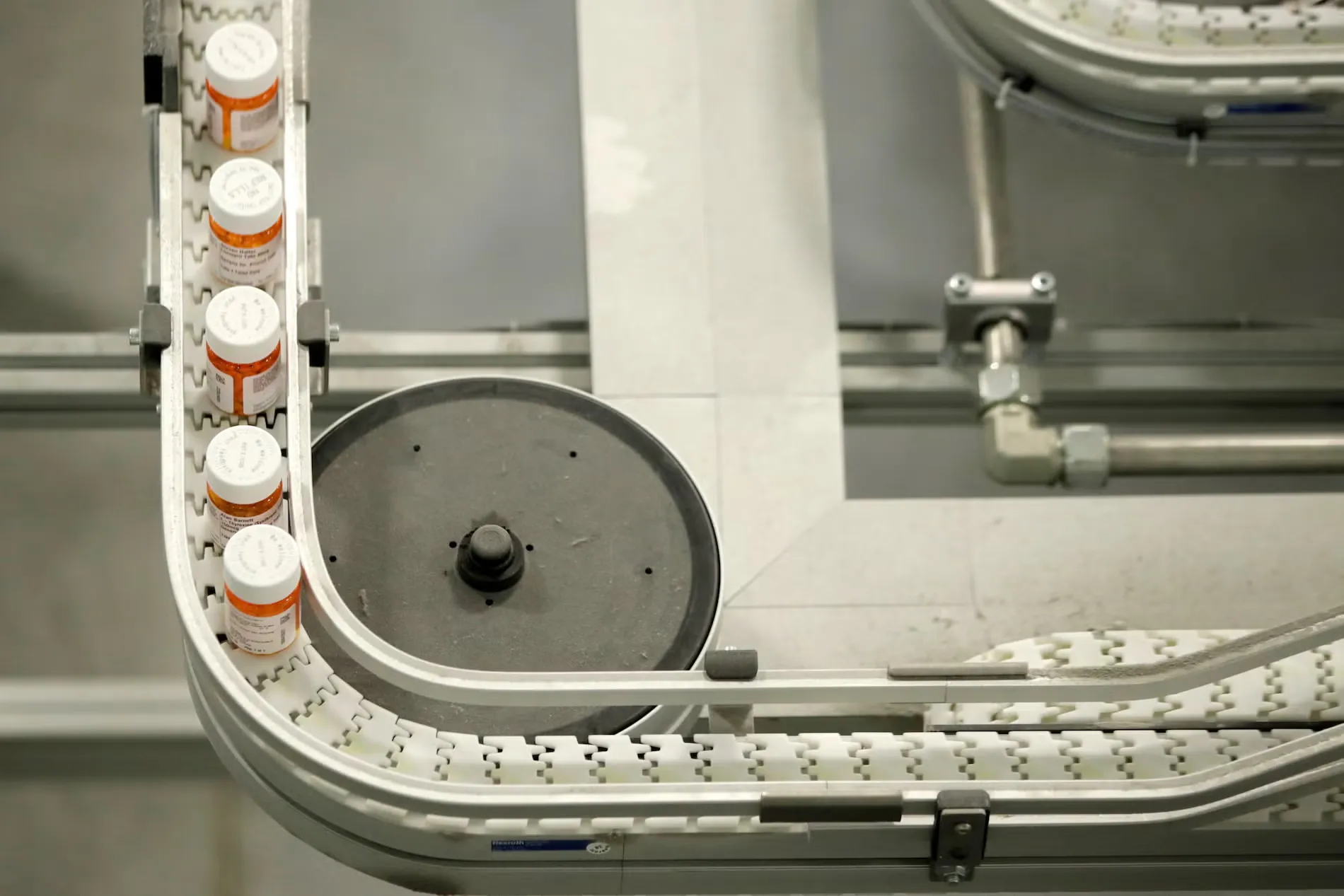 A plastic modular belt operates on a sprocket-drive principle rather than the friction-drive used by flat belts. Sprocket teeth engage drive holes moulded into the centreline or edges of each module row, converting rotational motor torque into linear belt motion with near-zero slip. This positive drive mechanism means the belt position relative to the drive shaft is always known, making it ideal for indexing conveyors where containers must stop at precise fill or label positions within ±2 mm tolerance.
Modules are injection-moulded in high-cavitation tooling to maintain dimensional consistency across production batches. The hinge rod — typically 6 or 8 mm diameter — connects each row through the male and female hinge eyes that are integral to the module geometry. When a damaged module must be replaced, the hinge rod is pushed laterally out of the row, the damaged module is slid free, and a replacement module is inserted, all without lifting or cutting the belt. This is the single most operationally significant feature for UK chemical packaging sites where planned maintenance windows are shrinking under pressure from contract manufacturing timelines.
The return path of a plastic modular belt runs beneath the carrying surface and is supported by either slider beds (low-friction UHMWPE wear strips for light-load applications) or return rollers (for heavier loads or longer centres). Proper return support prevents belt sag, which in chemical packaging lines can cause container positional errors that generate downstream packing jams. Our engineers specify return support spacing based on both the belt’s own mass and the maximum product load per metre, always applying a safety factor of 1.5 to account for production variations and future SKU weight changes.
Custom Belt Manufacturing for UK Chemical Packaging Specifications
Every packaging line is unique — our engineering and manufacturing capability reflects that
Off-the-shelf belt sizes rarely meet the dimensional requirements of existing conveyor frames on retrofit projects, and they almost never match the surface texture, chemical compatibility, or colour-coding requirements of a purpose-designed new line. Our manufacturing facility operates with full in-house tooling for module production in all standard pitch families, and our engineering team holds current experience with ATEX-rated anti-static belt compounds, FDA-grade formulations for dual-use chemical and food sites, and custom surface textures developed specifically for irregular container bases common in chemical packaging.
We provide full DXF conveyor frame drawings to customers who are building new conveyors around our belt geometry, ensuring that sprocket tooth profiles, drive shaft centres, and slider bed positions are correctly integrated from the design phase. For retrofit customers, we offer a dimensional survey service — either in-person at UK sites or via a guided video measurement protocol — to guarantee that a replacement plastic modular belt will fit the existing frame without modification. Our typical lead time for standard PP and acetal belt widths is 5 to 7 working days ex-factory; PVDF or anti-static compound belts require 10 to 14 working days.
Chemical Compatibility Quick Reference
Typical ratings for common chemicals in UK packaging operations — always confirm with full compatibility testing for critical applications
Frequently Asked Questions
Common questions from UK chemical packaging procurement and engineering teams
Ready to Upgrade Your Chemical Packaging Conveyor?
Send your conveyor dimensions and chemical environment details to our UK engineering team. We respond within 2 working hours with a specification recommendation and indicative price.
edit by gzl