Response within 24 hours · UK-specific technical support available
Why Chemical Packaging Lines Demand a Different Kind of Belt
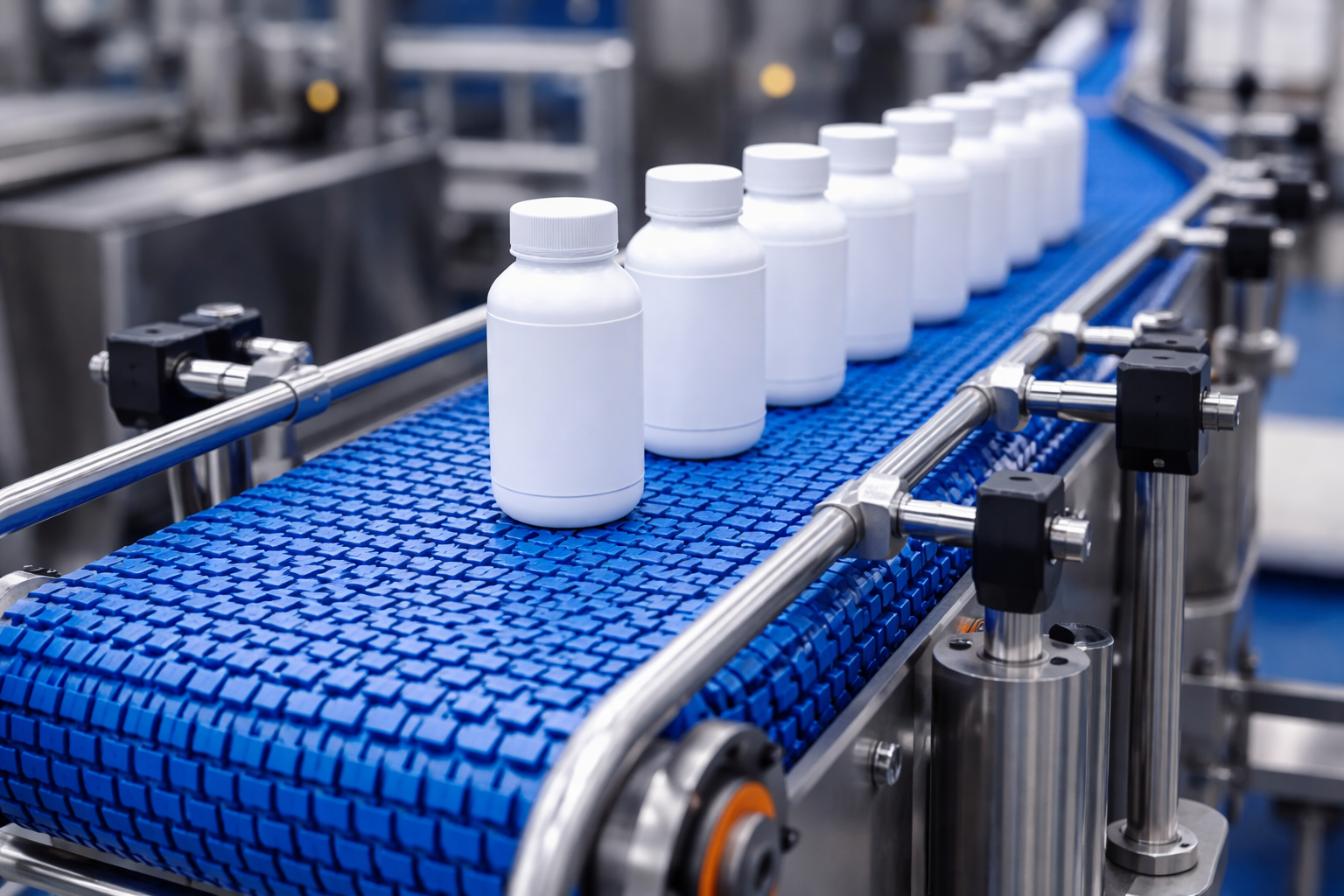 Chemical packaging operations sit at one of the most demanding intersections in modern industrial manufacturing. Unlike food or e-commerce conveyor systems, chemical packaging lines in the United Kingdom must simultaneously manage corrosive liquids, aggressive cleaning agents, temperature extremes, and strict regulatory compliance — all while keeping throughput rates competitive. The plastic modular belt has emerged as the definitive solution for these environments, and understanding exactly why requires a close look at the engineering realities that shape every metre of a typical UK chemical packaging line.
A traditional PVC or rubber belt simply cannot withstand the combination of chemical splash, wash-down cycles using sodium hypochlorite or caustic soda, and the mechanical stresses of heavy container handling. The interlocking modular design of a plastic modular belt solves this problem from the ground up. Each individual module — typically injection-moulded from polypropylene (PP), polyethylene (PE), or acetal (POM) — is chemically inert across a remarkably broad pH range. When one module is damaged, it snaps out and is replaced in minutes without removing the entire belt from the line. For a chemical packaging facility running three shifts in Birmingham, Teesside, or the Humber industrial corridor, that kind of field-replaceable design translates directly into less downtime and more output per shift.
The regulatory landscape in the UK adds another layer of complexity. Post-Brexit, UK chemical manufacturers follow a combination of UK REACH regulations, Health and Safety Executive (HSE) guidance, and site-specific COSHH assessments. A plastic modular belt chosen for a container-filling line handling biocides or agrochemicals must be traceable, dimensionally stable, and compatible with the cleaning validation protocols that HSE inspectors expect to see documented. This is where material certification — the ability to produce a full material data sheet confirming chemical resistance, operating temperature range, and approved colourants — becomes part of the procurement conversation, not just a technical footnote.
How a Plastic Modular Belt Actually Works
Interlocking Module Design
Individual moulded modules link together via hinge rods, forming a continuous flat or textured surface. The open-grid or flat-top topology allows liquid drainage, reducing contamination pockets — critical for chemical splash zones.
Polymer Material Selection
PP offers broad chemical resistance and low cost. POM (acetal) delivers superior dimensional stability and low friction. PE provides excellent impact resistance for heavy containers. Material choice is matched to the specific chemical environment on your packaging line.
Drive & Sprocket System
Plastic sprockets positively drive the belt through moulded drive tabs, eliminating the belt slip common in friction-driven systems. Stainless steel or plastic sprocket hubs resist corrosion throughout rigorous CIP or wash-down cycles.
Thermal Performance
Standard PP belts operate continuously from -10°C to +110°C — suitable for hot-fill chemical packaging, cold store warehousing, and steam-cleaning cycles. High-temp variants extend this range for specialist industrial coatings or resin handling lines.
Technical & Performance Parameters
| Parameter | Standard PP | POM (Acetal) | HDPE |
|---|---|---|---|
| Operating Temp Range | -10°C to +110°C | -40°C to +100°C | -50°C to +80°C |
| Chemical Resistance | pH 2–12 | pH 4–11 | pH 2–13 |
| Max Belt Width | Up to 2,400 mm | Up to 2,000 mm | Up to 2,400 mm |
| Pitch Options | 12.7 / 25.4 / 38.1 mm | 12.7 / 25.4 mm | 25.4 / 38.1 mm |
| Max Load (kg/m²) | Up to 250 kg/m² | Up to 300 kg/m² | Up to 220 kg/m² |
| Belt Speed | 0.1–2.5 m/s | 0.1–3.0 m/s | 0.1–2.0 m/s |
| Surface Type | Flat-top / Open-grid | Flat-top / Friction-top | Flat-top / Open-grid |
| Compliance | EU/UK REACH, FDA | FDA / RoHS | FDA / RoHS |
Application Zones on a Chemical Packaging Line
The plastic modular belt performs across every critical stage — from raw container in-feed to finished pallet dispatch.
📦 Container In-feed & Orientation
Empty containers — bottles, jerricans, or IBCs — arrive on a flat-top plastic modular belt. The low-friction surface allows accumulation without pressure build-up, preventing container damage before they enter the filling carousel. The belt’s open-grid option lets any dust or particulate fall clear, maintaining a clean in-feed zone.
🧴 Chemical Filling & Dosing Zone
Directly beneath filling nozzles, the plastic modular belt must withstand inevitable chemical drips — from dilute acids to alkali-based cleaning products. PP or HDPE modules resist these without staining, swelling, or delaminating, while the positive-drive sprocket system ensures consistent belt speed regardless of chemical contamination on the surface.
🔒 Capping & Sealing Transport
After filling, containers move to capping machines. A friction-top plastic modular belt module prevents container spin during torque application, while the belt’s structural rigidity eliminates the vibration that causes misalignment. This is especially relevant for tamper-evident and child-resistant closures mandated by UK packaging regulations for hazardous substances.
🏷️ Labelling & Inspection
Self-adhesive labelling and vision inspection systems demand belt surfaces with zero lateral wander and consistent top-of-belt heights. The rigid modular construction of plastic modular belts eliminates the sagging and tracking issues seen in flat rubber belts, ensuring label placement accuracy within ±0.5 mm — a requirement for GHS-compliant hazard labelling on chemical products.
🧹 Wash-down & CIP Zones
UK chemical packaging facilities follow rigorous clean-in-place protocols. The open-grid plastic modular belt allows pressurised water and cleaning solutions to penetrate the belt structure from both sides. No hidden pockets trap chemical residue. The belt’s corrosion-resistant hinge rods — available in stainless steel or polymer — complete the hygiene package.
🏗️ Case Packing & Palletising
At the end of the chemical packaging line, heavy cartons and grouped container packs transfer onto pallet conveyor systems. High-load-capacity plastic modular belts in HDPE or reinforced PP handle weights exceeding 200 kg/m² without elongation or premature wear, supporting automated palletisers and robotic pick-and-place cells that are increasingly common in UK packaging depots.
Seven Reasons UK Chemical Packagers Choose Plastic Modular Belts
Procurement managers and maintenance engineers at chemical packaging sites from Cheshire to Teesside are making the switch for a growing list of practical reasons. The case goes far beyond simple chemical resistance — it covers total cost of ownership, regulatory compliance, and the kind of operational flexibility that a busy packaging line genuinely needs.
Module-by-Module Repair
Replace only the damaged section. No full belt removal, no conveyor downtime measured in hours.
Broad Chemical Compatibility
Resistant to acids, alkalis, solvents, and oxidising agents at concentrations common in chemical packaging environments.
Positive Drive — No Slip
Sprocket-driven design eliminates belt creep and speed variation that undermines dosing accuracy and labelling registration.
Wash-down Ready
Open-grid topology drains liquid instantly. No hidden bacteria traps. Certified for high-pressure wash-down and CIP cleaning.
UK & EU Regulatory Compliance
Full material traceability. Certificates available for UK REACH, COSHH validation documentation, and FDA-compliant grades.
Lower 5-Year TCO
Modular replacement reduces spare parts cost. Longer service life versus rubber belts in chemical environments. Reduced unplanned downtime.
Customisable for Any Line Layout
Side-flexing, radius turning, and multi-strand configurations available. Designed to fit your existing conveyor frame — not the other way around.
Customer Success Case Study
A documented implementation from our UK industrial chemical sector client base
CASE STUDY
CleanMaster Industrial Ltd — Teesside, Northeast England
Industrial Cleaning & Hygiene Chemical Manufacturer · 3-shift production · Est. 1997
The Challenge: CleanMaster operates a 120-metre chemical packaging line producing 5L and 25L containers of industrial degreasers and alkaline cleaners. Their legacy PVC flat belt system required full belt replacement every 14 months due to chemical degradation, causing an average of 38 hours of planned downtime per year — not counting emergency breakdowns. The HSE had also flagged belt residue accumulation during a scheduled audit, raising concerns about cross-contamination between product SKUs.
The Solution: Ever Power supplied a full set of PP flat-top plastic modular belts for the filling and capping zones, and open-grid belts for the wash-down and draining sections. POM side-flexing modules were installed on the two radius turns at the labelling and inspection station. The entire installation — carried out in partnership with CleanMaster’s maintenance team — was completed over a planned Bank Holiday weekend shutdown.
The Results (18 months post-installation): Unplanned belt-related downtime dropped from 38 hours/year to under 4 hours. Three individual modules were replaced in that period — each in under 12 minutes without line shutdown. The HSE audit flag was closed. CleanMaster’s operations director confirmed a 31% reduction in belt-related maintenance spend over the first year, and the company has since ordered plastic modular belt systems for their second packaging line in Stockton-on-Tees.
What UK Customers Say
“We were replacing our old belt system every 14 months. Since fitting the Ever Power plastic modular belt, we’ve had one maintenance call in two years. The chemical resistance is exactly as specified — no cracking, no swelling.”
— Production Manager, Industrial Chemicals
Teesside, Northeast England
“The open-grid design has transformed our CIP process. Wash-down time is down by nearly a third. Our compliance team can now complete the cleaning validation log in half the time it used to take.”
— HSE Compliance Officer, Agricultural Chemicals
Humber, East Yorkshire
“We operate three shifts, six days a week. The modular belt system from Ever Power has given us a level of production reliability we didn’t think was possible with conveyor belts. The quote process was fast and the technical support was genuinely useful.”
— Engineering Director, Cleaning Products Manufacturer
Cheshire, Northwest England
Ever Power: Custom Belt Manufacturing for UK Chemical Packaging
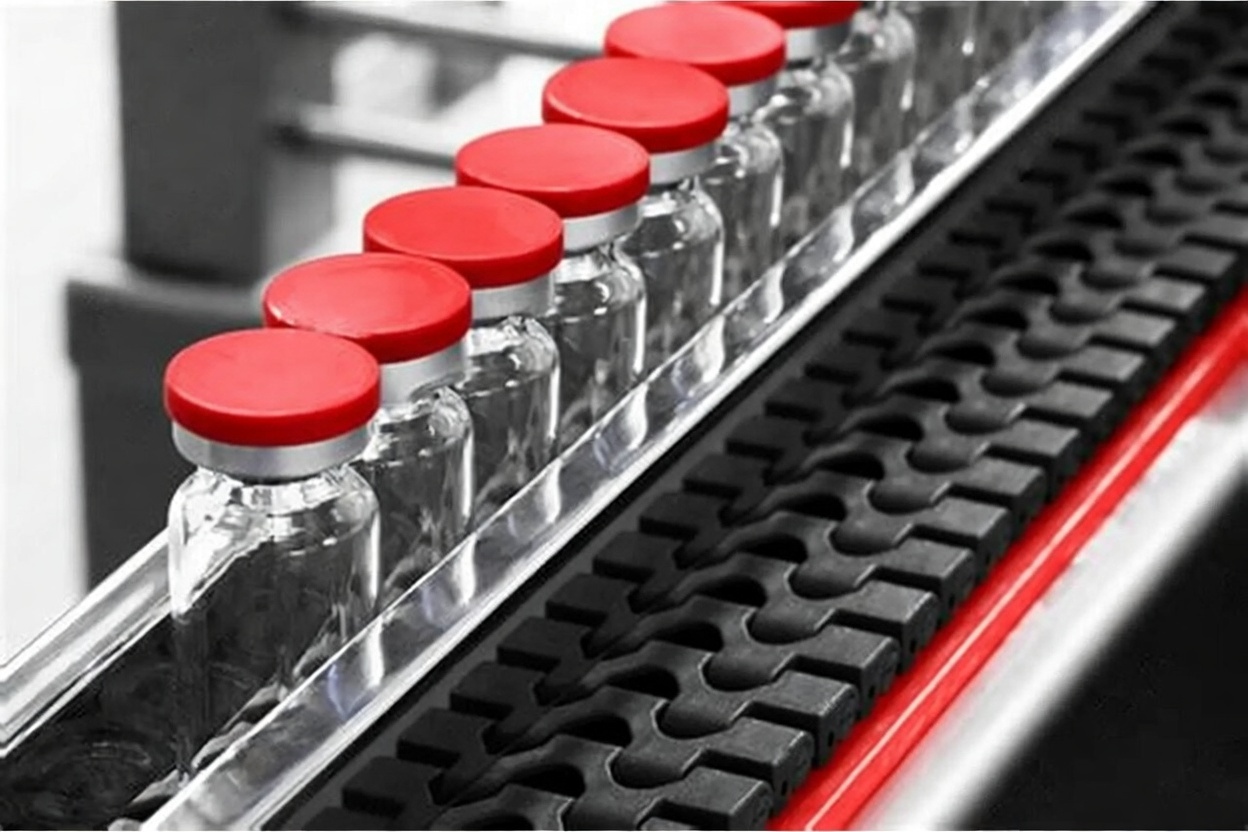 No two chemical packaging lines in the UK are identical. Line layouts, container formats, conveyor frame dimensions, and cleaning protocols all vary between facilities in Teesside, Cheshire, the Midlands, and the South East. That is precisely why Ever Power’s belt manufacturing capability is built around customisation as a standard service — not an optional extra that adds lead time and cost.
Our production facility operates precision injection moulding for belt modules across all standard pitches and a growing range of specialist profiles. We can manufacture flat-top, open-grid, flush-grid, friction-top, and side-flexing modules. We stock PP, POM, HDPE, and nylon grades, and can source specialist materials including anti-static compounds and conductive variants for ATEX-rated chemical environments. Belt widths from 100 mm to 2,400 mm can be assembled and shipped with stainless steel or polymer hinge rods to your specification.
For UK chemical packaging clients, we also provide technical drawing review, chemical compatibility consultation, and sample belts for on-site testing before full procurement. Our applications engineering team — with over 18 years of plastic modular belt deployment experience across chemical, pharma, and food processing sectors — works directly with your engineers to confirm the right belt specification before any order is placed. This reduces the risk of incompatible belt selection and protects your compliance documentation from the start.
Request a Custom Belt Specification
Send us your line drawings, container dimensions, chemical environment data, and throughput targets. We’ll respond with a full technical recommendation and price within 24 hours.
Serving UK Chemical Packaging Facilities
The United Kingdom has one of Europe’s largest chemical manufacturing sectors, with major production and packaging clusters concentrated in Teesside (the Tees Valley industrial corridor), the Humber estuary (including Hull and Grimsby), Cheshire (particularly the Mersey Valley chemical belt around Runcorn and Widnes), the Midlands, and the Thames Gateway in the South East. Each of these regions has specific logistical and regulatory characteristics that inform conveyor belt specification decisions.
Northern England packaging facilities tend to handle bulk industrial chemicals — solvents, acids, and agrochemicals — which demand the highest chemical resistance ratings and strict COSHH compliance. Scottish chemical manufacturers increasingly focus on specialty cleaning and hygiene products for the food and drink processing supply chain, where FDA-compliant PP belts are the standard. In the Midlands and Southeast, a growing number of chemical packaging lines are being integrated into automated distribution centres, requiring plastic modular belts that interface seamlessly with robotic palletisers and WMS-controlled conveyor networks.
Ever Power’s technical sales team has direct experience supporting plastic modular belt projects in all of these UK regions. Whether you are replacing legacy belt systems on an existing Teesside chemical packaging line, specifying belts for a new greenfield facility in Cheshire, or retrofitting an automated packaging system in Birmingham, we provide belt solutions that match the specific operational demands of your site.
Frequently Asked Questions
Questions from chemical packaging engineers and procurement teams across the UK
Ready to Upgrade Your Chemical Packaging Line?
Send us your belt specifications, conveyor dimensions, and chemical environment details. Our engineers will provide a full recommendation within 24 hours.
Get a Quote — [email protected]
Ever Power · Plastic Modular Belt Manufacturer · Serving UK Chemical Packaging Industry
© Ever Power Industrial Belt Solutions · United Kingdom · edit by gzl