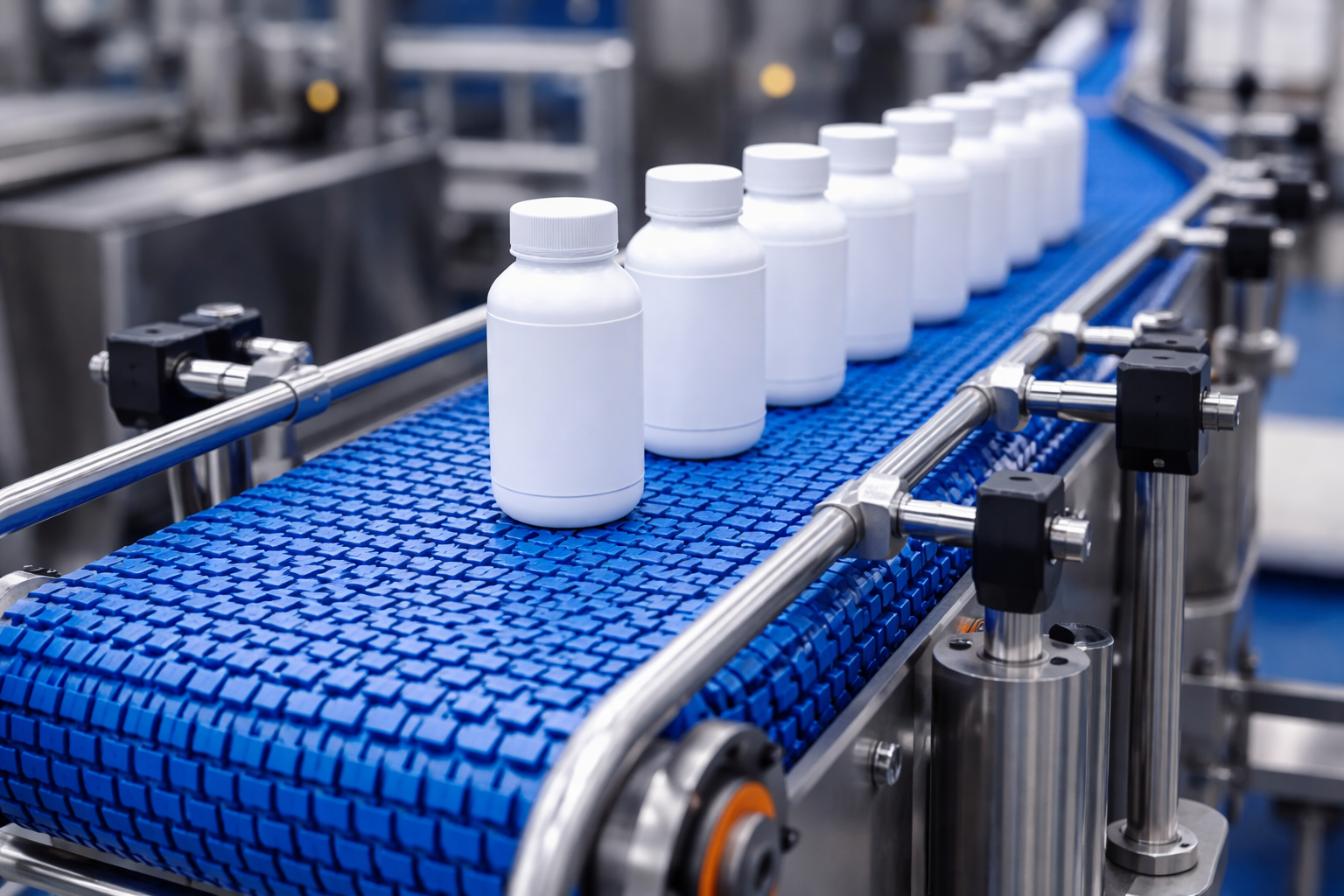
 In any pharmaceutical manufacturing facility, the solid dosage line is arguably the most scrutinised part of the entire production floor. Tablets pass from compression through coating, sorting, inspection and packaging — each stage demanding absolute product integrity, zero cross-contamination risk, and the kind of hygienic design that can survive a MHRA inspection without generating a single observation. The plastic modular belt has become the preferred conveying solution across these lines precisely because it meets those demands in ways that traditional rubber belts, stainless steel mesh and slat conveyors simply cannot.
Over eighteen years of working closely with pharmaceutical clients across the United Kingdom — from tablet manufacturers in the East Midlands to contract packaging organisations in the North West — I have seen how the right plastic modular belt specification can reduce line changeover time, cut cleaning validation costs, and extend belt service life well beyond anything a conventional flat belt offers. This guide sets out the technical principles, material science, application-specific configurations and real-world performance data that should inform every specifier’s decision when selecting conveyor belting for solid dosage production.
What follows is not a catalogue page. It is the distilled engineering knowledge of someone who has solved real problems — jams at tablet coolers, product breakage on incline conveyors, failed FDA inspections linked to belt wear debris — and who understands that pharmaceutical conveying is a discipline requiring the same rigour as the products it handles.
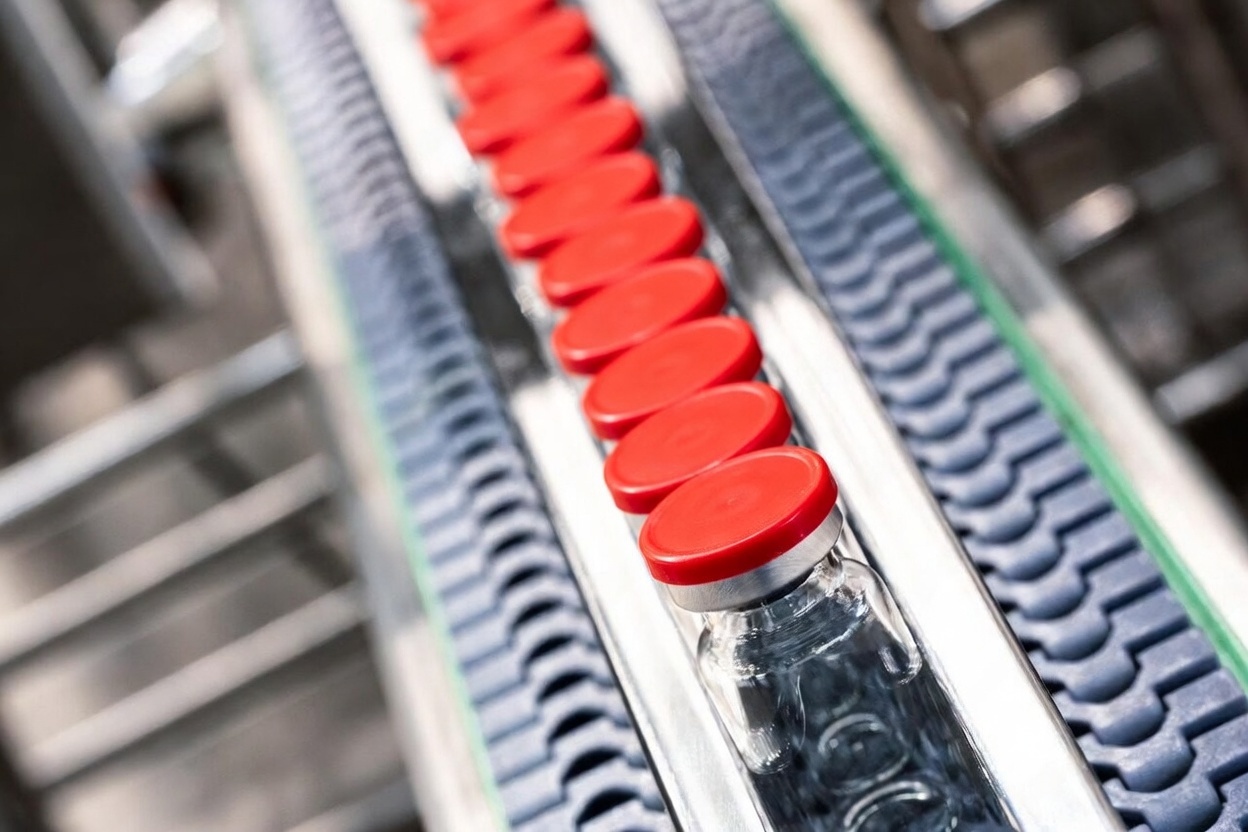
Ever Power plastic modular belts in active deployment on a UK pharmaceutical solid dosage production line
Why the Pharmaceutical Solid Dosage Line Demands a Different Belt Philosophy
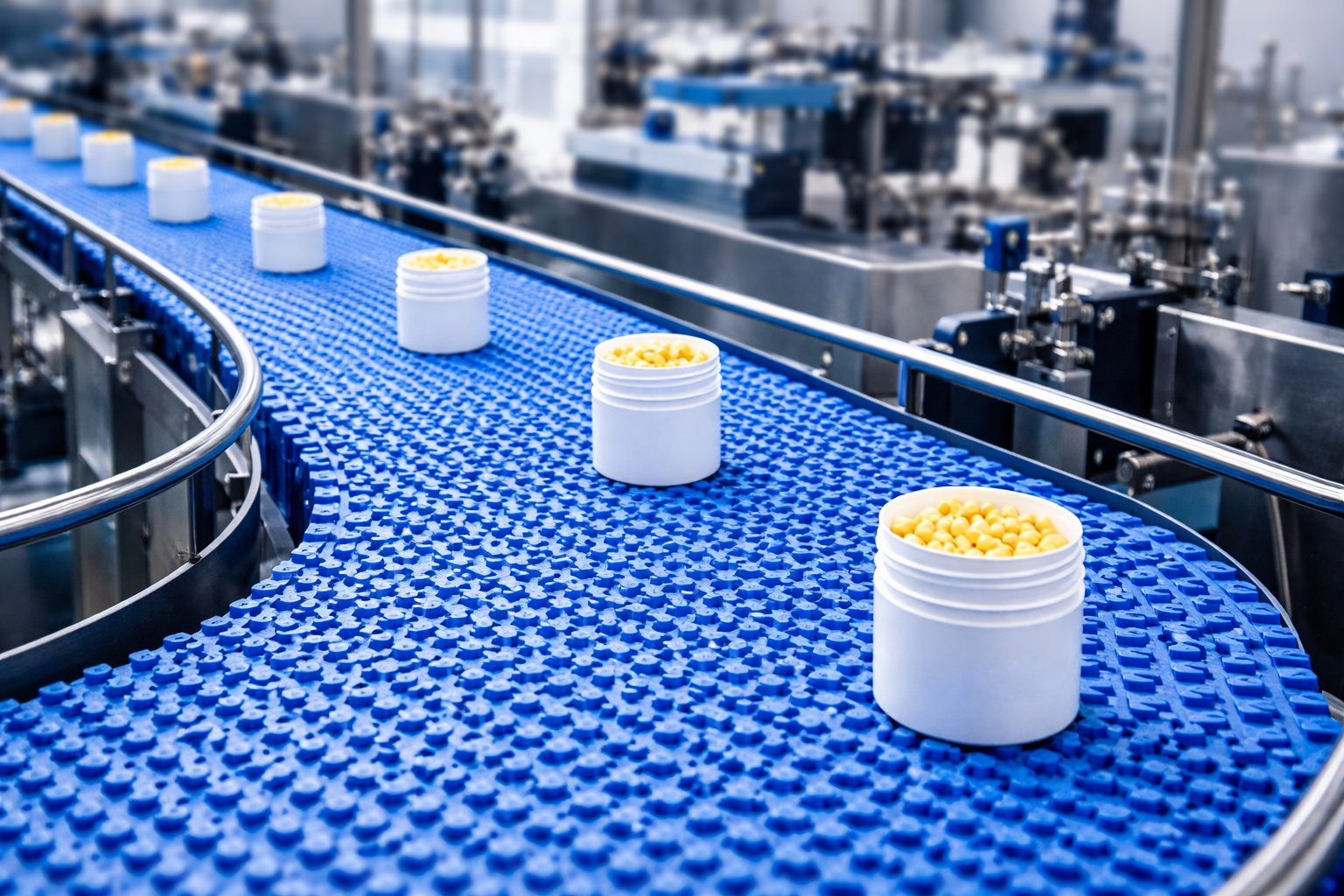 The moment a compressed tablet leaves a rotary press, it enters an environment where every surface it contacts must be demonstrably inert, cleanable to validated standards, and dimensionally stable across temperature and humidity variations that occur during routine production. A standard rubber flat belt fails on all three counts within months. The surface degrades, particles migrate, and belt-edge wear creates visible dark debris that triggers OOS investigations during in-process quality checks.
A plastic modular belt, by contrast, is constructed from individual interlocking polypropylene, polyethylene or acetal modules. Each module is injection-moulded to tight dimensional tolerances, creating a belt surface that is inherently open (allowing drainage and airflow during cleaning), repairable module-by-module without replacing the entire belt, and completely free from the vulcanisation agents and plasticisers that make rubber belts incompatible with pharmaceutical GMP environments. The modular construction also means that belt tension is distributed mechanically rather than relying on material elasticity — a fundamental advantage in the high-humidity, high-temperature zones around tablet coating pans and fluid-bed dryers.
From a compliance standpoint, the plastic modular belt is the only conveyor belt type that can be fully disassembled for deep cleaning, visually inspected piece-by-piece during routine maintenance, and documented to a cleaning validation protocol without relying on statistical inference. That level of cleaning assurance is not optional in a UK pharmaceutical facility — it is the minimum standard that MHRA auditors expect to see in a site’s conveyor maintenance SOP.
Material Composition, Technical Properties & Performance Parameters
The performance characteristics of a plastic modular belt are determined almost entirely by the base polymer selected and the geometric design of the module. For pharmaceutical solid dosage applications, material choice is non-negotiable: the polymer must carry a valid FDA 21 CFR food contact declaration, be listed in the EU Regulation No 10/2011 for plastic materials, and in most UK facilities must also be referenced in the equipment qualification (DQ/IQ) documentation as a primary contact surface material. The table below summarises the four most commonly specified materials and their relevant performance characteristics for solid dosage conveying environments.
How a Plastic Modular Belt Actually Works in a Solid Dosage Environment
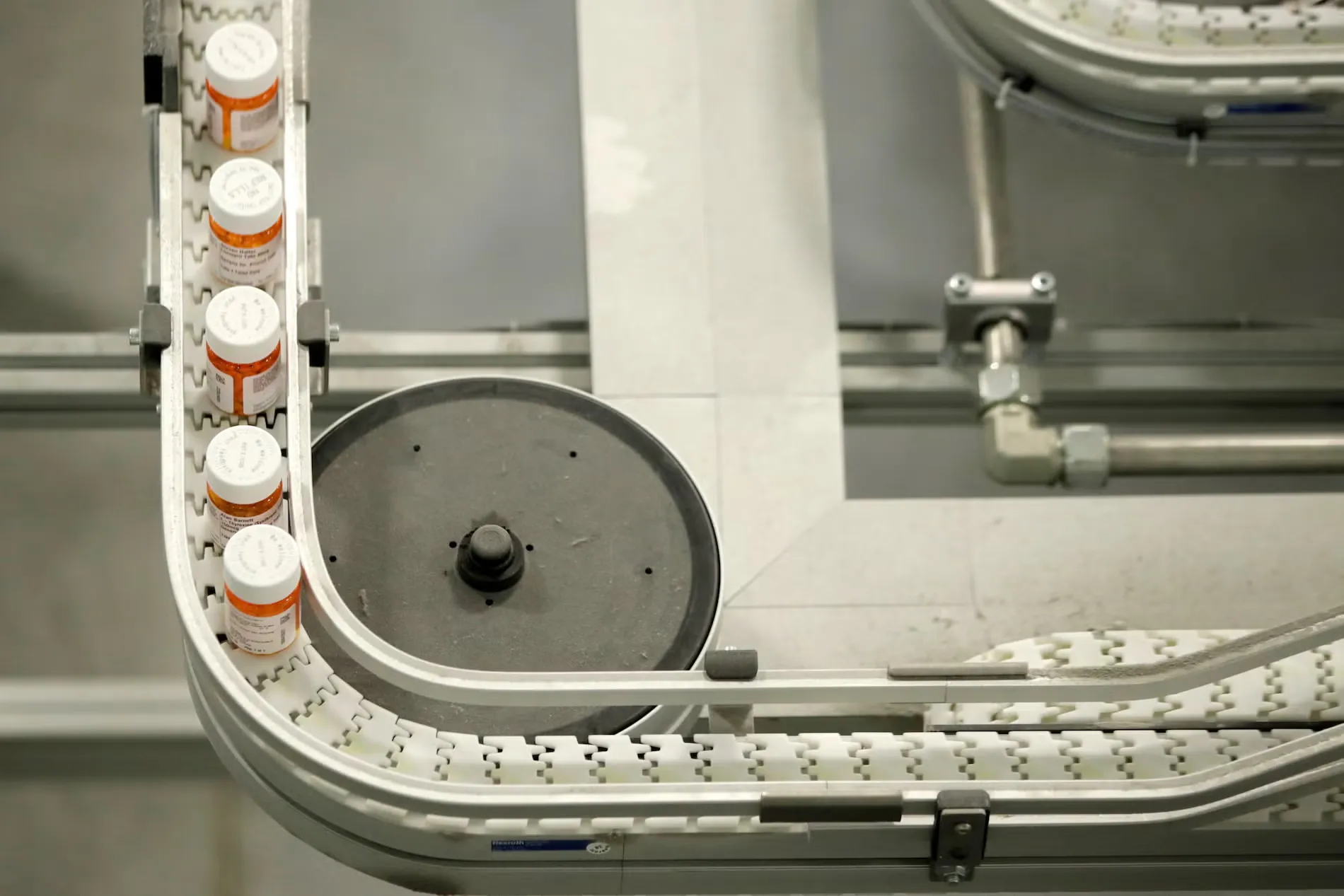 At its core, a plastic modular belt operates on a positive-drive principle. Individual modules are linked by transverse hinge rods — typically made from stainless steel 316L in pharmaceutical configurations — and the entire belt is driven by a sprocket wheel whose teeth engage directly with the module’s drive socket. Because the motive force is applied through the sprocket-to-module interface rather than through belt tension, there is no elongation under load and no requirement for periodic retensioning. This completely eliminates one of the most common causes of conveyor downtime on solid dosage lines — the belt-tensioning adjustment that typically disrupts production for 25 to 40 minutes per incident.
The module geometry itself is equally important. A standard flat-top module presents a continuous, smooth upper surface ideal for tablet transfer between machines. A radius module uses a tapered lateral profile that allows the belt to navigate horizontal curves without lateral guides, reducing the number of transfer points on a line — each transfer point being a location where tablet friability loss is most likely to occur. A raised-rib module uses a corrugated surface pattern to grip product on inclines of up to 45 degrees without requiring cleats, which would create cleaning-validation complications. For particularly delicate coated tablets, a soft-top module variant with a compliant TPE surface overlay is available, reducing impact energy at high conveying speeds to levels that prevent coating fracture.
The hygienic engineering of modern plastic modular belt products for pharmaceutical use goes well beyond the module itself. The conveyor frame must be designed to the EHEDG (European Hygienic Engineering & Design Group) guidelines, with sloped surfaces that prevent liquid pooling, open-leg frame designs that allow cleaning-in-place (CIP) spray to reach all surfaces, and a tail pulley arrangement that gives complete access to the belt underside. When a plastic modular belt is correctly specified and installed in a UK pharmaceutical solid dosage line, the entire system — belt, frame, drives and guiderails — becomes a single validated assembly that can be cleaned to a documented 4-log microbiological reduction in under 20 minutes.
Specific Application Scenarios Across the Solid Dosage Line
A solid dosage production line is not a single conveyor; it is a sequence of interconnected handling stages, each with different mechanical and hygienic requirements. Understanding which plastic modular belt configuration is optimal for each stage is the mark of an experienced specifier. Below are the six most common solid dosage conveying stages and the belt solutions that deliver the highest performance in UK pharmaceutical manufacturing environments.
Stage 01
Tablet Press Discharge
Flat-top PP or POM modules with a pitch of 12.7 mm provide the smoothest possible surface for freshly compressed tablets exiting a rotary press. The belt runs at a controlled speed matched to the press output, preventing tablet stacking and chipping. Blue-detectable variants are standard on OSD lines with inline metal detection checks.
Stage 02
Coating Pan Infeed & Discharge
PA 6/6 modules rated to +120 °C handle the high-temperature discharge from coating pans. Perforated module designs allow residual warm air to escape, preventing moisture condensation on tablet surfaces during the transfer phase. The same belt can be used for solvent-based coating lines when chemical compatibility of the hinge rod material is verified.
Stage 03
In-Line Vision Inspection Transfer
For automatic vision inspection systems (AVS), the belt surface must be optically neutral — no reflective sheen, no surface texture that interferes with camera imaging. A matt-finish flat-top PP module in white or grey provides the ideal background contrast for both colour and monochrome inspection cameras. Belt tracking precision must be within ±0.5 mm to prevent product drift across the camera field of view.
Stage 04
Blister Packing Infeed
Blister packing machines typically require a single-layer, oriented tablet feed arriving at a controlled rate matching the machine’s indexing speed. Raised-fin or side-flexing plastic modular belt configurations allow product to be singulated and aligned while navigating the final curve into the blister pack machine’s loading channel. This eliminates the mechanical singulator devices that are notoriously difficult to validate for cleaning.
Stage 05
Bottle Filling & Capping Lines
Bottle conveying on a filling line places different demands on the plastic modular belt — the focus shifts from product surface contact to container stability at high conveying speeds. Low-friction acetal modules with side guiderails prevent bottle tipping during acceleration and deceleration events. The belt’s dimensional stability also ensures accurate positioning beneath automatic capping heads where a ±1 mm positional error is sufficient to cause a capping failure and production stoppage.
Stage 06
Serialisation & Secondary Packaging
EU FMD (Falsified Medicines Directive) serialisation systems require cartons and bottles to pass cameras, lasers and printers at precisely controlled speeds. Plastic modular belts with servo-controlled positive drive maintain ±0.1% speed accuracy across the belt length — a level of precision that is physically impossible with friction-driven flat belts, which slip under variable loads and cause serialisation barcode scans to fail, triggering costly product quarantine events.
The Measurable Advantages Over Conventional Belt Systems
 The case for plastic modular belt technology in pharmaceutical solid dosage lines is not built on marketing claims. It is built on measurable process improvements that can be documented in a site’s continuous improvement programme and presented to regulatory auditors as evidence of engineering best practice. The advantages are most visible in three operational areas: cleaning validation efficiency, belt service life, and line changeover time.
On cleaning validation, pharmaceutical clients routinely report that switching from rubber flat belts to plastic modular belts reduces cleaning validation protocol execution time by 35–55%. The reason is straightforward: rubber belt cleaning validation requires swab sampling from multiple surface zones, and each zone must achieve a calculated acceptance limit based on surface area. A plastic modular belt’s disassembly into individual modules converts an area-based sampling problem into a unit-based one — the validation team simply swabs representative modules from statistically determined positions in the belt population, and the acceptance criteria are met with far fewer sampling events.
Belt service life comparisons consistently favour plastic modular belt products over rubber alternatives by a factor of three to five, depending on the operating environment. A rubber belt in a high-wash-down zone typically requires replacement every 12–18 months. The equivalent plastic modular belt, constructed from FDA-compliant PP modules, typically achieves 5–7 years of service with only module-level spot replacements during that period. At typical UK pharmaceutical site labour rates and replacement belt costs, the total cost of ownership over a seven-year lifecycle favours plastic modular belt technology by approximately 60–70%.
Customer Success: Nottinghamshire Contract Pharma Manufacturer, UK
CASE STUDY · Contract Pharmaceutical Manufacturer · East Midlands, UK
Reducing Cleaning Validation Time by 48% on a High-Volume OSD Line
A Nottinghamshire-based contract pharmaceutical organisation operating a 24/7 solid dosage facility producing tablets and hard-shell capsules for multiple clients was experiencing significant regulatory pressure around its conveyor cleaning documentation. The site ran eleven rubber flat-belt conveyors across two OSD suites, and cleaning validation records showed an average of 3.2 OOS (out-of-specification) cleaning swab results per quarter. MHRA had noted the trend in the site’s last periodic review and recommended a root-cause investigation.
Ever Power was commissioned to conduct a full conveyor audit and propose a technically justified replacement programme. After a three-day audit covering belt surface condition, cleaning SOP review and swab location mapping, the Ever Power engineering team recommended replacing all eleven rubber belts with pharmaceutical-grade plastic modular belt systems using white PP flat-top modules with blue-detectable hinge rods. The replacement programme was staged over two scheduled maintenance windows to avoid production disruption.
Within two quarters of completion, the site recorded zero OOS cleaning swab results. Cleaning protocol execution time dropped from an average of 47 minutes per conveyor to 24 minutes — a 48.9% reduction. The site’s next MHRA periodic review noted the improvement as a positive indicator of the quality management system’s responsiveness to risk signals. The total project cost was recovered through reduced cleaning labour and avoided batch rejection costs within fourteen months.
“We had tried two other belt suppliers before Ever Power. The difference in the engineering support — not just the product — was immediately apparent. Their team understood our cleaning validation requirements and had the documentation ready before we even raised a PQ protocol.”
— QA Director, Contract Pharma Manufacturer, Nottinghamshire
“The plastic modular belt we specified for our tablet coating discharge zone has now been running for over four years without a single module failure. The ROI against the rubber belts we were replacing every 14 months is extraordinary. Ever Power’s custom width capability was also critical — our frame dimensions are non-standard.”
— Engineering Manager, Generic Pharmaceutical Manufacturer, Yorkshire
“Switching to Ever Power’s plastic modular belt on our serialisation line resolved a chronic problem with barcode scan failure rates. The improved speed consistency we achieved — particularly during acceleration and deceleration events — brought our scan failure rate down from 1.8% to under 0.05%. That translates to thousands of cartons per week no longer being quarantined for manual re-scanning.”
— Operations Director, Specialty Pharma Group, Cheshire
Ever Power’s Manufacturing Capability & Custom Specification Service
Ever Power operates a vertically integrated manufacturing facility producing plastic modular belt products from raw polymer to finished, tested belt assembly. This is not a distributor operation: every product that leaves our facility has been manufactured, assembled and tested under our quality management system, which is certified to ISO 9001:2015 and operated in accordance with the quality requirements applicable to suppliers into pharmaceutical manufacturing environments. Our production capacity allows us to manufacture custom belt widths, module pitches and surface profiles that are simply not available through catalogue-only belt suppliers.
The custom specification service is particularly valued by UK pharmaceutical clients whose conveyor frames do not conform to standard equipment widths. Our engineering team works directly from the customer’s frame drawings or from site measurements taken by our field engineers, and designs a belt assembly — including sprockets, tail shafts and guiderails — that installs into the existing frame without modification. This is critical on pharmaceutical sites where any modification to a validated piece of equipment triggers a change control procedure that can delay production by weeks. By supplying a belt system that drops into the existing frame as a validated replacement, Ever Power eliminates the change control burden entirely.
Custom service capabilities available to UK pharmaceutical clients include: non-standard belt widths from 100 mm to 3,000 mm, module surface modifications (matt finish, textured, soft-top TPE overlay), colour coding for cross-contamination risk management (white, blue, grey, yellow), custom pitch configurations for specific product geometry, and rapid replacement belt sets held on consignment stock at customer sites for emergency changeovers. Our typical lead time for custom pharmaceutical belt assemblies is 7–14 working days for standard materials, and we maintain a fast-track manufacturing path for critical replacement orders.
Ready to Specify a Plastic Modular Belt for Your Pharmaceutical Line?
Our engineering team is available to review your application requirements, recommend the correct belt specification, and provide a detailed proposal including material certification documentation, dimensional drawings and a lifecycle cost comparison.
Serving UK Pharmaceutical Manufacturers from Tablet Compression to Finished Goods
The United Kingdom has one of the most stringent pharmaceutical manufacturing regulatory environments in the world. MHRA-licensed facilities operate under Good Manufacturing Practice regulations that draw on both the UK’s post-Brexit medicines legislation and, for export purposes, ICH Q10 and EU GMP Annex 1 requirements. In this regulatory context, every piece of production equipment — including conveyor systems — must be qualified, documented and maintained to a standard that can withstand scrutiny during both scheduled and unannounced inspections.
Ever Power’s plastic modular belt products are supplied with a full documentation package designed specifically for the UK pharmaceutical market. This includes material declarations referencing UK and EU food contact legislation, polymer traceability certificates, dimensional inspection reports, and pre-written qualification template sections (DQ/IQ) that site engineers can adapt directly into their validation documentation. For UK pharmaceutical clients, this documentation support alone eliminates approximately 20–30 hours of engineering time that would otherwise be spent sourcing and translating generic material certificates from offshore belt suppliers.
We actively support pharmaceutical manufacturing clusters across the UK — the East Midlands, Yorkshire and Humber, the North West, Scotland and the Thames Valley — with field engineering visits, belt audits and in-situ cleaning validation support. Our experience with MHRA-licensed facilities means we understand not just the technical specification of the plastic modular belt, but the wider compliance context in which it operates. That depth of understanding is what differentiates an engineering partner from a belt supplier.
Frequently Asked Questions
Ever Power · Plastic Modular Belt Specialists
Speak to a pharmaceutical conveyor engineer today
Serving MHRA-licensed pharmaceutical manufacturers across the United Kingdom · Custom belt specifications · GMP documentation supplied
edit by gzl