Plastic Modular Belt for Pharmaceutical Solid Dosage Conveying Lines:
The Ultimate Solution for UK Tablet & Capsule Handling
Precision-engineered plastic modular belts trusted by pharmaceutical manufacturers across England, Scotland and Wales
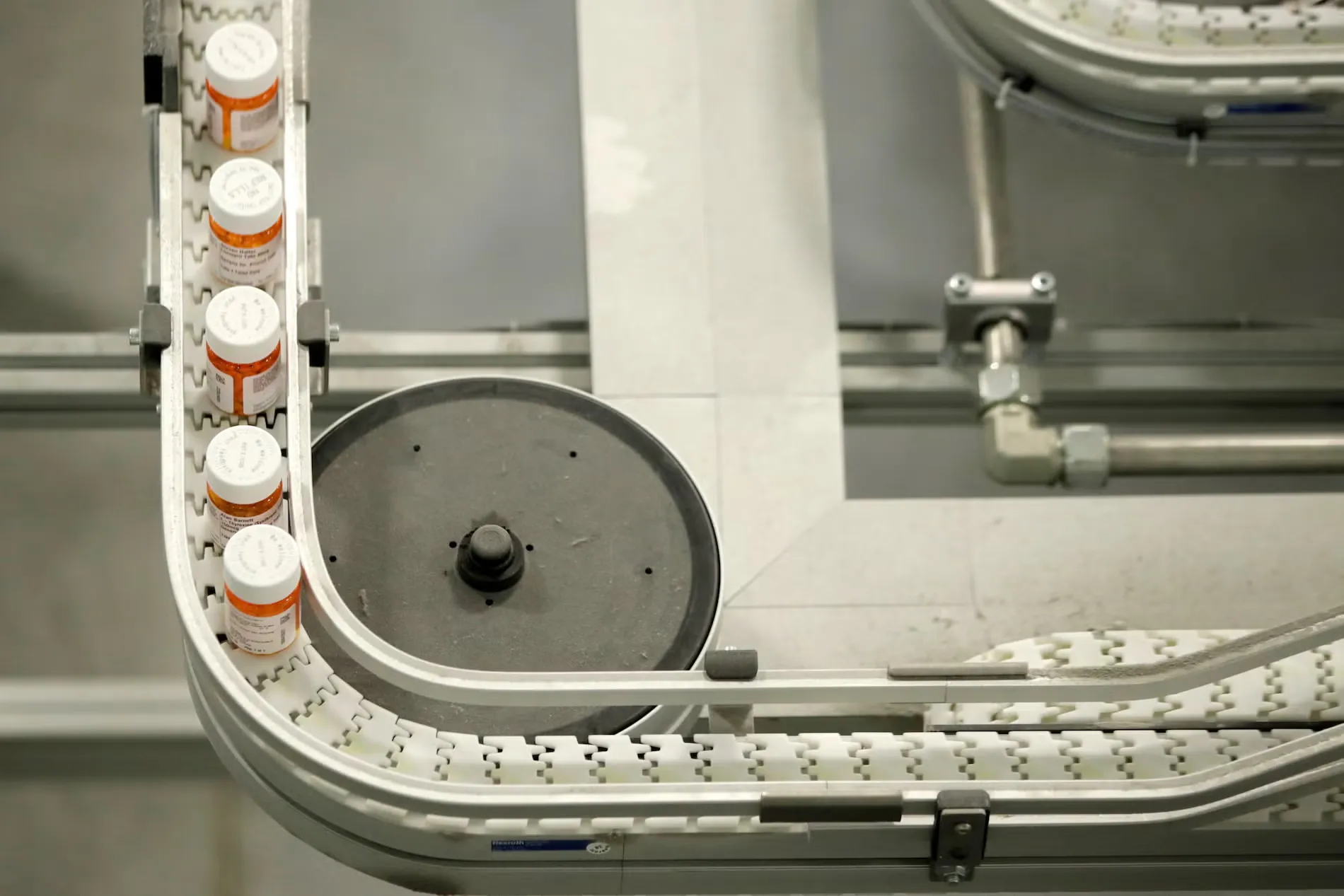 In pharmaceutical manufacturing, the integrity of every solid dosage form — whether a film-coated tablet, hard gelatine capsule or softgel — depends as much on the conveying system as it does on the formulation itself. A single scratch on a tablet coating, one instance of cross-contamination between product batches, or a conveyor system that cannot be validated to the standards required by the Medicines and Healthcare products Regulatory Agency (MHRA) can cost a UK facility tens of thousands of pounds in rejected product and, far more critically, jeopardise patient safety. That is precisely why growing numbers of solid dosage manufacturers in the United Kingdom now specify plastic modular belt technology for their conveying lines — and why the choice of belt material, surface finish, and module geometry matters far more than most engineers initially appreciate.
At Ever Power, we have supplied and engineered plastic modular belt solutions for pharmaceutical production environments for nearly two decades. Our engineers understand cGMP, 21 CFR Part 11 traceability requirements that many UK exporters must also satisfy, and the very specific mechanical demands that arise when belts carry blister packs from a sealing station, route loose tablets through a vision inspection system, or transfer filled capsule trays into an autoclave loading area. The following article draws on that accumulated knowledge to give pharmaceutical engineers, procurement managers, and plant maintenance teams a rigorous, practical guide to selecting and specifying plastic modular belts for solid dosage conveying.
Why Pharmaceutical Lines Demand Plastic Modular Belt Technology
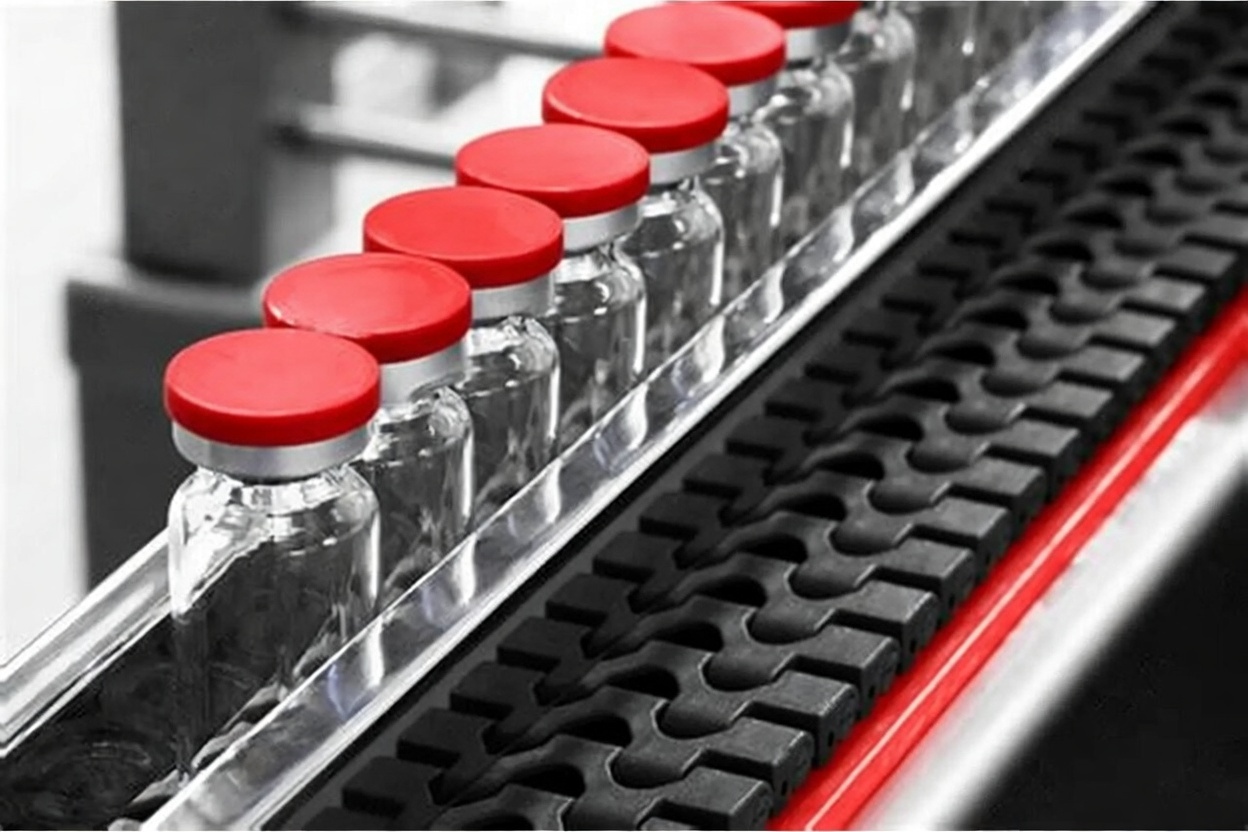 Traditional PVC flat belts dominated pharmaceutical conveying for decades, but they present a fundamental conflict with modern cGMP requirements. Gaps between belt ends create harbourage points for product fines, lactose dust, or active pharmaceutical ingredient (API) residues that are almost impossible to eliminate through in-place cleaning. When a UK pharmaceutical site operates under a MHRA licence requiring full batch-to-batch decontamination, this is not merely inconvenient — it is a compliance failure waiting to happen.
Plastic modular belt systems solve this structurally. Because each module is injection-moulded to a defined geometry and interlocks with adjacent modules via precision-engineered hinge rods, the entire belt surface can be disassembled, inspected and cleaned in minutes rather than hours. A maintenance team in a tablet compression room can remove, soak in a validated cleaning agent, rinse and reinstall a plastic modular belt section during a standard changeover window. That level of serviceability is simply not achievable with weld-spliced PVC belting.
Beyond cleanability, the geometric flexibility of plastic modular belts allows conveying engineers to match belt open area, surface texture and module pitch precisely to the product being handled. A belt carrying 500 mg paracetamol tablets needs a very different surface specification to one transporting 20 mm diameter soft gelatine capsules or thermoformed blister packs. Plastic modular belt technology accommodates all of these requirements within a single product family, allowing procurement teams to standardise on one supplier, one spares inventory, and one maintenance protocol across an entire solid dosage facility.
cGMP-Compliant Design
FDA-grade materials, no hidden harbourage zones, full disassembly in <10 minutes. Validated cleaning protocols available on request for MHRA-licensed UK sites.
Modular Interchangeability
Individual modules replaced on-site without specialist tools. Reduces planned maintenance windows and eliminates the cost of replacing entire belt runs due to localised damage.
Anti-Static & FDA-Grade Options
Carbon-loaded anti-static variants for dust-sensitive API handling. All materials conform to FDA 21 CFR and EU 10/2011 food-contact regulations, suitable for both OSD and nutraceutical lines.
Materials, Working Principle & Technical Parameters
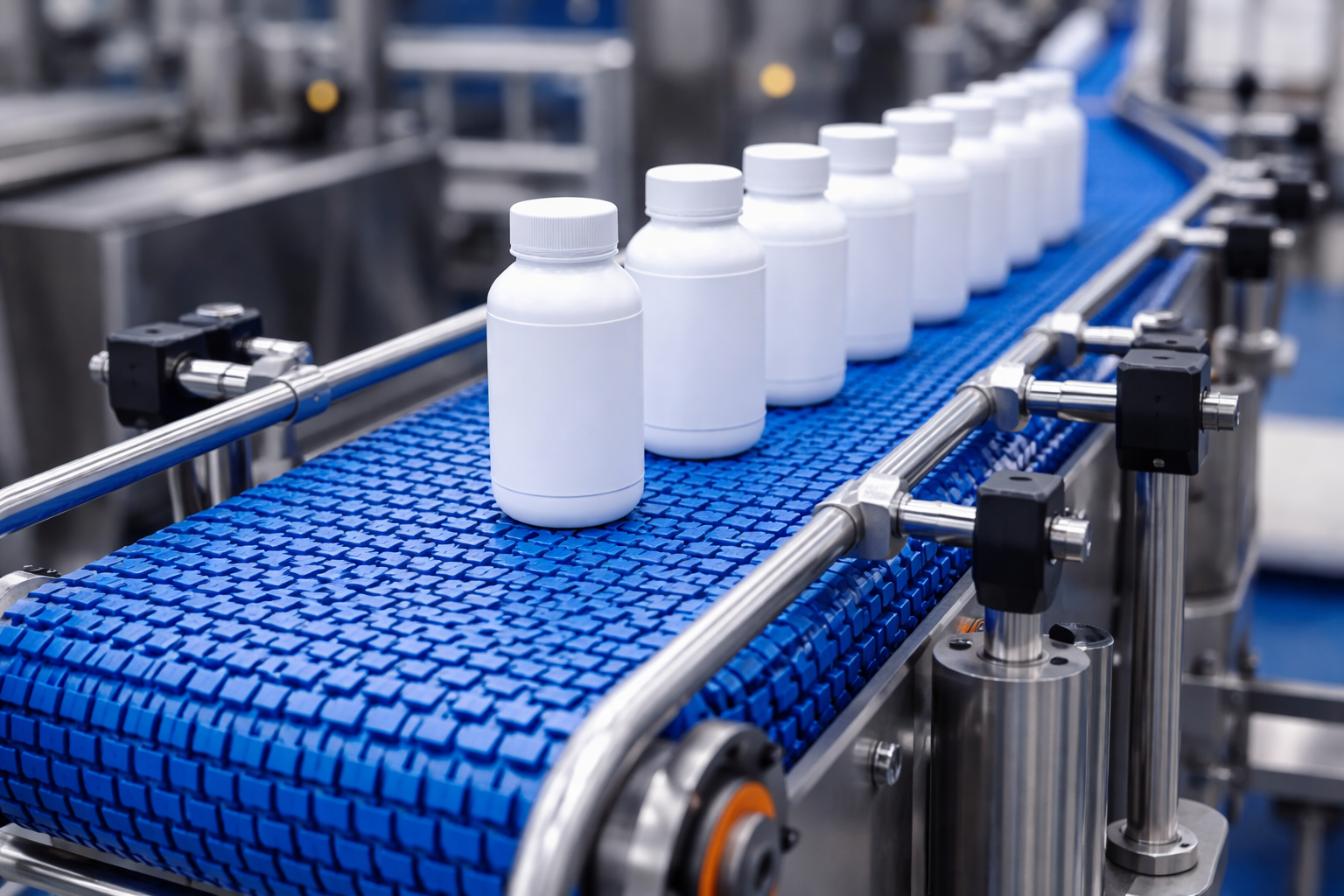 The operational principle of a plastic modular belt is elegantly simple yet mechanically sophisticated. Individual modules, typically produced from engineering-grade thermoplastics via high-precision injection moulding, are linked laterally by smooth-bore hinge rods to form a continuous, articulating surface. As the belt travels over a drive sprocket, the sprocket teeth engage precisely machined drive holes in each module, providing a positive, slip-free drive that maintains accurate positioning even under heavy or uneven loading — an important attribute when the belt is used as a metering or indexing surface in tablet coating drum discharge or blister pack cartoning lines.
The choice of base polymer depends on the specific demands of the application. Acetal (POM) is the workhorse of pharmaceutical modular belting — it combines excellent chemical resistance, low moisture absorption, and a self-lubricating surface that minimises tablet abrasion. Where the belt must pass through a washdown zone using chlorinated or peracetic acid-based cleaning agents, polypropylene (PP) offers superior chemical resistance at a modest reduction in tensile strength. For applications requiring FDA-compliant white surfaces that are easy to inspect visually for contamination, specific grades of nylon 6 or UHMWPE-reinforced compounds are available from our factory.
Application Scenarios Across the Solid Dosage Production Line
A solid dosage manufacturing facility in the UK typically moves product through a sequence of unit operations that each impose different demands on the conveying system. Understanding these demands is the starting point for intelligent plastic modular belt selection. At Ever Power, we map out the full conveying journey with every client before recommending a belt specification — a process that has consistently prevented costly misspecification and has helped clients in Yorkshire, the East Midlands and the Thames Valley corridor achieve first-pass validation on new production lines.
Tablet Press Discharge
Flat-top or flush-grid plastic modular belts collect compressed tablets directly from rotary press outlets. The smooth, low-friction surface prevents edge chipping while the rigid module geometry provides stable tablet orientation into downstream metal detection and checkweighing equipment.
Coating Drum Infeed & Outfeed
Cleated or side-wall plastic modular belts elevate film-coated tablets from drum exit to coating inspection conveyors. The inherent rigidity of modular belt construction eliminates the belt sag that causes product pile-up at the edges of conventional fabric conveyor belts under heavy loading.
Vision Inspection Transfer
Camera-based inspection systems require absolutely consistent tablet spacing and orientation. Open-grid plastic modular belts with precisely controlled pitch deliver the repeatable product singulation these systems need, while allowing direct illumination from below through the belt for backlit imaging.
Blister Pack & Cartoning Lines
Formed blister packs demand a belt surface that holds packs flat and prevents skewing as they enter the cartoner. Flat-top plastic modular belt with low-friction inserts provides ideal pack stability while the positive-drive system maintains accurate indexing into print-and-apply labelling stations.
Capsule Filling & Sorting
Hard gelatine capsules are fragile and sensitive to impact. Low-profile plastic modular belts with gentle transfer points and smooth module surfaces transport filled capsules from filling machine outlets to polishing and weight-checking stations without generating the cracking forces that standard metal belts can impose.
Cleanroom & WIP Corridors
Moving work-in-progress between cleanroom grades requires belts that shed no particles and can be validated alongside the room itself. Plastic modular belt systems are designed to produce minimal particulate generation during normal operation and can be subject to the same particle-count qualification protocols as the room.
Product Advantages That Matter on a Real UK Pharmaceutical Site
When pharmaceutical engineers in England evaluate any conveyor component for inclusion in a validated system, they apply a demanding set of criteria that goes well beyond the simple question of load capacity. The advantage of plastic modular belt technology in this context is not a single headline feature — it is the convergence of multiple performance characteristics that cumulatively address the full scope of what a pharmaceutical conveying system must deliver, from initial qualification through to ten years of continuous operation and product changeovers.
Hygienic Design
No hidden joints, full disassembly, validated CIP/WIP protocols available for MHRA-licensed UK sites
Configurable Surface
Flat-top, flush-grid, open-grid, friction-top, cleated and perforated modules available from stock or custom-engineered to your line layout
Long Service Life
Self-lubricating POM modules dramatically reduce wear on both belt and sprocket. Typical service life 3–5× longer than PVC flat belt in equivalent pharmaceutical duty
Positive-Drive Accuracy
Sprocket engagement eliminates slip, delivering ±1 mm positional accuracy required by vision inspection and serialisation systems under EU Falsified Medicines Directive
Low Noise Operation
Polymer-on-polymer running surfaces achieve <68 dB(A) in most pharmaceutical conveying applications, meeting UK workplace noise regulations without acoustic enclosures
Traceability & Documentation
Full material certification, FDA compliance letters, and batch-traceable delivery documentation supplied as standard — simplifying DQ/IQ/OQ protocols for UK pharmaceutical facilities
Customer Success: How UK Manufacturers Are Winning with Plastic Modular Belt
The following case illustrates the measurable outcome that rigorous plastic modular belt selection delivers in a real pharmaceutical production environment. The details have been compiled from project documentation provided by the client and validated by our application engineering team.
Midlands-Based OSD Manufacturer — Tablet Coating & Blister Packing Line Upgrade
A contract pharmaceutical manufacturer based in Nottinghamshire, UK, was experiencing recurring MHRA observations related to inadequate cleaning documentation for the flat PVC belts connecting their coating drum outlets to the blister packaging machines. The existing belts required approximately 4.5 hours of manual cleaning per product changeover, limiting the facility to a maximum of two product switches per day on a critical production line. Annual belt replacement costs were exceeding £28,000 due to chemical degradation from peracetic acid-based washdown solutions.
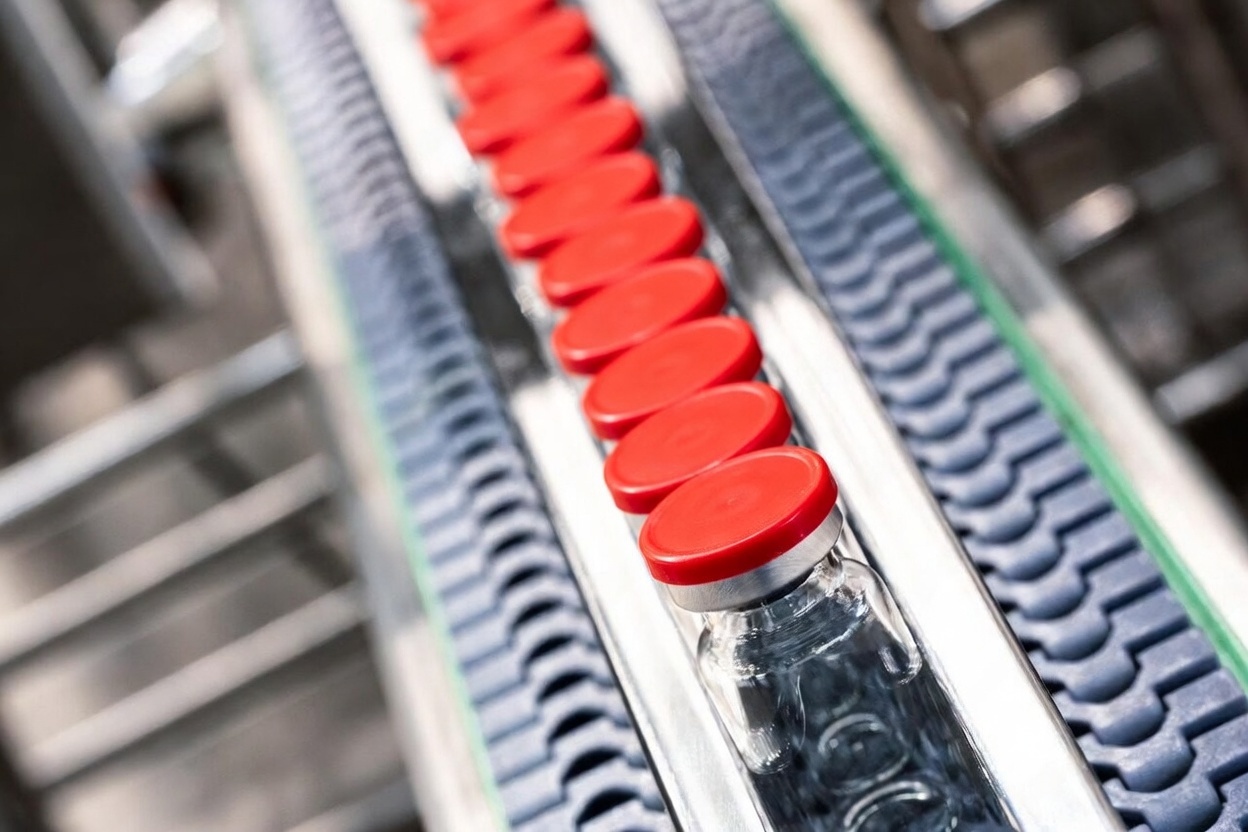
Ever Power proposed a full replacement programme using FDA-grade white polypropylene flat-top plastic modular belt across six conveyor sections, totalling 47 metres of installed belt width. The modular construction reduced changeover cleaning time from 4.5 hours to under 55 minutes per product switch, and the PP material’s superior chemical resistance eliminated belt degradation under the existing CIP protocol. Within 12 months, documented savings in belt replacement costs, labour and lost production time exceeded £94,000. The MHRA observation was formally closed at the subsequent inspection.
Changeover time reduced by 80% · Annual maintenance savings exceeding £94,000 · MHRA observation closed · No product rejects attributable to conveyor contamination in 18 months of post-installation monitoring.
★★★★★
“We specified Ever Power plastic modular belt across our entire tablet handling line following a line extension project at our Leicester site. The IQ/OQ documentation package was comprehensive and the material certificates were accepted by our QA team without any requests for additional data. Lead time was exactly as agreed and the technical support during commissioning was outstanding.”
— Production Engineering Manager
Solid Dosage CMO, East Midlands, UK
★★★★★
“After testing three competing plastic modular belt suppliers, Ever Power’s POM flat-top belt demonstrated the lowest coefficient of friction against our coated tablet surface in our own tribology trials. The anti-static version we use on the capsule inspection conveyor has performed without any electrostatic discharge events in over 14 months of continuous production — previously we were seeing one ESD-related jam every three weeks.”
— Maintenance & Reliability Engineer
Generic Pharmaceutical Manufacturer, Yorkshire, UK
★★★★★
“We use Ever Power plastic modular belt on our softgel transfer conveyors in our Surrey facility. The open-grid format allows our vision system to check product from below without any additional infrastructure. The price-to-performance ratio is genuinely competitive, and the fact that we can get individual replacement modules shipped within 48 hours from their UK distribution point means we carry minimal spare inventory.”
— Head of Engineering
Nutritional Softgel Manufacturer, Surrey, UK
Ever Power Factory: End-to-End Custom Plastic Modular Belt Solutions
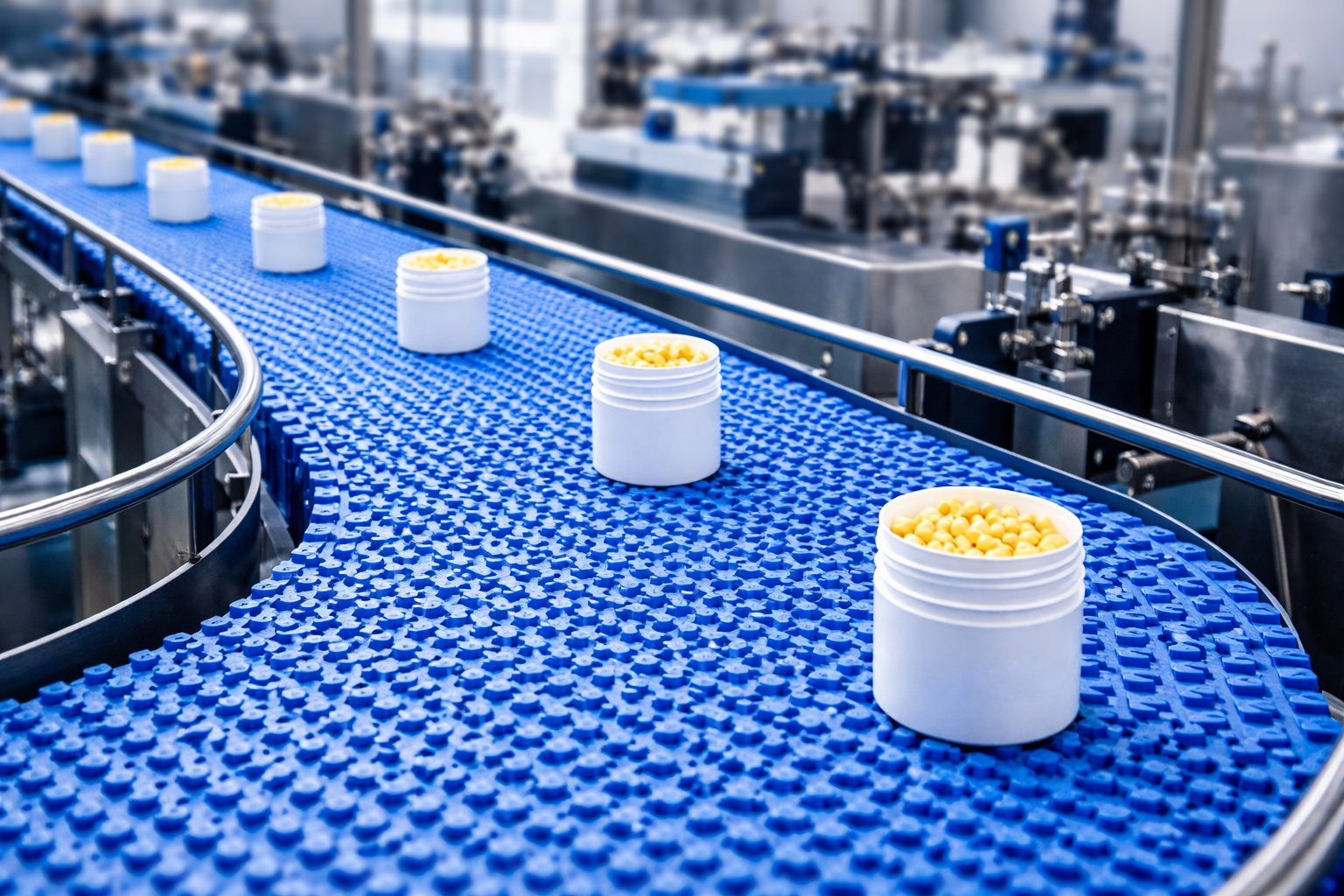 At Ever Power, our manufacturing facility is purpose-built for high-precision plastic modular belt production at scale, and our custom engineering capability is one of the most comprehensive available to UK pharmaceutical clients sourcing internationally. Standard catalogue belts represent only a fraction of what our factory can produce. If your solid dosage line requires a belt with a non-standard pitch, an integrated cleated-and-flat-top hybrid configuration, a specific colour for product traceability under UV inspection lighting, or a belt that incorporates both anti-static and chemically resistant properties in the same module body, our engineering team can develop and validate that solution to your specification.
Our factory operates a fully vertically integrated production model, from polymer compounding and mould design through to final assembly and quality inspection. This means that when a UK customer requires a plastic modular belt with a certified material data package for an upcoming DQ submission, we can generate that documentation from our own production records rather than relying on third-party material suppliers. Every custom belt project receives a dedicated project engineer who remains the single point of contact from initial technical consultation through to installation support and post-commissioning review.
We actively serve pharmaceutical equipment integrators, OEMs building validated conveying systems for UK pharmaceutical clients, and directly with in-house engineering teams at MHRA-licensed manufacturing sites across England, Scotland and Wales. Whether you need a single belt for a retrofit project or a complete belt package for a new greenfield facility, our custom service capability scales with your project.
Frequently Asked Questions
Ready to upgrade your pharmaceutical solid dosage conveying line? Speak to an Ever Power application engineer today.
✉ Get a Quote · [email protected]
edit by gzl