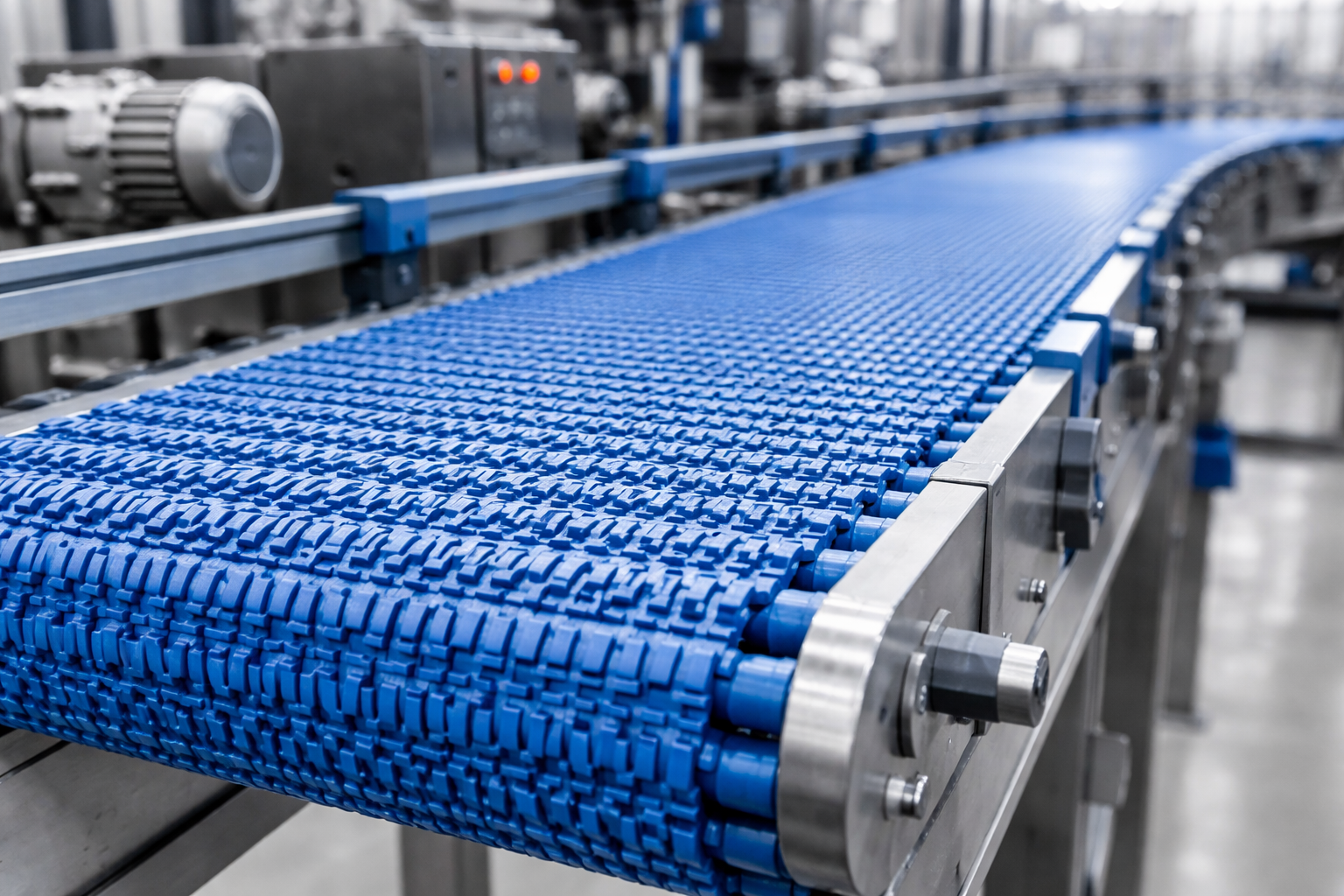
 Plastic Modular Belt for Automotive Final Assembly Lines: Precision, Durability & Smart Conveying
Walk the floor of any modern automotive final assembly plant in the UK — whether in the West Midlands, Sunderland, or Oxford — and you’ll notice one common thread running through the chaos of robotics, overhead gantries, and precision tooling stations: the belt. Not just any belt, but a plastic modular belt engineered to carry door panels, instrument clusters, powertrain sub-assemblies, and even partially trimmed vehicle bodies from one production cell to the next. These belts are the silent workhorses beneath every completed vehicle that rolls off the end of the line. Yet for many procurement engineers and plant managers, the specific technical advantages of a plastic modular belt over legacy steel slat conveyors or rubber flat belts remain underappreciated — until something goes wrong. This article addresses that gap head-on, drawing on over eighteen years of hands-on application engineering across automotive, tier-one supplier, and bodyshop environments.
The automotive final assembly process is arguably the most demanding conveying environment in any manufacturing sector. Parts arrive painted, trimmed, or pre-assembled and must travel without scratching, vibrating loose, or accumulating contamination. Electrical components near the instrument panel zone are particularly sensitive. In this context, the choice of plastic modular belt becomes a genuine engineering decision — not a commodity purchase. Material selection, surface finish, module pitch, and side-guide configuration all have measurable impacts on line throughput, maintenance downtime, and ultimately, vehicle quality.
Get a Custom Plastic Modular Belt Quote for Your UK Automotive Plant
Our engineers will assess your line speed, product profile, and environmental conditions to specify the right belt module — pitch, material, surface, and drive configuration included.
● Fast response · No obligation · UK-based support
Why Automotive Final Assembly Lines Rely on Plastic Modular Belts
 When engineers at Jaguar Land Rover’s Castle Bromwich facility or the BMW plant in Oxford evaluate their conveyor infrastructure, they’re not simply looking for something that moves parts from A to B. They’re looking for a conveying system that handles accumulated torque requirements across multi-level platforms, integrates cleanly with overhead power-and-free systems, and allows rapid belt replacement during planned maintenance windows without cutting the entire conveyor frame apart. Plastic modular belts satisfy each of these requirements in ways that rubber flat belts and steel slat conveyors simply cannot replicate.
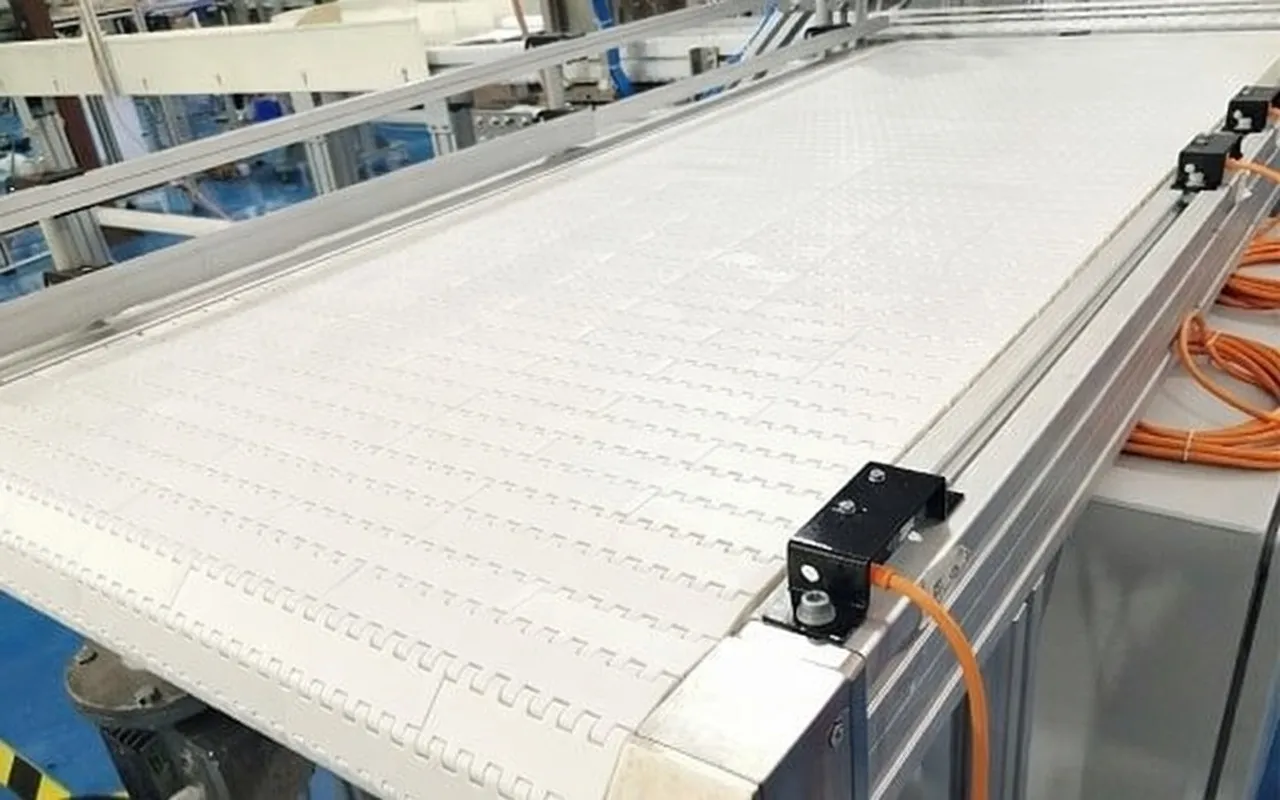
The modular construction — individual interlocking polypropylene, acetal, or polyethylene modules joined by hinge rods — means any damaged section of belt can be removed and replaced in minutes rather than hours. On a line running sixty-plus vehicles per hour, a 40-minute reduction in unscheduled downtime translates directly into recovered unit output. The plastic modular belt also offers a flat, stable surface without the sag or elongation that plagues rubber belts in high-temperature bodyshop environments where freshly cured paint or adhesive residues can create surface bonds. Flat-top modules provide the clean, snag-free surface that delicate painted panels demand, while perforated variants allow vapour or dust extraction from beneath the product, which is a critical advantage near sealing and underbody coating stations.
The material science behind a high-quality plastic modular belt is more sophisticated than it might first appear. Glass-fibre-reinforced modules carry payloads exceeding those of standard injection-moulded units by a considerable margin, while acetal (POM) modules offer self-lubricating properties that reduce belt-to-wearstrip friction, thereby lowering the drive power demand on longer conveyor runs. In combination with stainless-steel hinge rods, this results in a belt assembly that resists corrosion from the flux, lubricants, and cleaning agents routinely used on an automotive shop floor.
Technical Performance Parameters
Product Advantages That Drive Real Line Performance
Rapid Module Replacement
Individual modules snap out and back without tools or belt removal, cutting maintenance time from hours to minutes on live production lines running multiple shifts.
Scratch-Free Surface Transfer
Smooth flat-top or soft-insert module surfaces protect freshly painted panels, lacquered dashboards, and chrome-plated trim from surface defects during conveyance between trim and final fit stations.
Chemical & Corrosion Resistance
Resists the oils, adhesives, flux, and alkaline washdown chemicals common in automotive bodyshops and general assembly areas, outlasting steel alternatives in wet or chemically active zones.
High Throughput Capability
Designed for continuous duty cycles at belt speeds up to 80 m/min, supporting Takt time-driven lines where every second of belt velocity counts toward daily build target achievement.
Anti-Static Options Available
Carbon-filled or ESD-dissipative module variants protect electro-sensitive ECU modules, sensors, and wiring harness assemblies during conveyance at electronics-intensive final fit stations.
Lower Whole-Life Cost
While the initial investment in a plastic modular belt system may exceed that of a rubber belt, the sharply lower lubrication demand, longer service life, and reduced downtime consistently deliver a lower total cost of ownership over a five-year maintenance horizon.
Where Plastic Modular Belts Work on the Automotive Final Assembly Line
An automotive final assembly line is not a single conveyor — it’s a network of interconnected conveying zones, each with its own loading profile, environmental conditions, and product sensitivity. The plastic modular belt is exceptionally well-suited to the following specific zones, each of which presents challenges that generic belt types routinely fail to address adequately.
Body-in-White (BIW) Transfer
Heavy-duty GF-reinforced plastic modular belts with wide-pitch modules carry complete body shells between welding jigs, spot-welding robots, and sealing stations at the BIW stage.
Paint Shop Conveying
In oven zones reaching 200 °C, acetal and glass-fibre modules withstand thermal stress while remaining dimensionally stable, preventing belt stretch or distortion that could misalign body panels in the paint booth.
Trim & Final Fit Stations
Flat-top plastic modular belt surfaces convey door cards, headliners, carpets, and instrument panels without snagging or staining, maintaining component presentation quality right up to the point of fitment.
EV Battery Module Lines
As UK EV production scales at plants like Nissan’s Sunderland gigafactory, ESD-dissipative plastic modular belts are being deployed to convey sensitive battery packs and high-voltage wiring harnesses safely.
Parts Sequencing & Kitting
Accumulation-capable plastic modular belt zones with zero-pressure or low-back-pressure features allow sequenced parts to pause, buffer, and release to line-side assembly operators precisely according to Takt demands.
End-of-Line Quality Checks
At end-of-line audit and rework stations, perforated-surface plastic modular belts allow lighting and camera systems to inspect underneath components, supporting automated vision quality control processes.
Materials, Principles & Construction of Plastic Modular Belts
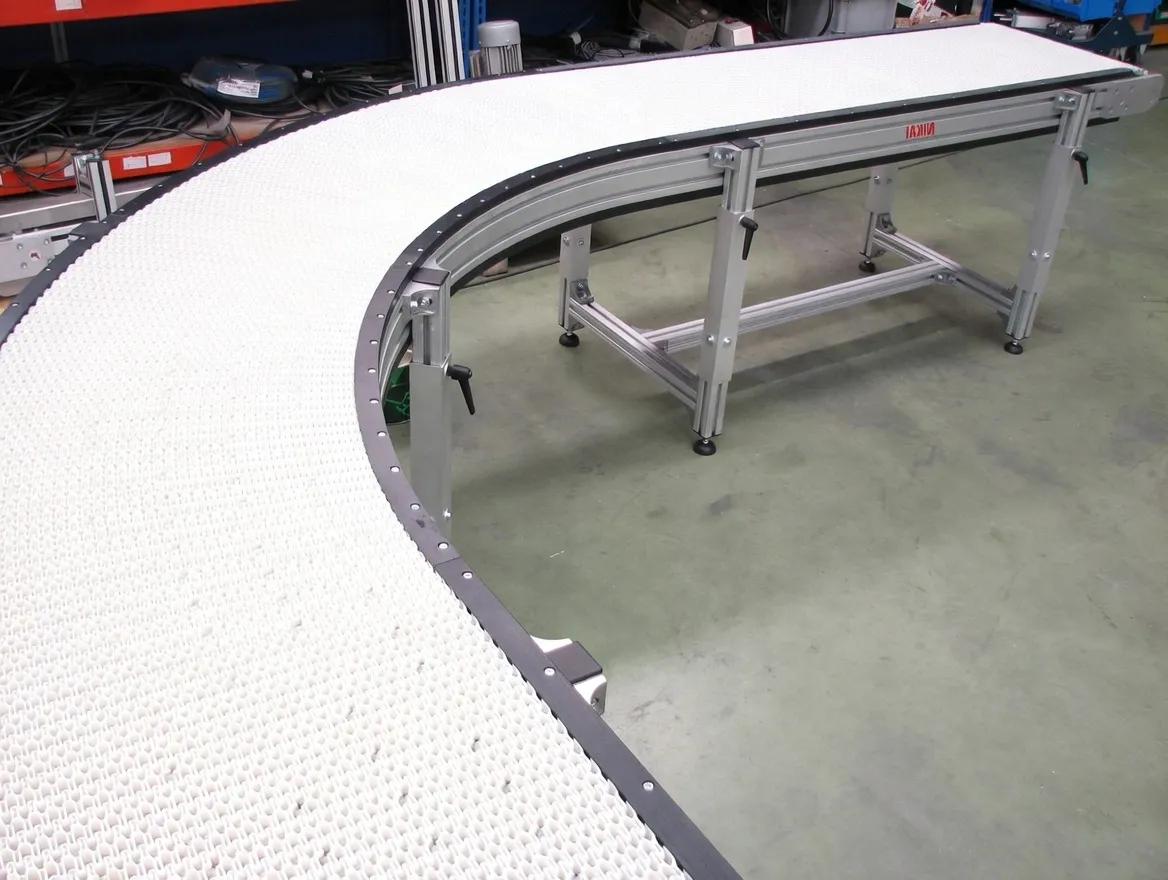
The functional principle of a plastic modular belt is deceptively simple: individual rigid polymer modules, each approximately 50 mm to 150 mm in length, are connected transversely by cylindrical hinge rods to form a continuous, laterally flexible chain-style belt. This lateral flexibility allows the belt to navigate horizontal curves on curved conveyors without the need for a flat-turning radius conveyor, which is a substantial space-saving advantage on congested automotive shop floors. The rigidity of each individual module, however, ensures that no vertical deflection occurs between modules under load — a property known as flat-top integrity — which rubber belts fundamentally cannot achieve at high speeds or under concentrated point loads.
Polypropylene (PP) is the most widely used module material due to its excellent cost-performance balance, impact resistance, and broad chemical compatibility. For applications demanding lower friction coefficients — such as accumulation zones where belt-to-product or belt-to-wearstrip slip must be minimised — acetal (POM) modules are specified. Acetal’s crystalline molecular structure delivers inherently low friction and outstanding dimensional stability across a wide temperature range, which is particularly valuable in the temperature-cycling environment near automotive curing ovens. Where load requirements exceed the tensile limits of standard injection-moulded modules, glass-fibre reinforcement is incorporated directly into the polymer matrix during moulding, typically adding 30% short GF by weight to raise the module’s tensile strength by a factor of two or more.
Hinge rod selection is equally critical. Standard polypropylene rods are sufficient for indoor, light-to-medium duty applications in ambient temperature trim halls. Stainless steel grades 304 or 316 are specified for environments with moisture, cleaning fluids, or elevated thermal loads. Grade 316L is preferred in any zone where chloride-based cleaning agents are used routinely, as it offers significantly enhanced pitting corrosion resistance compared to grade 304. The combined choice of module polymer, glass-fibre reinforcement level, surface finish, and hinge rod material constitutes the full belt specification — and getting this specification right from the outset is what separates a plastic modular belt that outlasts its expected service life from one that causes unexpected downtime six months into production.
Customer Success: UK Automotive Tier-One Supplier Case Study
A Coventry-based tier-one supplier producing instrument panel assemblies for a major UK OEM was experiencing rubber belt failures every four to six weeks on their sequential trim conveyor, leading to unplanned downtime averaging 3.5 hours per belt failure event. In addition, two electrostatic discharge incidents had damaged a batch of 64 ECU control units at a combined replacement cost exceeding £28,000. The maintenance team contacted Ever Power’s UK distribution partner, who carried out an on-site application survey and recommended a switch to ESD-dissipative acetal plastic modular belt with 38.1 mm pitch flat-top modules and stainless steel 316 hinge rods.
Following installation of the new plastic modular belt system across three conveyor sections, the facility reported zero ECU ESD incidents over a twelve-month monitoring period. Planned belt maintenance intervals extended from six weeks to fourteen months, and the average time to replace a damaged module dropped to under 25 minutes — compared to the four-hour full-belt replacement process previously required. The total saving in maintenance labour, downtime cost, and avoided component replacement was calculated at approximately £67,000 in year one alone, delivering full ROI on the belt investment in under four months.
“The switch to plastic modular belt on our IP trim line was the single most cost-effective maintenance decision we made this year. The ESD protection alone justified the project — the extended belt life was a welcome bonus.”
— Production Engineering Manager, Tier-One Supplier, Coventry
“We’ve run the acetal flat-top modules on our painted door panel line for eighteen months without a single module failure. The surface is still scratch-free and the belt tracking has been perfectly stable.”
“Ordering from Ever Power was straightforward. The technical data sheet matched every spec they quoted over the phone, delivery was ahead of schedule, and the belt fitted our existing conveyor frame dimensions exactly.”
“We specified glass-fibre modules for the bodyshell transport conveyor — these are carrying 380 kg loads at 12 m/min for two full production shifts daily. After two years, the belt shows minimal wear and the hinge rods are immaculate.”
Ever Power Factory & Custom Belt Manufacturing Capabilities
Ever Power operates a vertically integrated manufacturing facility where the production of plastic modular belt modules, hinge rods, side guides, and drive components is handled in-house from raw polymer to finished belt roll. This level of manufacturing depth — rare among belt suppliers serving the UK market — translates directly into tighter dimensional tolerances, shorter lead times, and more responsive custom engineering support. The facility operates high-precision injection moulding presses with real-time cavity pressure monitoring to ensure module-to-module consistency across batch production, a quality control capability that is particularly important for belts destined for high-speed automotive applications where even marginal dimensional variation between modules can introduce vibration or noise.
Custom engineering services at Ever Power include non-standard module pitch development for OEM conveyor retrofits, bespoke surface texture moulding for specialist friction requirements, custom belt width configuration outside standard catalogue widths, and proprietary additive compounding for applications requiring specific UV resistance, FDA compliance, or metal-detectable materials. For UK automotive clients replacing or upgrading legacy conveyor systems designed around non-standard belt widths, this in-house customisation capability eliminates the need for costly conveyor frame modifications — the belt is built to fit the existing hardware, not the other way around. Prototype runs of as few as 5 metres can be accommodated for trial installations, with full production runs typically despatched within three to four weeks from order confirmation.
Custom Service Options
Custom pitch & module geometry
ESD / anti-static variants
Metal-detectable compounds
UV-stabilised materials
Soft-insert top surfaces
Prototype & small-run orders
Application engineering support
Serving the UK Automotive Manufacturing Belt
The United Kingdom’s automotive manufacturing sector — concentrated across the West Midlands, the North East, Yorkshire, Oxfordshire, and the Scottish Lowlands — operates some of Europe’s highest-productivity final assembly facilities. Plants producing passenger vehicles, light commercial vehicles, and, increasingly, battery-electric models all share a common infrastructure requirement: dependable, precision conveying systems that keep pace with increasing Takt time demands. Ever Power’s plastic modular belt range is actively specified and stocked for rapid delivery to sites across England, Scotland, and Wales, with technical support provided in coordination with UK-based engineering partners.
Whether you’re a plant engineer at a West Midlands body pressing facility looking to eliminate rust contamination from corroded steel slat conveyors, a facilities manager at a Sunderland EV assembly site specifying new trim hall conveying infrastructure, or a procurement officer at a tier-two supplier in Birmingham evaluating belt replacement costs for the coming financial year, Ever Power has a plastic modular belt configuration that maps directly to your application. Contact our sales team with your line speed, product weight, belt width, and environmental conditions, and we’ll return a complete specification within 48 hours.
Frequently Asked Questions
Talk to an Automotive Conveying Specialist Today
Whether you need a standard replacement belt or a fully customised plastic modular belt system engineered for your specific automotive final assembly line, we’re ready to help.
edit by gzl