
 Step into the lower levels of any major British airport terminal and you are standing directly above one of the most demanding conveyor environments in industrial engineering. Thousands of suitcases, holdalls, golf bags, and oversized items move continuously through a precisely orchestrated network of belts, diverters, scanners, and sorters — around the clock, every single day of the year. The mechanical workhorse keeping that network running smoothly is the plastic modular belt, a component that has quietly replaced legacy rubber and steel solutions across UK baggage handling infrastructure over the past fifteen years. Where once a failed belt meant a four-hour maintenance window, a broken module today can be replaced in under five minutes without removing the belt from its frame — a capability that has transformed how ground-handling teams approach reliability planning in the post-pandemic era of rapid passenger growth.
The fundamental appeal of the plastic modular belt in airport baggage handling contexts lies in its architecture. Unlike a conventional flat belt — essentially a single continuous loop of rubber or fabric — a modular belt is assembled from hundreds of interlocking thermoplastic modules pinned together with stainless steel or polymer hinge rods. This grid-like structure distributes load across the full belt width, resists point damage from bag hardware impacts, and allows individual module removal without disturbing adjacent sections. For a Baggage Handling System (BHS) integrator or airport engineering team specifying a belt for a new terminal or retrofit project, understanding the full range of material grades, pitch options, and surface configurations available is essential to achieving the right balance between initial cost, longevity, and maintenance overhead.
This reference draws on applied engineering experience across conveyor projects serving UK and European airports, and is intended to serve the practical needs of BHS specifiers, ground-handling engineering managers, conveyor integrators, and procurement teams evaluating plastic modular belt solutions for airport applications.
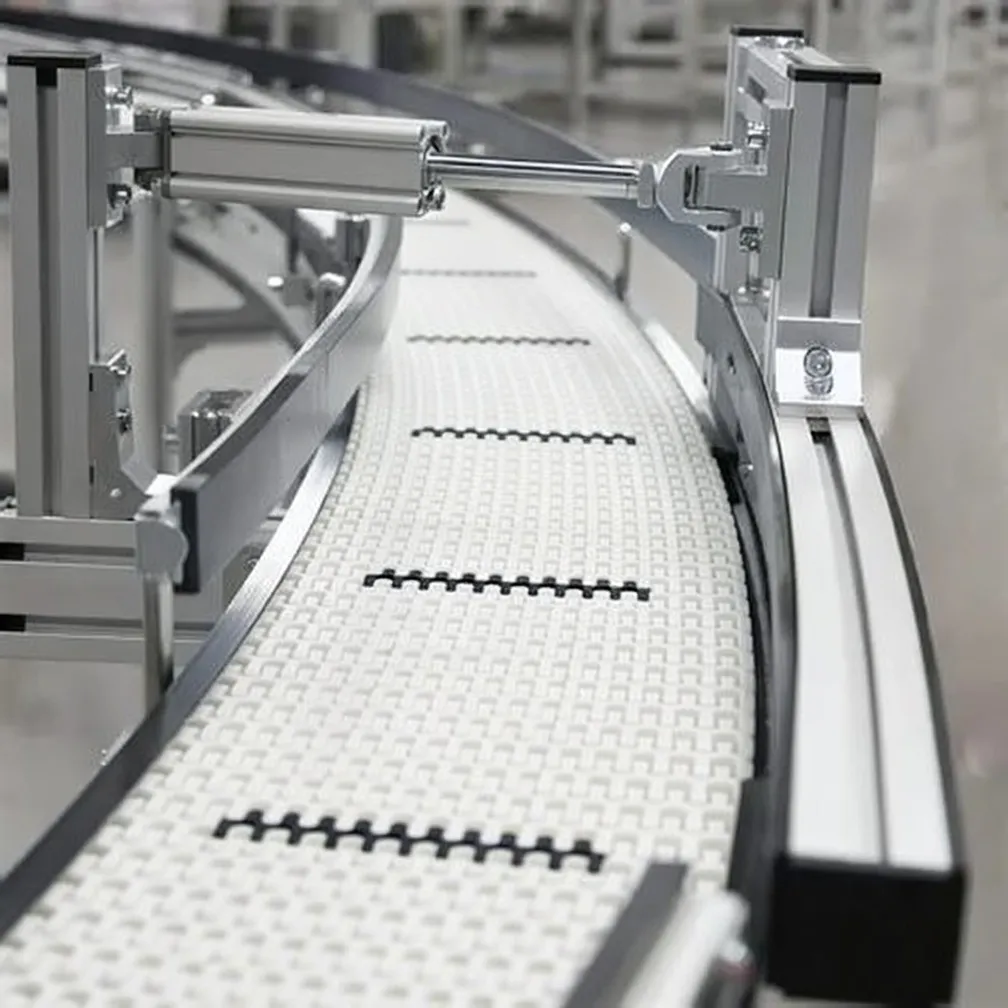
Ever Power plastic modular belt in service on a UK airport check-in feeder conveyor — engineered for 24/7 continuous operation
Why Airport Baggage Systems Demand Plastic Modular Belts
 Airport baggage handling systems operate under a set of stresses that simply do not exist in most other industrial conveyor contexts. A typical UK hub airport handles bags across dozens of check-in zones simultaneously, routes each item through mandatory security screening, sorts it to the correct outbound flight, and delivers it to a make-up area for loading — all within a two-hour window for domestic departures and a three-hour window for international. During peak summer periods, that cycle repeats for hundreds of flights per day, placing continuous mechanical stress on every component in the system.
The bags themselves are abrasive and unpredictable. Wheels, buckles, rigid frame rails, and hard shell surfaces impact belt surfaces repeatedly and at angles that no designer can fully anticipate. Wet luggage arriving from outdoor collection zones brings moisture, grit, and residual de-icing chemicals onto the belt surface. Cleaning crews apply strong disinfectants during overnight shutdown periods. In tarmac-side make-up areas, jet fuel residues, kerosene splatter, and direct UV exposure further challenge material durability. The plastic modular belt addresses each of these stressors through material selection, module geometry, and the inherent redundancy of its interlocking architecture — capabilities that no rubber flat belt or steel slat system can fully replicate at comparable operating cost.
Beyond resilience, the modular structure brings a decisive maintenance advantage. When a single module cracks or deforms, it is removed with a hinge-rod tool and replaced with a fresh module from an on-site spares kit — a process that takes less than five minutes and requires no specialised training beyond basic familiarity with the belt design. The entire belt does not need to be removed from the conveyor frame, tensioned, or re-tracked after the repair. For a 24-hour airport operation where engineering access is scheduled in 20-minute windows between flight banks, this level of maintainability is not a convenience — it is a requirement.
Technical Performance: Plastic Modular Belt for Airport BHS
Material Grades and Their Engineering Logic
Acetal (POM) — Precision Performer
Polyoxymethylene acetal is the benchmark material for check-in conveyor lines and trunk runs where dimensional stability, low friction, and chemical resistance must coexist. The self-lubricating surface reduces guide-rail drag by up to 30%, directly cutting drive motor energy consumption across long terminal conveyor runs. Acetal modules maintain tight dimensional tolerances through the full operating temperature range encountered inside and outside a terminal building — a critical characteristic where indoor climate-controlled zones transition abruptly to outdoor tarmac-side sections exposed to the British winter. Its resistance to cleaning agents, aviation lubricants, and standard disinfectants means surface integrity is preserved through years of intensive chemical cleaning cycles.
Polypropylene (PP) — Lightweight Economy
Polypropylene delivers reliable performance in weight-sensitive elevated conveyor installations — mezzanine-level sorting decks and overhead transfer bridges where structural load calculations are tightly constrained. Its natural resistance to acids, alkalis, and a broad range of aqueous cleaning solutions makes it the practical choice for outdoor tarmac sections exposed to persistent rainfall, puddle splash, and de-icing fluid contact in the British autumn and winter months. Compared to acetal, PP carries a lower material cost per module, which translates meaningfully when specifying replacement module stock quantities across a large terminal installation with hundreds of conveyor metres. The reduced belt weight also lowers aggregate tension in the belt circuit, extending the service intervals of sprockets, shafts, and bearing assemblies.
UHMW-PE — Heavy-Impact Durability
Ultra-high-molecular-weight polyethylene is the preferred material grade for baggage reclaim carousel surfaces and any receiving station where large, heavy items — golf bags, prams, ski equipment, oversized checked baggage up to 32 kg — are deposited onto the belt with significant impact force. The extraordinary impact toughness of UHMW-PE absorbs energy that would fracture or permanently deform acetal or PP modules under repeated loading, while its inherently low surface friction keeps bags moving smoothly without requiring lubrication. In comparative service trials at busy international terminals, UHMW-PE plastic modular belt modules have consistently outlasted alternative materials by a factor of two to three on the most heavily loaded reclaim positions, making the initial material premium a straightforward economic decision when total asset life is factored in.
Six Critical Application Zones Inside an Airport BHS
Check-in Feeder Lines
Flat-top plastic modular belt modules carry tagged bags from check-in desks to the sortation hub at controlled speeds, protecting bag surfaces and ensuring orderly entry into automated tag-reading and divert systems without snagging or jamming.
Security Screening Tunnels
Open-grid and flush-grid plastic modular belt designs provide the X-ray and CT beam transparency mandated by ECAC and DfT hold baggage screening regulations, while maintaining structural integrity and precise belt speed control at 0.25–0.40 m/s through the scanner aperture.
Sortation & Divert Junctions
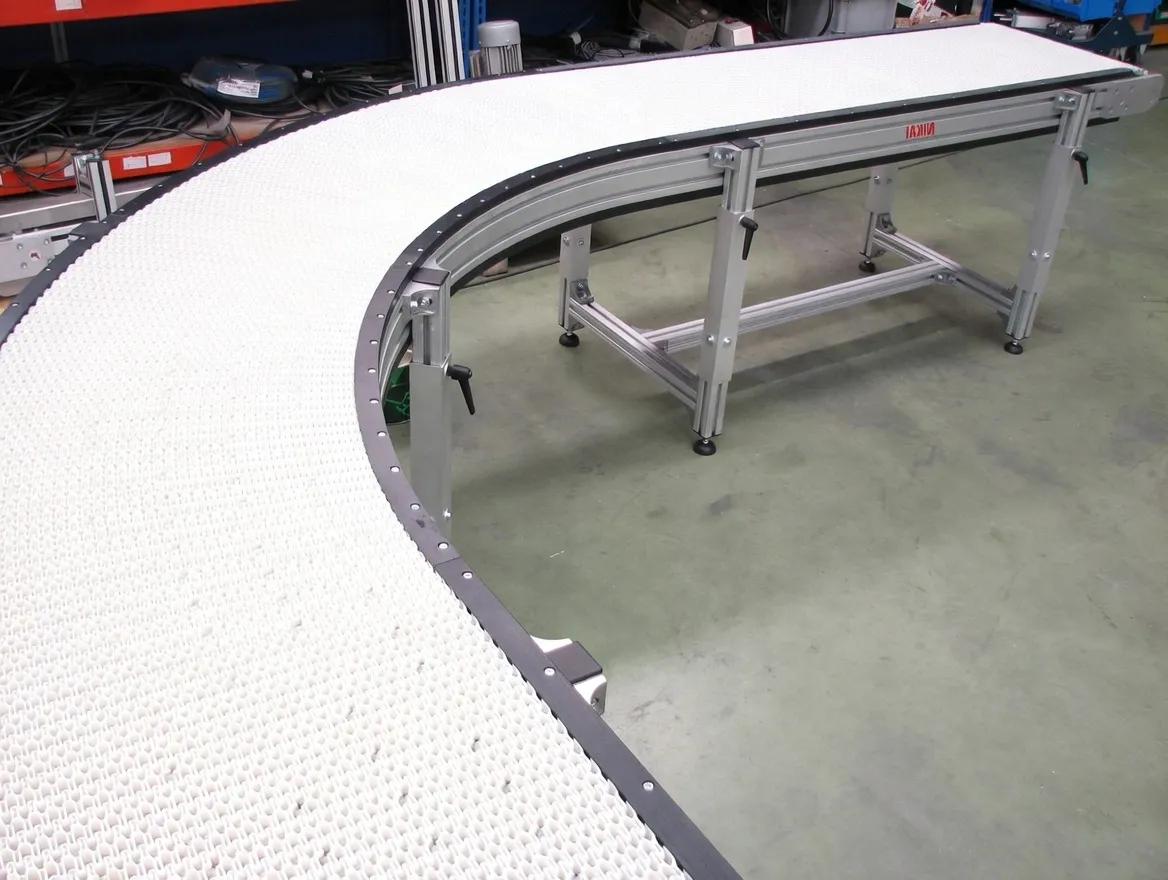
Side-flex plastic modular belt modules enable turn radii from 250 mm, reducing the floor footprint of multi-flight sorting hubs where tight directional changes must be achieved within constrained basement layouts at busy UK terminal buildings.
Baggage Reclaim Carousels
UHMW-PE plastic modular belt modules on reclaim carousels silently present bags for passenger collection during peak arrival waves, absorbing heavy-drop impacts from oversized items while maintaining the low-noise operation expected in modern passenger terminal environments.
Tarmac Make-up Areas
Perforated and raised-rib belt surfaces at outdoor apron make-up positions shed rain and de-icing fluid, while UV-stabilised polymer formulations prevent premature embrittlement under the variable but often harsh exposure conditions characteristic of northern UK airport sites.
Merge Injectors & Transfer Points
The consistent and repeatable module pitch of a plastic modular belt enables precise speed-ratio calculations at merge injectors where bags from multiple check-in zones must be fed into a single trunk stream without inter-bag collisions — a level of timing accuracy that rubber belts with variable elongation cannot sustain.
Six Reasons UK Airport Engineers Specify Plastic Modular Belts
Sub-5-Minute Module Repair
Individual modules are swapped directly on the live conveyor frame without tools beyond a hinge-rod pin remover, keeping unplanned downtime to engineering-window lengths that airport operations can accommodate without flight disruption.
Chemical & UV Resilience
Engineered polymer grades withstand de-icing fluids, aviation disinfectants, jet fuel residues, and direct sunlight without surface degradation, absorbing contamination, or structural embrittlement over extended operational cycles.
250 mm Radius Turns
Side-flex module configurations route tight directional changes in space-constrained terminal basements and mezzanine sorting floors that straight-run or large-radius systems simply cannot serve without major structural modification.
Low Operating Noise
Plastic-on-steel contact generates measurably less noise than steel slat or roller systems, supporting passenger comfort targets in terminal buildings and helping operators comply with the UK Control of Noise at Work Regulations 2005.
Recyclable & Net-Zero Aligned
Thermoplastic modules are fully recyclable at end of service life under standard polymer streams, supporting UK airport decarbonisation commitments and circular economy reporting requirements under the Government’s Net Zero strategy.
Zero Lubrication Needed
The self-lubricating nature of acetal and UHMW-PE eliminates routine belt-lubrication tasks, removes contamination risk in drainage systems adjacent to conveyor frames, and reduces the total cost of ownership over the full design life of the installation.
Belt Technology Comparison for Airport BHS
Customer Case Study: Gatwick Airport Ground Handler, South East England
✈ Aviation Ground Handling
🔧 BHS Retrofit Project
The Problem: Ageing Rubber Belt System and Mounting Emergency Costs
A major UK ground-handling operator responsible for baggage operations across North and South terminals at Gatwick Airport had been battling an ageing rubber conveyor system that dated from the mid-2000s. The belts, stretched and cracked from years of intensive use, were failing unpredictably during peak morning departure banks — the worst possible time for any BHS disruption. Each incident required a minimum two-person engineering team and an average four-hour repair window. With emergency calls running at approximately five per month and the combined cost in technician overtime, airline penalties, and management resource estimated at around £22,000 per incident, the financial argument for a capital upgrade had become unanswerable. The operator needed a solution that could be installed in a live operation without a terminal-wide shutdown.
The Solution: Ever Power Acetal Flat-Top Plastic Modular Belt, 25.4 mm Pitch
Ever Power’s application engineering team visited the site over two days to survey belt dimensions, drive configurations, and sprocket profiles across the fourteen most critical conveyor sections. The recommendation was a 25.4 mm pitch acetal flat-top plastic modular belt standardised across all feeder conveyors and the two main trunk lines feeding the Level 2 sortation carousel. Because acetal modules fit directly onto the existing drive sprockets without frame modification, the retrofit was structured across seven overnight engineering windows spanning ten weeks — one or two sections per night. The operator’s in-house technicians received a two-hour familiarisation session on module removal and installation, and a spares kit of 200 modules per belt width was left on-site for reactive maintenance use.
📊 Measured Results — 12 Months Post-Installation
Client Feedback
“The ability to swap a single module on a running shift, without pulling the whole belt, has genuinely changed how our maintenance team thinks about reactive engineering. We have not had a single unplanned conveyor stoppage in twelve months of running the Ever Power modular belt, which was simply unimaginable with our old rubber system.”
Engineering Operations Manager, Ground Handling — Gatwick Airport, UK
“We operate three international terminals in the Midlands and had been evaluating belt technologies for two years before specifying Ever Power’s UHMW-PE modules on our reclaim carousels. Fourteen months in, with zero unplanned stoppages and noticeably quieter operation, the decision looks more justified every quarter.”
BHS Systems Manager — Birmingham International, UK
“As a BHS system integrator delivering new terminal projects across England and Scotland, we have standardised on Ever Power plastic modular belts for virtually all new-build specifications. The breadth of pitch and surface options, the consistency of module quality batch-to-batch, and the depth of technical support during commissioning are genuinely difficult to match elsewhere in the market.”
Senior Project Engineer, BHS Integration — London, UK
Ever Power: Custom Plastic Modular Belt Manufacturing for UK Airport Projects
 No two airport baggage handling systems share the same geometry, throughput demand, or maintenance philosophy. Terminal layouts, security screening configurations, existing frame profiles, and budget structures all influence the optimal belt specification in ways that off-the-shelf catalogue products cannot always address. Ever Power operates dedicated injection moulding lines configured for custom plastic modular belt production across a full range of thermoplastic materials, pitches, widths, and surface finishes. Our manufacturing capability is built around the needs of the airport and ground-handling sector, where precision, repeatability, and traceability are not optional extras.
The scope of our customisation service covers non-standard module pitches outside the common 12.7 mm, 25.4 mm, and 38.1 mm catalogue sizes; belt widths in 10 mm increments from 300 mm to 2,000 mm; compound modules with rubber or polyurethane inserts for incline grip sections; anti-static and ESD-dissipative polymer formulations for scanning zones; colour-coded modules for zone identification within large terminal sortation systems; and bespoke hinge rod materials including 316 stainless steel and titanium alloy for corrosion-critical tarmac-side environments. Our rapid prototyping process delivers functional sample modules for engineering evaluation within 5 to 10 working days, with full production runs completed within 4 to 6 weeks for standard volume orders. Every production batch is subject to dimensional and tensile testing under our ISO 9001:2015 quality management system before despatch to UK and European project sites.
Frequently Asked Questions
Upgrade Your Airport’s Baggage Conveyor with the Right Belt
Talk to our UK-focused application engineering team. Free technical consultation available for BHS integrators and airport operators throughout England, Scotland, Wales, and Northern Ireland.
✉ Get a Free Quote — [email protected]
edit by gzl