
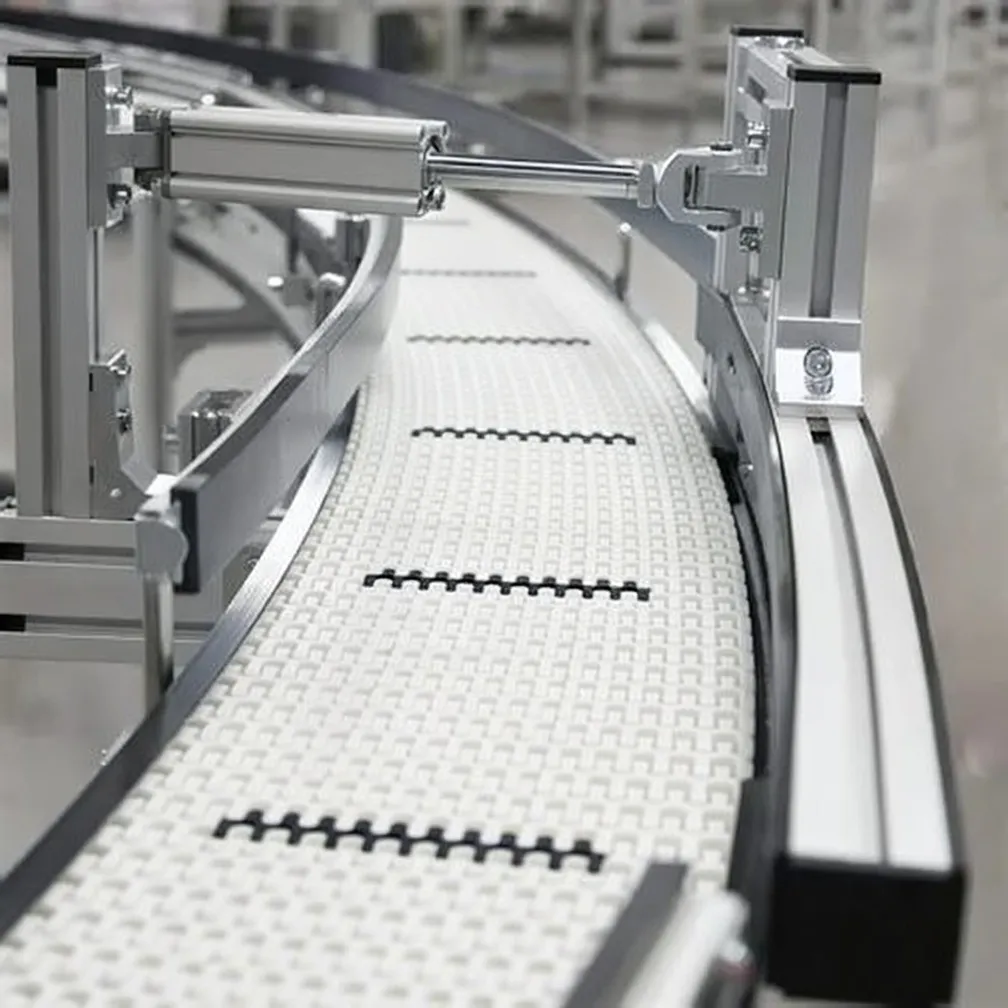
 Walk through any large-scale snack production facility in Birmingham, Leeds, or the East Midlands today and you will notice one thing immediately: the floor space is dominated not by workers but by conveyor systems. From seasoning tumblers and oven exit zones to checkweigher feeds and primary packaging stations, the plastic modular belt has quietly become the load-bearing skeleton of modern snack manufacturing. Unlike legacy flat-wire mesh or rubber slat conveyors — both of which demand frequent, costly replacement schedules — a well-specified plastic modular belt combines structural rigidity with genuine food-grade hygiene, allowing a single line configuration to handle everything from heavily oiled crisps to dry-roasted peanuts without cross-contamination risk or belt deformation under thermal cycling.
The UK snack food market exceeded £4.1 billion in retail value in 2023, with contract manufacturers and branded producers alike investing heavily in line automation and throughput expansion. In that environment, the specification of the conveyor belt module is no longer a secondary purchasing decision — it is a primary engineering choice that directly affects yield, OEE scores, and food safety audit outcomes. This guide draws on over 18 years of hands-on application engineering experience across UK, European, and global snack processing installations to give buyers, plant engineers, and procurement teams the technical depth they need to make the right call.
Ever Power · Plastic Modular Belt Series📧 Get a Quote — Contact Our UK Team
Reply within 24 hours · Bespoke specification available · samples dispatched UK-wide
Why Snack Food Processors in the UK Specify Plastic Modular Belts Over Alternatives
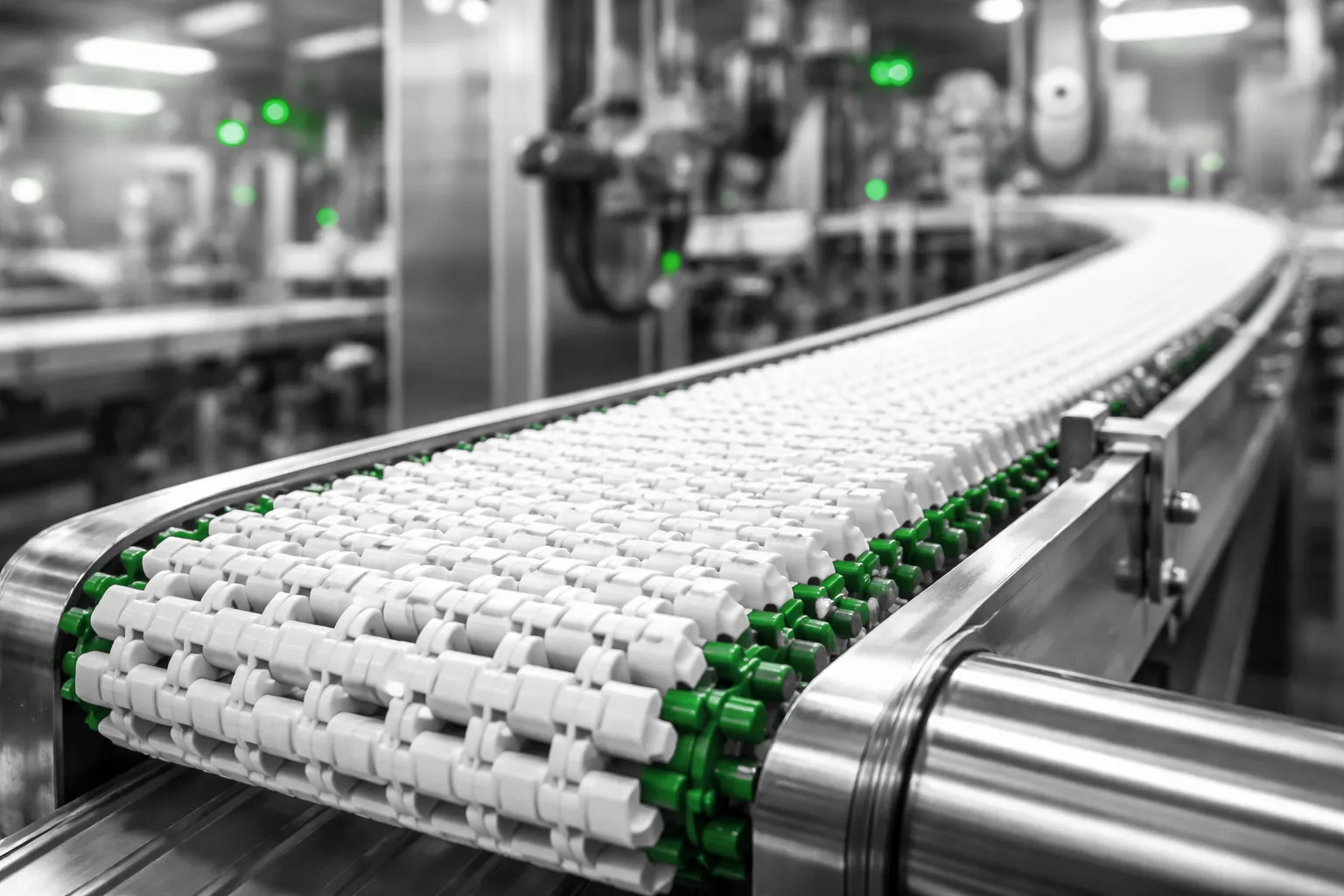 The snack food production environment is unusually demanding from a conveyor engineering standpoint. Processing lines cycle between ambient loading, high-temperature oven zones reaching 220 °C, wet seasoning application stages, and cold-air cooling tunnels — all within a matter of minutes. Rubber belts swell, crack, and absorb flavourings; traditional stainless steel flat-wire mesh is difficult to clean and retains fine salt or sugar crystals in its weave, creating persistent allergen control problems. Plastic modular belts made from acetal (POM), polypropylene (PP), or high-density polyethylene (HDPE) modules offer a fundamentally different engineering proposition: modular construction means individual broken links can be replaced in minutes without removing the entire belt from the frame, while the smooth or textured surface options dramatically reduce product entrapment.
Food safety legislation under UK Food Safety Act 1990 (as retained post-Brexit) and the Food Standards Agency’s guidance on allergen management means that any belt surface which harbours residue between CIP cycles is a compliance liability. Open-hinge plastic modular belt designs allow high-pressure wash-down water and cleaning chemistry to penetrate the full belt depth, flushing seasoning dust, oil residue, and microbial load with a thoroughness simply not achievable with solid rubber or tight-weave mesh. This directly shortens the daily sanitation window, which on a high-output snack line running 20 hours a day translates to measurable gains in productive capacity. Several UK manufacturers report a 35–45 minute reduction in daily CIP time after switching from legacy mesh to open-hinge plastic modular belt configurations.
Thermal Resistance
Acetal modules sustain continuous service up to 90 °C; specialist high-temp PP grades reach 120 °C, covering post-oven discharge zones without belt warping or pitch elongation.
Hygienic Design
Non-porous polymer surfaces are impervious to fats and flavour oils. Open-hinge geometry and flush-top profiles comply with EHEDG hygienic design guidelines for food contact conveyors.
Rapid Field Repair
Modular link replacement takes under 8 minutes per section using standard hand tools. No belt removal, no specialist technician. Reduces unplanned downtime by an average of 60% versus rubber alternatives.
Custom Geometry
Available in straight-run, radius, and spiral configurations with pitches from 12.7 mm to 50.8 mm. Bespoke widths, cleats, and side guards engineered to your existing line frame dimensions.
Technical Performance Parameters
Typical specification range for food-grade plastic modular belt modules supplied to UK snack food processors
Seven Key Application Zones on a Snack Food Processing Line
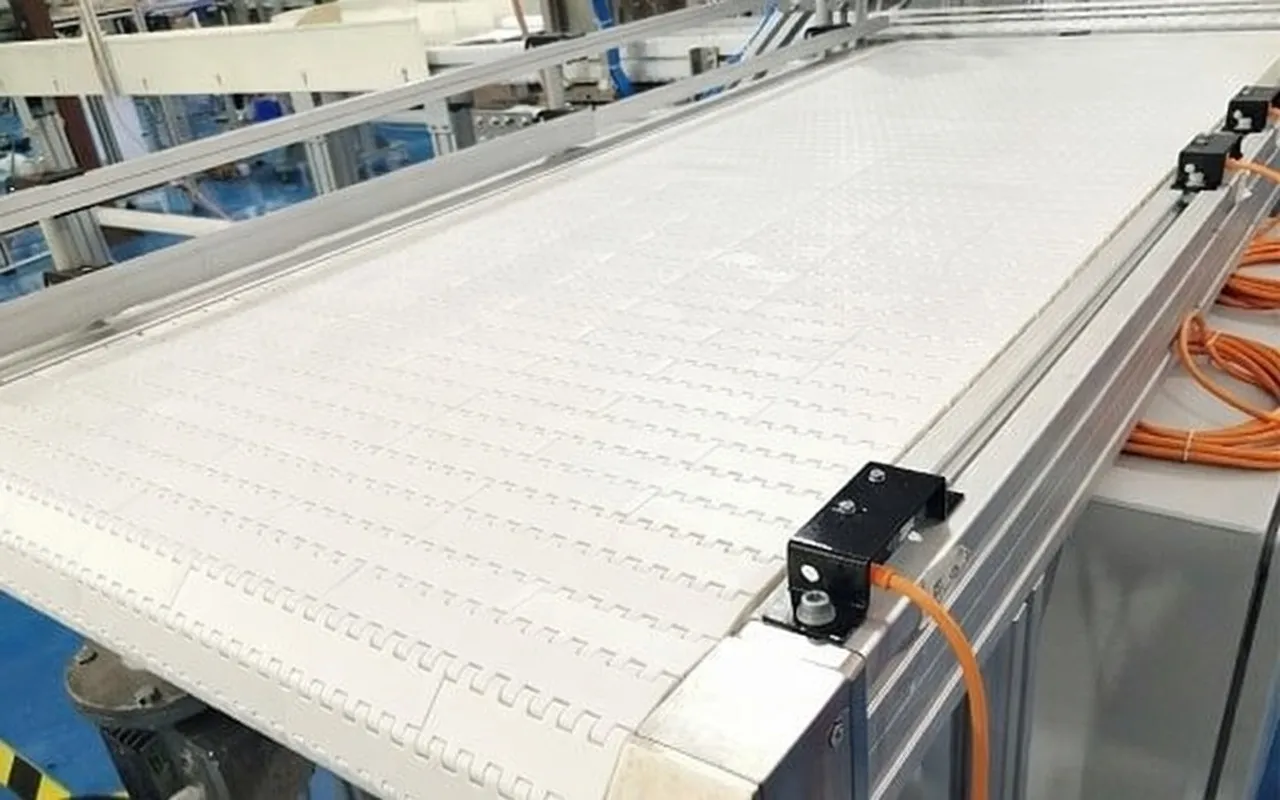 The plastic modular belt does not occupy a single position on a snack line — it appears in multiple forms across every stage of production. Understanding which belt construction best suits each zone is the difference between a line that runs reliably for three-plus years and one that suffers chronic micro-stoppages and contamination events. The following zones represent the most engineering-critical positions identified across UK snack manufacturing audits.
01 · Raw Material Infeed & Grading
Incoming potato slices, corn grits, or pellet stock require gentle, consistent transfer onto the main processing line. A flat-top plastic modular belt with flush surface and zero dead zones prevents slice stacking or edge bruising that causes uneven fry times and colour variation. Belt widths of 600–900 mm are common at this stage, with variable speed drives that synchronise belt velocity to upstream hopper output. For potato crisp lines in particular, anti-static PP modules prevent fine-starch particle accumulation that could otherwise interfere with downstream weight-fill accuracy.
02 · Continuous Frying Conveyor
The continuous fryer is the most thermally and chemically aggressive environment on any crisp or extruded snack line. Submerged in cooking oil at 170–185 °C, the belt must maintain dimensional stability, resist oil absorption, and prevent fragment loss into the fryer — which would create a food safety hazard. Stainless steel-cored PP modules, or specialist high-temperature acetal variants, provide the heat resistance needed while the open mesh construction (typically 35–48% open area) allows free oil circulation around the product. The plastic modular belt at this stage is typically replaced on an annual schedule rather than the quarterly replacement cycle of wire mesh, representing a significant cost saving on high-volume UK crisp lines.
03 · Oven Discharge & Cooling Tunnel
Extruded snacks and baked corn-based products exit the oven at temperatures between 130 and 200 °C before entering a forced-air cooling tunnel that brings the product to below 40 °C within 3–6 minutes. The belt must therefore tolerate a rapid thermal swing — a loading that would permanently deform standard rubber or cause metal expansion misalignment. High-temp PP plastic modular belts with anti-sag support bars handle this cycling without pitch elongation or lateral tracking drift, while the open-hinge construction encourages airflow through the product layer, accelerating cooling and reducing the risk of condensation-related sogginess in the finished snack.
04 · Seasoning Drum & Coating Station
Whether applying dry salt and flavour powder or a wet liquid seasoning coat, this stage deposits a fine aerosol of flavour chemistry across both product and belt. The hygiene implications are significant — any belt material that adsorbs flavour compounds will contaminate subsequent production runs with a different flavour, creating an allergen management nightmare. Non-porous plastic modular belt surfaces made from acetal or PP do not adsorb flavour chemistry. Combined with a zone-specific belt wash station (easy to design into modular belt returns), changeover between flavour variants can be completed in 20 minutes, giving multi-SKU snack manufacturers the schedule flexibility that drives operational profitability.
05 · Metal Detection & Checkweigher Infeed
Metal detection apertures demand a belt with near-zero metallic signal — a requirement that rules out all steel wire construction and makes the blue metal-detectable plastic modular belt the preferred specification globally. These specially compounded PP or PE modules incorporate a barium sulphate additive that makes the polymer itself detectable should a module fragment break loose into the product stream, satisfying BRC Global Standard for Food Safety and FSSC 22000 requirements without compromising detector sensitivity. UK retailers including major supermarket groups now routinely audit supplier conveyor specifications as part of their own brand food safety programmes, making this a procurement requirement rather than just an engineering preference.
06 · Spiral Accumulation & Buffer Conveyor
High-speed snack lines frequently outpace downstream packaging machine cycle rates, requiring buffering capacity without increasing floor footprint. Spiral plastic modular belt systems stack multiple conveyor tiers within a compact vertical footprint, holding 3–8 minutes of product in gentle motion. The radius-turning capability of modular belts — achieved through side-flex module designs — allows the belt to navigate the spiral turns without product fragmentation or off-specification fines generation. Fragmentation rate is a direct cost metric on premium snack lines: even a 0.5% improvement in whole-piece yield across a line producing 2,000 kg/hour represents a commercially significant reduction in giveaway and packaging rejects.
07 · Primary & Secondary Packaging Infeed
The final conveyor stage before the bagging machine or multipacking station must deliver product at a controlled and consistent rate, with precise lane spacing for multi-lane fill operations. Flat-top plastic modular belts with low-friction surface coatings allow product to orient naturally without manual assistance, while cleated lane-divider inserts — snapped directly into the modular hinge rows — eliminate the need for complex external lane guide assemblies. The result is a packaging infeed that is both mechanically simpler and more maintainable than traditional solutions, with no loose components to enter the product zone.
Customer Success: How a Yorkshire Snack Manufacturer Cut Belt Costs by 38%
CASE STUDY · HARROGATE, NORTH YORKSHIRE · POTATO CRISP PRODUCTION
A family-owned crisp manufacturer in North Yorkshire — producing seven flavour variants across two continuous lines running 19 hours per day — came to us in early 2022 with a persistent fryer belt problem. Their existing stainless wire mesh belts were degrading within 14–16 weeks due to oil-induced corrosion at the hinge points, and their maintenance log showed an average of 2.3 unplanned line stoppages per month attributable directly to belt failure. Total annual belt procurement and labour cost was running at approximately £47,000 across both lines.
After a site audit, we specified a high-temperature PP plastic modular belt with 38% open area and staggered hinge spacing on the fryer zones, transitioning to metal-detectable acetal flat-top modules at the seasoning and detection stages. By month 8 post-installation, the plant engineering team recorded zero belt-related unplanned stoppages, belt change intervals had extended to 52 weeks on the fryer zone, and total annual belt cost had reduced to £29,100 — a 38.1% saving. The production director noted that the cleaning time reduction alone had freed approximately 280 productive hours per year across both lines.
“We specified the blue metal-detectable plastic modular belt across our entire popcorn line following a BRC audit recommendation. Installation was straightforward and the supplier provided full dimension drawings compatible with our existing Dorner frame. Audit passed with flying colours.”
— Engineering Manager, Popcorn Manufacturer · Lincolnshire, UK
“The spiral accumulator belt retrofit was completed over a single weekend shutdown. The side-flex modular belt tracked perfectly from day one and we’ve had no product breakage increase — actually our whole-piece yield improved by 0.7% which on our volumes is meaningful. Happy to recommend.”
— Operations Director, Extruded Snack Producer · Greater Manchester, UK
“We needed a custom-width belt for a mixed-nut roasting oven that nobody had an off-the-shelf answer for. Ever Power came back with a full engineering drawing within 48 hours and sample modules within 10 days. Belt has now been running 14 months without a single link failure. Exceptional service.”
— Plant Manager, Premium Nut Processor · Kent, UK
Material Science Behind the Plastic Modular Belt: How It Actually Works
The term “plastic modular belt” covers a family of conveyor belt systems built from interlocking injection-moulded polymer modules connected by smooth transverse hinge rods. The mechanical principle is conceptually simple but the engineering precision required to manufacture a belt that runs true at 60 m/min under a 400 kg distributed load — while submerged in 180 °C cooking oil — is considerable. Each module is individually moulded to tolerances of ±0.05 mm on all hinge-axis dimensions, ensuring that drive-sprocket engagement is consistent across the full belt width and that the hinge rod is not under bending stress from geometric mismatch.
Polypropylene is the workhorse material for most snack food conveyor applications because it combines excellent resistance to the acid and alkali cleaning agents used in food plant CIP protocols with a usable temperature ceiling of 120 °C continuous and short-term excursions to 140 °C. The crystalline polymer structure of PP also gives it a very low coefficient of friction against both the product contact surface and the stainless steel frame wear strips, reducing belt tension requirements and extending bearing life. Acetal, or polyoxymethylene (POM), offers higher stiffness and better creep resistance under sustained load at elevated temperature — making it the correct choice for high-speed flat-top applications where belt sag between supports would cause product handling variation. HDPE modules find application in lower-temperature zones where chemical resistance to strongly alkaline sanitisers is the primary performance driver rather than temperature, and where the softer, more compliant surface is less likely to damage fragile product pieces.
Modular Construction Principle — Key Engineering Points
| Design Feature | Engineering Benefit | Snack Line Impact |
|---|---|---|
| Interlocking hinge module | Distributes tensile load evenly across width | Prevents edge-pull failure on wide belts |
| Open hinge geometry | Full CIP water penetration to hinge axis | Eliminates seasoning residue trap zones |
| Polished flush-top surface | Ra < 0.8 µm surface roughness achievable | No micro-crevice harbourage for pathogens |
| Side-flex module variant | Allows horizontal radius as tight as 300 mm | Enables spiral accumulator and turn designs |
| Metal-detectable compound | Module fragment triggers detector alarm | BRC / FSSC 22000 HACCP compliance |
Bespoke Manufacturing & Customisation Capability
Not every snack processing line was designed with a standard belt width in mind. Retrofit projects, OEM machine integrations, and expansion of legacy lines built to imperial dimensions all create situations where off-the-shelf belt widths simply will not fit without costly frame modification. Ever Power’s manufacturing facility operates a dedicated custom tooling programme that can produce plastic modular belt modules in any width from 150 mm to 2,400 mm without the minimum order volume constraints that other suppliers impose. This service is particularly valuable for UK food manufacturers who are upgrading individual processing stages rather than investing in an entirely new line — a capital efficiency model that is increasingly common in the post-Brexit, post-inflationary UK food manufacturing environment.
Beyond width customisation, Ever Power engineers work directly with plant teams to specify cleat height and profile for incline conveyors, side guard configurations for containment of loose product, perforation patterns for air-cooling or oil-drainage optimisation, and surface texture variants that balance product grip against cleanability. Custom colour coding is available for multi-line plants where colour identification supports the allergen management programme — different belt colours at different stations creating a physical visual cue for operators and auditors alike. Sample modules can be despatched from our UK distribution point within 48–72 hours for trial fitting and approval before full belt production commences, and our engineering team provides CAD drawings and load calculations as standard documentation with every bespoke order.
Custom Width
150 mm – 2,400 mm available
Material Selection
PP, Acetal, HDPE, MD-Blue grades
Cleat & Guard Design
Snap-in cleats, side guards, lane dividers
UK Fast Dispatch
Sample modules 48–72 hrs; full belt 2–4 wks
CAD Documentation
Full drawings & load calc supplied as standard
Get a Quote for Your Snack Line →
Send your belt width, pitch, and temperature requirements to [email protected]
Serving Snack Food Manufacturers Across the United Kingdom
The UK snack food manufacturing sector is geographically concentrated in a number of key regional clusters. The East Midlands and East Anglia host a significant proportion of potato processing and crisp manufacture, benefiting from proximity to the major Lincolnshire and Norfolk potato growing regions. Greater Manchester, Merseyside, and West Yorkshire have strong concentrations of extruded snack, popcorn, and nut processing operations, while the South East — particularly Kent, Essex, and Hampshire — supports a growing premium and artisan snack manufacturing community supplying retail multiples and food service operators throughout the country.
Ever Power maintains UK distribution stock and a UK-based applications engineering contact to support food manufacturers across all of these regions. Whether you are specifying a plastic modular belt for a new line build in the West Midlands, replacing legacy fryer mesh at a facility near Edinburgh, or benchmarking belt costs against an existing supplier agreement in the South West, our team can provide technical drawings, material certification documentation, and delivered pricing to your site address within 24 hours of enquiry. We understand that procurement decisions in the UK food industry involve not only unit cost but total cost of ownership, compliance documentation for BRC audits, and supply chain resilience — all of which are addressed within our standard quotation package.
Greater Manchester · West Yorkshire
Kent · Essex · South East England
Scotland · Wales · Northern Ireland
Nationwide UK Delivery Available
Frequently Asked Questions
Plastic Modular Belts · Snack Food Processing · UK Buyer Questions
What is the typical price or cost of a plastic modular belt for a UK snack food conveyor line?
Belt cost depends on material grade, module pitch, belt width, and total length. As a guide, a standard PP food-grade plastic modular belt for a 600 mm wide snack cooling conveyor in the UK typically falls between £280–£520 per linear metre, delivered. Metal-detectable acetal grades carry a 15–20% premium. Ever Power provides itemised quotations including UK delivery within 24 hours — send your specification to [email protected].
Which plastic modular belt material is best suited for a continuous fryer on a potato crisp production line in England?
For continuous fryer zones operating at 170–185 °C, a high-temperature polypropylene (PP) plastic modular belt with open-hinge construction and 35–48% open area is the preferred specification. PP offers excellent resistance to cooking oil chemistry, maintains dimensional stability in the continuous thermal cycle, and has significantly longer service life than stainless wire mesh in this application. If the fryer discharge transitions directly into a metal detection zone, a metal-detectable acetal flat-top belt is the correct downstream selection.
How do I find a reliable plastic modular belt supplier near me in the UK who can deliver quickly for a snack line shutdown?
Ever Power holds stock of standard-pitch PP and acetal modules at a UK distribution point and can despatch replacement modules to any UK postcode within 48–72 hours for emergency breakdown situations. For planned shutdowns, we recommend contacting us at least two weeks in advance to allow for bespoke width cutting and documentation preparation. We supply snack food manufacturers across England, Scotland, Wales, and Northern Ireland with full technical support included.
What certifications should a plastic modular belt carry to pass a BRC Global Standard food safety audit in the UK snack industry?
BRC auditors typically require food contact compliance under EC Regulation 1935/2004 (which the UK retained post-Brexit under equivalent domestic legislation) and/or FDA 21 CFR certification. For metal detection compliance, the belt should be made from a metal-detectable compound with documented sensitivity parameters. Material safety data sheets, migration test certificates, and Declaration of Compliance documents should be available from your supplier as standard. Ever Power provides a full documentation package with every order.
How long does a plastic modular belt last on an extruded snack processing line running 20 hours a day, and when should I get a quote for replacement?
On a 20-hour continuous extruded snack line, well-specified PP plastic modular belts on cooling and packaging zones typically achieve 18–30 months of service life before planned replacement. Fryer-zone belts are typically renewed annually. The right time to get a replacement quote is when you notice more than three individual link failures within a single month, visible hinge wear causing belt sag, or any surface discolouration that cannot be cleared through normal CIP. We recommend establishing a replacement belt stock agreement so that spares are on-site before failure — contact us to discuss a framework supply arrangement.
Can I get a custom-width plastic modular belt to fit an older non-standard conveyor frame at my UK nut processing facility?
Yes. Ever Power specialises in bespoke-width plastic modular belt manufacture for exactly this situation. We accept frame dimension drawings or direct measurements from your maintenance team, produce sample modules for trial fitting, and manufacture the full belt to your confirmed width. There is no minimum order quantity surcharge for custom widths in most standard pitch and material combinations. Send your frame dimensions and operating temperature requirements to [email protected] to start the process.
Ready to Upgrade Your Snack Line’s Conveyor Performance?
Tell us your belt width, pitch, operating temperature, and production environment. We will respond with a full technical recommendation and delivered price to your UK site within 24 hours.
[email protected] · UK distribution · Custom specification available · BRC documentation supplied
© Ever Power · Plastic Modular Belt Specialists · United Kingdom · All technical specifications subject to confirmation
edit by gzl